

Did you know that 85% of machine learning and predictive projects fail because of poor data hygiene and drift? It’s a sobering reality for leaders who want to move beyond spreadsheets but fear sinking capital into tools that don’t deliver. When you invest in predictive analytics software development, the goal isn’t just to build a fancy algorithm; it’s to create a reliable engine for growth. You’ve likely felt the frustration of siloed data that’s difficult to clean, or the anxiety of hiring engineering talent that operates in a completely different timezone.
We understand that you’re looking for more than just code; you need a strategic partner who has navigated these technical shifts before. This guide provides a clear roadmap to transform your raw data into a measurable competitive advantage by 2026. You’ll learn how to audit your data, navigate the strict requirements of the EU AI Act, and deploy custom solutions that actually speed up your decision making. We’ll explore everything from modernizing legacy stacks with Python 3.14 to managing the “Day 2” operations that keep your models accurate long after launch.
Key Takeaways
- Understand the fundamental shift from descriptive to predictive models to ensure your business moves beyond analyzing what happened to forecasting what’s next.
- Establish a scalable foundation for predictive analytics software development by focusing on a robust data ingestion layer and centralized warehousing.
- Navigate the development lifecycle with a disciplined data audit that identifies high-value opportunities while minimizing initial technical friction.
- Break down internal data silos and manage technical debt to maintain long-term code health and model accuracy.
- Leverage the “founder’s mentality” and timezone-aligned nearshore talent to bridge the gap between complex AI strategy and successful execution.
What is Predictive Analytics Software Development?
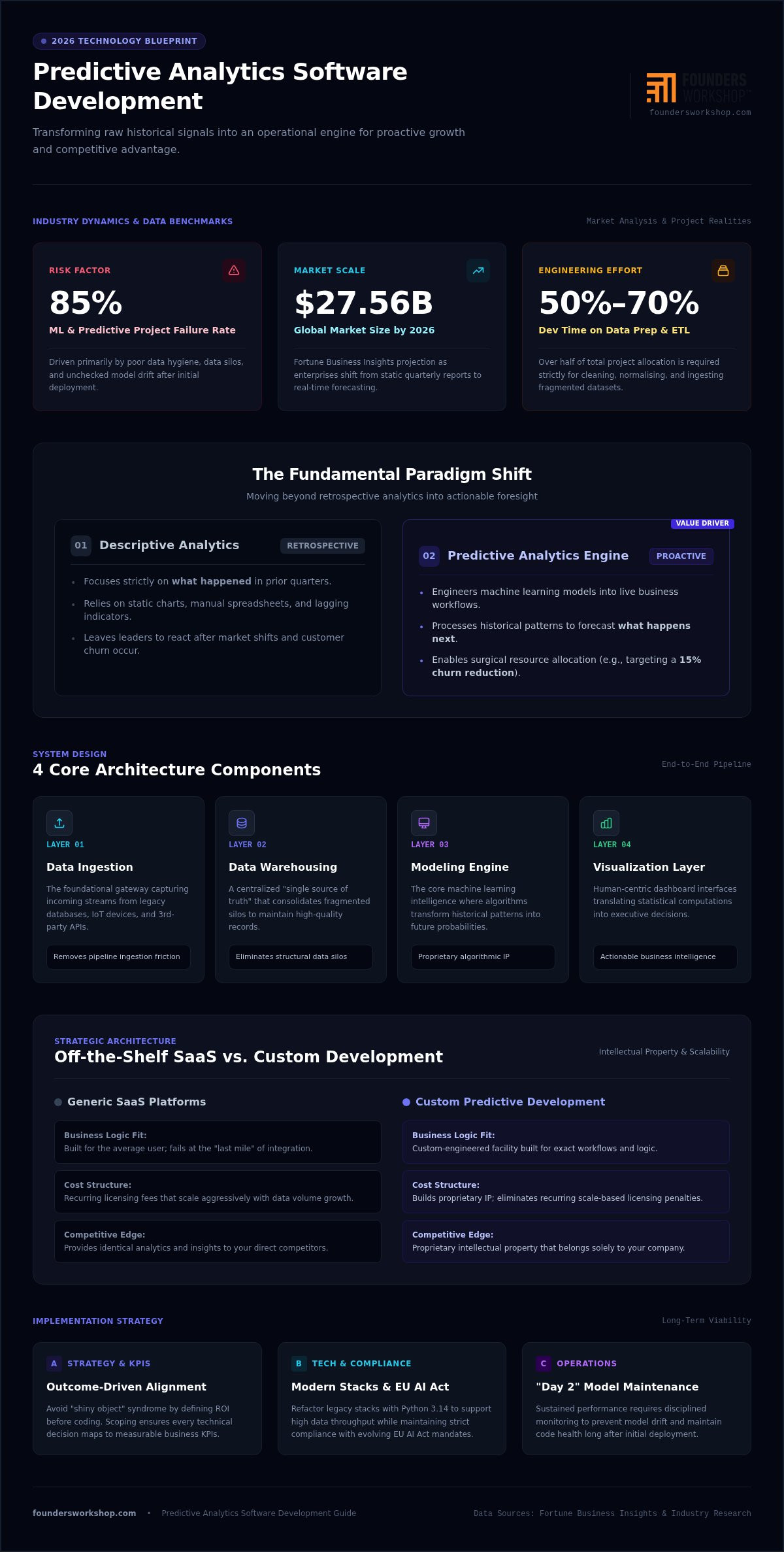
Predictive analytics software isn’t a crystal ball; it’s a sophisticated engine that processes historical data to forecast future trends. In 2026, as the global market for these tools reaches $27.56 billion according to Fortune Business Insights, the focus has shifted away from descriptive reports that merely list what happened last quarter. Modern predictive analytics software development is no longer about static charts. Instead, it’s about building active systems that use predictive analytics techniques to anticipate market shifts before they occur. The primary value for an organization lies in reducing operational uncertainty. When you can foresee demand spikes or equipment failures, you can optimize resource allocation with surgical precision.
Predictive analytics software development is the process of engineering custom AI models into functional business applications.
The Difference Between Off-the-Shelf and Custom Development
Generic SaaS platforms often struggle with the “last mile” of integration. These tools are built for the average user, which means they frequently overlook the specific business logic that defines your competitive edge. If you rely on a one-size-fits-all solution, you’re essentially using the same insights as your competitors. Custom development allows you to build proprietary intellectual property that belongs solely to your company. This ownership eliminates recurring licensing fees that scale aggressively as your data volume grows. Custom architectures also offer superior scalability. They allow your system to evolve alongside your internal processes without hitting the rigid walls of a third-party software roadmap. It’s the difference between renting a generic workspace and building a custom-engineered facility designed for your specific workflow.
Strategic Alignment: Why Tech Must Meet Business Goals
A common pitfall in high-stakes projects is the “shiny object” syndrome, where teams focus on technical novelty rather than business outcomes. To avoid this, you must define success before a single line of code is written. Whether you’re aiming for a 15% reduction in customer churn or more accurate supply chain forecasting, every technical decision must map back to these KPIs. This is where AI strategy consulting plays a critical role. A seasoned guide helps you navigate the complexities of project scoping, ensuring that the development team isn’t just building “cool” tech, but creating a tool that solves a tangible business problem. By aligning your technical roadmap with your core drivers, you ensure that the final product creates actual ROI rather than becoming a source of technical debt.
Core Components of a Scalable Analytics Architecture
A high-performance predictive system is more than a standalone algorithm; it’s a cohesive ecosystem designed to turn raw signals into executive action. Successful predictive analytics software development relies on a four-part structural framework that ensures data remains accurate, accessible, and actionable. Without this foundation, even the most advanced models will struggle to produce reliable results. You need a pipeline that handles the heavy lifting of data movement while keeping the end-user experience intuitive.
- Data Ingestion Layer: This is the gateway where information flows from legacy systems, IoT devices, or third-party APIs into your analytics engine.
- Data Warehousing: A centralized “single source of truth” that organizes fragmented data to ensure model training is based on consistent, high-quality records.
- The Modeling Engine: The core intelligence where machine learning transforms historical patterns into future probabilities.
- The Visualization Layer: The interface that translates complex statistical outputs into clear, human-centric dashboards for decision-makers.
Data Engineering: The Foundation of Reliable Predictions
The industry adage “garbage in, garbage out” has never been more relevant. Research indicates that data preparation and ETL engineering account for 50% to 70% of total project development time. If your underlying data is messy or siloed, your predictions will be flawed. You must implement strategies for cleaning and normalizing fragmented datasets to ensure the modeling engine has a stable base. Often, this requires refactoring legacy code to support modern data flows and remove the technical friction that slows down real-time processing. A disciplined approach to data hygiene at the start prevents costly model retraining cycles later.
Integrating AI into Existing Business Workflows
Predictive engines shouldn’t live in a vacuum. They need to connect seamlessly with your existing CRM or ERP systems via robust APIs. This integration allows your team to receive insights exactly where they already work, improving decision-making speed. To maintain trust, you must ensure low-latency responses, especially for real-time support like fraud detection or dynamic pricing. System stability is paramount during this phase; you don’t want an AI deployment to disrupt core business operations. Following a structured governance model, such as the NIST AI Risk Management Framework, helps mitigate deployment risks and ensures your software remains trustworthy and compliant. If you’re unsure where your current infrastructure stands, a quick consultation with an AI strategy expert can help clarify your path forward.
The Predictive Analytics Development Lifecycle
Success in predictive analytics software development doesn’t happen by accident. It requires a disciplined, multi-stage approach that moves from abstract data audits to concrete enterprise integration. This methodical lifecycle is designed to minimize financial risk while maximizing the velocity of actionable insights. By following a structured path, you avoid the common pitfalls of over-engineering and ensure that every technical milestone supports a broader business objective. It’s about building a sustainable engine that grows with your organization rather than a one-off tool that quickly becomes obsolete.
- Step 1: Data Audit and Strategy. Assess the quality, volume, and accessibility of your current data assets to identify gaps before you start coding.
- Step 2: Prototyping and Data Science. Validate your predictive models on historical subsets to ensure they can actually forecast outcomes with high accuracy.
- Step 3: MVP Development. Build a functional, high-velocity version of the tool to gather immediate feedback from internal stakeholders.
- Step 4: Integration and Scaling. Transition from a standalone pilot to a fully integrated enterprise asset that talks to your existing CRM and ERP.
- Step 5: Continuous Monitoring and Model Tuning. Implement “Day 2” operations to combat concept drift and maintain long-term accuracy as market conditions change.
Phase 1: Identifying High-Impact Use Cases
Every successful project begins by identifying where the technology can provide the most immediate relief. Instead of attempting a broad overhaul, prioritize development based on potential ROI. High-impact use cases often include churn prediction for subscription models, demand forecasting for retail, or preventative maintenance for industrial operations. By focusing on these specific drivers, you ensure the technical effort translates directly into a competitive advantage. This is why we advocate for a strategic MVP development approach. It allows you to test your core hypothesis and gather real-world data without the excessive costs of building a full-featured platform on Day One.
The Iterative Build: From Data Validation to Deployment
The transition from a prototype to a production-ready system must be steady and deliberate. Starting small is the most effective way to prevent the accumulation of massive technical debt that often plagues AI initiatives. During this phase, you can use feature flags to roll out predictive capabilities to select beta users, allowing for real-time adjustments based on human interaction. This iterative process turns a simple data experiment into a custom software development success story. As noted in discussions regarding predictive analytics in business decision-making, the ultimate goal is to translate statistical patterns into operational agility. You want a system that doesn’t just output numbers but provides the clarity needed to make bold, informed choices. Maintaining this edge requires a commitment to removing technical friction and ensuring your architecture remains compliant with evolving global standards.
Overcoming Common Hurdles in Analytics Implementation
Building the predictive engine is only half the battle. The real challenge lies in integrating that intelligence into a complex organization without triggering a cascade of failures. In our experience, predictive analytics software development often hits a wall not because the math is wrong, but because the operational environment is resistant or unprepared. Leaders must navigate several critical friction points to ensure their investment doesn’t stall in the pilot phase. According to research, 71% of organizations encounter critical data compatibility hurdles before reaching production, making early-stage mitigation essential.
- Data Silos: Breaking down departmental barriers to create a unified, cross-functional view.
- Technical Debt: Resisting the urge to cut corners that will require expensive fixes during the next scaling phase.
- Model Transparency: Avoiding the “black box” problem by using explainable AI (XAI) techniques like SHAP or LIME.
- Security: Moving beyond basic encryption to comprehensive governance that satisfies modern regulatory bodies.
Solving Data Silos and Quality Issues
Fragmented data is the natural byproduct of a growing company. To fix this, you need to implement automated data validation pipelines that catch errors at the source. Modern middleware serves as the connective tissue, allowing disparate legacy systems to communicate with your new analytics engine. When dealing with “noisy” or missing historical data, we use advanced imputation strategies to maintain model integrity without fabricating insights. It’s about creating a clean, reliable stream of information that flows effortlessly across the entire organization. If your current systems are too fragmented to support this, it’s time to modernize your legacy data infrastructure with a partner who understands the founder’s roadmap.
Security and Compliance in Data-Driven Apps
In 2026, the regulatory landscape is more unforgiving than ever. The EU AI Act reached general application on August 2, 2026, introducing strict transparency obligations and potential fines of up to €35 million or 7% of global turnover. Whether you’re adhering to SOC2, GDPR, or HIPAA, your predictive analytics software development must bake security into the architectural design phase. We utilize encrypted data processing and anonymization techniques to protect sensitive customer information while the model is training. Security isn’t a feature you add at the end; it’s a foundational requirement that ensures your business remains compliant and your users’ trust remains unbroken.
Why a Strategic Technical Partner is Essential
Hiring a group of developers to write code is easy. Finding a partner who understands how that code impacts your bottom line is the real challenge. When you engage in predictive analytics software development, you aren’t just buying a technical service; you’re investing in a strategic asset that must evolve with your market. A strategic partner brings a “founder’s mentality” to the project, looking beyond the immediate sprint to ensure the architecture supports your long-term business outcomes. This perspective is vital for avoiding the “Day 2” problem where models fail because they weren’t built with operational reality in mind. A managed team provides more than just engineering hours. They offer product strategy that ensures your AI investment delivers measurable ROI.
Scaling an internal engineering team is often fraught with friction. From the difficulty of finding high-quality talent to the overhead of managing complex technical roadmaps, the process can drain your resources. A technical partner absorbs this friction, allowing you to scale velocity without the traditional hiring lag. By providing a disciplined, human-centered approach, they bridge the gap between your strategic vision and the practicalities of technical execution. It’s the difference between having a vendor and having a professional commitment to your company’s growth.
The Nearshore Advantage for Real-Time Collaboration
Timezone alignment isn’t just a convenience; it’s a requirement for high-velocity AI projects. Predictive models require constant feedback loops between data scientists and business stakeholders. If your team is asleep while you’re making critical strategic adjustments, your momentum stalls. By bridging North American strategy with high-quality Latin American talent, you gain real-time collaboration without the communication lag of offshore models. This proximity allows for iterative data science sprints that keep projects on track and aligned with shifting market signals. For a deeper look at managing these distributed teams, our 2026 nearshore staff augmentation guide offers a blueprint for successful engineering integration.
Building for the Future: Sustainability and Scalability
Building for 2026 means selecting technologies that won’t require a total overhaul by 2028. A veteran guide ensures your stack remains sustainable by using modern runtimes and human-centered design principles. This focus on sustainability prevents the accumulation of technical debt that often cripples scaling companies. The goal is to remove technical friction so your leadership team can focus on innovation rather than troubleshooting legacy code. Partnering for long-term strategic growth provides the steady hand needed to navigate the complexities of AI strategy. When your technology is built for the future, you gain the peace of mind to make bold moves in an uncertain market.
Securing Your Competitive Edge for 2026
Moving from raw historical data to automated foresight is a requirement for staying competitive. Success involves more than selecting an algorithm; it requires a robust data foundation and a disciplined development lifecycle. By focusing on high-impact use cases and maintaining a human-centered approach, you ensure your technology serves your business goals. You don’t have to navigate this complexity alone.
Choosing the right path for predictive analytics software development means finding a partner who values accountability and strategic alignment. With 30+ years of leadership experience and managed nearshore teams in your timezone, Founders Workshop helps you navigate this transition with seasoned confidence. We specialize in removing technical friction so you can focus on scaling your operations. Our approach bridges the gap between high-level strategy and technical reliability, ensuring your custom solution creates long-term value.
The future of your industry is already hidden in your data. It’s time to unlock it and lead your market with clarity.
Frequently Asked Questions
How much does predictive analytics software development cost?
The cost of predictive analytics software development varies significantly based on the complexity of your data and the depth of the models required. While small scoped implementations for churn prediction or demand forecasting require a different investment than real-time enterprise platforms, the focus should remain on the projected ROI. Custom builds typically involve fixed-fee or time-and-materials contracts that cover everything from initial data auditing to final deployment and integration.
How long does it take to build a predictive analytics MVP?
Building a predictive analytics MVP typically takes between three to six months, depending on the accessibility and quality of your historical data. This timeframe allows for a thorough data audit, model prototyping, and the engineering of a functional interface. By following a strategic roadmap, you can validate your core hypothesis with a high-velocity build before committing to a full-scale enterprise deployment across your entire organization.
What kind of data do I need for predictive analytics to be effective?
To be effective, you need high-quality historical data that is structured, consistent, and relevant to the business outcome you’re trying to forecast. Predictive models rely on identifying patterns in past events, so the volume and cleanliness of your records are paramount. If your information is currently siloed or noisy, the first step involves a comprehensive data audit to normalize these sets before the actual modeling begins.
Can predictive analytics software integrate with my existing legacy systems?
Yes, custom predictive software is designed to integrate seamlessly with your existing legacy systems through robust APIs and modern middleware. We specialize in modernizing legacy applications by layering intelligent engines on top of older architectures without disrupting your current operations. This connectivity ensures that predictive insights flow directly into your CRM or ERP, allowing your team to make faster decisions within their existing workflows.
What is the difference between machine learning and predictive analytics?
Machine learning is the underlying technology, while predictive analytics is the specific business application of that technology to forecast future outcomes. Machine learning involves algorithms that learn from data without being explicitly programmed. Predictive analytics uses these algorithms, alongside statistical modeling and data mining techniques, to identify the likelihood of future events. One is the engine, while the other is the strategic vehicle used to drive business growth.
Do I need a data scientist or a software engineer to build these tools?
Building these tools requires a blend of both data science expertise and robust software engineering. While a data scientist designs the mathematical models, a software engineer builds the infrastructure to ensure those models are scalable, secure, and integrated into your business apps. This is why a managed team approach is often more effective, as it provides a cohesive unit that understands both the math and the product strategy.
How do I measure the ROI of custom predictive analytics software?
Measuring ROI involves comparing the cost of development against the measurable improvements in your core KPIs, such as reduced customer churn or optimized inventory levels. You should also factor in the removal of technical friction and the increased speed of decision-making across your leadership team. A successful custom solution pays for itself by preventing costly operational errors and identifying growth opportunities that generic tools frequently overlook.
Is my data secure when using custom AI development services?
Data security is a foundational requirement that must be baked into the architectural design phase of your project. When you partner with an expert in AI strategy and development, your project adheres to strict standards like SOC2, GDPR, or HIPAA. We use encrypted data processing and anonymization techniques to ensure your sensitive business and customer information remains protected while providing the transparency required by modern regulatory bodies.