
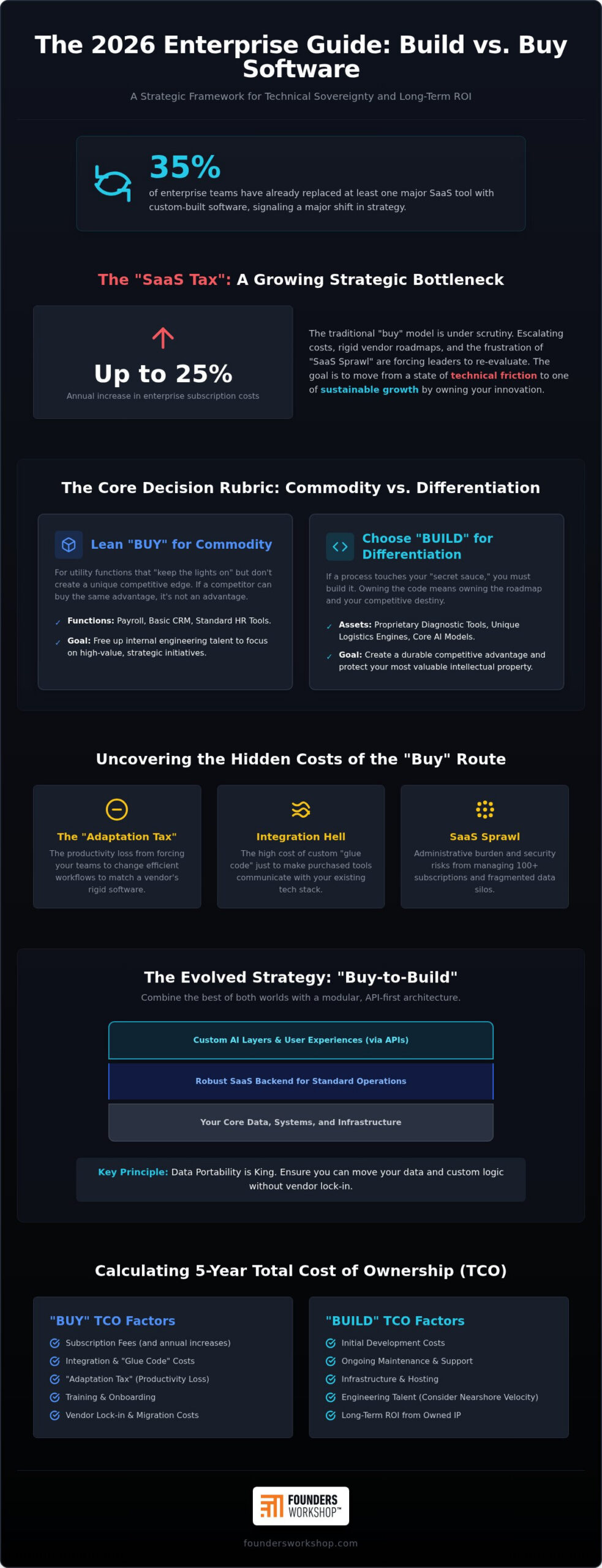
Did you know that 35% of enterprise teams have already replaced at least one major SaaS tool with custom-built software in 2026? The “SaaS Tax” is no longer just a line item; it’s a strategic bottleneck. With enterprise subscription costs climbing by up to 25% annually, the traditional framework for build vs buy software for enterprise is being aggressively re-evaluated. You’ve likely felt the friction of SaaS sprawl and the frustration of waiting for a third-party vendor to prioritize a feature your team needed months ago while your internal engineers are already overcapacity.
We understand the pressure to deliver high-impact results without exploding your technical debt. This guide provides a definitive framework to navigate these complex choices with the confidence of a seasoned executive. We’ll help you evaluate long-term ROI and strategic impact so you can stop reacting to vendor roadmaps and start owning your innovation. It’s about moving from a state of technical friction to one of sustainable business growth.
By the end of this guide, you’ll have a clear decision rubric to justify budget allocations to stakeholders and a pragmatic path to scaling your operations without the usual overhead.
Key Takeaways
- Distinguish between commodity tools and strategic differentiators to ensure your capital is only invested in software that creates a true competitive edge.
- Uncover the hidden costs of the “Adaptation Tax” and why modifying your core business processes to fit a SaaS vendor’s roadmap can be more expensive than building custom.
- Master a 2026 decision rubric for build vs buy software for enterprise that secures your technical sovereignty and protects proprietary data in an AI-driven market.
- Discover how nearshore staff augmentation provides the engineering velocity required to build custom internal software without the high costs of domestic senior talent.
- Gain a holistic framework for calculating five-year Total Cost of Ownership (TCO) to justify strategic budget allocations to executive stakeholders.
The 2026 Build vs Buy Framework: Commodity vs. Differentiation
In 2026, the build vs buy software for enterprise decision isn’t just about the initial price tag. It’s about where your company’s intelligence lives. Generative AI has lowered the barrier to custom development, making the “build” option more accessible for complex workflows. However, the foundational rule remains: if the software performs a utility function that doesn’t differentiate you from competitors, you should lean toward Commercial-off-the-shelf (COTS) solutions. This allows your team to focus on high-value initiatives rather than reinventing the wheel for standard business processes.
The “Differentiation” Rule is simple. If a process touches your secret sauce, you must build it. Relying on a third party for your core value proposition creates a strategic vulnerability. When you own the code, you own the roadmap. You aren’t at the mercy of a vendor’s sunsetting schedule or price hikes. Modern enterprises are moving away from binary choices. They’re adopting modular architectures that combine the best of both worlds.
Identifying Your Core Value Proposition
Auditing your workflows is the first step. You need to distinguish between “keeping the lights on” and “driving the ship.” Utilities like payroll or basic CRM functions are commodities. Strategic assets, such as a proprietary diagnostic tool or a unique logistics engine, are your competitive edge. Outsourcing these to a generic SaaS vendor risks commoditizing your own innovation. If a competitor can buy the same advantage for a monthly subscription, you don’t actually have an advantage. Focus your internal engineering on the 20% of your business that generates 80% of your unique value.
The Rise of the “Buy-to-Build” Strategy
The old wall between building and buying has crumbled. Modern leaders now use a modular, “buy-to-build” approach. This involves purchasing a robust SaaS backend for standard operations while building custom, high-touch AI layers or user experiences via APIs. Headless architecture is the standard for 2026. It allows you to maintain technical sovereignty over the user experience while offloading the heavy lifting of database management to specialized vendors. Data portability is now the king. You need the ability to move your data and custom logic without being held hostage by a vendor’s closed ecosystem. This hybrid model ensures you scale fast without losing control of your intellectual property.
Evaluating the “Buy” Route: Speed, SaaS Sprawl, and Hidden Costs
The primary allure of purchasing software is the “plug-and-play” promise. In a competitive market, a 30-day deployment sounds significantly better than a six-month development cycle. But this immediate gratification often masks a mismatch in long-term fit. When choosing build vs buy software for enterprise, leaders must account for the “Adaptation Tax.” This is the hidden cost of forcing your teams to change their efficient, proprietary workflows to match the rigid logic of a third-party tool. If your staff spends more time working around the software than working with it, the “speed” of buying is a mirage.
Integration hell is another common reality. Most “off-the-shelf” solutions aren’t truly standalone in an enterprise environment. They require custom middleware or complex system integrations to function within your existing stack. If you’re spending six figures on “glue code” just to make a purchased tool communicate with your legacy systems, you’ve already lost the speed advantage. You’re also stuck with the vendor’s roadmap. If they decide to pivot or deprioritize a feature your business relies on, your operations are effectively held hostage by their corporate strategy.
The True Cost of SaaS Sprawl
SaaS sprawl has become a significant drain on modern enterprise resources. Managing 100 or more subscriptions creates an administrative burden that often offsets the perceived savings of seat-based pricing. Beyond the monthly invoice, fragmented ecosystems introduce security and compliance risks that are difficult to monitor centrally. As noted in Forbes’ analysis on Thinking Beyond Total Cost Of Ownership, the true expense includes the loss of agility when your data is trapped in third-party silos. You aren’t just paying for the software; you’re paying for the complexity it adds to your governance model.
When Buying is the Correct Strategic Move
The Strategic Case for “Build”: IP, AI, and Technical Sovereignty
Custom software isn’t just an expense; it’s a foundational asset. In 2026, the build vs buy software for enterprise debate is increasingly won by those who value intellectual property (IP). When you build, you create a proprietary asset that adds directly to your company’s valuation. Similar to how a custom-built home from mwrconstruction.com creates lasting physical equity, custom code is a permanent part of your balance sheet—unlike a SaaS subscription that vanishes the moment you stop paying. It provides technical sovereignty, ensuring your strategic direction isn’t dictated by a third party vendor’s quarterly earnings report or sudden pricing pivots.
Ownership also allows you to eliminate the technical debt that accumulates when you try to force modern workflows into rigid, aging third party platforms. By replacing legacy systems with modern, cloud native software, you create a seamless user experience tailored specifically to your internal employee productivity. When the software fits the person rather than the other way around, you see a direct impact on operational velocity. Your teams stop fighting the tools and start leveraging them to drive the business forward.
AI Readiness and Custom Architecture
Generic SaaS tools often offer “wrapper” AI features that process your data through shared models. This is a security and strategic risk. A custom build allows for a more sophisticated AI strategy and implementation. By building your own architecture, you create proprietary datasets that competitors simply cannot access. You can integrate predictive analytics directly into your unique workflows, allowing for real time decision making based on your specific business logic. With AI assisted development now reducing build costs by 60 to 80 percent, the barrier to entry for custom, AI first platforms has never been lower. In fact, 78 percent of enterprise leaders plan to build more custom software this year to secure this exact advantage.
Legacy Modernization as a Build Catalyst
Many enterprises are held back by “zombie” applications. These are legacy systems that are too expensive to maintain but too critical to shut down. Choosing to build often starts with refactoring legacy code. This process isn’t just about cleaning up old scripts; it’s a catalyst for innovation. By moving from monolithic systems to scalable microservices, you provide a clean slate for custom innovation. A unified custom platform replaces fragmented legacy tools with a high performance engine. This transition turns a maintenance burden into a strategic asset, providing a massive ROI by consolidating multiple “zombie” apps into one cohesive system.
Calculating Total Cost of Ownership (TCO) Over 5 Years
To make an informed build vs buy software for enterprise decision, you must look past the initial invoice. A common mistake is comparing a one-time development quote to a monthly SaaS subscription. This narrow view ignores the five-year horizon where the real financial impact lives. A holistic TCO model accounts for implementation, customization, training, and the inevitable evolution of the software. While buying seems cheaper upfront, the compounding costs of subscriptions and process workarounds often flip the script by year three.
Don’t fall for the “Maintenance Myth” that suggests SaaS is maintenance-free. While you aren’t patching the server, your team is constantly adjusting workflows to accommodate the vendor’s non-negotiable roadmap changes. Custom software requires active maintenance, but every dollar spent there goes toward evolving a proprietary asset that you own. You’re investing in your own growth rather than subsidizing a vendor’s R&D department.
The Build Cost Breakdown
Building requires a significant initial capital expenditure (CAPEX), but it paves the way for long-term operational savings. The high cost of domestic engineering has traditionally been the biggest barrier to this path. However, leveraging nearshore staff augmentation can reduce these build costs by 40 to 60 percent without sacrificing timezone alignment or quality. This model allows you to deploy senior-level talent at rates significantly lower than US averages, which currently hover around $135,340 per year for a single engineer. By budgeting for continuous improvement and security patching from the start, you ensure the platform remains a high-performance asset rather than a depreciating one.
The Buy Cost Breakdown
Buying often feels like a predictable operational expense (OPEX), but “SaaS Tax” is real. Enterprise SaaS pricing has seen an annual increase of 15 to 25 percent over the last two years, far outpacing general inflation. Beyond the escalating seat-based fees, you must account for the cost of “Workarounds.” When a generic tool doesn’t fit your specific workflow, employees lose hours every week to manual data entry or redundant processes. You also face heavy consulting fees for any enterprise-level customization required to make the platform usable. If you are ready to stop paying for tools that don’t quite fit, it’s time to explore strategic internal software development that grows with your business.
The Hybrid Solution: Leveraging Nearshore Velocity to Build Better
The traditional binary choice between building or buying is increasingly obsolete. In 2026, the most resilient companies are adopting a hybrid strategy that leverages the stability of purchased core systems with the agility of custom-built proprietary layers. This approach allows you to buy the “commodity” engine while building the “differentiation” interface. If you want to move fast without losing control, the hybrid model is your path forward. It relies on a “Squad-as-a-Service” model where your internal leaders provide strategic oversight while an external nearshore squad handles the heavy engineering lift.
This partnership model directly addresses the primary objection to custom builds: the perceived lack of speed. By integrating a technical partner into your workflow, you gain access to seasoned expertise without the friction of traditional hiring cycles. Consider the impact of a recent legacy modernization project we oversaw. An enterprise was struggling with a fragmented system that hindered their AI readiness. By utilizing a hybrid build strategy and a dedicated nearshore team, they successfully modernized their core platform in just six months. They didn’t just replace old code; they built a scalable foundation that now serves as their primary competitive advantage.
Scaling with Nearshore Staff Augmentation
Latin American talent has become the strategic choice for US-based enterprises because it eliminates the communication gaps common in offshore models. When your engineering team works in the same timezone, you achieve true collaborative velocity. You don’t have to wait 12 hours for a response to a critical pull request. This alignment allows for 24-hour development cycles where your internal and nearshore teams pass the baton seamlessly. Maintaining high culture and communication standards is easier when your partners share your workday, ensuring that the build vs buy software for enterprise decision results in a product that actually reflects your brand’s values.
Partnering for Strategic Growth
A technical partner does more than just write code. They act as a seasoned guide to help you navigate the complexities of long-term ROI and technical debt. Choosing custom software development ensures that your technology remains aligned with your evolving business goals rather than being constrained by a vendor’s rigid feature set. We focus on human-centered results, ensuring that every custom layer we build removes friction for your employees and adds value for your customers. Ready to build your competitive edge? Consult with our expert strategists today to see how we can accelerate your roadmap.
Owning Your Technical Future
Deciding on the right path for build vs buy software for enterprise requires a shift from short term cost management to long term strategic ownership. You’ve seen how the “SaaS Tax” and rigid vendor roadmaps can stifle innovation, while custom builds now offer unprecedented ROI thanks to AI assisted development and nearshore velocity. By distinguishing between commodity utilities and your proprietary “secret sauce,” you ensure that every dollar spent strengthens your technical sovereignty and market position. It’s about moving from a state of technical friction to one of sustainable business growth.
At Founders Workshop, we bring over 30 years of executive technology leadership to help you bridge the gap between strategy and execution. Our expertise in human-centered legacy modernization ensures your internal platforms don’t just function, they thrive. With our timezone-aligned nearshore engineering teams, you can scale your operations without the communication friction of traditional offshore models. It’s time to stop adapting your business to fit your software and start building software that fits your vision. Maximize your ROI with a custom enterprise build; talk to Founders Workshop today. You have the roadmap, and we have the steady hand to help you navigate it.
Frequently Asked Questions
What are the main risks of building software in-house?
The primary risks involve scope creep and the high cost of talent retention. Internal engineering teams are often overcapacity with maintenance, which leaves little room for innovation. Without a structured methodology, projects can stall and lead to high technical debt. Partnering with an external squad can mitigate these risks by providing dedicated focus and seasoned leadership.
How do I know if my business problem is “standard” enough for off-the-shelf software?
Apply the commodity rule: if the process doesn’t provide a competitive advantage, it’s likely standard. Tasks like payroll, generic CRM, or basic communication are utilities. If the workflow touches your “secret sauce” or requires unique data handling, it’s a strategic asset that warrants a custom build rather than a generic package.
What is the “SaaS Tax” and how does it affect enterprise ROI?
The “SaaS Tax” refers to the compounding cost of endless subscriptions and annual price hikes, which have reached 15 to 25 percent recently. Over time, these fees often exceed the cost of a custom build. This sprawl reduces your long-term ROI as you continue to pay for features you don’t use while lacking the ones you actually need.
Can custom software be built as fast as a SaaS deployment?
While SaaS offers immediate access, the build vs buy software for enterprise timeline has narrowed significantly. AI-assisted development has reduced build times by up to 80 percent. When you factor in the weeks spent customizing a “generic” tool to fit your specific needs, a streamlined custom build often reaches full operational utility in a similar timeframe.
How does data privacy and security differ between build and buy options?
Custom builds offer technical sovereignty, which allows you to design security protocols that fit your exact compliance needs, such as the EU AI Act. When you buy, you’re dependent on the vendor’s security roadmap and their data handling policies. Building ensures your proprietary data stays within your controlled environment, which reduces the risk of third-party breaches.
What is the role of nearshore development in the build vs buy calculation?
Nearshore development bridges the gap between high domestic costs and the communication friction of offshore teams. By using timezone-aligned squads in Latin America, you get senior engineering talent at a more manageable price point. This makes the “build” option financially viable for projects that might otherwise be cost-prohibitive when using only US-based senior engineers.
Is it possible to switch from a buy solution to a build solution later?
Yes, many enterprises use a “buy-to-build” strategy. They start with a SaaS product to validate a workflow and then migrate to a custom solution once the requirements are clear. Modern headless architectures and APIs make it easier to extract your data and logic when you’re ready to move toward a proprietary platform that you own.
How do I calculate the TCO for a custom software project?
A true build vs buy software for enterprise TCO calculation covers a five-year window. You must include initial design, development, and QA costs, alongside long-term maintenance and security patching. Compare this against the total cost of SaaS subscriptions, integration consulting fees, and the “adaptation tax” paid when employees use inefficient, generic tools.