
By the end of 2026, many organizations will hit a “digital cliff” where the financial burden of maintaining aging infrastructure officially outweighs the cost of total transformation. Building a rock-solid business case for legacy system modernization is no longer a back-office IT concern; it’s a strategic necessity when cyber insurance premiums for unsupported platforms are spiking by 60% and technical debt compounds at 20% every year. You’ve likely seen your innovation budget swallowed by a maintenance tax that leaves your team unable to integrate the AI tools your competitors are already using.
It’s frustrating to watch your best developers leave because they’re tired of patching decades-old code. We understand that justifying these costs to the C-suite requires more than just technical jargon. This article provides the exact roadmap you need to quantify a potential 362% ROI, mitigate existential system risks, and secure the budget for your 2026 initiatives. We’ll walk through how to transition from stagnant maintenance to a high-velocity, scalable architecture that actually drives revenue.
Key Takeaways
- Understand why legacy systems are defined by their inability to meet 2026 business demands rather than just the age of the code.
- Learn to build a persuasive business case for legacy system modernization by quantifying the “maintenance tax” currently consuming your innovation budget.
- Compare execution strategies to determine why nearshore teams provide the necessary balance of velocity and cost-efficiency for complex transformations.
- Follow a step-by-step framework to audit your system inventory and align C-suite stakeholders with clear, value-driven metrics.
- Explore case studies that demonstrate how modernizing to a composable architecture creates a sustainable foundation for AI integration and rapid scaling.
The Hidden Cost of Doing Nothing: Quantifying Legacy Software Risks
In 2026, the definition of a legacy system has shifted. It’s no longer just about the age of the code or the decade the software was written. Instead, legacy is defined by technical friction and the inability to meet modern business demands. If your platform can’t integrate with AI agents, scale elastically, or support real-time data flows, it’s a legacy system. This realization is the first step in building a strong legacy system modernization strategy that sticks.
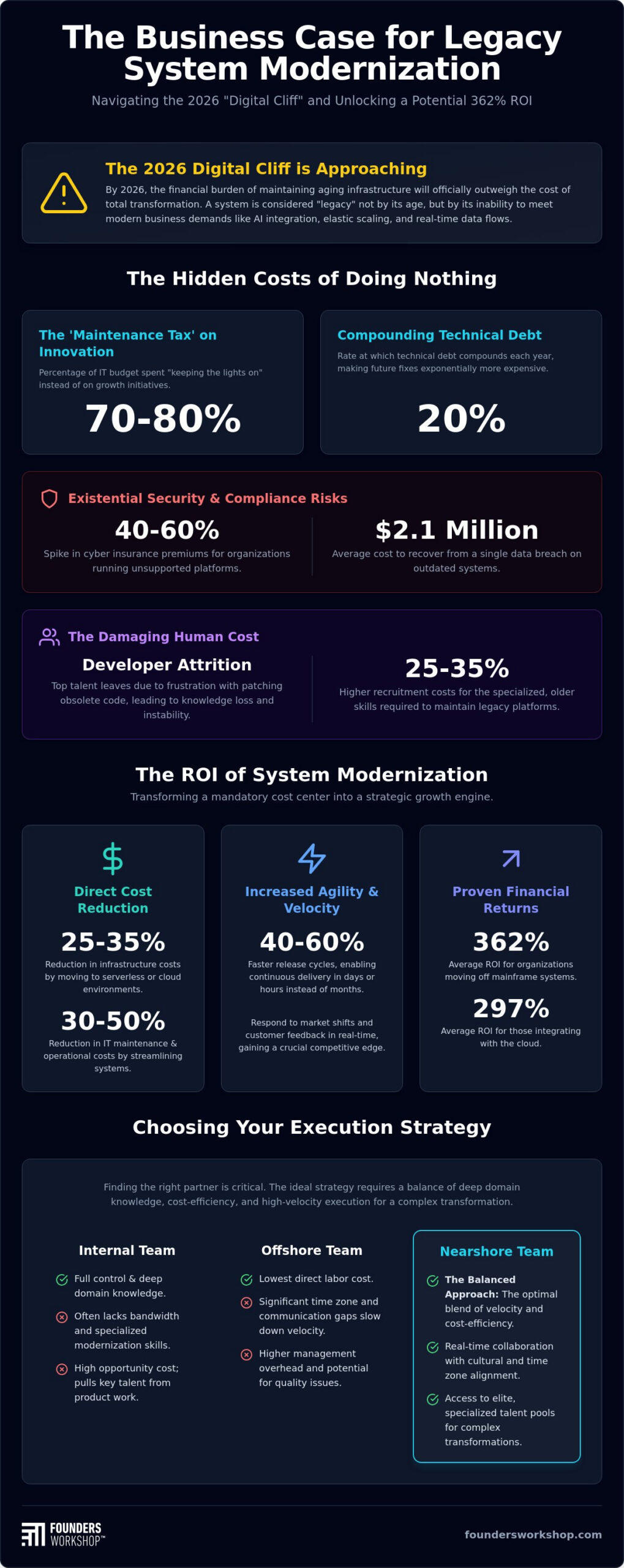
Maintaining these systems isn’t just a nuisance. It’s a massive financial drain. Research shows that many organizations spend between 70% and 80% of their IT budget just to keep the lights on. This “maintenance tax” prevents you from investing in the very innovations that would drive growth. When you’re trapped in this cycle, your innovation budget isn’t just small; it’s effectively non-existent. You lose the ability to ship features as fast as competitors, resulting in a steady erosion of market share.
Calculating the ‘Maintenance Tax’ on Innovation
To quantify the drain on your resources, you must look beyond obvious line items. Start with direct costs like high hosting fees for inefficient hardware and expensive, specialized licensing for outdated platforms. Then, move to indirect costs. These include the hundreds of developer hours spent on “patching” instead of “building.”
The human cost is often the most damaging. Working with outdated tech leads to developer attrition; top talent doesn’t want to manage a crumbling monolith. When they leave, recruitment costs for specialized, older skills can be 25% to 35% higher than for modern roles. To simplify the financial argument for your board, consider this: Technical Debt ROI is the ratio of recovered developer time to modernization cost.
Security and Compliance: The Existential Business Case
Running end-of-life software in 2026 is a massive risk. Cyber insurance providers have recognized this, increasing premiums by 40% to 60% for organizations on unsupported platforms. If a breach occurs, the average recovery cost now sits around $2.1 million. This makes the business case for legacy system modernization a matter of corporate survival.
Outdated systems also drive employees toward “shadow IT.” When the official tools are too slow, teams use unauthorized third-party apps to get work done, creating unmonitored data silos. In regulated sectors like healthcare and finance, this isn’t just a security flaw; it’s a legal liability. The 2026 regulatory landscape is less forgiving than ever. Every day you wait, your technical debt compounds by roughly 20%, making the eventual fix even more expensive.
The ROI of System Modernization: Three Pillars of Value
Transitioning from a legacy footprint to a modern architecture isn’t just about avoiding disaster; it’s a calculated move to reclaim capital. When you build a business case for legacy system modernization, you’re shifting the conversation from “what we’re losing” to “what we’re gaining.” Organizations that move off mainframe systems see an average 362% ROI, while those that integrate with the cloud achieve a 297% return. These aren’t just theoretical numbers. They represent a fundamental shift in how your technology supports your bottom line by turning a cost center into a growth engine.
Direct Cost Reduction and Infrastructure Optimization
The most immediate impact of modernization is found in your infrastructure spend. Moving from rigid on-premise servers to serverless or containerized environments can reduce infrastructure costs by 25% to 35%. This transition allows you to stop paying for idle capacity and start paying only for what you use. By consolidating redundant systems and streamlining third-party SaaS integrations, you can reduce IT maintenance and operational costs by 30% to 50%. This creates a leaner, more predictable budget that focuses on innovation rather than just keeping the lights on. System uptime and performance also improve, which directly impacts customer retention and employee productivity.
Agility and Velocity: Shipping at the Speed of Business
Legacy systems often trap companies in quarterly release cycles that can’t keep pace with market shifts. Modernization enables a shift to continuous delivery, where updates are measured in days or hours rather than months. Statistics show that release cycles can be 40% to 60% faster after a successful transformation. This increased engineering velocity means your team can respond to customer feedback and competitive threats in real time. It removes the technical friction that currently prevents your best ideas from reaching the market.
Modernization as a Prerequisite for AI Strategy
In 2026, the primary driver for modernization is the urgent need for AI-readiness. You simply can’t run sophisticated AI models or predictive analytics on siloed, legacy data structures. Modernization serves as the essential first step in a comprehensive AI strategy consulting roadmap. By breaking down data monoliths and implementing modular, API-driven architectures, you unlock the ability to automate complex workflows. This data foundation is what allows for the integration of generative AI tools that are predicted to reduce modernization costs by 70% by 2027. If you’re looking to bridge the gap between your current capabilities and your 2026 goals, a strategic audit of your existing systems is the best place to start.
Comparing Execution Strategies: Internal, Offshore, and Nearshore
Selecting the right execution model is the point where many well-reasoned business cases fall apart. While the technical requirements might be clear, the human element of delivery determines whether you actually realize the ROI projected in your business case for legacy system modernization. Leaders often face the “Build vs. Buy vs. Modernize” dilemma. Buying off-the-shelf software might seem fast, but it often lacks the unique business logic that gives your company its competitive edge. Building from scratch is expensive and slow. Modernization, when executed correctly, preserves your proprietary value while stripping away the technical debt holding you back.
Internal teams are frequently the first choice for these projects, yet they often struggle to gain momentum. Your in-house engineers are already burdened with maintaining current operations, and forcing them to lead a massive transformation creates a conflict of interest. They are essentially being asked to change the tires on a car while it’s moving at 60 miles per hour. This split focus leads to burnout and project delays, which quickly erodes the financial justification for the initiative.
The Nearshore Advantage for Modernization Projects
When looking outside for help, the choice between offshore and nearshore models is critical. Traditional offshore models often suffer from significant timezone gaps that lead to “communication debt.” If your team has to wait 12 hours for a response to a critical architecture question, your engineering velocity stalls. This is why nearshore staff augmentation has become the preferred strategy for 2026 initiatives. By partnering with high-quality talent in Latin America, you gain US timezone alignment that allows for real-time collaboration. This proximity reduces the “Modernization Tax” caused by rework and misalignment, ensuring that your project stays on schedule and within budget.
Risk Mitigation through Incremental Modernization
Success in modernization rarely comes from a “Big Bang” replacement. Research indicates that 88% of business transformation initiatives fail to achieve their original goals when they attempt to replace everything at once. Instead, seasoned leaders use the “Strangler Fig” pattern. This approach involves gradually replacing legacy functionality with modern services piece by piece. It allows you to maintain business continuity while proving value early through MVPs. By delivering modular wins, you build confidence with stakeholders and ensure the system remains stable throughout the transition. This incremental path is the most disciplined way to secure your budget for 2026 and beyond without risking a total system failure.
- Internal Teams: Best for domain knowledge but often lack the capacity for large-scale shifts.
- Offshore: Low initial cost but high hidden costs due to communication delays and cultural misalignment.
- Nearshore: High-quality talent with timezone parity, facilitating agile delivery and faster ROI.
How to Build the Modernization Pitch: A Step-by-Step Framework
Creating a persuasive business case for legacy system modernization involves a shift from justifying IT expenses to presenting a strategic investment plan. You aren’t just fixing bugs; you’re unlocking the company’s ability to pivot. Start with a rigorous audit of your current inventory. Categorize every system by its business value and its technical health. Systems that sit in the “high value, low health” quadrant are your primary targets for immediate attention. This data-driven categorization prevents the project from becoming a generic “refresh” and turns it into a targeted strike on technical friction.
Your financial modeling should project a three-year Total Cost of Ownership (TCO) for both the status quo and the modernized path. Be honest about the “J-Curve” where costs rise temporarily during the transition as you run systems in parallel. However, contrast this with the 30% to 50% reduction in maintenance costs once the new architecture is live. By presenting a phased roadmap, you demonstrate a disciplined approach to capital allocation that respects the bottom line.
Securing C-Suite Buy-In: Speaking the Language of Business
The biggest mistake in a modernization pitch is focusing on refactoring. Instead, frame the entire initiative around “Business Growth.” Address the CFO’s biggest fear: the “Never-Ending Project.” You can mitigate this by setting clear, measurable milestones that tie back to revenue or risk reduction. Use data to show that the cost of inaction is actually higher than the investment, especially when factoring in the 40% to 60% spikes in cyber insurance premiums for aging platforms.
The ‘Quick Win’ Strategy: Building Momentum
To maintain momentum, your roadmap must deliver high-visibility, low-complexity wins within the first 90 days. We recommend applying an MVP development approach to specific modules, treating each modernization phase as a product launch rather than a chore. This allows you to report on initial ROI and prove the methodology before scaling. If you’re ready to stop the drain on your innovation budget, a professional system integrations audit can provide the clarity required to move forward with confidence.
Modernization Case Study: Transitioning to an Agile Future
Consider the case of a mid-sized healthcare provider that entered 2025 struggling with a monolithic patient management system. This platform, while stable for basic records, was entirely unable to integrate with modern diagnostic AI agents or third-party telehealth APIs. Their innovation budget was effectively frozen; 75% of their IT spend went toward maintaining aging servers and paying for specialized developers to patch a codebase that few understood. This scenario is common for organizations that haven’t yet formalized a business case for legacy system modernization.
The justification for their transformation was built on three specific metrics: a projected 30% reduction in annual infrastructure costs, a 50% increase in developer velocity, and the elimination of a $1.2 million “security risk” identified by their insurance provider. By framing the project around these outcomes, they moved from a defensive posture to an offensive one. They weren’t just fixing old software. They were building a foundation for AI-driven predictive patient care that would eventually increase their market share by 15% over two years.
Success in this transition required more than just technical skill. It required a technical partner for founders who understood that code is a means to a business end. Through a phased approach, they replaced high-friction modules one by one, ensuring that the business remained operational throughout the shift. This disciplined execution turned a stagnant cost center into a high-performance asset that could finally support the organization’s 2026 growth targets.
Human-Centered Modernization: Beyond the Code
Modernization often fails not because of the technology, but because of the people. In the healthcare example, ensuring user adoption among clinical staff was as critical as the backend migration. A human-centered approach involves designing a modern UI/UX that feels intuitive to those who spent years mastering the old, clunky interface. It also requires a plan for upskilling your internal team. You want your engineers to feel empowered by the new ecosystem, not replaced by it. A scalable, maintainable tech stack is only valuable if your team has the knowledge to evolve it as market demands change.
Partnering for Success in 2026
At Founders Workshop, we align technical execution with strategic business growth. We’ve navigated multiple eras of technology over 30 years, and we know that tools are secondary to business outcomes. By utilizing nearshore staff augmentation, we provide the high-quality talent and US timezone alignment necessary to lower the “Modernization Tax” and accelerate your ROI. We act as a steady hand, helping you navigate the complexities of scaling while removing technical friction.
If your innovation budget is currently trapped in maintenance mode, it’s time to build a path forward. Schedule a consultation to build your modernization business case and ensure your organization is ready for the digital demands of 2026.
Securing Your Competitive Edge for 2026 and Beyond
The transition from managing technical debt to driving innovation is a strategic pivot that requires more than just a code refresh. By quantifying the maintenance tax and aligning your transformation with AI-readiness, you transform a technical burden into a revenue-generating asset. Building a successful business case for legacy system modernization depends on proving that the cost of inaction, from soaring insurance premiums to lost market velocity, far exceeds the investment in a modern, composable architecture.
Founders Workshop brings 30+ years of software engineering expertise to your transformation. With nearshore talent in your timezone and a proven track record in healthcare tech and AI strategy, we provide the steady hand needed to bridge the gap between your legacy past and an agile future. It’s time to stop patching the status quo and start building for scale. We help you navigate the complexities of scaling while removing the technical friction that limits your growth.
Build Your Legacy Modernization Roadmap Today
Frequently Asked Questions
What is the average ROI of legacy system modernization?
Organizations moving off mainframe systems typically see an average 362% ROI, while those integrating with cloud-based services achieve approximately 297%. These returns are driven by a 30% to 50% reduction in IT maintenance and operational costs. By shifting capital from “keeping the lights on” to innovation, companies turn a stagnant cost center into a high-velocity growth engine.
How do I calculate the ‘Cost of Doing Nothing’ for our legacy software?
You calculate the cost of inaction by summing direct maintenance fees, indirect productivity losses, and escalating risk factors. Include obvious expenses like specialized licenses and high hosting fees, but also factor in the 20% annual compounding rate of technical debt. Don’t overlook the “innovation gap,” which is the revenue lost when your competitors ship modern features faster than your platform allows.
What are the biggest risks associated with modernizing a legacy system?
The primary risks include data corruption during migration, business logic gaps, and high failure rates due to poor change management. Research suggests that 88% of transformation initiatives fail when they lack stakeholder alignment or attempt a “big bang” replacement. You can mitigate these risks by adopting an incremental approach that replaces functionality piece by piece, ensuring business continuity throughout the transition.
Can we modernize our system without a complete ‘rip and replace’?
Yes, you can utilize the “Strangler Fig” pattern to replace legacy functionality gradually without a total system shutdown. This method involves wrapping old services in modern APIs and migrating specific modules to a new architecture over time. It’s a disciplined way to build a business case for legacy system modernization because it delivers modular wins and reduces upfront risk.
How long does a typical legacy modernization project take in 2026?
Most organizations see measurable results from their first modernization phase within three to nine months. While a full enterprise overhaul is a multi-year journey, the use of AI-powered tools is now predicted to reduce modernization timelines by up to 70% by 2027. Focusing on high-visibility MVPs allows your team to prove the project’s value to the board within the first 90 days.
Why is nearshore staff augmentation better for modernization than offshore?
Nearshore staff augmentation offers US timezone alignment, which is vital for the real-time collaboration that agile modernization requires. Traditional offshore models often suffer from significant communication delays that stall engineering velocity and lead to expensive rework. By partnering with talent in Latin America, you maintain a steady development rhythm and ensure that your external partners are fully aligned with your business goals.
What role does AI play in the business case for modernization?
AI acts as both the primary driver for modernization and a powerful tool to execute it. You can’t leverage modern AI agents or predictive analytics on siloed, legacy data structures, making modernization a prerequisite for any 2026 AI strategy. At the same time, generative AI tools are significantly lowering the cost of refactoring code, making the financial justification for these projects more compelling than ever.
How do I convince my CFO to invest in technical debt reduction?
You must frame technical debt as a high-interest financial liability that drains the innovation budget. Present a 3-year Total Cost of Ownership comparison and highlight that cyber insurance premiums have spiked up to 60% for organizations on unsupported platforms. Showing the CFO that the cost of maintaining the status quo is higher than the investment makes the business case for legacy system modernization a clear strategic priority.