

Most of the AI solutions flooding the market today are little more than thin wrappers around existing models, offering zero long-term competitive advantage. If you’ve felt the frustration of investing in tools that don’t actually solve your core business problems, you’re not alone. For leaders seeking AI development services phoenix offers a crowded field, but the real challenge isn’t finding a coder; it’s finding a strategic partner who understands that technology must serve the bottom line.
You already know that a poorly integrated model creates more technical debt than it’s worth. This guide provides a clear framework to help you identify, evaluate, and partner with a custom AI development company that prioritizes technical execution alongside your long-term business strategy. We’ll examine how to move past the hype to build a scalable roadmap that integrates seamlessly with your existing SaaS or legacy systems, ensuring your investment delivers measurable results rather than just technical novelty.
Key Takeaways
- Identify the critical difference between superficial AI wrappers and proprietary models that create a sustainable competitive moat for your business.
- Learn how to leverage predictive analytics and custom LLMs to transform your raw data into strategic, forward-looking intelligence.
- Discover a framework for evaluating AI development services phoenix providers by prioritizing strategic executive guidance over simple technical execution.
- Explore incremental modernization strategies to integrate AI into legacy systems and SaaS platforms without the high cost of a complete rebuild.
- Understand why human-centered design and nearshore team alignment are essential for ensuring high adoption rates and seamless collaboration.
What is a Custom AI Development Company and Why Do You Need One?
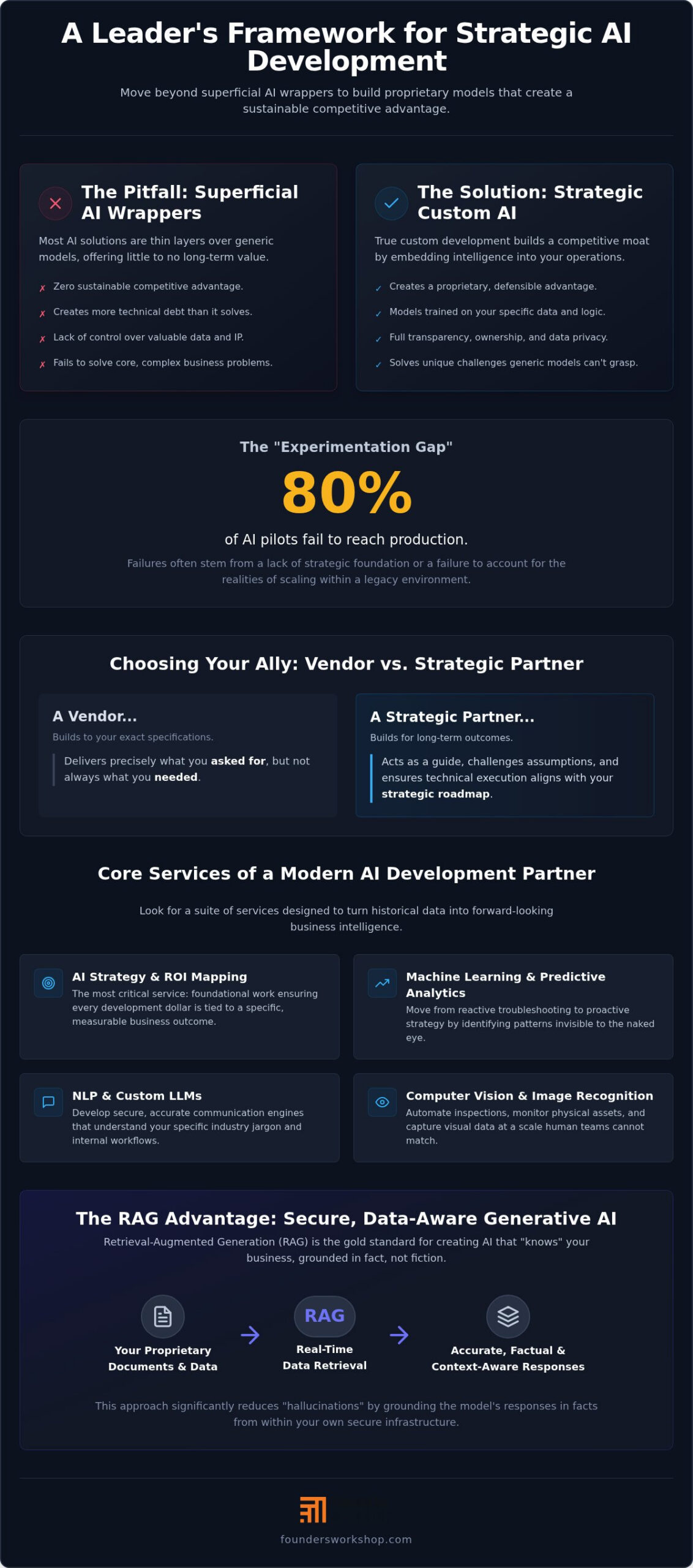
A custom AI development company does more than just write code; it builds proprietary machine learning models and intelligent workflows designed specifically for your unique business logic. While many firms claim to offer Artificial intelligence (AI) solutions, there’s a significant difference between a superficial wrapper around a generic API and a deep-tech integration. True custom development creates a competitive moat by training models on your specific data and embedding them directly into your operational DNA.
The market is shifting. We’ve moved away from the novelty phase where a simple chatbot was enough to impress stakeholders. Now, leaders are looking for AI development services phoenix businesses can rely on to solve complex, high-stakes problems. This shift is driven by the “Experimentation Gap.” Industry research suggests that roughly 80% of AI pilots fail to reach production. These failures usually happen because projects lack a strategic foundation or fail to account for the realities of scaling within a legacy environment.
Choosing a partner for AI development services phoenix involves more than checking technical boxes. A vendor builds to your specifications, often delivering exactly what you asked for but not necessarily what you needed. A partner builds for outcomes. They act as a strategic guide who challenges assumptions and ensures the technical execution aligns with your long-term roadmap. This partnership model is essential for navigating the transition from a proof-of-concept to a production-ready asset.
Custom AI vs. Off-the-Shelf Solutions
Off-the-shelf SaaS tools are excellent for immediate, low-stakes efficiency, such as basic transcription or generic content drafting. However, when your competitive advantage relies on data privacy, unique intellectual property, or complex logic that a generic model cannot grasp, custom development becomes a necessity. Relying on black box solutions often leads to high technical debt and a lack of control over your most valuable assets. Custom builds offer the transparency and ownership required for long-term sustainability.
The Role of an AI Strategy Consultant
A veteran consultant moves beyond the mechanics of coding to focus on the strategic why. They help you identify high-ROI use cases that create Operational Alpha, a term used to describe the efficiency gains and market advantages that competitors cannot easily replicate. This strategic oversight ensures that your technical architecture doesn’t just work today; it supports future scalability and provides a steady hand to navigate the complexities of integration. For a comprehensive look at how to structure this process, explore our AI strategy consulting guide to ROI-driven implementation.
Core Services of Modern AI Development Partners
Modern AI partners don’t just sell software; they sell the ability to anticipate market shifts and automate complex human decisions. When evaluating AI development services phoenix providers, it’s essential to look beyond basic coding capabilities. A true partner offers a suite of services designed to turn historical data into forward-looking business intelligence. This starts with Machine Learning (ML) and predictive analytics, which allow your organization to move from reactive troubleshooting to proactive strategy by identifying patterns that remain invisible to the naked eye.
Natural Language Processing (NLP) and custom Large Language Models (LLMs) represent the next pillar of modern service. While generic tools exist, a custom-built communication engine understands your specific industry jargon and internal workflows. This ensures that data extraction and automated client interactions are accurate and secure. For businesses with physical assets or high-volume visual data, computer vision and image recognition services can automate inspections and capture data at a scale human teams cannot match. However, the most critical service is often the initial AI strategy and ROI mapping. This foundational work ensures that every dollar spent on development is tied to a specific, measurable business outcome. If you’re ready to define your roadmap, our team can help you align your AI strategy with your unique operational goals.
Generative AI and RAG Architectures
Retrieval-Augmented Generation (RAG) has emerged as the gold standard for secure, data-aware AI. Unlike standard generative models that rely on static training data, RAG architectures allow your AI to reference your proprietary documents in real-time. This approach significantly reduces “hallucinations” by grounding the model’s responses in facts it finds within your own security infrastructure. It’s the difference between an AI that guesses and an AI that knows your specific business rules.
Predictive Models for Specialized Industries
In highly regulated or complex sectors, general-purpose AI often falls short. In the medical field, for example, using predictive healthcare models helps providers anticipate patient needs and optimize resource allocation before a crisis occurs. Similar logic applies to logistics, where AI-driven supply chain optimization can shave days off delivery times. In fintech, these models are used for real-time fraud detection and automated risk assessment, providing the speed and accuracy necessary to maintain trust in high-stakes environments. When you seek AI development services phoenix, ensure your partner has the depth to handle these industry-specific nuances.
How to Evaluate an AI Development Partner: A Decision Framework
Evaluating a partner requires looking past the surface level of technical certifications or star ratings. For those seeking AI development services phoenix, the decision comes down to how well a team bridges the gap between raw code and industry-specific logic. Does the team understand your market nuances, or are they simply building to a checklist? A strategic partner acts as a veteran guide, ensuring that the technical architecture doesn’t just function but actually drives long-term business growth. They should challenge your assumptions and offer pragmatic solutions that prioritize your bottom line over technical novelty.
Usability is often the silent killer of AI initiatives. You need a partner who prioritizes human-centered design, ensuring the AI integrates into existing human workflows without causing friction. If your team finds the tool difficult to use, adoption will fail regardless of how advanced the underlying model is. Simultaneously, data security and governance must be foundational. Your proprietary data is your competitive moat. A disciplined partner establishes rigorous protocols to protect this asset, ensuring your most sensitive information remains secure and compliant with industry standards.
Deployment is only the beginning of the journey. AI models naturally suffer from “drift” as real-world data changes and user behaviors evolve. You must verify who handles the ongoing maintenance and MLOps. Without a plan for post-launch support, your high-performing asset will eventually degrade into technical debt. A true partner provides the steady hand needed to monitor performance and recalibrate models, ensuring your investment continues to deliver value long after the initial launch. Understanding how to structure this ongoing commitment is a core focus of effective AI strategy consulting for business leaders.
The Timezone and Communication Factor
Nearshore talent models provide a distinct advantage over offshore outsourcing for complex AI builds. Real-time collaboration is vital during iterative development where quick feedback loops prevent costly pivots. When your team works in the same US timezone, you avoid the delays and “lost in translation” traps common with distant vendors. Native-level English communication ensures that strategic nuances are captured and reflected in the technical execution, providing the peace of mind that comes from true alignment.
Portfolio and Proven ROI
Don’t settle for proof-of-concepts that never left the lab. Demand to see “production-grade” examples where AI is currently solving problems for real users. Ask for specific metrics: did the solution reduce manual labor hours, increase conversion rates, or lower churn? If you’re a product leader, evaluate their specific experience in building AI features into SaaS environments. This ensures they understand the unique pressures of scaling a commercial software product and can deliver a solution that remains robust under heavy user load.
Integrating Intelligence: AI in Legacy Systems and Modern SaaS
Many founders believe their older software is a dead end for innovation. This isn’t necessarily true. While technical debt often makes legacy systems feel rigid, AI development services phoenix can provide the bridge needed to modernize without a total overhaul. The goal isn’t just to fix old code; it’s to layer intelligence onto existing workflows to unlock hidden value. This process requires a disciplined approach to system integration, ensuring that new models can communicate with old databases without causing system-wide friction.
Bridging the gap between siloed data and centralized intelligence is the most common hurdle. When your data lives in separate, aging databases, AI can’t see the full picture. System integration services act as the connective tissue, creating a unified ecosystem where your proprietary information becomes accessible to modern machine learning models. This transformation turns static records into a dynamic fuel source for predictive analytics and automated decision-making. It’s about making your data work for you, rather than just taking up space on a server.
The Roadmap for Legacy AI Integration
Modernization doesn’t have to be a “rip and replace” disaster. By following a structured approach, you can introduce intelligence gradually while maintaining operational stability. This methodical path ensures that each step adds value before you commit to larger changes:
- Data Audit and Cleaning: You must ensure your foundational data is accurate and structured before feeding it into a model.
- API-first architecture: Use modular deployments to keep the system flexible and prevent future vendor lock-in.
- Pilot testing: Start with non-critical internal workflows to prove value and build stakeholder trust before scaling.
For a deeper dive into this process, read our full guide on integrating AI into legacy systems.
AI for Internal Business Efficiency
Think about the logic-heavy tasks that slow your team down every day. Automating invoice processing or claims triage doesn’t just save time; it transforms your entire operational model. These custom internal tools empower employees to focus on high-value strategy rather than repetitive manual entry. Over time, this shift moves your organization from a state of technical debt to one of technical equity. Your software becomes an appreciating asset that generates “Operational Alpha” rather than a liability that drains resources. If you’re ready to modernize your stack, let’s discuss how to integrate AI into your legacy systems effectively.
The Founders Workshop Approach: Strategic AI Execution
Technology is a tool, not a destination. At Founders Workshop, we prioritize human-centered AI, ensuring that every model we build serves a practical purpose for your team and your customers. With 30+ years of leadership experience, we’ve navigated multiple technology cycles; we know that the only thing that matters is a solution that actually works in production. For those evaluating AI development services phoenix, our approach centers on removing technical friction so you can focus on growth. We act as a seasoned executive guide, helping you avoid the common pitfalls of technical debt and unscalable prototypes.
Communication is the most frequent point of failure in complex software projects. We solve this through our nearshore talent model, providing high-quality tech talent from Latin America that works in your exact US timezone. This ensures real-time collaboration and native-level English communication, preventing the “lost in translation” errors that often plague offshore outsourcing. You get the efficiency of a global workforce without the logistical headaches of a twelve-hour time difference. This alignment is critical when building sophisticated systems that require constant feedback and iterative refinement.
Our Multi-Disciplinary Managed Teams
We don’t just assign a coder to your project. We deploy managed teams that combine product strategy, UI/UX design, and AI engineering into a single, cohesive unit. This multi-disciplinary approach ensures that the technical execution remains aligned with the user experience and your broader business goals. Our “Founder-first” mentality means we prioritize your company’s survival and long-term scalability. We treat your product as if it were our own, offering transparent communication and disciplined project management throughout the entire development lifecycle.
Getting Started: Your AI Strategy Roadmap
Every successful partnership begins with a clear plan. Our initial consultation focuses on identifying your “Operational Alpha”, the specific areas where AI can give you a measurable market advantage. We then move into rapid prototyping and MVP development to validate your assumptions quickly and cost-effectively. Once we’ve proven the concept, we help you scale with confidence through our flexible staff augmentation retainers. This outcome-driven model ensures we’re focused on launching a successful product rather than just billing hours. If you’re looking for AI development services phoenix that act as a strategic guide, we’re ready to help you navigate the path ahead.
Securing Your Competitive Moat with AI
The transition from technical novelty to strategic execution is the defining challenge for founders in 2026. Successfully navigating this shift requires a partner who understands how to bridge the gap between legacy constraints and future scalability. By prioritizing human-centered design and proprietary models over generic wrappers, you ensure that your investment creates a sustainable competitive advantage rather than just increasing your technical debt. It’s about building software that scales alongside your long-term business ambition.
When you’re ready to evaluate AI development services phoenix provides a crowded market, but Founders Workshop brings the seasoned perspective required for high-stakes projects. With 30+ years of executive tech leadership and dedicated nearshore teams working in your timezone, we provide the technical reliability and strategic alignment needed to turn your vision into a production-ready asset. Our human-centered design philosophy ensures that your AI tools are built to be adopted and utilized, not just deployed.
Schedule Your AI Strategy Consultation with Founders Workshop to begin defining your roadmap. Let’s work together to build the future of your business with confidence.
Frequently Asked Questions
What does a custom AI development company actually do?
A custom AI development company builds proprietary machine learning models and intelligent workflows tailored to your specific business logic. Unlike firms that simply resell generic APIs, these partners focus on deep-tech integrations that create a unique competitive moat. They handle everything from initial strategy and ROI mapping to the technical execution of predictive analytics or custom LLMs, ensuring the solution aligns with your long-term goals.
How much does it cost to build a custom AI solution for my business?
The cost of a custom AI solution depends on the complexity of the data, the required accuracy, and the level of integration with your existing systems. Projects often range from building a focused MVP to a full enterprise-grade deployment. Instead of looking for a fixed price, you should evaluate the potential ROI and Operational Alpha the tool will generate. A strategic partner will help you map these costs against specific business outcomes.
How long does it take to integrate AI into an existing legacy system?
Integration timelines vary based on the state of your legacy architecture and data quality. A typical roadmap begins with a data audit and cleaning phase, followed by building an API-first architecture for modular deployment. While a pilot program might launch in a few months, a comprehensive integration that modernizes your full stack is an ongoing strategic process. Starting with non-critical internal workflows allows for faster validation and reduced risk.
Will I own the intellectual property (IP) of the AI model developed?
Yes, when you partner with a reputable custom development firm, you should retain full ownership of the resulting intellectual property. This includes the proprietary code, trained models, and the unique logic built into your workflows. Owning your IP is essential for maintaining your competitive advantage. It ensures that you aren’t tied to a specific vendor’s “black box” solution or ongoing licensing fees for your own innovations.
What is the difference between nearshore and offshore AI development?
Nearshore development involves teams in similar timezones, such as Latin America for US companies, while offshore development often involves teams in vastly different timezones. For high-stakes AI development services phoenix leaders require, nearshore models offer real-time collaboration and native-level English communication. This alignment reduces the feedback delays and communication errors that frequently derail complex AI projects during the iterative development phase.
How do you ensure data privacy and security during AI development?
Security is handled through rigorous data governance protocols and secure architectures like Retrieval-Augmented Generation (RAG). By building models that live within your own security infrastructure, a partner ensures that your sensitive proprietary data never leaves your control. This approach prevents data leaks to public models and ensures compliance with industry-specific regulations, providing the peace of mind necessary for scaling in sensitive sectors like healthcare.
Do I need a technical background to work with an AI development company?
You don’t need a deep technical background to lead a successful AI initiative. A seasoned executive guide at your development partner will bridge the gap between business strategy and technical execution. Their role is to translate your operational needs into technical requirements. This allows you to focus on high-level outcomes while they handle the complexities of machine learning, data engineering, and system integration.
How do you measure the ROI of a custom AI project?
ROI is measured by tracking specific metrics tied to your business goals, such as reduced manual labor hours, increased conversion rates, or lower customer churn. For AI development services phoenix businesses, this often involves calculating the “Operational Alpha,” which represents the efficiency gains that competitors cannot easily replicate. By setting clear benchmarks during the strategy phase, you can ensure the technical execution delivers a measurable impact on your bottom line.