

The era of the “AI wrapper” has officially ended, leaving product leaders to face a market that demands more than just a chat interface. As you consider building ai features into saas this year, you’re likely balancing the promise of agentic workflows against the reality of GPT-5.6 Sol costing $30 per million output tokens. It’s a high-stakes environment where the wrong architectural choice can lead to unsustainable compute costs or, worse, a product with no defensible moat.
We understand that the challenge isn’t just about technical capability; it’s about strategic alignment and business outcomes. This guide provides a definitive roadmap for transitioning from basic generative tools to high-ROI agentic features that drive sustainable growth in 2026. You’ll discover how to navigate the complex landscape of API pricing, comply with the EU AI Act’s August 2026 deadline, and scale your engineering team without the friction of a talent war. We’re moving beyond the hype to focus on the practicalities of shipping features that actually improve your product’s value proposition.
Key Takeaways
- Understand the strategic shift from general LLMs to specialized Small Language Models (SLMs) to optimize performance and significantly reduce compute costs.
- Master a phased roadmap for building ai features into saas that uses opportunity audits and MVPs to validate ROI before committing to full-scale engineering.
- Discover why Retrieval-Augmented Generation (RAG) has become the essential architecture for integrating proprietary SaaS data securely and accurately.
- Evaluate the strategic benefits of nearshore staff augmentation to scale your AI engineering capabilities and bridge the specialized talent gap.
- Learn to design agentic workflows that move beyond simple chat interfaces to automate core business outcomes and build a long-term competitive moat.
The Evolution of AI in SaaS: Moving Beyond Simple Wrappers in 2026
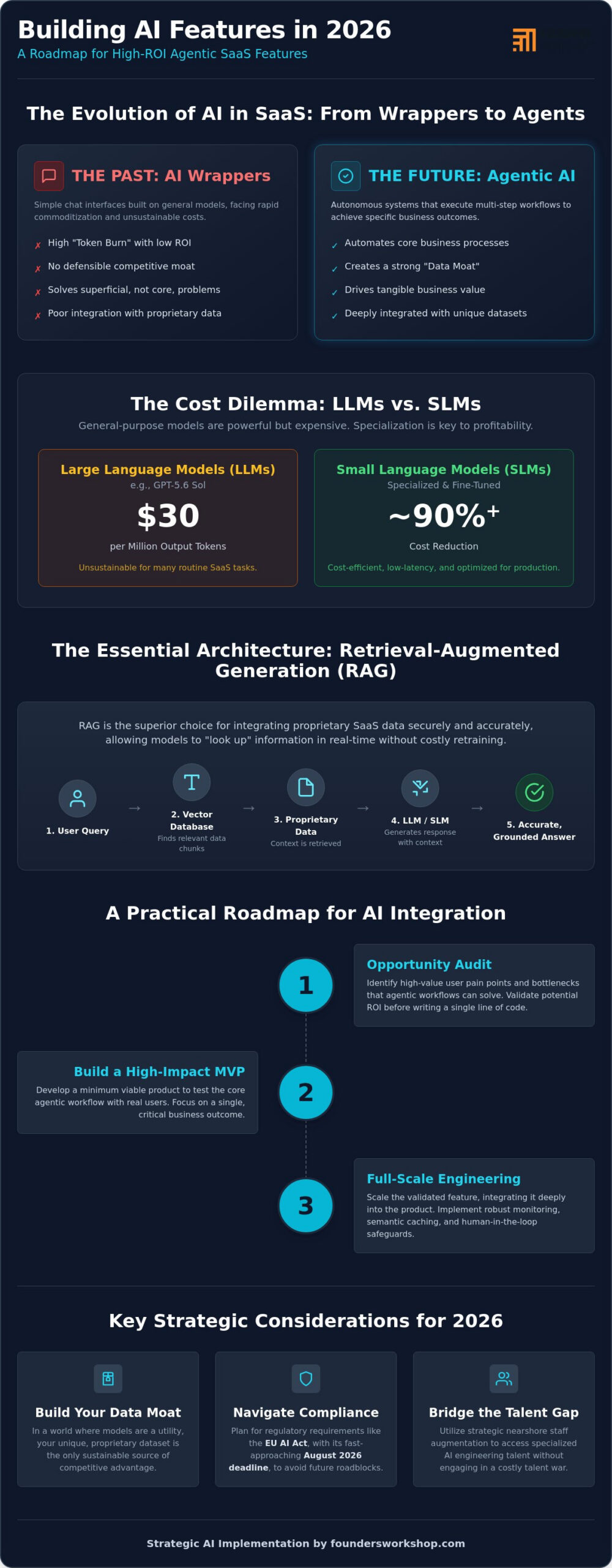
The market has matured past the novelty of generative text. In 2026, building ai features into saas requires a fundamental shift from “tacked-on” chat interfaces to AI-native components that are deeply integrated into the application’s core logic. These features aren’t just cosmetic additions. They’re functional layers that utilize proprietary data to solve specific business problems. This evolution is supported by AI-assisted software development practices that allow for more precise engineering than we saw in the early hype cycles of 2023 and 2024.
We’re seeing a decisive pivot from massive, general-purpose Large Language Models (LLMs) toward specialized Small Language Models (SLMs). While a flagship model like GPT-5.6 Sol offers immense power, its $30 per million output tokens price point makes it a strategic liability for many routine SaaS tasks. SLMs provide the low-latency and cost-efficiency needed for production-grade features while running on more modest infrastructure. This technical shift reinforces the importance of your “Data Moat.” In a world where model access is a utility, your unique, proprietary datasets are the only sustainable source of competitive advantage.
Agentic AI refers to autonomous systems designed to pursue specific goals by executing multi-step workflows across different software environments without constant human prompting.
The Problem with “AI Hype” Features
Simple API wrappers are facing rapid commoditization. Users are tired of basic chatbots that offer little more than a skin over a public model. These unoptimized features often lead to “token burn,” where high API costs don’t translate to proportional business value. To succeed, you must identify features that solve real user pain points. If a feature doesn’t reduce a user’s time-to-value or eliminate a manual bottleneck, it’s likely a “shiny object” that will eventually contribute to churn.
The Rise of the Agentic SaaS Model
Modern SaaS is moving from “Ask AI” to “AI Does.” In an ERP system, an agent doesn’t just flag a supply chain delay; it identifies alternative vendors and drafts the purchase orders. In 2026, the most successful implementations use human-in-the-loop (HITL) designs. This ensures that while the agentic workflow handles the heavy lifting, the human remains the final authority. This balance is critical for maintaining trust in sectors like healthcare and finance, where accountability is non-negotiable.
Engineering the AI-Driven Feature Set: RAG, Fine-Tuning, and Agentic Workflows
The technical architecture you choose today determines your margins for the next three years. When building ai features into saas, the primary challenge is no longer just getting a model to respond; it’s about grounding that response in your application’s unique data environment. While prompt engineering remains the fastest way to prototype, production-grade features in 2026 rely on a sophisticated stack of Retrieval-Augmented Generation (RAG) and specialized orchestration layers. This infrastructure ensures that your AI remains accurate, cost-effective, and performant under load.
Deciding between fine-tuning and RAG depends on your specific goals. Fine-tuning is ideal for teaching a model a specific style, tone, or complex industry nomenclature. However, for most SaaS applications, RAG is the superior choice for data integration because it allows the model to “lookup” information in real-time without the high cost of retraining. Strategic leaders often look to academic models, such as this Decision Framework for Governments, to weigh the long-term trade-offs of these architectural investments. Balancing these technical choices requires a clear AI strategy and development plan that aligns engineering effort with business value.
To maintain performance, 2026-era infrastructure utilizes semantic caching to store and reuse common query results. This significantly reduces “token burn” on flagship models like GPT-5.6 Sol. By implementing a vector database alongside traditional relational data, you create a hybrid environment where the AI can access structured user records and unstructured documentation simultaneously.
Implementing Robust RAG Architectures
Accuracy in RAG depends heavily on your chunking strategy. Breaking data into the right sizes ensures the embedding model can find the most relevant context. In 2026, hybrid search is the standard; it combines vector similarity with traditional keyword matching to improve reliability. This approach prevents the system from “hallucinating” when a user asks for a specific technical term or SKU that a pure vector search might miss.
Orchestration and Agent Frameworks
Modern orchestration tools have evolved far beyond simple chains. In July 2026, the Model Context Protocol (MCP) has become a critical standard for allowing AI agents to interact with your existing SaaS APIs securely. Designing these “Tools” correctly allows your agents to perform actions, like updating a CRM record or generating an invoice, rather than just talking about them. For agents to maintain continuity during multi-step tasks, implementing a privacy-first memory layer like NovaCortex provides a secure, self-hosted solution for managing persistent state. Observability is also key; you must track not just latency, but also “agent drift” to ensure autonomous workflows don’t veer away from their intended business logic over time.
The Build vs. Buy Dilemma: Navigating Machine Learning Development Services
Choosing between internal development and external machine learning development services is a decision that defines your product’s agility and long-term cost structure. For many organizations, partnering with a technical services firm like Vanguard X provides the necessary expertise to navigate these choices. In 2026, the scarcity of specialized ML talent has pushed US-based salaries to levels that can strain even well-funded R&D budgets. When building ai features into saas, you’re essentially deciding whether to own the underlying intelligence or lease it from a provider. While “buying” through API-first solutions offers speed, it often leads to escalating usage-based pricing and vendor lock-in that can erode your margins as you scale.
Custom AI feature rollouts typically reach their break-even point and show positive ROI within six to nine months when they’re focused on high-impact automation. To hit these timelines, product leaders are increasingly Making Smarter Software Decisions by adopting hybrid models. This approach combines internal product vision with specialized external execution to bypass the friction of a six-month hiring cycle. For many, the answer lies in nearshore staff augmentation, which provides the technical depth of veteran ML engineers without the geographical or cultural hurdles of offshore alternatives.
The Economics of AI Engineering
The total cost of ownership for an in-house team includes not just salaries, but also the infrastructure and training required to keep pace with model evolution. In 2026, Latin American nearshore talent has become the strategic standard for US startups looking to optimize their burn rate. By building your own features, you retain the intellectual property and the ability to customize workflows for specific user needs. This “Build” advantage is critical for creating a defensible moat that a simple API wrapper can’t replicate.
Strategic Staff Augmentation for AI
Integrating specialized engineers into an existing agile team requires more than just technical skill; it requires cultural and timezone alignment. Nearshore teams in Latin America allow for real-time collaboration during your core business hours, which is essential for the rapid iteration cycles AI development demands. At Founders Workshop, we bridge this gap by combining high-level AI strategy with executive-led technical delivery. This ensures that your augmented team isn’t just writing code, but is actively contributing to your broader business objectives and long-term sustainability.
A Practical Roadmap for Integrating AI Features Without Increasing Technical Debt
Execution speed often comes at the cost of long-term stability. When building ai features into saas, the goal is to create a system that evolves with the rapidly shifting model landscape rather than becoming a rigid legacy burden. A disciplined roadmap allows you to validate assumptions early and ensure that your engineering efforts translate into measurable business value. This five-phase approach provides a structured path from initial concept to a production-grade, compliant feature set.
- Phase 1: Opportunity Audit. Identify high-friction user workflows where automation provides the highest ROI. Focus on “low-hanging fruit” that uses existing data assets.
- Phase 2: Prototyping and Validation. Use MVPs to test your AI assumptions. This stage is about proving the user will actually engage with the feature before committing to deep integration.
- Phase 3: Architecture Design. Build for model flexibility by decoupling your application logic from specific providers. This ensures you can swap models as pricing or performance benchmarks change.
- Phase 4: Security and Compliance. Address the regulatory landscape of 2026. This includes meeting EU AI Act obligations for high-risk systems by August 2, 2026, and complying with the Colorado AI Act effective June 30, 2026.
- Phase 5: Iterative Deployment. Use feature flags and A/B testing to roll out AI features safely. This allows you to monitor for hallucinations or performance regressions in a controlled environment.
The AI Opportunity Audit
Success starts with mapping user workflows to find tasks suitable for AI intervention. You must analyze your existing data assets to determine if they’re “AI-ready” or if they require significant cleaning and structuring. Prioritize your roadmap using a matrix that weighs business value against technical complexity. If a feature is highly complex but offers low marginal utility to the user, it should be deprioritized in favor of simpler, high-impact automations.
Maintaining Engineering Velocity
To prevent AI features from becoming a legacy burden, you must adopt a modular architecture. By isolating model-specific code, you protect your core application from breaking changes when a vendor deprecates a model version. Testing non-deterministic outputs remains a challenge. We recommend implementing automated evaluation frameworks that use “judge” models to score AI responses against a set of golden safety and accuracy standards. If you’re ready to define your path forward, our team at Founders Workshop can help you build a custom AI strategy and development roadmap that prioritizes sustainable growth.
Strategic AI Implementation with Founders Workshop
Building ai features into saas is a high-stakes endeavor that requires more than just technical proficiency; it demands a partner who can bridge the gap between abstract strategy and production-ready code. At Founders Workshop, we focus on a human-centered approach that prioritizes your users’ outcomes over the latest industry buzzwords. Our 30 years of leadership experience have taught us that technology is a tool for business growth, not an end in itself. We’ve seen technology cycles come and go, and we understand that long-term reliability is more valuable than chasing fleeting trends.
We help founders modernize legacy SaaS platforms by integrating custom predictive analytics and automation. Whether you’re replacing manual data entry with agentic workflows or implementing the RAG architectures discussed earlier to leverage proprietary datasets, our methodology ensures that every feature contributes to your long-term ROI. For founders operating in regulated industries, our work extends to building predictive models for healthcare that meet the rigorous compliance and clinical integration standards of 2026. We don’t just build features. We build sustainable business assets that create a defensible moat for your product. Our team has successfully navigated the transition from legacy systems to AI-native environments for clients across various sectors, including healthcare and enterprise ERP. For organizations concerned about the cost and risk of this transition, our guide on integrating AI into legacy systems provides a practical framework for modernizing your existing stack without discarding decades of reliable infrastructure.
Scaling an AI engineering team in the current US market is often cost-prohibitive. We solve this through our nearshore staff augmentation model, providing access to elite machine learning engineers in Latin America. This allows you to scale your R&D efforts while maintaining the same timezone alignment and cultural synergy as a domestic team. It provides the peace of mind that comes from having a stable, accountable team that understands your business objectives.
Your Partner in AI Transformation
Our AI Strategy Consulting services are designed for founders who need a clear, actionable path forward. We apply three decades of experience to help you navigate the complexities of model selection and infrastructure design. We focus on the pragmatic realities of your business, ensuring that your AI roadmap is both ambitious and achievable. If you’re ready to move from a conceptual roadmap to a deployed feature set, we invite you to schedule a strategic consultation to discuss your 2026 AI goals.
Scaling with Nearshore Excellence
Choosing Latin American talent is a strategic move for US-based SaaS companies looking to optimize their burn rate without sacrificing quality. Our rigorous vetting process ensures that every developer we place has the technical depth and communication skills required for high-velocity AI development. This model removes the technical friction often found in offshore alternatives. By leveraging Nearshore Staff Augmentation, you can bridge the specialized talent gap and maintain your competitive edge in an increasingly automated market.
Securing Your Competitive Advantage in the Agentic Era
The transition from generative hype to agentic reality represents the most significant shift in software architecture since the cloud. Success in 2026 requires more than just technical implementation; it demands a clear-eyed strategy that balances model performance with sustainable compute costs. By building ai features into saas that utilize proprietary data through RAG and specialized SLMs, you create a defensible moat that simple API wrappers cannot replicate.
Scaling these capabilities doesn’t have to mean overextending your R&D budget or getting lost in a domestic talent war. Founders Workshop brings 30+ years of software leadership and deep expertise in AI implementation for enterprise SaaS to help you navigate this transition. Our dedicated nearshore teams operate in your timezone, providing the technical reliability and strategic alignment needed to ship high-ROI features with confidence.
If you’re ready to move beyond the hype and start delivering measurable business outcomes, we’re here to help. Book an AI Strategy Consultation with Founders Workshop today to define your roadmap for the years ahead. The future of SaaS is agentic, and the path to leadership starts with a single, strategic step.
Frequently Asked Questions
What are the most common mistakes when building AI features into SaaS?
The most frequent error is building “thin wrappers” that provide no unique value beyond what a user can get from a public chatbot. Another critical mistake is ignoring the long-term “token burn” that occurs when prompts and architectures aren’t optimized for cost. Finally, many leaders fail to clean their proprietary data before building ai features into saas, which leads to unreliable outputs that quickly erode user trust.
How much does it cost to integrate machine learning development services into an existing product?
Total costs are determined by model selection, data complexity, and ongoing inference requirements. While development investment varies, product leaders must account for both the initial R&D and the recurring compute fees. Leveraging specialized machine learning development services often reduces these costs by ensuring the most efficient model is used for each specific task, preventing over-expenditure on flagship APIs.
Should I use OpenAI/Anthropic APIs or host my own open-source models in 2026?
APIs like GPT-5.6 Sol or Claude Fable 5 are the superior choice for complex reasoning and rapid prototyping where speed-to-market is the priority. Conversely, hosting open-source models or specialized SLMs is the strategic path for high-volume, repetitive tasks where data privacy and cost-per-token are the primary drivers. Most successful 2026 architectures use a hybrid approach to balance reasoning power with operational margins.
How do I ensure my AI features comply with data privacy regulations like GDPR or HIPAA?
Compliance requires a rigorous approach to data governance and model transparency. You must implement PII masking before data reaches third-party APIs and ensure your providers offer necessary legal protections like Business Associate Agreements for healthcare data. With the EU AI Act’s high-risk obligations taking effect on August 2, 2026, you also need detailed audit logs and impact assessments to remain compliant in international markets. For those operating in clinical environments, understanding the full scope of building predictive models for healthcare under the 2026 HIPAA Security Rule updates is essential to maintaining compliant AI pipelines.
How can I measure the ROI of new AI features in my SaaS product?
ROI should be measured through business outcomes like churn reduction and expansion revenue rather than just technical accuracy. Track how AI features shorten the user’s “time-to-value” and monitor the adoption rate of premium agentic workflows. If a feature doesn’t demonstrably reduce manual work for your users or increase their success rate, it isn’t delivering a meaningful return on your engineering investment.
What is the best way to hire machine learning engineers for a startup?
The most effective strategy for US startups is nearshore staff augmentation in Latin America. This model provides access to veteran ML talent within your own timezone, avoiding the friction of offshore coordination. It allows you to scale your team’s specialized capabilities quickly without the prohibitive costs and hiring delays often found in the domestic US talent market.
Can I integrate AI into a legacy SaaS application without a full rewrite?
You can modernize legacy systems by adding AI as an orchestration layer that interacts with your existing infrastructure. By using RAG and system integrations, an AI agent can query legacy databases and execute actions through your current APIs. This allows you to deliver sophisticated building ai features into saas while preserving the stability of your core codebase. For a deeper look at this approach, our 2026 strategic guide to integrating AI into legacy systems walks through the incremental modernization steps that protect your existing infrastructure investment.
How do agentic workflows differ from standard generative AI features?
Generative features focus on producing content like text or summaries based on a specific user prompt. Agentic workflows are autonomous; they use “tools” to execute multi-step business processes across your application. An agent doesn’t just draft an email; it analyzes user behavior, identifies a churn risk, and triggers a personalized retention sequence without requiring a human to initiate every step.