

If you believe the success of your AI initiative rests solely on the complexity of your algorithm, you are likely focusing on the wrong 20% of the problem. In reality, building predictive models for healthcare is a disciplined exercise in data engineering and seamless clinical integration. You are likely already feeling the pressure of the 2026 HIPAA Security Rule updates, which have turned previous addressable standards like encryption and multi-factor authentication into absolute mandates. These hurdles, combined with the high cost of domestic AI talent, can make scaling feel like an uphill battle against technical friction.
We understand that as a founder, your priority is moving from a strategic vision to a clinically valid, commercially scalable product. This guide provides the roadmap you need to develop custom predictive models that improve patient outcomes and drive operational ROI. We will walk through the process of breaking down legacy data silos, integrating tools directly into provider workflows, and utilizing cost-effective nearshore engineering to maintain high velocity. It is time to move past the technical noise and focus on the sustainable growth of your healthcare platform.
Key Takeaways
- Understand the strategic shift from descriptive to prescriptive AI to move beyond simply identifying problems toward automating clinical and operational solutions.
- Master the foundational data engineering required for building predictive models for healthcare, focusing on ETL pipelines that satisfy the strict 2026 HIPAA encryption mandates.
- Evaluate the “build vs. buy” dilemma to determine when a custom clinical architecture is necessary to outperform generic, off-the-shelf AI platforms.
- Follow a disciplined development roadmap that prioritizes opportunity audits and data feasibility to ensure your MVP delivers measurable ROI.
- Scale your engineering velocity and bridge the specialized AI talent gap by leveraging nearshore staff augmentation in Latin America.
What is Predictive Modeling for Healthcare and Why Does it Matter in 2026?
Medical technology has fundamentally shifted. Predictive modelling in healthcare is no longer a futuristic experiment; it’s a core operational requirement for 2026. At its center, this discipline uses AI and machine learning to analyze historical data to forecast future events. For founders, building predictive models for healthcare represents the natural evolution of legacy EHR modernization. It moves beyond just storing data to extracting actionable foresight that can save lives and protect margins.
The industry has pivoted from “descriptive” analytics, which simply tell you what happened last month, to “prescriptive” models. These systems don’t just flag a high-risk patient; they suggest the specific intervention needed to prevent a crisis. This shift is critical for reducing clinician burnout. By automating the triage of information, these tools allow doctors to focus on care rather than hunting for signals in a noisy data environment. It creates a proactive environment where the software does the heavy lifting of pattern recognition.
The financial logic is equally compelling. Strategic predictive tools drive ROI by slashing hospital readmission rates and optimizing how expensive resources are allocated. When you can predict a surge in patient volume 48 hours in advance, you can staff accordingly. This avoids both expensive overtime costs and patient safety risks. It’s a pragmatic solution to the rising costs of healthcare delivery.
Key Use Cases Driving Healthcare Innovation
Innovation in this space is currently focused on three high-impact areas that offer clear paths to clinical adoption:
- Early Disease Detection: Using longitudinal data to identify early markers for sepsis or oncology, often before physical symptoms become acute.
- Operational Forecasting: Predicting bed availability and staffing needs to ensure hospital throughput remains fluid and efficient.
- SDOH Integration: Incorporating Social Determinants of Health, such as zip code or food security, to provide a holistic view of patient risk profiles.
The Human-Centered Approach to AI
A model is only as good as its adoption rate. If an AI tool adds three extra clicks to a nurse’s workflow, it will likely fail regardless of its accuracy. Success requires building predictive models for healthcare that integrate seamlessly into existing clinical decision support systems. We must also avoid the “black box” trap. Clinicians need transparency and explainability; they must understand why a model is making a recommendation to trust it with a patient’s life. Predictive healthcare modeling is a strategic asset for clinical decision support that turns raw data into proactive care pathways.
The Foundation: Data Engineering and Regulatory Compliance
Building predictive models for healthcare isn’t just about selecting a machine learning library. It’s about engineering a pipeline that can handle the “dirty data” inherent in legacy EHR systems. Most founders find that 80% of their effort goes into cleaning fragmented, unstructured lab results and clinician notes. Without a robust ETL (Extract, Transform, Load) process, your model is essentially guessing based on noise. Real-time data requires pipelines that can ingest information without latency, ensuring that clinical forecasts are based on the patient’s current state, not yesterday’s records. For organizations where legacy infrastructure is consuming the majority of IT resources, integrating AI into legacy systems through an incremental modernization strategy is often the most pragmatic path to unlocking clean, reliable data for predictive use.
In 2026, regulatory compliance is a moving target. The updated HIPAA Security Rule now requires vulnerability scans every six months and penetration testing every 12 months. Encryption for ePHI is no longer optional; it is mandatory at rest and in transit. You need a foundation that supports Fast Healthcare Interoperability Resources (FHIR) to ensure your data stays liquid yet protected. If you’re struggling to modernize these legacy connections, our team specializes in system integrations that bridge the gap between old records and new AI.
Data Ingestion and Interoperability
Connecting to legacy software without crashing hospital operations is a delicate balancing act. You need normalization techniques that can take multi-source data lakes and turn them into a single source of truth. Automated validation checks are your first line of defense. They ensure that a misplaced decimal point in a lab report doesn’t trigger a false sepsis alert across an entire ward. By building these checks into the ingestion layer, you maintain data integrity before the information ever reaches your predictive engine.
Compliance-First Architecture
A zero-trust security model is the only way to build for 2026. This means every user and device must be verified, regardless of whether they’re inside the hospital network. When training your models, you must distinguish between data anonymization and pseudonymization to stay within HIPAA guidelines. Transparency is also a regulatory requirement now. Implementing Explainable AI in predictive healthcare ensures that your outputs are auditable. This is especially critical if your software falls under the FDA’s Software as a Medical Device (SaMD) guidelines. You’ll need to prove how your model reached its conclusion during a formal audit, making “black box” algorithms a significant business liability.
Selecting the Right Architecture: Custom Models vs. Off-the-Shelf
Founders often find themselves at a strategic crossroads: do you leverage a pre-built platform or invest in a bespoke solution? While cloud-native APIs offer an attractive speed-to-market, they frequently fall short in specialized clinical niches. When you’re building predictive models for healthcare, the “one size fits all” approach rarely accounts for the nuanced data structures of a specific therapeutic area. Off-the-shelf tools are excellent for horizontal tasks, but they often lack the depth required to handle proprietary clinical logic or unique patient demographics. Product leaders navigating similar architectural decisions when building AI features into SaaS platforms face the same fundamental trade-off between speed-to-market and long-term defensibility.
Choosing a custom architecture is about more than just technical preference; it’s about securing your competitive advantage. Owning your technical stack eliminates the long-term “AI tax” associated with third-party vendors and prevents the risk of vendor lock-in. A custom-built engine also allows for superior scalability. As your patient volume grows, your architecture can be optimized for your specific load patterns rather than relying on a generic infrastructure that may become prohibitively expensive at scale. This ownership is what transforms a software tool into a high-value piece of intellectual property that increases your company’s valuation. Before committing to a development partner, reviewing a comprehensive framework for choosing a custom AI development company can help you identify a strategic partner who prioritizes long-term business outcomes over short-term technical novelty.
When to Leverage Existing Healthcare Platforms
Existing platforms are best suited for non-clinical, administrative forecasting where the stakes are lower and speed is the primary driver. If you’re building a budget-constrained MVP to predict billing cycles or appointment no-shows, an off-the-shelf module integrated with an EHR might be the right starting point. These tools allow you to validate business hypotheses quickly without a massive initial engineering spend. They serve as an excellent proof of concept before you commit to more intensive development cycles.
The Case for Bespoke Predictive Software
Bespoke software provides the level of control necessary for implementing predictive models in health systems where clinical trust is non-negotiable. You gain total oversight of algorithm bias and can perform rigorous clinical validation tailored to your specific patient population. This is a critical factor for long-term cost efficiency and regulatory peace of mind. A custom solution integrates seamlessly into your platform’s unique workflow, ensuring the predictive insights feel like a natural extension of the clinician’s experience rather than a disruptive add-on. Investing in custom AI development today builds a sustainable moat for your business tomorrow.
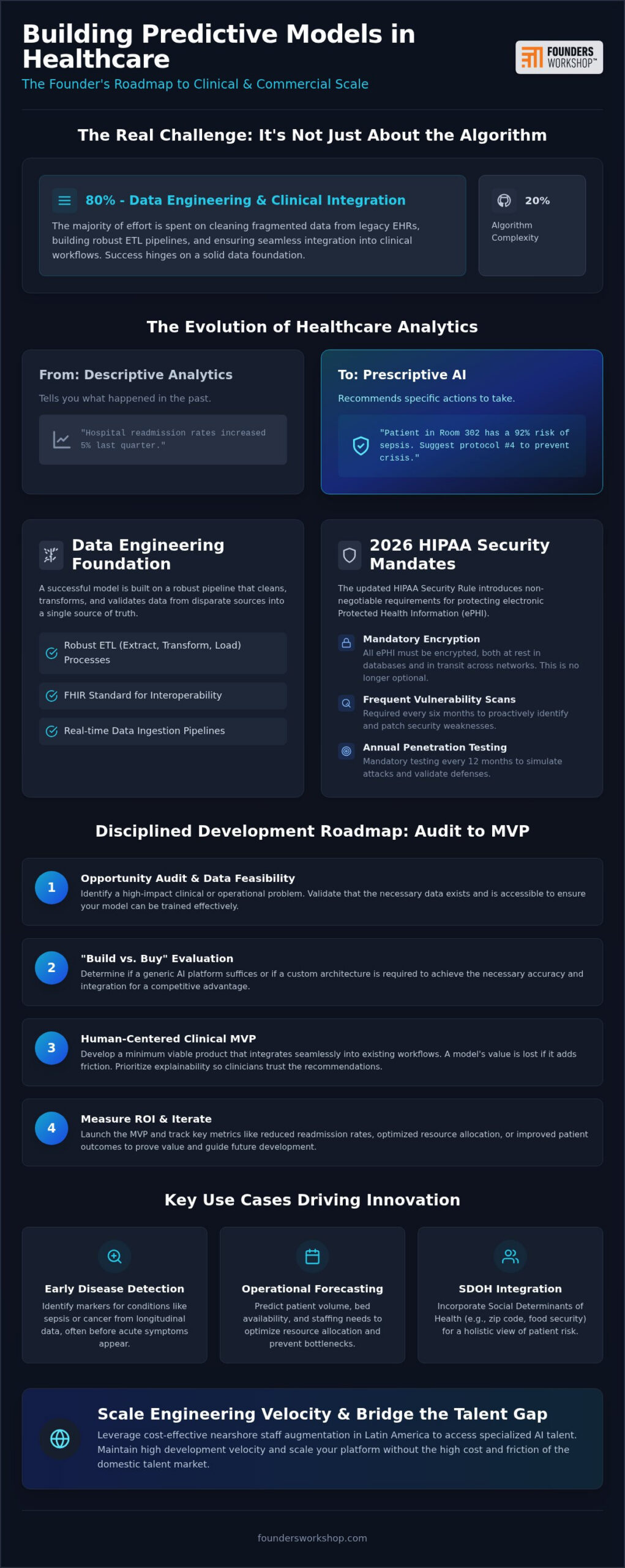
The Development Roadmap: From Data Audit to Clinical MVP
Moving from a high-level strategy to a functional product requires a disciplined, phased approach. Building predictive models for healthcare is a complex undertaking where the cost of error is high, both clinically and financially. Without a structured roadmap, even the most sophisticated algorithm will fail to gain traction in a busy hospital environment. Success depends on a methodology that prioritizes clinical validation and data integrity over technical novelty.
- Phase 1: Opportunity Audit: We begin by identifying high-impact clinical or business gaps. This isn’t about what AI can do, but where it can solve a specific friction point, such as reducing surgical cancellations or predicting patient no-shows.
- Phase 2: Feasibility and Data Discovery: This phase involves assessing the quality of your historical records. We determine if the “dirty data” identified earlier in your pipeline can be normalized and if you have a sufficient volume of records to train a reliable model.
- Phase 3: The Lean MVP: Focus on building a single, high-value predictive feature. This allows for early validation without over-extending your engineering budget.
- Phase 4: Clinical Integration: Designing the “Human-in-the-loop” interface ensures that the model acts as a co-pilot. The goal is to augment the clinician’s judgment, not replace it.
- Phase 5: Continuous Learning: Models decay as clinical practices evolve. You must implement automated feedback loops to retrain your models based on real-world outcomes and new data patterns.
Designing for Clinician Adoption
Clinicians are already overwhelmed by “click fatigue” and information overload. For your model to succeed, it must provide actionable recommendations rather than just raw probability scores. Dashboards should be intuitive and integrated directly into the existing EHR view. An iterative MVP approach reduces risk in healthcare AI projects by allowing for the validation of core clinical assumptions before a full-scale engineering commitment is made.
Avoiding Common Pitfalls
One of the most frequent mistakes is over-engineering the model before validating the data source. If your input data is inconsistent, a more complex algorithm won’t fix the output. You must also account for the “Cold Start” problem; your software needs a plan for how it will function in new clinical environments that lack deep historical records. Finally, never neglect the legal implications of automated decision-making. Ensure your team understands the liability frameworks surrounding AI-driven clinical support. If you’re ready to transition from strategy to development, our team can help you build a high-velocity Startup MVP that prioritizes clinician trust.
Scaling Healthcare Innovation with Nearshore Engineering Teams
Finding specialized AI engineers within the U.S. has become a significant bottleneck for growth. The domestic market is saturated and expensive; a senior U.S. based engineer can command $150,000 to $180,000 annually. This scarcity often stalls projects just as they need to scale. Building predictive models for healthcare requires a rare combination of machine learning expertise and a deep understanding of clinical compliance. If your internal team is already stretched thin, adding domestic headcount may not be the most sustainable path forward for your engineering budget.
Nearshore staff augmentation in Latin America has emerged as the strategic choice for founders who need to move fast without sacrificing quality. By leveraging talent in similar timezones, you maintain high engineering velocity through real-time collaboration. In 2026, senior engineers in Latin America typically cost between $50 and $90 per hour. This allows companies to save 40-60% on talent-related expenses compared to domestic hiring. This isn’t just about reducing costs; it’s about accessing a massive pool of senior engineers who are already experienced in US-compliant healthcare environments and ready to contribute on day one.
Staff Augmentation vs. Managed Teams
You have two primary paths for scaling your engineering capacity. Embedding experts directly into your existing squad allows for tighter alignment on proprietary logic and faster knowledge transfer. Alternatively, managed teams provide a turnkey solution for specific deliverables, such as a new predictive module or a data pipeline upgrade. Both models benefit from the strong cultural and language alignment found in Latin American tech hubs. It ensures that complex clinical requirements and strict HIPAA protocols don’t get lost in translation during the development of your predictive healthcare software.
Founders Workshop: Your Partner in Healthcare Transformation
With 30+ years of executive leadership, Founders Workshop understands that technology is a tool for business outcomes, not an end in itself. We bridge the gap between high-level U.S. strategy and technical execution in Latin America. Our focus remains on human-centered results, especially when building predictive models for healthcare that clinicians actually trust and adopt. We specialize in legacy software modernization, AI strategy, and system integrations, providing a steady hand as you navigate the complexities of 2026 regulations. We are committed to removing technical friction so you can focus on scaling your business and improving patient lives. Schedule a Consultation to Scale Your Healthcare Platform to see how we can accelerate your roadmap and drive long-term ROI.
Securing Your Clinical Competitive Advantage
Success in the 2026 landscape requires more than just a functional algorithm. It demands a commitment to data integrity and a deep understanding of how to integrate foresight directly into the clinician’s hand. By focusing on a compliance-first foundation and choosing a custom architecture over generic tools, you ensure your platform remains scalable and proprietary. Building predictive models for healthcare is a disciplined journey that transforms legacy records into a proactive engine for patient safety and business growth.
Founders Workshop offers the steady hand you need to navigate this transition. With 30+ years of software leadership and specialized healthcare technology expertise, we bridge the gap between complex AI strategy and pragmatic execution. Our top-tier nearshore talent works in your timezone to maintain high engineering velocity while removing technical friction. Ready to transform your healthcare data into foresight? Partner with Founders Workshop for custom AI development. It’s time to turn your strategic vision into a clinical reality that delivers lasting value.
Frequently Asked Questions
What is the difference between predictive analytics and machine learning in healthcare?
Predictive analytics is the strategic business outcome, while machine learning is the technical engine that makes it possible. Predictive analytics uses statistical techniques to forecast future events. In a clinical setting, machine learning allows these models to improve automatically as they ingest more patient data. This shift from static rules to dynamic learning is what enables the prescriptive “how to fix it” approach required in 2026.
How much historical data do I need to build a reliable predictive model?
The volume depends on the complexity of the clinical outcome, but you typically need several thousand high-quality records to achieve statistical significance. For building predictive models for healthcare, data quality is more important than sheer quantity. If your historical records are fragmented or “dirty,” you’ll need a larger sample size to train a model that clinicians can trust for real-world decision support.
Is custom predictive software compliant with HIPAA regulations?
Yes, custom software is fully compliant if you implement a compliance-first architecture from the first day of development. This includes mandatory encryption for data at rest and in transit, multi-factor authentication, and strict access controls. By building your own technical stack, you have total control over data anonymization and audit logs. This ensures you meet the prescriptive 2026 HIPAA Security Rule updates without relying on third-party limitations. To explore specialized privacy solutions, you can visit Wodan AI to learn about their zero-trust platform that runs models on data that remains mathematically encrypted.
How long does it take to launch a healthcare predictive MVP?
A focused healthcare predictive MVP typically takes between three to six months to develop and launch. This timeline includes the initial data audit, ETL pipeline construction, and the development of a human-centered interface. Starting with a lean feature set allows you to validate clinical assumptions and gather user feedback. It reduces your initial engineering spend while providing a clear path toward a full-scale product launch.
What are the biggest risks when building predictive models for patient care?
The primary risks are data bias and a lack of clinician adoption. If your training data doesn’t represent your actual patient population, the model’s forecasts will be inaccurate. Additionally, if the model acts as a “black box” that clinicians don’t understand, they won’t use it. Managing these risks requires building predictive models for healthcare that prioritize transparency, explainability, and seamless integration into existing clinical workflows.
Can predictive models be integrated into my existing EHR system?
Integration is highly recommended and usually achieved through FHIR standards and modern APIs. Predictive tools must live where clinicians already work to be effective. By utilizing system integrations, you can pull real-time data from legacy EHRs and push actionable insights back into the provider’s dashboard. This approach ensures that your AI acts as a co-pilot rather than a disruptive, standalone application.
What is Software as a Medical Device (SaMD) and does it apply to my model?
Software as a Medical Device (SaMD) refers to software intended for medical purposes that functions without being part of a hardware device. If your model provides specific diagnosis or treatment recommendations, it likely falls under FDA SaMD regulations. You must verify your specific use case against the 2026 FDA guidelines. This determines the level of clinical evidence and regulatory oversight your product will require before it can be marketed.
How do nearshore teams handle the security of sensitive healthcare data?
Nearshore teams maintain security through SOC 2 compliance, secure VPNs, and strict adherence to U.S. data privacy laws. Because these teams operate in your timezone, you can maintain real-time oversight of their security protocols. They use the same enterprise-grade tools as domestic teams. This ensures that sensitive patient data is handled with the highest level of accountability and technical discipline throughout the entire development lifecycle.