
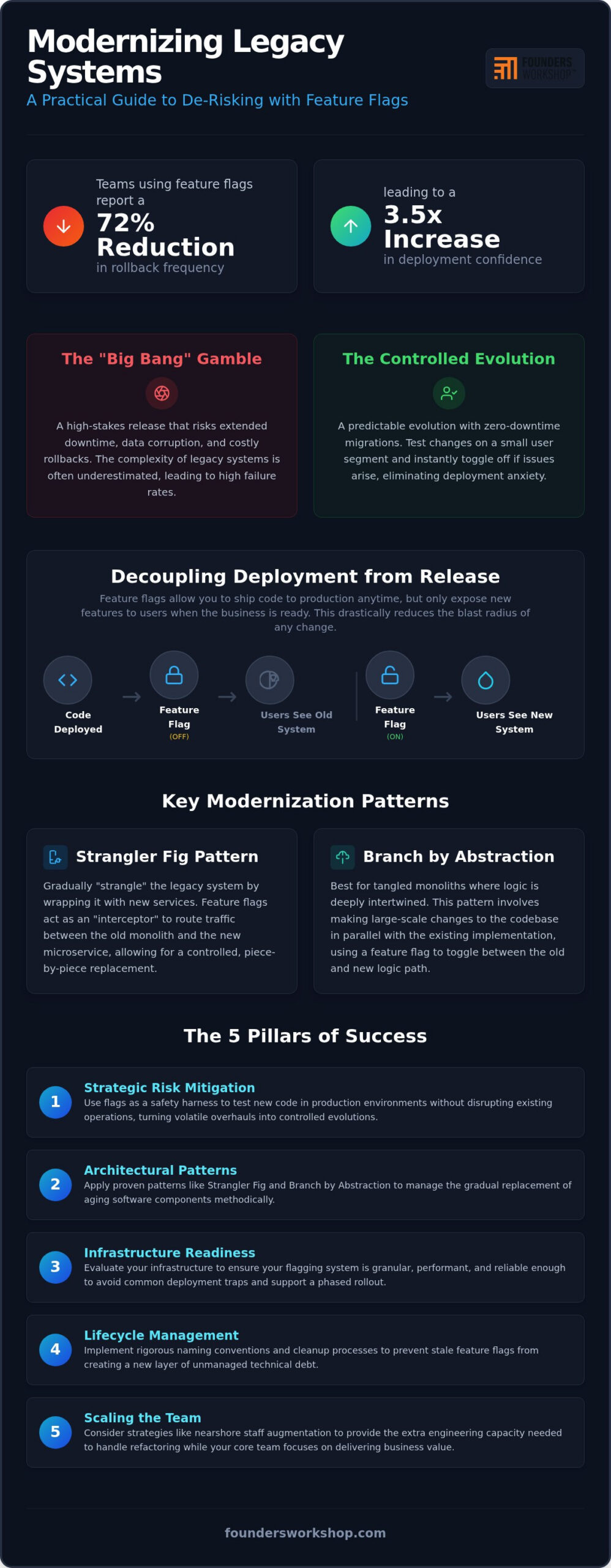
Did you know that teams utilizing feature flags report a 72% reduction in rollback frequency and a 3.5x increase in deployment confidence? For many engineering leaders, the prospect of touching a decades-old codebase feels less like standard development and more like a high-stakes rescue mission. You likely recognize the paralyzing anxiety that comes with “big bang” deployments, where one minor oversight could freeze operations or compromise data integrity. We agree that the traditional approach to updates is a risk your business shouldn’t have to take.
Implementing feature flags for legacy system modernization allows you to move beyond this fear. It turns a volatile overhaul into a controlled, predictable evolution where you can test changes in production without impacting the broader user base. This article provides a practical implementation checklist to help you build a phased rollout strategy. You’ll learn how to use these tools as a safety harness to achieve zero-downtime migrations and significantly improve your engineering velocity while retiring technical debt.
Key Takeaways
- Understand how feature flags act as a strategic risk-mitigation framework, allowing you to test new code in production environments without disrupting existing operations.
- Learn to apply architectural patterns like Strangler Fig and Branch by Abstraction to manage the gradual replacement of aging software components.
- Use our 5-pillar checklist to evaluate infrastructure readiness and ensure your feature flags for legacy system modernization are granular enough to avoid common deployment traps.
- Implement rigorous naming conventions and lifecycle management to prevent your modernization efforts from creating a new layer of unmanaged technical debt.
- Discover how nearshore staff augmentation provides the additional engineering capacity needed to handle refactoring while your core team focuses on delivering business value.
The Role of Feature Flags in De-Risking Legacy Modernization
“Big Bang” migrations in enterprise environments are notorious for high failure rates. When you attempt to swap out an entire core system at once, you’re essentially betting the company’s operational stability on a single release. It’s a high-stakes gamble that often leads to extended downtime, data corruption, or costly rollbacks. In my experience, these massive failures occur because the complexity of legacy systems is often underestimated until the moment of truth.
Think of feature flags for legacy system modernization as a safety harness for your code. Just as a climber wouldn’t scale a cliff without protection, your engineers shouldn’t refactor critical systems without a way to instantly retreat. A feature flag is a simple conditional statement that allows you to wrap new logic and toggle it on or off at runtime without redeploying. This mechanism enables “Dark Launching” in older architectures. You can deploy the new modernized code into production, let it run silently in the background, and observe how it interacts with the legacy database. If it performs as expected, you dial up the traffic. If it stumbles, you toggle it off immediately.
Breaking the Modernization Deadlock
The primary benefit of this approach is decoupling deployment from release. Your team can ship code to production every day, but the users don’t see the changes until the business is ready. This approach drastically reduces the blast radius of any single change. If a new service fails, it only affects the small percentage of traffic you’ve toggled on, rather than the entire user base.
Consider a scenario involving a legacy database migration. By using a kill switch, if the new database starts hitting latency thresholds that threaten the user experience, the system automatically reverts to the legacy source. This prevents a total system meltdown. It gives your team the breathing room to investigate the root cause without the pressure of a frantic midnight rollback. This shift in strategy moves the team from a paralyzing fear of breaking things to a disciplined confidence in toggling features.
Strategic Alignment: Business Goals vs. Technical Debt
Modernization shouldn’t mean freezing feature development. If you stop shipping new value for six months to fix the plumbing, you will lose market share. Feature flags allow you to maintain product velocity while refactoring the core. You can continue delivering the updates your customers demand while your engineering team systematically replaces aging components in the background.
For non-technical founders and executives, these strategies are not just developer tools. They are insurance policies for your revenue. They link technical execution directly to business KPIs like uptime and user retention. By implementing feature flags for legacy system modernization, you ensure that the path to a modern architecture is a steady, predictable climb rather than a dangerous leap of faith. This alignment ensures that technical debt is retired without sacrificing the growth of the business.
Modernization Patterns: Strangler Fig vs. Branch by Abstraction
Choosing the right pattern is the first real hurdle. While the Strangler Fig approach works well for systems with clear boundaries, Branch by Abstraction is often necessary for tangled monoliths where logic is deeply intertwined. In both cases, the success of the transition relies on your ability to route traffic between the old and the new. Using feature flags for legacy system modernization provides the granular control needed to act as this router, ensuring that you can pivot between architectures without a single second of downtime.
Implementing the Strangler Fig with Flags
The Strangler Fig pattern involves “wrapping” your legacy system with new services. You start by identifying a specific bounded context, such as a payment module or a user profile service, and rebuilding it externally. To make this work, you implement an “interceptor” layer. This layer uses feature flags to decide whether an incoming request should be handled by the old monolith or the new microservice.
This approach allows for a gradual, controlled rollout. You don’t have to switch everyone at once. Instead, you can start with a 1% rollout to the new system. If the telemetry shows increased latency or error rates, the flag acts as a kill switch. This methodical migration ensures that the legacy system is slowly “strangled” until it can be safely decommissioned. If your team is already stretched thin maintaining current operations, leveraging internal software development experts can help build these interceptor layers while your core engineers focus on the roadmap.
Branch by Abstraction for Deep Refactoring
When the code is too messy to wrap from the outside, Branch by Abstraction is the better path. This pattern involves creating an abstraction layer directly within the legacy codebase. Your existing code calls this abstraction, which then delegates the work to either the legacy implementation or the new, modernized logic. Feature flags live inside this abstraction, allowing you to swap implementations at the flip of a switch.
One of the most powerful techniques here is “Shadowing.” You can use flags to run both the old and new logic in parallel for every request. The system returns the result from the legacy code to the user but compares it against the result from the new code in the background. This ensures parity and data integrity before the new system ever goes live. It’s a pragmatic way to prove that your modernization is working exactly as intended without risking the production environment. Feature flags for legacy system modernization transform this deep refactoring from a “guess and check” process into a data-driven engineering exercise.
The Legacy System Feature Flag Checklist: 5 Pillars of Success
Successful modernization requires more than just technical skill; it demands a structured framework for managing change. While the patterns discussed previously provide the architectural blueprint, this checklist serves as your operational guide. Implementing feature flags for legacy system modernization effectively means addressing these five pillars to ensure your transition is as smooth as possible.
- Pillar 1: Infrastructure Readiness. Verify if your legacy CI/CD pipeline is flag-aware. Many older systems rely on rigid deployment cycles that conflict with the dynamic nature of toggles. Your infrastructure must support real-time configuration updates without triggering a full system reboot.
- Pillar 2: Flag Granularity. Avoid the “One Flag to Rule Them All” trap. Wrapping massive chunks of logic in a single toggle creates a binary risk. Instead, use granular flags that allow you to isolate specific functions or database calls.
- Pillar 3: Observability. You must monitor the legacy system’s pulse during every toggle. If you can’t see the impact of a change immediately, the flag loses its value as a safety mechanism.
- Pillar 4: Testing Strategy. Validating the “Off” state is just as important as testing the new code. You must ensure that the legacy environment remains stable and performant when the new logic is disabled.
- Pillar 5: Cleanup Protocol. Establish a strategy for removing modernization flags once they’ve served their purpose. Temporary toggles that linger indefinitely become a new form of unmanaged technical debt.
Ensuring Observability in Aging Systems
Mapping legacy logs to modern flagging dashboards is a non-negotiable step. Older systems often produce fragmented data that doesn’t easily correlate with new microservices. You need a unified view where error rates and latency metrics are tied directly to flag states. This allows for automated rollbacks: if a flag is toggled on and errors spike beyond a set threshold, the system should automatically revert to the legacy path. Observability is the prerequisite for safe toggling.
The Testing Checklist for Toggled Code
Testing in a legacy environment requires a dual-track approach. First, perform unit tests on the legacy code both with and without the flag active to prevent regressions. Second, integration testing must focus on the “interceptor” layer to ensure traffic routes correctly between architectures. By leveraging feature flags vs a/b testing logic, you can execute canary releases. This allows you to expose the new system to a small subset of users, gathering real-world performance data before committing to a full-scale rollout.
Engineering Teams Feature Flags Best Practices: Managing the Mess
While flags provide the safety harness needed for modernization, they can quickly become a “Tangle of Toggles” if left unmanaged. Without strict operational discipline, you risk replacing old technical debt with a new layer of configuration complexity. Managing feature flags for legacy system modernization requires a balance between engineering freedom and rigorous governance. It’s about ensuring that every toggle has a clear purpose, a defined owner, and a scheduled expiration date.
Naming conventions are your first line of defense. A flag named new_logic is useless in a system with twenty years of history. Instead, use searchable, descriptive names that indicate the scope and version, such as MODERNIZATION_AUTH_SERVICE_V2. This clarity allows any developer to understand the flag’s intent without digging through documentation. You must also distinguish between short-lived migration flags, which should disappear once parity is achieved, and long-lived operational toggles used for permanent circuit breaking. Regular “Flag Debt” audits ensure that your legacy environment remains clean and navigable.
Governance and Lifecycle Management
Ownership is the cornerstone of a successful flagging strategy. In a legacy environment, the team responsible for refactoring a specific module must own the associated toggles. They are best positioned to decide when a feature is stable enough to remain “on” permanently. Integrating flag cleanup into your broader refactoring legacy code strategies ensures that removing old toggles is a standard part of the “definition of done.” If your internal team is overwhelmed by the dual burden of maintenance and modernization, leveraging nearshore staff augmentation can provide the dedicated capacity needed to handle these cleanup tasks effectively.
Human-Centered Engineering Velocity
Beyond the technical benefits, feature flags significantly impact team morale and engineering velocity. Complex migrations in aging systems are often stressful for developers who fear breaking critical functionality. Flags act as a psychological safety net. They enable junior developers to contribute to legacy codebases safely because the blast radius of their changes is strictly controlled. This safety leads to a 3.5x increase in deployment confidence, allowing your team to move away from stressful, infrequent releases toward a steady rhythm of continuous improvement. When engineers feel empowered to ship code without the looming threat of a system-wide failure, productivity and retention naturally improve.
Scaling the Modernization: The Nearshore Advantage
Modernizing a legacy system is rarely a resource-neutral endeavor. Most organizations eventually face the “Dual Burden” problem. Your internal team is already fully committed to maintaining the existing system and supporting current customers. Asking them to lead a complex refactoring project often leads to burnout or stalled roadmaps. You can’t rebuild the engine while the car is driving at full speed without extra hands on deck.
This is where nearshore staff augmentation becomes a strategic lever. By integrating developers from Latin America, you gain a “modernization engine” that operates in your own timezone. This alignment is critical when using feature flags for legacy system modernization because toggling features and monitoring production requires real-time collaboration. You don’t want to wait twelve hours for a response when a flag needs to be adjusted or a canary release requires immediate analysis. Nearshore teams allow for the synchronous communication that high-stakes migrations demand.
The challenge isn’t just capacity; it’s the specific skill set. You need engineers who can navigate the idiosyncrasies of Java 6 or older C# code while simultaneously building modern React or Go services. Nearshore teams often bridge this gap, offering the technical versatility required for the “interceptor” layers and abstraction branches discussed earlier. At Founders Workshop, we bring over 30 years of leadership experience to these transitions. We don’t just provide developers; we offer a seasoned guide to help you navigate the strategic complexities of legacy evolution.
Bridging the Talent Gap in Legacy Tech
Finding the right talent is often the biggest hurdle in modernization. By scaling capacity through nearshore partners, you avoid the high overhead and long lead times of US-based hiring. These teams integrate directly into your flagging workflow, providing the extra hands needed to manage the “Tangle of Toggles” and ensure that flag cleanup remains a priority. This allows your core team to stay focused on high-level architecture and new business value while the nearshore team handles the heavy lifting of refactoring.
Next Steps: Your Modernization Roadmap
Moving forward requires a methodical approach. Start by conducting a comprehensive legacy system audit to identify hidden dependencies and technical debt. From there, select your first “Flag-Ready” module. This should be a low-risk, high-value component where you can prove the methodology and build team confidence. If you’re ready to accelerate your timeline and reduce deployment risk, you can scale your modernization effort with Founders Workshop to ensure your transition is both safe and sustainable.
Building a Resilient Path to Modern Architecture
Modernizing a legacy system doesn’t have to be a high-stakes gamble. By adopting a disciplined approach to feature flags for legacy system modernization, you transform a volatile overhaul into a series of controlled, data-driven steps. Whether you utilize the Strangler Fig pattern or Branch by Abstraction, the goal remains the same: protecting your operational integrity while retiring technical debt. Success depends on rigorous governance, clear observability, and the engineering capacity to manage the dual burden of maintenance and evolution.
At Founders Workshop, we bring 30+ years of software leadership and specialized expertise in legacy-to-modern transitions. Our dedicated nearshore teams operate in US timezones, acting as the modernization engine your business needs to scale safely. If you’re ready to move beyond the fear of “big bang” deployments, it’s time to scale your engineering team and modernize your legacy systems today. You have the tools and the framework to build a more sustainable future. Now is the time to take the first step toward a frictionless architecture.
Frequently Asked Questions
Do feature flags add significant technical debt to legacy systems?
Feature flags act as temporary technical debt to facilitate a safer transition. While they add conditional logic to your codebase, this is a strategic trade-off. By following the cleanup protocols mentioned earlier, you ensure these toggles are removed once the modernization is complete. This discipline prevents them from becoming a permanent burden on your engineering team or complicating future maintenance.
What is the best way to handle data migrations when using feature flags?
Data migrations are best handled through a dual-write strategy controlled by toggles. You configure the system to write data to both the legacy and modern databases simultaneously while still reading from the old source. Once you verify data parity through shadowing, you flip the flag to begin reading from the new database. This approach ensures zero-downtime transitions and maintains data integrity throughout the process.
Can feature flags be used in monolithic legacy applications?
Feature flags are highly effective in monolithic architectures when applied through the Branch by Abstraction pattern. You don’t need a microservices environment to benefit from these tools. By creating an internal abstraction layer, you can route logic between legacy functions and new modules. This allows you to modernize specific sections of a monolith without having to decouple the entire system first.
How do I ensure performance doesn’t degrade when adding flag logic to old code?
Performance degradation is avoided by utilizing local flag evaluation and simple conditional logic. You should never make an external network request to a flag provider within a critical code path. Most modern flagging tools provide SDKs that cache flag states locally. This ensures that the toggle check adds only a few microseconds of latency, which is negligible even in aging, resource-constrained legacy environments.
What tools are recommended for managing feature flags during modernization?
Several tools offer robust support for feature flags for legacy system modernization, ranging from open-source to enterprise solutions. ConfigCat offers flat usage-based pricing, while Unleash and GrowthBook provide self-hosted options that are ideal for sensitive legacy data. For those seeking a vendor-agnostic approach, OpenFeature provides a standardized API to avoid long-term vendor lock-in as you scale your modern architecture.
How do I convince non-technical stakeholders that feature flags are worth the effort?
Convince stakeholders by framing feature flags for legacy system modernization as a revenue insurance policy. Explain that flags reduce the 72% rollback frequency typically seen in complex deployments. Focus on the peace of mind that comes from knowing any failure can be reversed in seconds without a full system outage. This strategic alignment ensures that technical refactoring directly supports business continuity and user retention.