

What if the “minimum” in your healthcare MVP is actually your biggest liability? In the complex world of healthcare mvp development, the urge to launch fast often leads to cutting corners on security, yet a single data breach can end a company before it begins. You’re likely balancing the need to impress investors with the constant fear of HIPAA violations or building a product that clinicians simply refuse to use. It’s a high-stakes environment where technical debt isn’t just a nuisance; it’s a structural failure that prevents future growth.
We understand that you need a path that guarantees both compliance and user adoption without exhausting your capital. This guide provides a strategic framework that prioritizes clinical validation and scalable architecture. We’ll walk through a proven roadmap from initial idea to a market-ready product, demonstrating how a nearshore development model can bridge the gap between high-level strategy and sustainable execution. By the end, you’ll have the clarity needed to build a product that earns trust, satisfies regulators, and scales effortlessly as your patient base grows.
Key Takeaways
- Shift your mindset from traditional SaaS tactics to a model where healthcare mvp development prioritizes clinical safety and regulatory alignment from day one.
- Learn why engineering security into your foundation is five times more cost-effective than trying to retrofit compliance after your launch.
- Master the “One Problem, One User” rule to eliminate feature creep and focus on the high-risk unknowns that matter most to investors.
- Build a scalable software architecture that supports rapid patient growth without creating technical debt that stalls your long-term vision.
- Gain a framework for evaluating development partners based on their hands-on experience with EHR integrations and complex interoperability standards.
Why Healthcare MVP Development Demands a Different Strategic Playbook
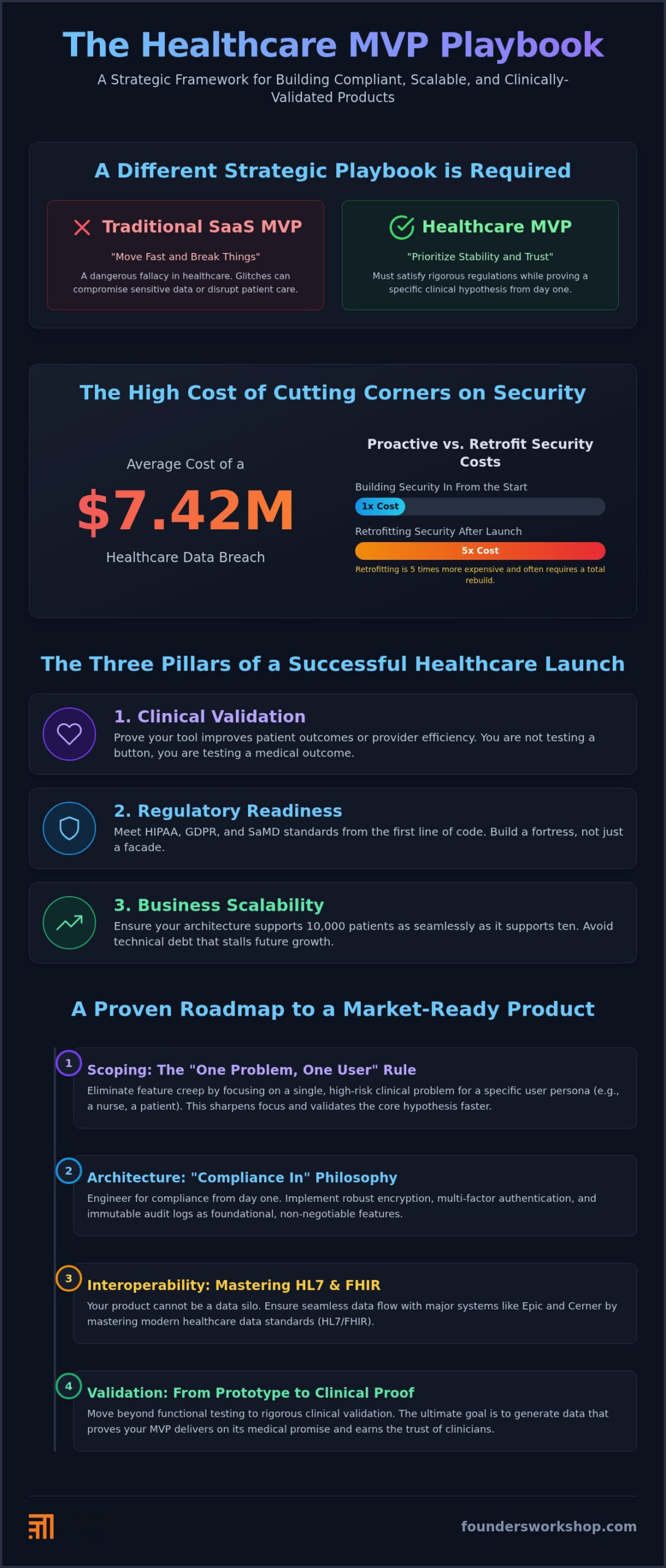
Traditional software development often relies on the Minimum Viable Product (MVP) model to test market interest with the smallest possible feature set. In a clinical setting, this definition must evolve. A healthcare MVP is a functional version of a product that satisfies rigorous regulatory requirements while proving a specific clinical hypothesis. You aren’t just testing a button; you’re testing a medical outcome. If the product fails to deliver, the cost isn’t just a lost user. It’s a loss of trust from clinicians and patients alike.
The “Move Fast and Break Things” mantra is a dangerous fallacy here. While a social media app can afford a glitchy login, healthcare mvp development requires a foundation that prioritizes stability. Breaking things in healthcare means compromising sensitive data or disrupting a care plan. We’ve seen that engineering trust through security and compliance must be treated as a primary feature, not a post-launch afterthought. Retrofitting these elements later is often impossible without a total rebuild.
The Three Pillars of a Successful Healthcare Launch
To secure investor confidence and user adoption, your MVP must stand on three specific pillars. First is clinical validation. You must prove the tool actually improves patient outcomes or provider efficiency. Second is regulatory readiness. This means meeting HIPAA, GDPR, and SaMD standards from the very first line of code. Finally, you need business scalability. Your architecture should support 10,000 patients as seamlessly as it supports ten, ensuring that technical debt doesn’t stall your growth when you hit the market.
Human-Centered Design in a Clinical Context
Software is only as good as the person using it. Clinician burnout is at an all-time high, so your UI/UX must focus on removing clicks rather than adding them. Empathy is a technical requirement in medical engineering. If a patient finds your interface confusing during a high-stress health event, they will abandon the tool. Reducing this friction isn’t just about aesthetics; it’s about ensuring high engagement rates that lead to better health data and improved clinical results. To help your team master the nuances of user behavior in these environments, find out more about specialized UX research training. As we look toward 2026, the bar for “minimum” includes sophisticated AI that feels intuitive, not intrusive.
Engineering for Compliance: HIPAA, Security, and Interoperability
Compliance isn’t a checkbox; it’s your product’s immune system. If you treat security as an afterthought, you risk the average $7.42M cost associated with a healthcare data leak. Retrofitting security measures after your launch costs five times more than building them correctly from the start. This is why successful healthcare mvp development begins with a “Compliance In” philosophy. It ensures that every architectural decision protects patient privacy and maintains data integrity from the first line of code. It’s about building a fortress, not just a facade.
Foundational security requires more than just a strong password. You must implement robust encryption at rest and in transit, multi-factor authentication, and immutable audit logs. These aren’t just technical preferences. They are core requirements of the HIPAA Security Rule standards. When these protocols are baked into your core architecture, you gain the peace of mind needed to focus on clinical outcomes. If you’re unsure where your current architecture stands, a consultation with a seasoned partner like Founders Workshop can help identify hidden vulnerabilities before they become liabilities.
EHR Integration and Modern Standards
Interoperability is the lifeblood of the modern medical ecosystem. Your MVP cannot exist in a vacuum; it must speak the language of the broader healthcare world. This means mastering HL7 and FHIR (Fast Healthcare Interoperability Resources) to ensure data flows smoothly between systems. Connecting to major platforms like Epic and Cerner is often the biggest hurdle for new founders. Utilizing specialized system integration services ensures your data remains liquid and accessible without breaking your development budget. This connectivity transforms a standalone tool into an essential part of a provider’s daily workflow.
Navigating SaMD (Software as a Medical Device)
Not every health app is a medical device, but the line is thinner than many realize. If your MVP provides clinical decision support or diagnostic features, it likely falls under FDA oversight. Determining this classification early is vital for your timeline. You’ll need meticulous documentation for every algorithm and data flow to satisfy regulatory audits. As machine learning becomes a standard feature, implementing AI strategy consulting helps manage algorithmic transparency. This ensures your tool remains compliant and trustworthy as regulatory shifts continue through 2026.
Scoping Your Healthcare MVP: Clinical Utility vs. Feature Creep
Scoping is the stage where visionary ideas meet the cold reality of development budgets. For many founders, the temptation to build a comprehensive platform is overwhelming. However, successful healthcare mvp development relies on the “One Problem, One User” rule. This means ruthlessly prioritizing a single clinical challenge for a specific user persona. By narrowing your focus, you accelerate your timeline and reduce the risk of building features that nobody actually needs. Launching a focused tool that solves one problem perfectly is always better than launching a broad tool that solves five problems poorly.
You must also distinguish between technical feasibility and market fit. If your core value proposition relies on an unproven algorithm, that’s a high-risk technical unknown. If the tech is standard but you aren’t sure doctors will use it, that’s a market fit unknown. Addressing these high-risk areas early is what secures investor trust. In the 2026 landscape, AI is no longer a future luxury; it’s a baseline expectation. However, you should distinguish between basic automation, which provides immediate ROI by reducing manual tasks, and complex predictive analytics. Unless prediction is your primary clinical hypothesis, start with automation to prove your workflow first during healthcare mvp development.
Must-Have Features for Modern Healthcare Apps
While you should be lean, certain features are now non-negotiable for clinical adoption. Your MVP must include secure, HIPAA-compliant messaging and telehealth capabilities to facilitate immediate provider-patient communication. Additionally, you need a way to ingest and visualize patient-generated health data (PGHD) to provide clinicians with actionable insights. Finally, automated reporting for compliance and clinical oversight ensures that your tool fits seamlessly into existing regulatory workflows without adding to a clinician’s administrative burden.
What to Save for Version 2.0
Distinguishing between “essential” and “eventual” is the hallmark of a seasoned founder. Pushing non-core features to a later phase preserves your capital and keeps your team focused on clinical validation. Consider deferring these complex elements to your post-launch roadmap:
- Complex billing integrations: Start with simple payment processing or manual invoicing before building full revenue cycle management.
- Advanced AI-driven diagnostics: Use robust, rule-based logic to prove the clinical pathway before moving to deep learning models.
- Broad EHR support: Focus on a single-point integration with one major provider rather than trying to support every system at once.
Balancing investor demands for a “complete” product with a clinician’s need for simplicity is difficult. By focusing on high-impact, low-friction features, you create a product that gains immediate traction while leaving room for strategic scaling. This disciplined approach ensures that your version 1.0 is a stable foundation rather than a cluttered experiment.
The Development Lifecycle: From Prototype to Clinical Validation
Successful healthcare mvp development requires a methodical transition from a strategic concept to a clinically validated tool. This journey begins with Discovery and Strategy, where you align technical execution with a broader framework for strategic MVP development. You aren’t just building features; you’re building a business case. This phase ensures every line of code serves a validated clinical need while keeping your long-term roadmap in sight. Skipping this alignment often leads to expensive pivots later in the cycle.
Once the strategy is set, focus shifts to Architecture and UI/UX Design. This is where you build the blueprint for a scalable software ecosystem. In healthcare, your architecture must be modular enough to handle future EHR integrations yet robust enough to pass rigorous security audits. We prioritize iterative development using Agile methodologies, allowing teams to pivot based on early user feedback. However, unlike traditional SaaS, healthcare requires an additional layer of rigorous QA. This includes penetration testing and clinical simulations to ensure the product performs safely under real-world pressure.
The Nearshore Advantage: Quality Meets Velocity
Operational efficiency in healthcare mvp development often hinges on your choice of engineering talent. Timezone alignment is critical for healthcare engineering velocity. If your team is ten hours ahead, a critical security bug found during the US workday remains unaddressed until the next morning. Leveraging nearshore staff augmentation allows for real-time collaboration with specialized talent in Latin America. This model provides the same high-quality output as US-based hires but at a more sustainable cost, allowing you to extend your runway without sacrificing the technical sophistication required for medical-grade software.
Clinical Beta Testing and Validation
The final hurdle is proving your tool works in a live clinical environment. Recruiting early-adopter clinicians for real-world feedback is essential for measuring “Time to Value” for both patients and providers. If a clinician can’t see the benefit within the first three minutes of use, adoption will fail. During this phase, you might identify technical friction that requires refactoring legacy code strategies to maintain performance as you scale. If you’re ready to move from a prototype to a market-ready product, Founders Workshop can provide the seasoned engineering leadership needed to navigate this complex lifecycle.
Choosing a Healthcare MVP Development Partner
Selecting a partner for healthcare mvp development is one of the most consequential decisions a founder will make. Many agencies can write functional code, but few understand the strategic nuances of a clinical environment. You need a partner who acts as a technical co-founder. This means finding a team that understands that a product’s success is measured by clinical validation and investor trust, not just a successful deployment. A vendor delivers a list of features, but a strategic partner delivers a business outcome.
Evaluating domain expertise is your first line of defense against future failure. You don’t want to be the “test case” for a team’s first medical project. If a partner hasn’t navigated the complexities of patient privacy and data liquidity before, the resulting technical debt will likely lead to the “rebuild risk.” This is the scenario where your MVP is so structurally flawed that it must be scrapped entirely to support real-world growth. A seasoned partner identifies these architectural traps before they are even built, saving you years of rework and millions in lost capital.
Transparency and communication form the foundation of a long-term technical partnership. You should expect clear, honest dialogue regarding architectural trade-offs and regulatory hurdles. A veteran guide won’t just say “yes” to every feature request. Instead, they’ll push back when a feature risks your compliance posture or extends your timeline without adding immediate clinical value. This discipline is what keeps your project on track and your budget focused on high-ROI activities.
Key Questions to Ask Your Potential Partner
- “How do you handle HIPAA compliance documentation and audits?” A partner should have a standardized process for maintaining the necessary audit logs and security documentation required by regulators.
- “What is your experience with FHIR/HL7 integrations?” Interoperability is non-negotiable in 2026. Your team must prove they can move data securely between disparate systems without friction.
- “Can you demonstrate a successful healthcare MVP that scaled to 10k+ users?” Growth introduces unique technical stresses. You need a team that has successfully managed the transition from a small pilot to a large-scale patient population.
The Founders Workshop Approach
At Founders Workshop, we bridge the gap between high-level strategy and technical execution. We combine 30 years of leadership experience with high-quality nearshore talent and modern AI strategy to build products that last. Our human-centered focus ensures that your technology aligns with your business growth and the practical needs of clinicians. We don’t just build apps; we engineer compliant, scalable ecosystems that secure trust and drive adoption. Launch your healthcare vision with Founders Workshop.
Engineering Your Clinical Future
The path to a successful launch is paved with disciplined engineering and strategic foresight. You’ve learned that compliance isn’t a hurdle but a foundation for trust, and that ruthlessly scoping for clinical utility is the only way to outpace the competition. By moving through a structured lifecycle from prototype to validation, you ensure your product is ready for the high stakes of a clinical environment. Successful healthcare mvp development isn’t just about the code; it’s about bridging the gap between a visionary idea and a scalable, compliant reality.
At Founders Workshop, we bring 30+ years of executive experience to every project. Our HIPAA and EHR integration specialists provide the technical depth you need, while our nearshore model offers the efficiency and US-based strategy required for rapid growth. We’re ready to help you navigate the complex regulatory landscape with a partner who understands your business as well as your technology. Build Your Healthcare MVP with Seasoned Experts and turn your clinical hypothesis into a market-leading reality. Your vision has the potential to transform patient care; let’s build the foundation it deserves.
Frequently Asked Questions
How much does healthcare MVP development cost in 2026?
The total investment depends on the complexity of your clinical logic and the scope of required integrations. A compliant product requires a significant commitment to security architecture and regulatory documentation. Factors like whether you leverage nearshore talent or US-based specialists will influence your final budget. We recommend focusing on a single, high-impact clinical problem to keep initial costs manageable while ensuring a scalable foundation for future growth.
How long does it take to build a HIPAA-compliant MVP?
Most healthcare products take several months to reach a launch-ready state, depending on the complexity of the clinical hypothesis. Building for compliance adds time for rigorous testing and documentation that traditional SaaS apps don’t require. A focused approach that prioritizes “must-have” features over “nice-to-have” additions helps you reach the market faster without compromising on safety or the regulatory standards required for clinical use.
Does my healthcare app need to be FDA approved?
Your app requires FDA approval if it functions as Software as a Medical Device (SaMD), such as providing diagnostic advice or clinical decision support. If your tool simply tracks wellness data or facilitates communication, it may not fall under FDA oversight. It’s critical to determine this classification early in the development process to ensure your documentation meets the specific requirements for regulated medical software and clinical validation.
What is the difference between a healthcare prototype and an MVP?
A prototype is a non-functional visualization used to test user flow and aesthetics with stakeholders. In contrast, healthcare mvp development results in a functional, compliant product that solves a real clinical problem for actual users. While a prototype helps you secure initial feedback, the MVP is what you use to gather clinical validation data and prove your business model to investors and early adopters.
Why is nearshore development better than offshore for healthcare?
Nearshore development offers timezone alignment, which is vital for the real-time collaboration required in complex medical engineering. Offshore teams often face significant communication delays that can stall critical security updates or bug fixes. Working with nearshore partners in similar timezones ensures that your engineering velocity remains high while maintaining the quality standards necessary for HIPAA-compliant software. This model provides a steady hand during complex technical executions.
Can I integrate my MVP with existing EHR systems like Epic?
Yes, you can integrate your tool with major EHR systems like Epic and Cerner using modern standards like FHIR and HL7. These integrations allow for seamless data exchange, ensuring that your tool fits into existing provider workflows. Successful healthcare mvp development often starts with a single-point integration to prove the data flow before scaling to a broader ecosystem of medical records systems and clinical platforms.
How do I ensure patient data security in a mobile app?
Protecting patient data in a mobile environment requires a multi-layered approach. You must implement end-to-end encryption for all data in transit and at rest, along with multi-factor authentication for user access. Additionally, ensuring that no sensitive health information is stored locally on the device helps mitigate risks if a phone is lost or stolen. Regular penetration testing is essential to identify and patch potential vulnerabilities before they become liabilities.
What are the most important features for a healthcare MVP?
The most critical features for a healthcare product focus on security, communication, and data utility. These include:
- HIPAA-compliant secure messaging and telehealth capabilities.
- Actionable visualization of patient-generated health data (PGHD).
- Automated reporting for clinical and regulatory oversight.
- Robust audit logs to track every data interaction for compliance.
Focusing on these core elements ensures your product provides immediate value to both patients and clinicians while maintaining a lean development profile.