

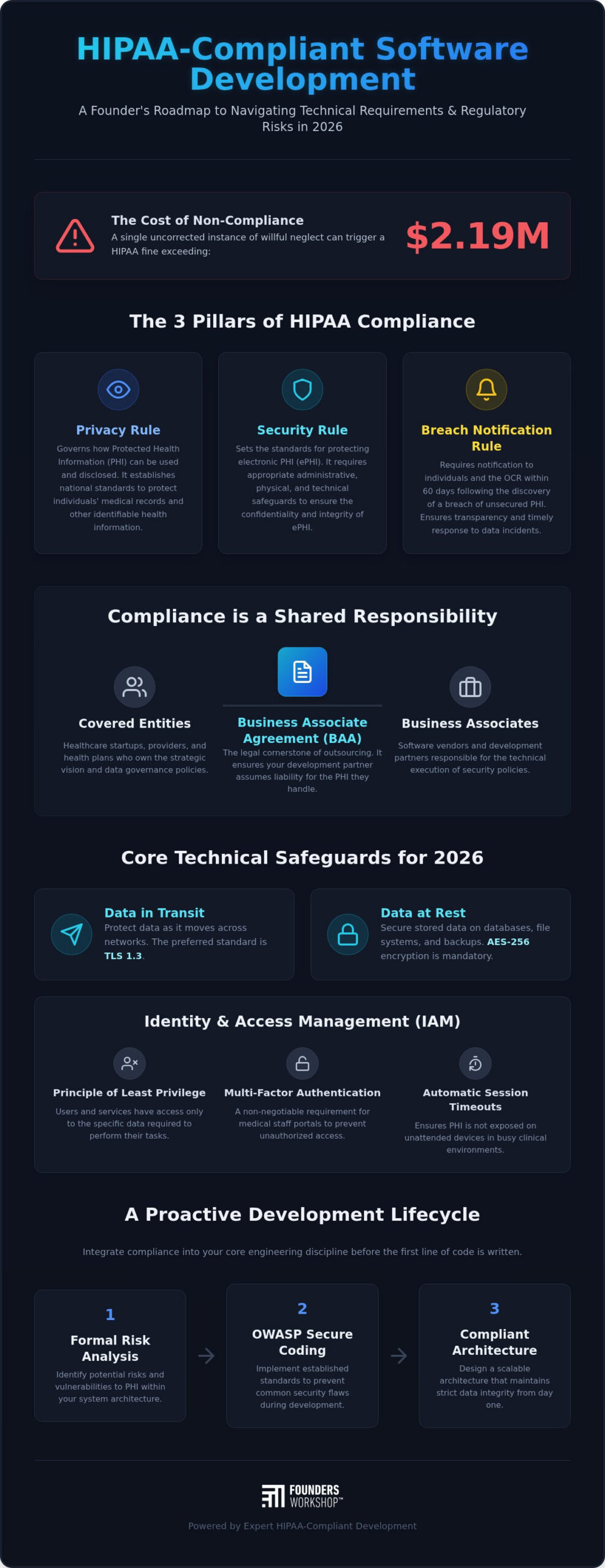
In 2026, a single uncorrected instance of willful neglect regarding patient data can trigger a HIPAA fine exceeding $2.19 million. For healthcare founders and executives, this figure represents more than just a financial risk. It is a direct threat to the long-term sustainability of your platform. You likely understand that building in this space requires a delicate balance between rapid innovation and the rigid, often opaque demands of federal regulations. It is frustrating when technical friction slows your speed to market, especially when you are struggling to find a team that truly speaks the language of healthcare security.
This article provides the strategic roadmap you need to navigate these complexities with confidence. By leveraging expert HIPAA compliant software development services, you can move beyond reactive security and build a foundation for genuine growth. We will explore the latest 2026 technical requirements, including TLS 1.3 encryption standards and AES-256 protocols. You’ll learn how to design a scalable architecture that handles surging patient volumes while maintaining strict data integrity. We will also outline a clear process for selecting a development partner who treats compliance as a core engineering discipline rather than a secondary checklist.
Key Takeaways
- Learn to distinguish between Covered Entities and Business Associates to ensure every vendor in your ecosystem maintains strict data integrity.
- Master the implementation of AES-256 and TLS 1.3 encryption standards by leveraging expert HIPAA compliant software development services that prioritize patient privacy.
- Discover how to integrate a formal Risk Analysis and OWASP secure coding standards into your development lifecycle before the first line of code is written.
- Understand how to scale your engineering velocity using nearshore talent and BAA-covered cloud infrastructure without compromising regulatory compliance.
- Identify the specific criteria for selecting a long-term development partner who balances technical rigor with a human-centered approach to medical technology.
Understanding the HIPAA Compliance Framework for Software Developers
Success in the medical tech sector requires more than a great user interface; it demands a deep alignment with federal law. Before you write your first line of code, you must understand that HIPAA (Health Insurance Portability and Accountability Act) governs every aspect of how your software handles sensitive data. In a digital context, Protected Health Information (PHI) includes any data point that can identify a patient, from names and social security numbers to IP addresses and device identifiers. If this data is linked to health status, provision of care, or payment details, it falls under the strict regulatory umbrella.
The framework is built upon three pillars: the Privacy Rule, the Security Rule, and the Breach Notification Rule. While the Privacy Rule dictates how data is used and disclosed, the Security Rule sets the standards for protecting electronic PHI. The Breach Notification Rule is equally critical; it requires you to notify the OCR and affected individuals within 60 days of discovering a data breach. Engaging professional HIPAA compliant software development services ensures that your platform is built on a foundation of legal and technical integrity from day one.
Compliance is a shared responsibility. As a founder, you own the strategic vision and the high-level policies for data governance. However, your engineering team is responsible for the actual execution of those policies. Most healthcare startups function as Covered Entities, while the software vendors they hire act as Business Associates. This distinction is vital because it determines the legal liability and the specific regulatory requirements each party must meet.
The Role of Business Associate Agreements (BAAs)
A signed Business Associate Agreement stands as the legal cornerstone of healthcare outsourcing, ensuring that your development partner assumes liability for the data they handle. This document must clearly outline how the partner will protect PHI and what steps they will take in the event of a security incident. You cannot legally share patient data with a development partner who refuses to sign a BAA. Working without this agreement exposes your company to massive fines and leaves you solely responsible for any technical failures on the developer’s part.
Administrative vs. Technical Safeguards
HIPAA categorizes its requirements into three types of safeguards. Administrative safeguards focus on the “human” element, such as employee training, formal risk assessments, and internal policies. Technical safeguards are the engineering requirements, including AES-256 encryption for data at rest and TLS 1.3 for data in transit. Physical safeguards involve the security of the actual hardware. Even in a cloud-based environment, you must ensure your cloud provider manages their data centers with restricted access and robust device management protocols. Balancing these three areas is the only way to achieve a truly secure environment for patient data.
Technical Requirements: Architecting for PHI Security
Building on the regulatory foundation discussed previously, technical safeguards represent the actual implementation of the HIPAA Security Rule. In 2026, the baseline for security has shifted. You should no longer settle for TLS 1.2; TLS 1.3 is now the preferred standard for protecting data in transit. For data at rest, AES-256 encryption is mandatory for databases, file systems, and backups. These aren’t just technical choices. They’re business safeguards that protect your company from catastrophic data exposure.
Implementing robust Identity and Access Management (IAM) requires a strict adherence to the principle of least privilege. This means every user, service, and application component has access only to the specific data sets required to perform their designated tasks. For medical staff portals, multi-factor authentication (MFA) is a non-negotiable requirement to prevent unauthorized access. Clinical applications must also incorporate automatic session timeouts and log-offs to ensure PHI isn’t exposed on unattended devices in busy hospital environments. High-quality HIPAA compliant software development services prioritize these technical safeguards early in the architectural phase to prevent expensive rework later.
If you’re unsure if your current architecture meets these 2026 standards, consider a review of your healthcare tech development strategy to identify potential gaps in your security posture.
Database Security and PHI Isolation
Effective architecture isolates PHI from non-sensitive application data. This strategy minimizes the “blast radius” in the event of a security incident. Use encrypted database volumes and managed cloud services that offer built-in, compliant security features. Don’t overlook the importance of backups. Your backup strategy must be regular, fully encrypted, and stored in a separate, secure environment to ensure business continuity without compromising your compliance status.
Audit Controls and Activity Logs
Your system must record every instance where PHI is accessed, modified, or deleted. These logs should include the user ID, the timestamp, and the specific action taken. To maintain integrity, store these logs in a secure environment where they cannot be altered or deleted by any user. If it isn’t logged, it didn’t happen in the eyes of HIPAA auditors. Robust logging provides the transparency needed to prove you’re in full control of your data environment during an audit or a breach investigation.
The HIPAA Compliant Software Development Lifecycle (SDLC)
Compliance is not a static destination reached at the end of a project. It is a continuous methodology that must be woven into every phase of your software development lifecycle. Relying on automated tools alone is a common mistake; true security requires a disciplined human element. Before your team writes a single line of code, you must conduct a formal Risk Analysis to identify potential vulnerabilities in how data will be handled. This proactive step aligns your technical roadmap with the HHS Security Rule Guidance, ensuring that your architecture is defensible from the start.
Once development begins, your team should adhere to secure coding standards based on OWASP guidelines. These standards help prevent common vulnerabilities like SQL injection or cross-site scripting, which are often the entry points for data breaches. Integrating HIPAA compliant software development services into your workflow allows you to implement automated vulnerability scanning directly within your CI/CD pipeline. This ensures that every code commit is checked for security flaws before it ever reaches a production environment. However, automation is only half the battle. You also need regular manual penetration testing and third-party audits to validate your defenses against sophisticated, evolving threats.
Finally, your SDLC must include a formal Incident Response Plan. Even with the best defenses, you need a documented process for containing a potential breach, investigating the root cause, and meeting the 60-day notification deadline required by federal law. Having this plan in place provides the peace of mind that your business can remain resilient under pressure.
Integrating Security into the Sprint Cycle
To maintain velocity without sacrificing safety, include security requirements directly in your user stories. For example, a story for a new patient profile feature should explicitly list the encryption and access control requirements as part of the “Definition of Done.” Peer code reviews are another vital safeguard; they allow senior developers to spot compliance gaps that automated tools might overlook. Most importantly, ensure your developers never use real PHI in testing or staging environments. Using de-identified or synthetic data prevents accidental exposure during the development process.
Legacy Modernization for Healthcare
Many healthcare executives face the challenge of managing older systems that weren’t built with modern security standards in mind. Bringing these platforms into compliance often requires refactoring legacy code to eliminate technical debt and close security holes. Instead of a risky “rip and replace” approach, consider an incremental migration to secure cloud infrastructures. This allows you to modernize high-risk components first, such as identity management or database storage, while maintaining the stability of your core clinical operations.
Scaling Your Healthcare Platform Without Compromising Compliance
Expanding your patient base should be a milestone, not a liability. As your platform grows, the complexity of your data environment increases exponentially. Choosing a major cloud provider like AWS, Azure, or GCP provides a solid foundation, but you must verify that every specific service you deploy is covered under their signed Business Associate Agreement (BAA). It’s easy for a growing team to accidentally move PHI into a non-compliant storage bucket or analytics tool. Maintaining engineering velocity while managing these risks is the primary hurdle for founders.
To overcome this, many organizations integrate HIPAA compliant software development services to bridge the gap between speed and security. Scaling a compliant team requires more than just adding headcount; it requires a shared engineering culture where security is treated as a core feature. This is where nearshore staff augmentation offers a distinct strategic advantage. By partnering with developers in Latin America, you gain access to a timezone-aligned workforce that can collaborate in real-time. This alignment ensures that compliance protocols are followed during every daily stand-up and code review.
If you’re looking to grow your team without the overhead of US-only hires, explore how nearshore staff augmentation can provide the secure, scalable talent you need.
The Nearshore Advantage for Healthcare Tech
Timezone alignment is a non-negotiable requirement for healthcare platforms that demand rapid incident response. When a security alert triggers at 2:00 PM EST, you don’t want to wait twelve hours for an offshore team to wake up. Nearshore talent provides the immediate collaboration necessary to address threats before they compromise patient data. This model allows you to tap into high-quality engineering hubs while keeping your development costs sustainable. For founders, this is a vital part of a Strategic MVP Development plan, allowing for a lean start that scales into a robust enterprise solution.
Automating Compliance Monitoring at Scale
Manual oversight cannot keep pace with a rapidly growing infrastructure. Implementing Compliance as Code ensures that every new instance, network configuration, or storage volume is secure by default. By defining your security requirements in your configuration files, you prevent human error from creating compliance gaps. You should also implement real-time alerting for unauthorized PHI access or unusual data patterns. This proactive monitoring allows your team to scale the database and application layers without creating security bottlenecks that could hinder performance or invite regulatory scrutiny.
Partnering for Success: Finding HIPAA Compliant Development Services
Selecting a partner for your medical platform is a high-stakes executive decision that extends far beyond simple technical capability. You are choosing a steward for your company’s reputation and a guardian of sensitive patient data. A history of building general enterprise applications doesn’t automatically translate to an understanding of the rigorous, high-stakes demands of the healthcare sector. When evaluating HIPAA compliant software development services, you must look for a partner that views security as a foundational engineering culture rather than an added expense or a final hurdle.
Success requires a human-centered approach to software. This means your development team should understand that behind every data point is a patient relying on your platform for their well-being. Offshore agencies often present significant communication and timezone barriers that can derail a project during critical security incidents. In contrast, nearshore teams provide the real-time collaboration needed to maintain high velocity without sacrificing safety. If an agency hesitates to sign a BAA or lacks a clear process for legacy modernization, it is a clear signal to look elsewhere. You need a team that prioritizes alignment between your strategic vision and the technical realities of 2026 regulations.
Founders Workshop has become the trusted choice for scalable healthcare platforms by combining over 30 years of leadership experience with specialized expertise in medical tech. We don’t just provide developers; we provide a seasoned executive guide to help you navigate the complexities of scaling a compliant organization.
A Checklist for Vetting Technical Partners
Before committing to a long-term partnership, use this checklist to ensure your provider has the discipline required for healthcare technology solutions:
- Do they sign a BAA by default? Any hesitation here is a non-starter for a compliant project.
- What is their process for secure data migration? They should have a documented methodology for moving PHI without exposure.
- Do they provide dedicated personnel? Your developers should integrate with your core team to ensure a consistent compliance culture.
- How do they handle legacy modernization? Look for a partner who can refactor older codebases into secure, cloud-native environments.
The Founders Workshop Healthcare Methodology
We focus on bridging the gap between high-level executive strategy and hands-on technical execution. Our nearshore teams in Latin America are specifically trained to maintain high velocity while adhering to strict HIPAA standards. This model allows you to scale your engineering capacity without the friction of extreme timezone differences or the high costs of US-only hiring. We treat your compliance as our own accountability, providing the peace of mind you need to focus on business growth and patient outcomes. If you are ready to build a secure, high-performance platform, schedule a consultation for your healthcare software project today.
Securing the Future of Your Medical Innovation
Building a platform that balances rapid scaling with rigid compliance requires a shift from reactive security to proactive engineering. We’ve explored how modern standards like TLS 1.3 and AES-256 form the technical bedrock, while a disciplined SDLC ensures that every sprint reinforces your regulatory posture. By leveraging nearshore talent, you can maintain high velocity and timezone alignment without the friction often found in offshore models. Selecting the right HIPAA compliant software development services is the final, most critical step in ensuring your platform remains a resilient asset rather than a legal liability.
At Founders Workshop, we bring over 30 years of software engineering leadership and a specialized healthcare technology solutions team to every partnership. Our secure nearshore staff augmentation models are designed to help you grow with confidence and peace of mind. It’s time to focus on your mission while we handle the technical complexities of your infrastructure. Scale your healthcare platform with a HIPAA-compliant engineering partner and remove the technical friction standing between your vision and patient care. The path to a scalable, compliant platform is complex, but with the right strategic guide, your success is entirely within reach.
Frequently Asked Questions
What is the penalty for a HIPAA violation in software development?
Penalties are tiered based on the level of culpability and can reach a maximum of $2,190,294 per year for uncorrected willful neglect as of January 2026. Even minor violations occurring without prior knowledge can result in minimum fines of $145 per instance. These civil monetary penalties are adjusted annually for inflation. Beyond the financial impact, a violation can lead to mandatory oversight by the Office for Civil Rights and significant damage to your brand’s reputation in the medical community.
Does every developer on my team need to be HIPAA certified?
No official “HIPAA certification” for individuals exists or is recognized by the U.S. Department of Health and Human Services. Compliance is instead demonstrated through regular, documented training and strict adherence to internal security policies. It is more important that your provider of HIPAA compliant software development services has established protocols and a culture of security. You should look for partners who can prove they follow frameworks like SOC 2 or HITRUST to validate their engineering discipline.
Can I use offshore developers for a HIPAA compliant project?
You can legally use offshore developers, but it introduces significant legal and operational hurdles that often outweigh the initial cost savings. Enforcing a Business Associate Agreement (BAA) in distant jurisdictions is notoriously difficult, leaving your company with limited legal recourse in the event of a breach. Nearshore teams in Latin America provide a safer alternative. They offer timezone alignment for real-time collaboration and operate within legal frameworks that are more compatible with U.S. healthcare regulations.
Is AWS or Azure better for HIPAA compliant hosting?
Both AWS and Azure are excellent choices for healthcare hosting, provided you use their “HIPAA-eligible” services and sign a formal BAA with the provider. Azure is often the preferred choice for platforms that need to integrate with legacy hospital systems already using the Microsoft ecosystem. AWS is frequently favored by startups for its extensive range of flexible, scalable tools. The best choice depends on your specific technical requirements and the existing infrastructure of your target clinical partners.
What is the difference between HIPAA and HITRUST?
HIPAA is a federal law that sets the mandatory standards for data privacy, whereas HITRUST is a private, certifiable security framework that encompasses HIPAA and other global standards. While you cannot be “HIPAA certified,” you can achieve HITRUST certification to prove your platform meets the highest industry standards. HITRUST is significantly more rigorous and requires a third-party audit. Many large healthcare networks now require their software vendors to be HITRUST certified before signing a contract.
How much does it cost to build a HIPAA compliant MVP?
Building a compliant MVP typically carries a 15% to 25% overhead compared to non-regulated software applications. This additional cost covers the implementation of mandatory technical safeguards, such as AES-256 encryption and TLS 1.3 protocols, as well as the required administrative documentation. While the total investment varies based on the complexity of your clinical workflow, budgeting for this early rigor is essential. It prevents the need for expensive architectural refactoring as your patient volume grows.
Do I need a BAA if I’m using a third-party API for health data?
Yes, you must have a signed BAA with any third-party API provider that handles, stores, or transmits PHI on your behalf. This requirement applies to every link in your data chain, including communication tools, payment processors, and cloud storage vendors. If a vendor refuses to sign a BAA, you cannot legally use their service to process patient data. Using an un-covered service is one of the fastest ways to trigger an audit and face significant federal fines.
How often should I conduct a HIPAA risk assessment?
You should conduct a formal Security Risk Analysis (SRA) at least once a year or whenever you make significant changes to your software architecture. Regular assessments are a foundational requirement of the HIPAA Security Rule and are often the first thing auditors look for during an investigation. These reviews help you identify new vulnerabilities as your platform scales and ensure your defenses remain effective against evolving cyber threats. Continuous monitoring should supplement these annual deep dives for maximum security.