
Ninety-five percent of enterprise generative AI pilots fail to deliver a measurable impact on profit and loss in 2026. If you feel the friction of technical debt or struggle to find high-quality developers who understand your business goals, you aren’t alone. Most leaders find themselves trapped by legacy systems that refuse to integrate with modern tools, turning what should be an asset into a mounting cost center. Scaling business operations with software isn’t about writing more code; it’s about building a sustainable technical foundation that moves as fast as your vision.
You can transform your engineering department from a source of frustration into a strategic growth engine. This guide explores how to eliminate technical friction, leverage nearshore talent in your own timezone, and modernize your infrastructure for the AI era. We’ll examine the 2026 executive strategy for reducing operational costs through automation while ensuring your team delivers new products to market ahead of the competition. It’s time to move past the struggle of finding talent and start building a scalable architecture that supports long-term business outcomes.
Key Takeaways
- Learn how to align your technical roadmap with revenue goals so it’s a growth engine rather than a mounting cost center.
- Identify the technical debt slowing your progress and discover how the “strangler pattern” helps you modernize legacy systems without disrupting your workflow.
- Understand why timezone alignment is the critical factor in accelerating engineering velocity when scaling business operations with software through nearshore talent.
- Move beyond the hype to implement practical AI applications and system integrations that create a unified, data-driven ecosystem.
- Discover the benefits of a founder-to-founder methodology that prioritizes business outcomes and human-centered results over technical novelty.
What is Software Development for Business Growth in 2026?
Software is no longer a utility; it’s the primary lever for revenue. In 2026, software development for business growth means aligning every line of code with a specific, measurable financial outcome. While many executives still view IT as a cost center, the most successful leaders treat engineering as their most potent growth engine. This isn’t just about technical proficiency. It’s about strategic alignment.
Off-the-shelf solutions often provide a quick start, but they eventually create a growth ceiling. These platforms are built for the average user, not for your unique competitive advantage. When you’re scaling business operations with software, those rigid boundaries become friction points that slow down your team and frustrate your customers. If your software can’t adapt to your specific workflow, you’re forced to adapt your business to the software’s limitations.
The difference between maintenance-mode and growth-mode is the difference between surviving and thriving. Maintenance focuses on keeping the lights on and patching bugs. Growth-mode engineering focuses on building features that capture market share. It’s a proactive approach that prioritizes human-centered solutions. Instead of just automating tasks to cut costs, you’re empowering your team to deliver higher value by removing the repetitive technical tasks that drain their energy.
The Shift from Cost Center to Growth Engine
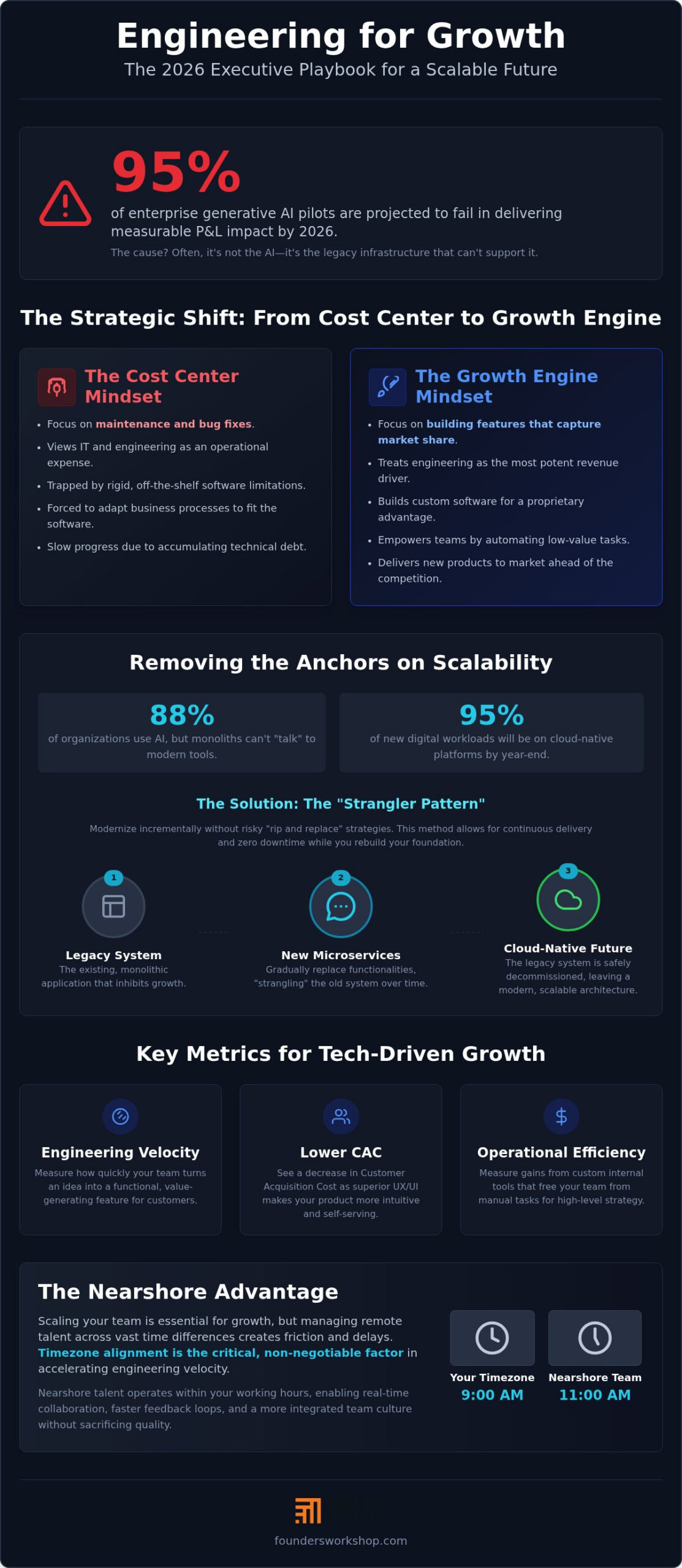
Market dynamics in 2026 are unforgiving. With total worldwide spending on AI projected to reach $2.59 trillion this year, the gap between tech-enabled leaders and laggards is widening. Custom software creates a proprietary advantage that competitors cannot simply buy. For many companies, custom software development has become the blueprint for turning local successes into national brands by building infrastructure that scales without breaking. This investment ensures your technology is an asset that appreciates as you grow, rather than a liability that requires constant, expensive repairs.
Key Metrics for Tech-Driven Growth
To manage this transition, you need the right KPIs. Engineering velocity is critical; it measures how quickly your team can turn an idea into a functional feature that generates value. You should also see a decrease in Customer Acquisition Cost (CAC) as superior UX/UI makes your product more intuitive and self-serving. Finally, building custom internal tools for productivity allows you to measure operational efficiency gains. This ensures your team spends less time on manual data entry and more time on the high-level strategy that actually moves the needle for your business.
Modernizing Legacy Systems: Removing the Anchors on Scalability
Technical debt is the silent inhibitor of enterprise growth. It represents the implied cost of additional rework caused by choosing an easy, short-term solution instead of using a better approach that would take longer. For many leaders, this debt has accumulated into a massive anchor that makes scaling business operations with software nearly impossible. If your engineering team spends 80% of their time patching bugs in a legacy monolith rather than shipping new features, you aren’t just losing time. You’re losing market share.
The risk of remaining on monolithic systems is particularly high in an AI-driven market. Monoliths are notoriously difficult to integrate with modern data tools because their data is often siloed and inaccessible to external APIs. In 2026, where 88% of organizations are using AI in at least one business function, having a system that can’t “talk” to an LLM or an agent-based workflow is a strategic dead end. To move forward, you must transition to a cloud-native architecture. This shift is no longer optional; industry forecasts suggest that 95% of new digital workloads will be deployed on cloud-native platforms by the end of this year.
Modernization doesn’t require a risky “rip and replace” strategy that threatens your daily operations. Instead, we often recommend the strangler pattern. This methodology involves incrementally replacing specific functionalities of the legacy system with new microservices. Over time, the new system “strangles” the old one until the legacy codebase can be safely decommissioned. This allows for continuous delivery and zero downtime, ensuring your business stays operational while you rebuild your foundation.
The Cost of Doing Nothing
Maintaining outdated codebases carries hidden expenses that rarely show up on a balance sheet. These include the high cost of specialized developers who know obsolete languages and the increased risk of catastrophic system failure. Furthermore, legacy systems are a primary target for cyberattacks. With the updated 2026 SBOM guidance from CISA and the FBI, the regulatory pressure to maintain a transparent and secure software supply chain has never been higher. If you’re struggling to balance these risks with your growth goals, partnering with a seasoned development guide can help you identify the most efficient path forward.
Strategic Modernization Framework
A successful modernization effort requires a disciplined, three-step approach to ensure you’re investing in the right areas:
- Step 1: Audit technical debt vs. business value. Not all debt needs to be paid down immediately. Focus on the systems that directly impact your revenue or customer experience.
- Step 2: Implement a cloud migration strategy for legacy systems. Move your core data and logic to a scalable environment that supports modern integration.
- Step 3: Refactor for modularity. Break down your application into smaller, independent services that can be updated or scaled individually without affecting the entire system.
By following this framework, you ensure that your technical infrastructure is an asset that supports scaling business operations with software rather than a liability that holds you back.
The Nearshore Advantage: Accelerating Engineering Velocity
Scaling business operations with software requires more than just a clear roadmap; it demands a team that can execute at the speed of your ambition. Many US-based companies face a significant talent shortage that makes local hiring prohibitively expensive and slow. This has traditionally led leaders to look offshore to Asia or Eastern Europe. However, the hidden costs of offshore development, such as management overhead and rework due to miscommunication, often negate the initial savings. Nearshore development in Latin America has emerged as the strategic alternative for executives who prioritize velocity and reliability.
Latin American tech talent offers a unique blend of cultural and linguistic alignment that offshore markets often lack. Because these engineers share a similar business culture and high English proficiency, there’s less friction during the handoff of complex requirements. This alignment ensures that your technical team isn’t just following instructions but is actively contributing to your strategic goals. It’s the difference between a vendor and a partner who understands the “why” behind every feature.
Timezone Alignment as a Growth Lever
Timezone alignment is the secret sauce for modern Agile development. When your engineering team works in your same hours, you eliminate the 12-hour delay in feedback loops that plagues offshore models. Real-time communication via Slack or Zoom allows for immediate course corrections and same-day problem solving. This constant synchronization significantly compresses your product launch timelines. Instead of waiting overnight for a response to a critical bug, your team resolves issues as they arise, keeping your momentum high and your technical debt low. It creates a collaborative environment where ideas are tested and refined in real time.
Staff Augmentation vs. Full Outsourcing
Deciding how to scale your team depends on your existing internal capabilities. Nearshore staff augmentation allows you to integrate dedicated developers directly into your current workflow. This model helps you maintain control over your company culture and technical standards while rapidly increasing your output. You get the specialized expertise you need without the long-term overhead of US-based benefits and office space. To better evaluate your hiring options, discover more about Retained and Contingent Recruitment Placement Fees from Dataworks, a leader in AI-focused team building. Founders Workshop leverages over 30 years of leadership experience to vet and manage high-quality Latin American talent, ensuring that every engineer we provide is ready to contribute from day one. This human-centered approach to technical execution bridges the gap between your current capacity and your growth targets.
Leveraging AI and System Integration for Exponential Growth
By 2026, the novelty of artificial intelligence has faded, replaced by a demand for measurable ROI. While 88% of organizations now use AI in some capacity, research shows that 95% of generative AI pilots fail to deliver a tangible impact on profit and loss. This gap exists because many leaders treat AI as a standalone miracle rather than a component of a broader technical strategy. Scaling business operations with software requires a shift from chasing trends to implementing practical, data-driven automation that solves specific bottlenecks.
Success starts with data hygiene. You cannot build a reliable machine learning model on a foundation of messy, fragmented data. Before you invest in predictive analytics, your core systems must be clean and accessible. This is where system integration services become the backbone of your growth strategy. By connecting disparate data sources, you create the high-quality environment necessary for AI to actually work. Without this unified ecosystem, your AI initiatives will struggle to move beyond the pilot phase.
AI Strategy for Founders
The most effective AI implementations focus on “low-hanging fruit.” These are the high-volume, repetitive tasks that drain your team’s resources and slow down your engineering velocity. Instead of building a general-purpose bot, focus on custom AI tools that address specific operational pain points. For example, predictive analytics can now optimize supply chains and customer retention by identifying patterns that human analysts might miss. This allows you to transition from reactive management to a proactive stance, using predictive insights to anticipate market shifts before they impact your bottom line.
Connecting the Tech Ecosystem
Siloed data is the primary enemy of scalability. When your CRM, ERP, and custom internal tools don’t talk to each other, your team wastes hours manually syncing information. A unified technical architecture uses APIs to bridge these gaps, creating a “single source of truth” for your entire organization. This modular approach ensures your tech stack remains flexible. As new tools emerge in the rapidly evolving 2026 landscape, you can integrate them without rebuilding your entire foundation. If you’re ready to move past the hype and build a technical ecosystem that drives real revenue, start your AI strategy and development journey with our veteran team today.
Partnering for Success: The Founders Workshop Methodology
Success in scaling business operations with software depends on more than technical skill. It requires a partner who has navigated the same growth challenges you face. At Founders Workshop, we employ a “Founder-to-Founder” approach. This means we don’t just act as a service provider; we act as a strategic ally. Our 30-year legacy of building MVPs and scaling enterprises gives us a unique perspective on how to bridge the gap between a high-level vision and a functional, revenue-generating reality. We focus on pragmatic execution, ensuring that your technology is always an asset, never a bottleneck.
We believe that code is a means to an end, not the end itself. While many agencies focus on finishing a list of deliverables, our priority is your business outcome. We understand the intense pressure of scaling a company because we’ve been there ourselves. This experience allows us to offer a steady hand, helping you navigate the complexities of modern engineering with seasoned confidence. Our goal is to provide peace of mind by removing technical friction and allowing you to focus on your core mission.
Beyond Coding: Strategic Technical Partnership
Our methodology follows a disciplined path: Strategy, Design, Build, and Scale. This structured flow ensures that every feature we develop is grounded in human-centered design. We don’t just build what you ask for; we build what your business needs to grow. By focusing on long-term sustainability rather than fleeting trends, we create technical infrastructures that can handle the demands of a rapidly expanding user base. This partnership model ensures that your technical roadmap remains perfectly aligned with your financial goals, providing a clear path from initial concept to market leadership.
The Power of Nearshore Talent
Our Latin American teams are designed to act as a natural extension of your business. We don’t just provide extra hands; we provide high-level expertise that integrates seamlessly into your existing workflow. Our rigorous vetting process ensures we only hire the top 3% of tech talent in the region, focusing on both technical mastery and cultural alignment. This commitment to quality allows for scaling business operations with software in a way that is both sustainable and predictable. You gain the advantage of high engineering velocity and timezone-aligned collaboration without the volatility of the freelance marketplace or the extreme overhead of US-based hiring. This model provides the reliability and accountability you need to scale with confidence.
Future-Proof Your Growth Strategy
The transition from viewing software as a cost to treating it as a revenue driver is the defining shift for successful executives this year. You’ve seen how modernizing legacy systems and integrating intelligent automation can remove the anchors holding your team back. Scaling business operations with software is no longer just a technical goal; it’s a fundamental requirement for staying competitive in a market that moves at the speed of AI. By choosing a nearshore model that aligns with your timezone, you ensure the real-time collaboration necessary for high-velocity growth.
Founders Workshop brings 30+ years of executive leadership to every partnership. We specialize in AI strategy and legacy modernization, providing the steady hand you need to navigate complex technical transitions. Our nearshore teams act as a natural extension of your business, ensuring your vision is executed with pragmatic discipline. It’s time to eliminate technical friction and focus on what you do best: growing your company.
Scale your business with a strategic software partner. Contact Founders Workshop today.
Your path to a scalable, efficient, and innovative future starts with a single strategic decision. We’re ready to help you build it.
Frequently Asked Questions
How does custom software development directly contribute to business growth?
Custom software contributes to growth by creating proprietary advantages that competitors can’t simply purchase. It allows for scaling business operations with software by automating unique workflows that off-the-shelf tools don’t support. This alignment ensures your tech stack evolves as fast as your revenue goals, turning your infrastructure into a strategic engine rather than a maintenance burden.
What is the difference between nearshore and offshore software development?
The primary difference lies in timezone alignment and geographic proximity. Nearshore development occurs in neighboring regions like Latin America, providing real-time collaboration during US business hours. Offshore models often involve a 10 to 12 hour time difference, which can lead to communication delays, feedback loops that take days instead of hours, and slower overall development cycles.
When should a business choose custom software over an off-the-shelf solution?
You should choose custom software when standard platforms create a growth ceiling for your specific business model. If you find yourself changing your unique, successful processes to fit the limitations of a pre-built tool, it’s time to invest in a custom solution. This ensures your technology supports your strategy rather than dictating it, allowing you to maintain your competitive edge.
How long does it typically take to see ROI from a software modernization project?
ROI typically becomes visible within 6 to 12 months after the initial implementation phase. Gains are usually measured through reduced operational costs, lower maintenance fees, and a faster time-to-market for new features. By paying down technical debt early, you avoid the compounding costs of maintaining inefficient legacy systems that drain your budget without adding value.
What are the biggest risks in software development for scaling companies?
Technical debt and a lack of strategic alignment are the most significant risks for growing firms. When companies rush to build features without a scalable architecture, they often create a “spaghetti code” environment that breaks under high load. This technical friction can stop your growth momentum entirely if your engineering team isn’t focused on long-term sustainability and modular design.
How does Founders Workshop handle communication with nearshore teams?
We facilitate communication through daily synchronization and real-time messaging platforms that operate within your specific US timezone. This “founder-to-founder” level of transparency ensures that nearshore teams act as a natural extension of your internal staff. You get immediate feedback and same-day resolutions to critical technical challenges, which keeps your engineering velocity high and your roadmap on track.
Can AI be integrated into my existing legacy software?
AI can be integrated into most legacy systems using modern APIs and modular refactoring techniques. The key is ensuring your data is clean and accessible before you attempt to layer on machine learning or predictive analytics. Once your data hygiene is addressed, AI becomes a powerful tool for scaling business operations with software by providing predictive insights and automating complex tasks.
What is the average cost of building a custom internal tool for growth?
The investment for a custom internal tool depends on the scope of the problem you’re solving and the complexity of the integrations required. Rather than focusing on a fixed price, we recommend evaluating the total cost of ownership against the projected efficiency gains. A well-built tool should pay for itself by significantly reducing manual labor, eliminating human error, and increasing your team’s overall output.