

Adding engineers can make a delivery bottleneck worse before it makes it better. If your roadmap keeps moving while hiring drags on, it’s natural to ask how to scale your engineering team quickly. But adding people before finding the constraint can create more onboarding, review, and coordination work without increasing delivery.
Headcount alone isn’t the answer. First identify what’s slowing the team down: a skills gap, unclear priorities, overloaded technical leadership, or a workflow that makes it hard to ship. Once you know the cause, you can choose an approach that fits the work and the level of control you need.
This guide will help you assess your capacity gap, compare in-house hiring, staff augmentation, and project-based development, and scale without losing communication or accountability. For founders and executives in Dallas, Fort Worth, Plano, Frisco, and Irving, the goal is the same as it is for teams elsewhere: add the right capacity while keeping delivery focused. Founders Workshop is based in Phoenix and works remotely with businesses across the United States.
Key Takeaways
- Learn how to scale your engineering team quickly by identifying the specific constraint limiting delivery before adding capacity.
- Compare direct hiring, staff augmentation, and project-based development based on control, continuity, management effort, and the work at hand.
- Prepare onboarding, decision rights, and code review capacity so new contributors can join the team without adding avoidable coordination friction.
- Use a step-by-step plan to turn your capacity assessment into practical decisions your current team can act on.
- Consider when nearshore staff augmentation may suit your needs, whether your business is in North Texas or elsewhere in the U.S.
How to Scale Your Engineering Team Quickly Without Hiring in a Panic
An urgent roadmap can make adding engineers feel like the obvious move. But if the team is slowed by unclear priorities, long review queues, or unresolved dependencies, new hires may increase coordination work before they increase delivery. For a Frisco company preparing a launch or a Dallas, Fort Worth, Plano, or Irving business responding to a changing market, the first decision is not how many people to add. It’s what’s preventing the current team from moving work forward.
Engineering capacity is the combined ability of a team’s people, skills, and delivery systems to turn prioritized work into reliable, released software. Scaling quickly isn’t simply increasing headcount. It’s adding useful capacity where it’s needed, while making sure contributors can get context, make decisions, and move work through the development process.
Identify the constraint before adding engineers
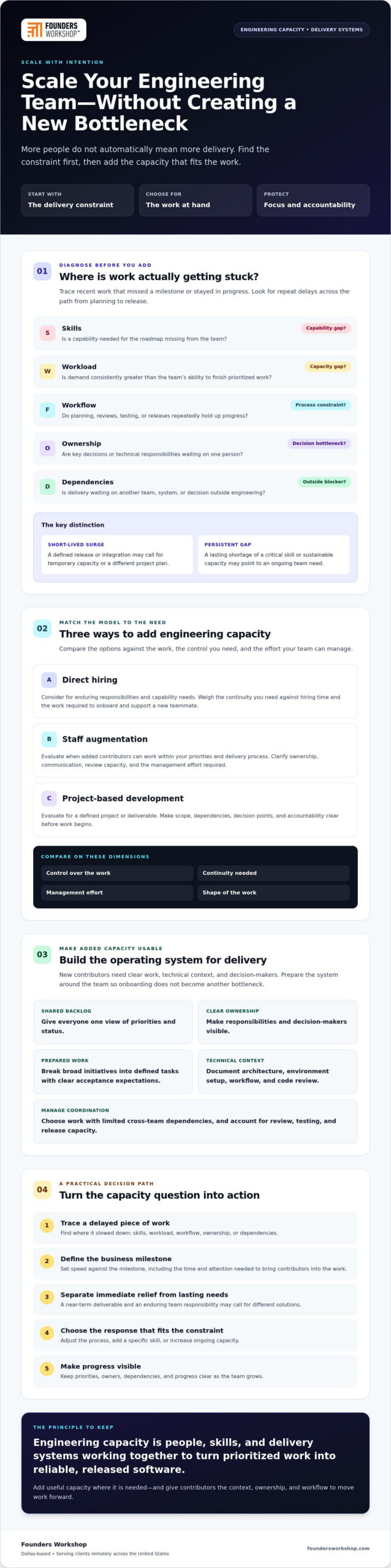
Start with recent work that missed a milestone or stayed in progress longer than expected. Trace where it slowed down: Was a specialist skill missing? Was the team carrying more work than it could complete? Were priorities shifting, ownership unclear, or external dependencies unresolved? Review delays in planning, code reviews, testing, and releases, too. These patterns can point to a process constraint rather than a staffing shortage.
Ask engineering leads which responsibilities lack clear ownership or adequate coverage. A concise diagnostic checklist can help:
- Skills: Is a capability needed for the roadmap missing from the team?
- Workload: Is demand consistently exceeding the team’s ability to complete prioritized work?
- Workflow: Do planning, review, testing, or release steps repeatedly hold up progress?
- Ownership: Are key decisions or technical responsibilities waiting on one person?
- Dependencies: Is delivery blocked by teams, systems, or decisions outside engineering?
Set a useful definition of quick
Define speed against the business milestone, then account for the time and attention needed to bring contributors into the work. A useful project management approach makes priorities, owners, dependencies, and progress visible. Separate near-term relief from long-term team design: the immediate need may be focused support for a deliverable, while future hiring addresses enduring responsibilities. Don’t assume a fixed ramp-up timeline. It depends on the work, team context, and onboarding readiness.
With the constraint identified, leaders can decide whether to adjust the process, add a specific skill, or increase ongoing capacity. That diagnosis is the practical starting point for how to scale your engineering team quickly without creating a second bottleneck.
Build the Operating System That Lets a Larger Engineering Team Deliver
Adding engineers doesn’t automatically accelerate a constrained team. If new contributors arrive without clear work, technical context, or decision-makers, existing engineers may spend more time answering questions and resolving overlap than advancing the roadmap. The operating system around the team determines whether added capacity becomes completed work.
Think of onboarding as a delivery responsibility, not an administrative task. A shared backlog gives everyone one view of priorities and status. Clear ownership helps prevent duplicate effort and stalled decisions, especially when product, engineering, and testing responsibilities cross team boundaries. For further perspective, Scaling engineering organizations also involves preparing to recruit, train, and support engineers, not simply filling roles.
Prepare work, ownership, and technical context
Before a new engineer or partner joins, select work that can progress with limited cross-team dependencies. Break broad initiatives into defined tasks, explain acceptance expectations, and identify which decisions need input from others. Document the architecture and development workflow, including how to set up the environment and where code changes are reviewed. Assign accountable owners for product decisions, code review, testing, and release coordination.
This context doesn’t need to become a large handbook. A concise set of current notes, a prioritized backlog, and named contacts can give incoming contributors a practical starting point while preserving the team’s existing standards.
Protect communication and quality as the team grows
Agree on how the team shares written updates, which discussions need meetings, and how blockers or urgent decisions are escalated. Make review responsibilities visible so work doesn’t collect in an unowned queue. Incoming contributors should also understand how testing and deployment fit into the development workflow. Keep these practices consistent across locations and employment arrangements.
Measure progress by completed outcomes and quality signals, not by commits, tickets touched, or hours logged alone. If output appears to rise but rework, defects, or stalled reviews also increase, the team’s delivery system may need attention. This is part of how to scale your engineering team quickly without confusing activity with meaningful progress.
Before someone joins, check that you have:
- A prioritized backlog with clear task ownership.
- Architecture, workflow, and environment setup notes.
- Named contacts for product decisions, reviews, testing, and releases.
- Agreed communication and escalation practices.
- Visible expectations for code quality and completed work.
If you’re deciding how to prepare your existing team for additional contributors, review engineering team support options as you assess the operating model and capacity need.
Compare Hiring, Staff Augmentation, and Project Teams for Speed
The right model depends on what you need to deliver, how long the need will last, and how much management capacity your current leaders can provide. Direct hiring builds internal capability. Staff augmentation adds dedicated talent to an existing team. Project-based development can put a defined build or modernization effort in another team’s hands. None is universally best.
| Model | Control | Continuity | Management effort | Best fit |
|---|---|---|---|---|
| Direct hiring | High, within your organization | Strong for ongoing product work | Recruiting, onboarding, and team management remain internal | Long-term roles requiring product knowledge and internal ownership |
| Staff augmentation | Day-to-day direction stays with your team | Dedicated talent can support ongoing work | Your leads guide priorities, collaboration, and review | Adding specific skills or capacity to an existing team |
| Project-based development | Control centers on scope and agreed outcomes | Typically focused on the defined engagement | Requires clear requirements, decisions, and coordination | A bounded build or modernization effort |
When direct hiring is the better fit
Hire directly when the role is likely to remain important beyond the current roadmap push, depends on deep product knowledge, or carries long-term internal responsibility. Your organization owns recruiting and onboarding, and engineering leaders need time to support the new teammate. Hiring may strengthen the team for the long run, but it may not close an immediate capacity gap by itself. For guidance on evaluating dedicated talent, see this staff augmentation guide for specialized skills.
When staff augmentation or project delivery fits
Choose staff augmentation if the work needs dedicated contributors integrated into your team’s existing backlog, communication, and review process. It can suit a defined capability gap or sustained workload, provided your leads have capacity to direct the work. A Dallas-area staff augmentation comparison can help frame questions for teams in Dallas, Fort Worth, Plano, Frisco, and Irving, while this Latin America tech talent guide offers context for U.S. businesses considering nearshore talent.
A Step-by-Step Plan to Add Engineering Capacity Without Losing Momentum
Turn the capacity decision into a sequence your team can act on. Each step should leave behind a clear choice or working document, so new contributors join a plan rather than a moving target.
- Diagnose the bottleneck. Identify where delivery is slowing and what evidence supports that diagnosis. Output: a brief statement of the constraint, such as a missing skill, overloaded review capacity, or recurring dependency delays.
- Choose the right model. Match the need to direct hiring, staff augmentation, or project-based development. Consider how long the workload is expected to last, the expertise required, and whether internal leads can manage and onboard additional contributors. Output: a model choice with the reasoning behind it.
- Select bounded priorities and define success. Choose work that fits the missing skills and can move forward without excessive handoffs. Document responsibilities, dependencies, and acceptance criteria before assigning it. Agree on indicators such as completed work, fewer delays at the original bottleneck, and maintainable quality. Output: a prioritized work package with clear ownership and completion criteria.
- Prepare a consistent onboarding path. Provide the access, technical documentation, team contacts, and workflow expectations contributors need to begin. Explain how work is planned, reviewed, tested, and released. For distributed teams, set expectations for written updates, meetings, and escalation. Texas businesses considering nearshore collaboration can also review the timezone advantages of nearshore teams when planning handoffs and shared working time. Output: an onboarding checklist and communication agreement.
- Review the result and adjust. Schedule regular checkpoints to surface blockers, handoff issues, code-quality concerns, and stakeholder feedback. Compare progress with the original diagnosis. If added capacity hasn’t eased that constraint, investigate whether the work was scoped poorly, ownership is unclear, or another dependency has become the limiting factor. Output: a decision to continue, adjust the work or model, or address a process issue.
This sequence makes how to scale your engineering team quickly a managed decision, not a headcount reaction. It also gives leaders a way to check whether added capacity is improving delivery without overlooking quality or accountability.
Scale with a Dallas-Based Nearshore Partner When You Need More Capacity
After identifying the capacity gap and preparing your team’s workflow, nearshore staff augmentation may be a practical option if dedicated engineering talent needs to join an existing team. Founders Workshop is based in Phoenix, Arizona, and works remotely with U.S. businesses, including teams in Dallas, Fort Worth, Plano, Frisco, and Irving. Its nearshore staff augmentation connects North American businesses with Latin American tech talent, with contributors working within the client’s team and its established priorities, communication practices, and delivery process.
This model is different from handing off a defined project. With staff augmentation, your team retains day-to-day direction and product decisions while additional talent contributes to its ongoing work. Project-based software development may be a better fit for a defined build, such as a startup MVP or legacy application modernization. The right path depends on whether you need added people inside your operating model or a partner to deliver a bounded project.
Evaluate partner fit before you commit
Look beyond whether a provider can identify people with the technical skills you need. Discuss how proposed talent will align with your backlog, engineering standards, and communication practices. Clarify who will set daily priorities, make product decisions, review work, resolve blockers, and oversee delivery. These responsibilities should be clear before work begins, so new contributors know where to get direction and your internal leads understand their role.
Confirm the engagement scope, commercial terms, and assumptions directly with the provider. For example, agree on the capabilities required, the work the contributors are expected to support, and the context your team will supply. Clear expectations help both sides assess fit without assuming that a particular model guarantees a specific delivery outcome.
Choose a next step that matches the capacity gap
If the need is dedicated additional talent working with your current engineers, explore staff augmentation. If you have a defined product build or modernization effort, discuss whether project-based development is more appropriate. Keep the decision tied to the diagnosis: don’t choose a delivery model simply because it sounds faster if your actual constraint is unclear ownership, blocked decisions, or a process that needs attention.
That distinction is central to how to scale your engineering team quickly: match the engagement to the work, then establish responsibilities and communication before delivery begins. Founders Workshop offers software development and nearshore staff augmentation to U.S. businesses, including organizations across North Texas.
Build Capacity Around the Work Ahead
Scaling well starts with a clear diagnosis. Identify whether delivery is constrained by missing skills, workload, unclear ownership, or process delays before deciding to hire or bring in outside support. Then match the solution to the need: direct hiring can build lasting internal expertise, staff augmentation adds dedicated talent to an existing team, and project-based development can suit a defined build or modernization effort.
New contributors need more than a backlog. Clear priorities, technical context, decision owners, and review practices help them work within your team’s operating model. Reassess whether added capacity is easing the original bottleneck, and adjust if it isn’t.
For founders and executives considering how to scale your engineering team quickly, Founders Workshop offers nearshore staff augmentation connecting U.S. businesses with Latin American tech talent, as well as project-based software development. Based in Phoenix, the team works remotely with businesses across the United States, including teams in Dallas, Fort Worth, Plano, Frisco, and Irving. Its leadership team brings over 30 years of experience.
Contact Founders Workshop to discuss your engineering team’s capacity needs and the right support for the work ahead.
Frequently Asked Questions
How can I scale my engineering team quickly without sacrificing quality?
Start by identifying what’s limiting delivery, then add capacity only where it addresses that constraint. Set clear ownership, prepare technical context, and define review, testing, and release expectations before new contributors begin. Track completed work alongside maintainability and quality signals, not raw activity alone. That’s a more reliable way to approach how to scale your engineering team quickly without creating extra rework or coordination problems.
Is staff augmentation faster than hiring full-time engineers?
Staff augmentation may help address a capacity need without running a full in-house recruiting process, but no model guarantees a specific start date or faster delivery. The fit and availability of the required skills, onboarding needs, and your team’s ability to provide direction all matter. Direct hiring may better serve a lasting internal role, particularly when working with specialized recruitment advisors such as QNT Partners for technical and quantitative skill sets. Compare the time required to recruit and onboard with the effort needed to integrate dedicated augmented talent.
When should a company use staff augmentation instead of project-based development?
Use staff augmentation when dedicated contributors need to work within your existing engineering team, backlog, and review process. Project-based development may be a better match for a defined outcome, such as building a startup MVP or modernizing a legacy application. Consider whether your internal leads can direct ongoing work and whether the scope is likely to continue changing. Clear responsibilities and boundaries help you choose a model that fits.
Can nearshore engineers work effectively with a Dallas or Texas-based team?
Yes, nearshore engineers can collaborate with a Dallas or Texas-based team when expectations are explicit. Agree on communication routines, working hours, written updates, decision owners, and how code is reviewed and tested. These practices matter whether your team is in Frisco, Plano, Fort Worth, Irving, Dallas, or distributed elsewhere. Founders Workshop is based in Phoenix, connects North American businesses with Latin American tech talent, and works remotely with U.S. businesses.
What should a company prepare before adding engineers to an existing team?
Prepare a prioritized backlog, clear task ownership, and practical technical context. Document how to access the development environment, where architecture information lives, and how work moves through review, testing, and release. Identify who handles product decisions and escalations, and set communication expectations. A concise onboarding checklist can help new engineers understand the work and team practices without relying on repeated explanations from already-busy colleagues.
How do you know whether an engineering team needs more people or better processes?
Look for patterns in delayed work. A persistent shortage of a skill or a workload that exceeds the team’s capacity may point to a staffing need. Repeated stalls in planning, code review, testing, releases, or decisions may indicate a process or ownership problem. Ask engineering leads where work waits and why. If adding contributors wouldn’t remove the recurring blocker, address that constraint before expanding the team.
What should I ask a staff augmentation partner before choosing one?
Ask how proposed talent will match your technical needs, priorities, and team practices. Clarify who directs daily work, makes product decisions, reviews contributions, and oversees delivery. Discuss onboarding expectations, communication, scope, commercial terms, and assumptions directly with the provider. Founders Workshop’s leadership team brings over 30 years of experience. You can discuss your capacity needs and whether nearshore staff augmentation fits with the Founders Workshop team.