
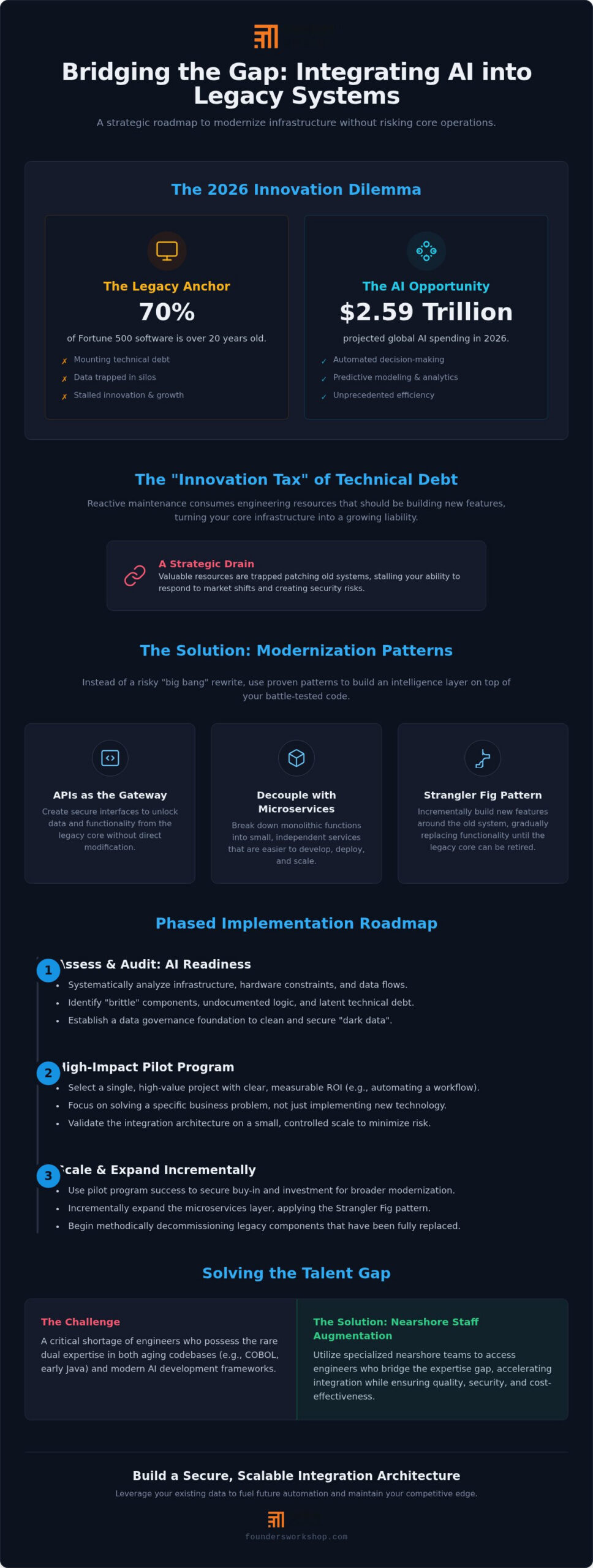
While global AI spending is projected to hit $2.59 trillion in 2026, McKinsey reports that 70% of the software within Fortune 500 companies is now more than two decades old. This massive gap between aging infrastructure and modern capability creates a significant hurdle for any leader aiming to scale. It’s a frustrating reality where mounting technical debt and data silos often stall innovation before it even begins. You likely feel the pressure to automate, yet the fear of a security breach or a total system collapse keeps your most ambitious plans on the shelf.
Success in this era requires a pragmatic approach to integrating AI into legacy systems that prioritizes business outcomes over technical novelty. You don’t have to risk your core operations to achieve modern efficiency. This article provides a clear, phased roadmap to bridge the expertise gap between legacy maintenance and AI innovation. We’ll explore how to build a scalable architecture that supports future growth while ensuring your existing data remains secure and accessible. By the end, you’ll have a strategic framework to drive measurable ROI and remove the technical friction holding your business back.
Key Takeaways
- Understand the “innovation tax” of technical debt and how to develop a strategic AI roadmap that protects your existing infrastructure.
- Discover how modernization patterns like the Strangler Fig allow you to incrementally decouple the legacy monolith using APIs and microservices.
- Learn a phased implementation roadmap for integrating AI into legacy systems that prioritizes high-impact pilot programs for immediate ROI.
- Solve the talent shortage by utilizing nearshore staff augmentation to access engineers who understand both aging codebases and modern AI development.
- Build a secure, scalable integration architecture that supports future growth while maintaining the integrity of your core business operations.
The Strategic Mandate: Why Integrating AI into Legacy Systems is Critical in 2026
In 2026, a legacy system is no longer defined solely by its age. It is defined by its inability to participate in the modern AI economy. Many organizations find themselves trapped in a cycle of reactive maintenance, where engineering resources are consumed by patching technical debt rather than building new features. This “innovation tax” isn’t just a line item on your budget; it’s a strategic drain that prevents you from responding to market shifts. Without a proactive roadmap, your existing infrastructure becomes a liability that grows more expensive every day.
The shift from maintenance to strategy requires a fundamental change in how we view our core software. Integrating AI into legacy systems isn’t about a total rewrite; it’s about building an intelligence layer that sits atop your reliable, battle-tested code. Companies that delay this integration past 2026 face a significant risk of obsolescence. As your competitors adopt automated decision-making and predictive modeling, the gap between your manual processes and their automated efficiency will become insurmountable.
Beyond the Hype: Real Business Value of AI Integration
Real modernization delivers results that show up on the balance sheet. First, it unlocks “dark data” trapped in siloed legacy databases. This historical information is a goldmine for training specialized models that understand your specific business logic. Second, AI can automate complex internal workflows that currently cause operational friction. By removing manual data entry and cross-referencing between old systems, you reduce errors and speed up delivery. Finally, intelligent interfaces can use predictive analytics to enhance customer experiences, providing the kind of personalization that was previously impossible on older platforms.
The 2026 Competitive Landscape
The current market favors the agile. While massive corporations often struggle with the inertia of their own scale, mid-market companies are using AI to outpace them. By integrating AI into legacy systems rather than waiting for a five-year modernization project to finish, these firms gain an immediate advantage. They extend the lifecycle of their existing software investments while simultaneously adopting cutting-edge capabilities. AI integration is the strategic bridge between historical data and future automation. It allows you to leverage what you’ve already built to fuel what you want to become.
Assessing AI Readiness: Auditing Your Legacy Infrastructure
Before you write a single line of code, you must understand the terrain. Auditing your infrastructure is the essential first step in integrating AI into legacy systems without triggering a catastrophic failure. This isn’t just about cataloging servers; it’s a Systematic Analysis of AI Integration Challenges that evaluates your hardware constraints, data flows, and latent technical debt. You need to determine which components are “AI-ready” and which require significant modernization. For example, a 15-year-old database might store the right information but lack the throughput needed for real-time AI workloads. You must also consider whether your existing on-premise hardware can handle the increased computing power required for local model inference or if you need to transition specific workloads to the cloud.
Mapping your data flows identifies the integration points where an AI layer provides the most value. It also reveals where your system is most brittle. If your core logic is buried in undocumented COBOL or early Java, you’ll need to prioritize those areas for refactoring. Understanding these dependencies prevents the “house of cards” effect where a new AI feature inadvertently breaks a critical legacy function.
The Data Governance Foundation
Quality AI requires quality data. Legacy systems are often filled with “dark data”, unstructured or inconsistent records that can’t be easily consumed by machine learning models. You must develop a strategy for cleaning this data while maintaining security and compliance. In regulated industries like healthcare, this means ensuring that integrating AI into legacy systems doesn’t compromise patient privacy or violate data residency requirements. It’s about building a foundation that is both accessible for the model and secure for the business. This often involves creating data pipelines that normalize information from multiple disparate sources before it reaches the AI layer.
Technical Debt vs. Strategic Opportunity
Not all technical debt is created equal. Some parts of your codebase are stable and can be wrapped in an API, while others are too fragile to touch. Identifying these brittle areas helps you decide where to invest engineering hours. If you find that a critical system component is hindering your growth, you might need to explore refactoring legacy code strategies before proceeding. This ensures that your AI integration sits on a stable, scalable base rather than a crumbling one.
Choosing the right path requires a balance between technical feasibility and business impact. Navigating these complexities is easier with a partner who understands the nuances of aging infrastructure. Engaging in a professional AI strategy and development consultation can provide the clarity needed to move forward with confidence.
Integration Strategies: APIs, Middleware, and Modernization Patterns
Once you’ve audited your infrastructure, the next hurdle is execution. For mid-market leaders, the decision often comes down to a choice between building a massive custom bridge or augmenting existing teams to handle the transition incrementally. Integrating AI into legacy systems requires a strategic selection of architectural patterns that minimize risk while maximizing agility. You don’t need a “big bang” migration that threatens your uptime. Instead, you need a methodology that allows for continuous operation while you layer in modern intelligence.
Using middleware acts as an essential abstraction layer for data ingestion. It handles the difficult work of pulling data from aging databases and translating it into a format AI models can actually use. This setup also lets you decide between batch and real-time processing based on your business needs. While real-time processing is the goal for customer-facing tools, batch processing is often more cost-effective and technically feasible for internal analytics where a few hours of latency won’t break the business model. It allows you to build momentum without over-engineering your initial deployment.
The Strangler Fig Pattern: Modernizing Without Downtime
The Strangler Fig Pattern is the gold standard for incremental modernization. It works by wrapping new AI-native services around the legacy monolith. Over time, these new services “strangle” the old functions until the legacy system can be safely decommissioned. This approach significantly reduces risk because the legacy system remains as a reliable fallback. To implement this in a production environment, start by identifying a single, non-critical function. Build a modern replacement, route a small percentage of traffic to it, and monitor performance before scaling further. This methodical pace ensures that your modernization efforts never outrun your ability to maintain stability.
API-First Integration: Building the Bridge
Robust APIs are the connective tissue of your modernization strategy. They allow modern AI tools to “talk” to legacy databases without requiring deep changes to the underlying code. This is where specialized system integration services become invaluable. They help create a unified tech ecosystem by managing the nuances of latency and throughput in hybrid environments. When you decouple the AI layer from the monolith via microservices, you gain the freedom to scale your intelligence capabilities independently of your legacy constraints. This modularity is what separates a sustainable strategy from a temporary patch, providing the scalable architecture you need for 2026 and beyond.
The 2026 Implementation Roadmap: Phased Deployment and ROI
A successful transition doesn’t happen overnight. It’s a disciplined, multi-stage journey that protects your current revenue while building future capabilities. Integrating AI into legacy systems requires a methodology that prioritizes stability over speed. I’ve seen many organizations rush into full-scale deployments only to be derailed by the integration gaps that cause up to 95% of AI projects to fail. To avoid this, we follow a four-phase roadmap designed for maximum reliability.
- Phase 1: The Pilot Program. We start by choosing a high-impact, low-risk entry point. This might be automating a specific data entry workflow or adding a predictive analytics layer to a single department’s dashboard; for instance, click here to see how the ApexSmartAI managed receptionist handles incoming calls.
- Phase 2: Building the Secure Integration Architecture. Building on the middleware patterns we’ve established, this phase focuses on hardening the connection between your legacy core and the new AI services.
- Phase 3: Model Training and Validation. Here, we use your historical data to train models that understand your specific business context. Validation ensures the AI’s logic aligns with your established operational standards.
- Phase 4: Scaling and Continuous Monitoring. Once the pilot proves its value, we scale the solution across the enterprise, implementing real-time monitoring to ensure performance remains consistent as data volumes grow.
Measuring What Matters: AI Modernization KPIs
Modernization is an investment, and like any investment, it must be measured by its return. We focus on three primary categories of KPIs. First, we track the reduction in technical debt and maintenance costs. By automating parts of the legacy system, you can often reallocate the 15-25% of the budget typically spent on annual maintenance. Second, we measure process velocity and decision accuracy. If your team can process 40% more transactions with 90% fewer errors, the value is clear. Finally, we calculate the real ROI over a 12-to-24 month period, looking at how the integration has contributed to top-line growth and operational savings. This long-term view ensures that the project remains aligned with your strategic vision.
Risk Mitigation and Change Management
The greatest risk during modernization isn’t the technology; it’s the disruption to your people and processes. We prioritize system reliability by maintaining the legacy environment as a fallback until the AI layer is fully battle-tested. Change management is equally critical. You must train your internal teams to work alongside these new, AI-enhanced workflows so they feel empowered rather than replaced. Phased deployment is the only way to ensure 99.9% uptime during modernization. It allows you to troubleshoot in a controlled environment before a wider rollout. If you’re ready to define your path forward, our team can help you design a custom AI Strategy and Development roadmap that fits your specific needs.
Solving the Talent Gap: How Nearshore Teams Accelerate AI Integration
The most significant hurdle in integrating AI into legacy systems isn’t the code itself. It’s the people. As we navigate 2026, the industry faces a critical shortage of “Dual-Fluent” engineers—professionals who possess the modern expertise required for AI development while maintaining a deep respect for the architectural constraints of 20-year-old systems. Most AI specialists want to work on greenfield projects, while legacy experts are often disconnected from the latest generative frameworks. This expertise gap leads to integration projects that are technically sound on paper but fail to perform in production environments.
Bridging this gap requires more than just hiring additional developers; it requires a strategic alignment of talent and vision. This is where AI strategy consulting plays a vital role. By establishing a clear roadmap before a single line of code is written, you ensure that external teams aren’t just adding features, but are actually solving business problems. It allows you to guide your engineering resources toward high-impact modernization rather than endless troubleshooting.
The Nearshore Advantage for Modernization
Offshore models often fail in complex modernization projects because of the communication friction caused by massive timezone gaps. When you’re dealing with the nuances of aging infrastructure, you can’t afford a 12-hour delay in feedback loops. Choosing nearshore staff augmentation from Latin America provides the real-time collaboration necessary for agile AI pivots. You gain access to a deep pool of senior developers who operate in your same timezone, allowing them to integrate seamlessly into your existing engineering culture. This proximity fosters a sense of accountability and partnership that is impossible to replicate with distant teams, providing the agility you need to scale without the overhead of a massive domestic hiring campaign.
Partnering for Success with Founders Workshop
At Founders Workshop, we take a human-centered approach to technical execution. We’ve spent 30 years helping leaders navigate multiple eras of technology, and we understand that tools are always secondary to business outcomes. Our role is to act as your seasoned executive guide, bridging the gap between your strategic vision and the technical reality of your existing systems. We don’t just provide developers; we provide a disciplined methodology for growth.
Modernizing your business doesn’t have to be a leap into the unknown. It’s a calculated progression toward a more efficient, scalable future. The next step is a thorough assessment of your current infrastructure to build a 2026 AI roadmap that delivers real ROI. We’re here to offer the steady hand and technical reliability you need to turn your legacy data into your greatest competitive advantage.
Future-Proofing Your Foundation: The Path Forward
Modernization isn’t about discarding your past. It’s about leveraging your reliable foundation to fuel a more intelligent future. By following a phased roadmap and utilizing modern architectural patterns, you can mitigate the risks of technical debt while capturing the immense value of your historical data. Success in 2026 depends on bridging the gap between aging infrastructure and the new AI economy through disciplined execution and the right human capital.
Integrating AI into legacy systems is a journey that requires a steady hand and a clear strategic vision. With 30+ years of software leadership and specific expertise in complex legacy modernization, Founders Workshop provides the technical reliability and dedicated nearshore teams you need to scale with confidence. We help you remove the friction of timezone gaps and engineering shortages so you can focus on driving measurable ROI.
Don’t let aging code hold your business back from its next era of growth. Schedule your AI Strategy Consultation with Founders Workshop today to begin assessing your readiness and building your modernization roadmap. Your existing systems are a goldmine of opportunity; it’s time to unlock them.
Frequently Asked Questions
Is it possible to integrate AI without replacing my entire legacy system?
Yes, you don’t need a total overhaul to modernize. Most successful strategies for integrating AI into legacy systems involve layering intelligence over your existing infrastructure rather than ripping it out. By using APIs or middleware, you create a bridge that allows modern models to communicate with aging databases. This incremental approach protects your core operations and allows you to prove value through pilot programs before committing to a larger transformation.
What are the biggest risks of adding AI to old software architecture?
The primary risks involve data security, system instability, and integration gaps. If the legacy code is brittle, adding new layers can cause unexpected failures elsewhere in the monolith. Additionally, unapproved tool usage can create significant governance risks. You must also address the “innovation tax” where technical debt hinders the model’s performance. Proper auditing and a phased deployment roadmap are essential to mitigate these technical and operational friction points.
How long does a typical AI legacy integration project take?
While timelines vary based on system complexity, a phased roadmap typically delivers a pilot program within 90 days. A comprehensive enterprise-wide integration often spans 12 to 24 months. The initial phase focuses on high-impact, low-risk use cases to ensure immediate ROI. This steady, deliberate pace allows your team to troubleshoot in controlled environments and maintain 99.9% uptime while the AI-native services gradually replace or enhance legacy functions.
Do I need to hire a separate AI team, or can my current developers handle it?
Most internal teams lack “Dual-Fluent” engineers who understand both legacy maintenance and modern AI strategy. Your current developers are likely consumed by technical debt and reactive maintenance. Rather than hiring a separate, expensive domestic team, many leaders choose nearshore staff augmentation. This provides access to senior talent in your timezone who can bridge the expertise gap without the overhead of a full-scale domestic recruitment campaign or the friction of offshore models.
What kind of data security measures are required for AI integration?
Security requires a multi-layered approach including encryption, robust access controls, and rigorous data normalization. You must ensure that integrating AI into legacy systems doesn’t expose sensitive information through new API endpoints. In regulated industries like healthcare, compliance with standards like HIPAA or the 2026 state-level AI acts is mandatory. Regular audits and a secure integration architecture are necessary to prevent data leaks and ensure the integrity of your core business logic; to bolster your defense during this process, you can learn more about Trinity Networx, LLC and their specialized cybersecurity solutions.
ROI is calculated by measuring the reduction in annual maintenance costs and the improvement in process velocity. Organizations often see a 15% to 25% decrease in technical debt spending as AI automates manual cross-referencing and data entry. You should also track gains in decision accuracy and employee productivity. By comparing these operational savings and top-line growth against the initial integration costs over a 24-month period, you can quantify the real business impact.
Which AI integration pattern is best for a monolithic application?
The Strangler Fig Pattern is typically the most effective choice for monolithic applications. This pattern allows you to wrap the monolith in a modern API layer and incrementally replace specific functions with AI-native microservices. It reduces risk by keeping the legacy system as a fallback during the transition. This methodology ensures that you can modernize your capabilities without the downtime associated with a “big bang” migration, providing a sustainable path for long-term growth.
Can nearshore developers effectively work on highly complex legacy code?
Nearshore developers in Latin America are highly effective at managing complex legacy code because they operate in your same timezone. This proximity allows for the real-time collaboration and deep architectural discussions required to navigate undocumented or aging systems. These senior engineers bring a pragmatic, problem-solving mindset that aligns well with North American business cultures. Their ability to work alongside your internal team ensures a smooth transfer of knowledge and a more reliable integration process.