What if the “efficiency” tools your team uses every day are actually the primary source of your operational friction? You’ve likely felt the persistent frustration of forcing your unique business logic into a rigid, off-the-shelf platform that simply doesn’t fit your needs. It’s a common reality where manual workarounds and legacy systems that refuse to integrate with modern AI aren’t just minor annoyances. They’re expensive bottlenecks that drain your team’s energy and cap your growth potential.
We understand that technology should serve the business, not the other way around. This is why strategic internal business software development has shifted from a back-office expense to a front-line competitive advantage in 2026. This guide will show you how to transform that friction into a scalable engine for growth by creating custom tools that mirror your specific workflows. We’ll provide a clear framework for the build versus buy decision, demonstrate how to modernize technical debt, and help you build a tech stack that’s ready for the next era of AI integration. It’s time to stop fighting your tools and start leveraging them to scale.
Key Takeaways
- Shift your perspective from viewing internal tools as back-office expenses to strategic assets that bridge the gaps generic SaaS platforms leave behind.
- Master a framework for internal business software development that balances the speed of low-code prototyping with the long-term scalability of custom builds.
- Identify the critical signs that your legacy systems are throttling growth and learn why incremental refactoring is typically safer than a risky replacement.
- Discover why human-centered UI/UX design is the primary driver of employee adoption and measurable ROI for internal applications.
- Learn how to leverage nearshore staff augmentation to maintain the high-collaboration, timezone-aligned environment needed for complex technical projects.
The Strategic Importance of Internal Business Software Development
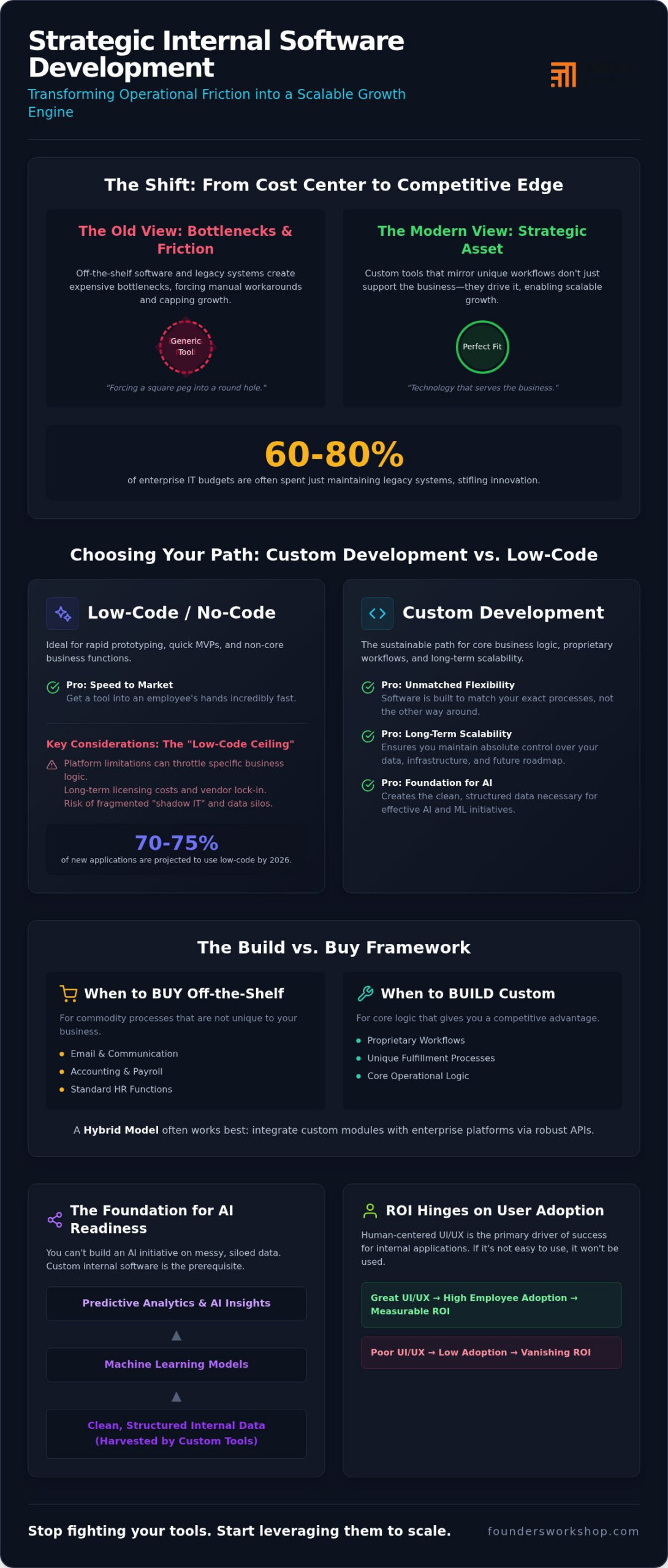
Internal business software is the digital nervous system of modern operations. Historically, many organizations viewed these tools as a necessary cost center; a burden on the IT budget that simply kept the lights on. By 2026, this perspective has fundamentally shifted. High-growth companies now treat internal business software development as a primary profit center. When your software is built to match your unique business logic, it doesn’t just support the business; it drives it.
Standard SaaS platforms often leave a significant “feature gap.” You might find that your team spends hours every week performing manual workarounds because your off-the-shelf tool doesn’t account for a specific step in your fulfillment process. Research indicates that enterprises often allocate 60% to 80% of their IT budgets just to maintain legacy systems, which leaves little room for the innovation required to close these gaps. Custom development ensures that every click and data entry point aligns with your strategic vision, allowing your operations to scale without a linear increase in headcount.
Operational Efficiency vs. Competitive Advantage
Standardizing your workflows is the essential first step toward scaling. Without a unified digital foundation, your processes rely on individual tribal knowledge, which is a recipe for inconsistency. Custom internal tools turn these processes into repeatable, automated sequences. For example, custom executive dashboards can reduce decision-making time from days to minutes by consolidating fragmented data into a single, authoritative view. This isn’t just about speed; it’s about clarity. These tools only work if people use them, which is why human-centered design is critical. If an internal tool is difficult to navigate, adoption will fail, and your ROI will vanish.
Internal Software as a Foundation for AI Readiness
You can’t build a sophisticated AI initiative on a foundation of messy, siloed data. Clean internal data structures are the mandatory prerequisite for any effective AI strategy consulting engagement. Your internal software acts as the primary data harvester, ensuring information is structured and ready for machine learning models. As we navigate the 2026 automation wave, the businesses that succeed will be those that integrated predictive analytics directly into their daily workflows. Instead of looking at what happened last month, your team should use internal tools that suggest what to do next based on real-time operational data.
Custom Development vs. Low-Code: Choosing the Right Path
The debate between custom engineering and low-code platforms often centers on speed, but the real conversation should be about sustainability. By 2026, industry data suggests that 70% to 75% of new applications will utilize low-code or no-code technologies. This surge is driven by the need for rapid prototyping and quick MVPs. However, a seasoned leader knows that speed at the start doesn’t always translate to velocity over time. Evaluating the total cost of ownership (TCO) requires looking past the initial setup to the long-term licensing, maintenance, and the inevitable “Low-Code Ceiling” where platform limitations begin to throttle your specific business logic.
The Build vs. Buy Framework
Deciding when to invest in custom internal business software development requires a clear distinction between commodity processes and competitive advantages. You should buy off-the-shelf software for tasks that aren’t unique to your business, such as email, accounting, or standard HR functions. These are solved problems. Conversely, you should build when the software manages your core business logic or proprietary workflows. If your process is what makes you better than your competitors, you can’t afford to have that logic trapped in a third-party vendor’s rigid framework. A hybrid model often works best, where you use robust APIs to integrate custom-built modules with established enterprise platforms.
Scalability and Technical Debt
Low-code tools are excellent for getting a tool into an employee’s hands by next Tuesday, but they can inadvertently create a fragmented ecosystem of “shadow IT.” This creates a new form of technical debt where data is siloed and security governance becomes nearly impossible to enforce. Custom-coded architecture provides the long-term sustainability needed for enterprise-grade tools. It ensures you maintain absolute control over your data and infrastructure, rather than being at the mercy of a platform’s pricing changes or feature deprecations. For leaders looking to navigate these complex choices, partnering with an experienced internal software development team can provide the clarity needed to choose the most sustainable path forward.
Enterprise-grade security is another critical factor. While low-code platforms offer built-in security, they often lack the granular control required for complex compliance environments, especially in sectors like healthcare. Custom internal business software development allows for “security by design,” where every layer of the application is hardened specifically for your risk profile. This disciplined approach removes technical friction and provides the peace of mind that your proprietary data remains secure as you scale.
Modernizing Legacy Internal Systems: A Growth Imperative
Legacy software eventually becomes an anchor that no amount of manual effort can overcome. You’ll recognize the signs when integrations fail, simple updates take weeks, and your engineering team is hesitant to touch the core database for fear of breaking a critical workflow. Technical debt is the interest paid on poor architectural decisions. In the context of internal business software development, ignoring these signs doesn’t just slow you down; it creates a ceiling on your ability to adopt the AI and automation tools required to stay competitive in 2026.
The “Big Bang” approach, where you scrap everything to start from scratch, is a high-stakes gamble that seasoned leaders avoid. It often leads to massive operational disruptions and budget overruns that can take years to recover from. Instead, successful modernization relies on refactoring legacy code through a disciplined, incremental methodology. This strategy allows you to replace high-friction components piece by piece while the rest of the system continues to function. It ensures business continuity while steadily improving the underlying architecture.
Audit and Assessment: Mapping the Legacy Landscape
Before writing a single line of new code, you must map your existing dependencies and identify where data silos are throttling your velocity. Legacy systems are often a web of hidden connections where one change can have unintended consequences across the entire organization. We recommend an ROI-based prioritization for your roadmap. Evaluate which modules cause the most daily friction for your employees or where the highest maintenance costs reside. Modernizing these high-impact areas first provides immediate proof of value and builds the momentum needed for larger systemic changes.
Modernizing with Cloud-Native Architecture
Modernization is the ideal time to transition from fragile monolithic structures to a resilient cloud-native architecture. By breaking your system into microservices, you ensure that a failure in one specific area doesn’t bring down your entire operation. Utilizing serverless functions and containerized tools allows your internal software to scale automatically based on demand, which is far more cost-effective than maintaining underutilized servers. This shift also provides a critical opportunity to harden your security. You can implement zero-trust protocols and modern encryption that legacy systems simply weren’t designed to handle, providing long-term peace of mind.
The Development Roadmap: From Discovery to Deployment
The most successful internal business software development projects begin long before the first line of code is written. We’ve seen many founders rush into coding, only to realize six months later that the tool doesn’t solve the core operational bottleneck. The Discovery Phase is your safeguard against this. It’s a period of intense alignment where technical requirements are mapped directly to business outcomes. By identifying key performance indicators early, you ensure the final product isn’t just functional, but transformative.
Agile methodology is the standard for a reason. It allows for iterative feedback loops that keep the project on track as your business needs evolve. Instead of waiting months for a finished product, your team sees progress in two-week sprints. This transparency builds trust and allows for course corrections before expensive mistakes are baked into the architecture. It’s a disciplined approach that prioritizes the delivery of high-value features first.
Human-Centered Design for Employees
Usability isn’t just a luxury for consumer apps; it’s a primary driver of ROI for internal tools. If an employee finds a tool difficult to use, they’ll find a way to work around it, rendering your investment useless. Applying consumer-grade UX standards to internal business software development reduces training time and minimizes data entry errors. Wireframing plays a critical role here, allowing stakeholders to visualize workflows and provide feedback on the interface before development begins. This human-centered approach ensures that the software actually supports the person doing the work.
Testing, QA, and Continuous Integration
Stability is non-negotiable when a tool manages your core business logic. Implementing CI/CD pipelines ensures that updates are deployed smoothly without breaking existing functionality. Automated testing acts as a safety net, catching regressions in your core logic before they reach the production environment. We always recommend maintaining a dedicated staging environment that mirrors your live setup. This allows your internal power users to beta test new features in a safe space, providing real-world validation that the tool is ready for a full-scale rollout.
Execution is the bridge between a strategic vision and a tangible competitive advantage. If you’re ready to turn your operational challenges into a custom solution, our team provides the internal software development expertise required to build tools that scale with your business. We focus on delivering reliable, human-centered results that remove technical friction and allow your team to focus on growth.
Partnering for Velocity: The Nearshore Advantage
Internal business software development is rarely a “set it and forget it” task. It requires deep, ongoing collaboration between your technical team and the stakeholders who use the tools daily. This is where traditional offshore models often fail. When your developers are twelve timezones away, simple feedback loops turn into 24-hour delays that stall your engineering velocity. By contrast, the nearshore model provides the real-time interaction necessary to maintain momentum and ensure that your tools evolve as quickly as your business needs.
Choosing nearshore staff augmentation allows you to work with talent in Latin America who share your business day. This alignment is critical when you’re refactoring legacy systems or building complex AI integrations that require constant communication. Beyond the logistical benefits, there’s a strong cultural affinity. Tech talent in Latin America often brings a proactive, problem-solving mindset that matches the pace and discipline of U.S. based organizations. It’s about finding a partner who understands the nuances of your business logic, not just someone who can write code.
Scaling Your Engineering Team Sustainably
Integrating nearshore developers into your existing business workflows shouldn’t feel like a disruption. It should feel like a natural extension of your internal team. The cost-efficiency is undeniable; as of September 2026, senior engineers in Latin America command hourly rates between $50 and $90. This represents a 40% to 65% saving compared to equivalent U.S. salaries without sacrificing technical quality or seniority. High communication standards are maintained through synchronous collaboration, ensuring that your strategic goals are translated into code without the friction of a language barrier or significant lag.
Choosing a Partner with 30 Years of Experience
At Founders Workshop, we don’t just provide developers; we act as a seasoned executive guide through the complexities of modernization. With over 30 years of leadership experience, we’ve navigated multiple eras of technology and understand that tools are always secondary to business outcomes. We’re committed to delivering human-centered results that prioritize employee adoption and long-term scalability. We bridge the gap between high-level strategy and technical execution, ensuring that your investment in internal business software development leads to measurable growth and operational peace of mind.
If you’re ready to transform your operational friction into a competitive advantage, we’re here to help you navigate the path forward. Schedule a consultation with Founders Workshop today to discuss how we can modernize your tech stack for the 2026 landscape.
Building a Resilient Foundation for Future Growth
The shift toward strategic internal business software development represents a fundamental change in how high-growth organizations operate. By treating your internal tools as profit centers rather than overhead, you remove the technical friction that often caps scalability. Whether you’re modernizing a legacy system to prepare for AI integration or building a custom platform from the ground up, the goal remains the same: creating a digital foundation that mirrors your unique business logic.
Success in the 2026 landscape requires more than just code; it requires a partner who understands the bridge between technical execution and long-term business strategy. Founders Workshop brings over 30 years of technical leadership to your project, specializing in legacy modernization and AI strategy to ensure your tools stay ahead of the curve. Our nearshore talent model provides the timezone alignment and real-time collaboration needed to maintain high engineering velocity throughout the development lifecycle.
It’s time to stop letting rigid, off-the-shelf software dictate your operational limits. Scale your business with custom internal software from Founders Workshop and build the tools your team needs to lead in your industry. Your path to a frictionless, scalable future is within reach.
Frequently Asked Questions
What is the average timeline for custom internal business software development?
Custom internal business software development projects usually span three to nine months depending on complexity. A Minimum Viable Product (MVP) often takes twelve to sixteen weeks to reach deployment. Larger legacy modernization efforts require a phased roadmap that can extend further to ensure business continuity. We prioritize a discovery phase to define these timelines accurately; this ensures technical requirements align with your actual business goals before coding begins.
How do I decide between building a custom tool and using a low-code platform like Appsmith?
Use low-code platforms for rapid prototyping or simple internal utilities that don’t handle proprietary business logic. If the tool manages your core competitive advantage, custom internal business software development is the safer long-term investment. Low-code often hits a “complexity ceiling” where licensing costs and platform limitations eventually outweigh initial speed. Custom builds offer total control over your data and infrastructure as you scale your operations.
Can custom internal software integrate with our existing legacy systems?
Yes, custom tools are specifically designed to bridge the gap between modern interfaces and legacy databases. We utilize APIs, middleware, or microservices to extract value from older systems without requiring a risky “Big Bang” replacement. This incremental approach allows you to modernize your operations while maintaining access to historical data. It’s a pragmatic way to improve efficiency while managing the technical debt that often throttles growth.
What are the security risks of developing internal tools with offshore teams?
Offshore teams often operate in timezones with twelve-hour differences, which creates significant delays in identifying and patching security vulnerabilities. This lag can leave your systems exposed longer than necessary. Additionally, differing legal frameworks regarding data privacy can complicate compliance for sensitive industries. Nearshore models mitigate these risks by offering real-time collaboration and closer alignment with U.S. data security standards and professional business practices.
How does nearshore staff augmentation differ from standard outsourcing?
Nearshore staff augmentation focuses on timezone alignment and high-collaboration integration rather than just handing off tasks to a third party. Your augmented team in Latin America works your exact hours; this allows for synchronous communication and agile sprints. Standard outsourcing often relies on asynchronous hand-offs that lead to misunderstandings. Nearshore developers become a true extension of your team, sharing your language and professional culture for smoother execution.
What is the typical ROI for modernizing legacy internal software?
ROI typically manifests through a 20% to 30% increase in employee productivity and a significant reduction in maintenance costs. Since enterprises often spend 60% to 80% of IT budgets on legacy upkeep, modernization frees up capital for innovation. You’ll also see gains from AI readiness and better data accuracy. These improvements directly impact your bottom line by removing the manual workarounds that slow down your engineering velocity.
Do we need to hire a full-time CTO to manage internal software development?
You don’t always need a full-time executive hire to manage your technical roadmap. Many founders find success by partnering with a seasoned development agency that provides strategic guidance alongside execution. This “fractional leadership” model gives you access to thirty years of industry experience without the overhead of a C-suite salary. It allows you to focus on business growth while experts handle the complexities of software architecture and deployment.
How do we ensure employee adoption for a new internal software system?
Adoption is driven by human-centered UI/UX design that solves specific employee pain points. If a tool is intuitive and saves them time, they’ll use it. We recommend involving “power users” early in the discovery phase and throughout iterative testing. When employees feel their feedback is reflected in the final product, they become internal advocates for the new system, which significantly lowers the barrier to organizational change and training.