

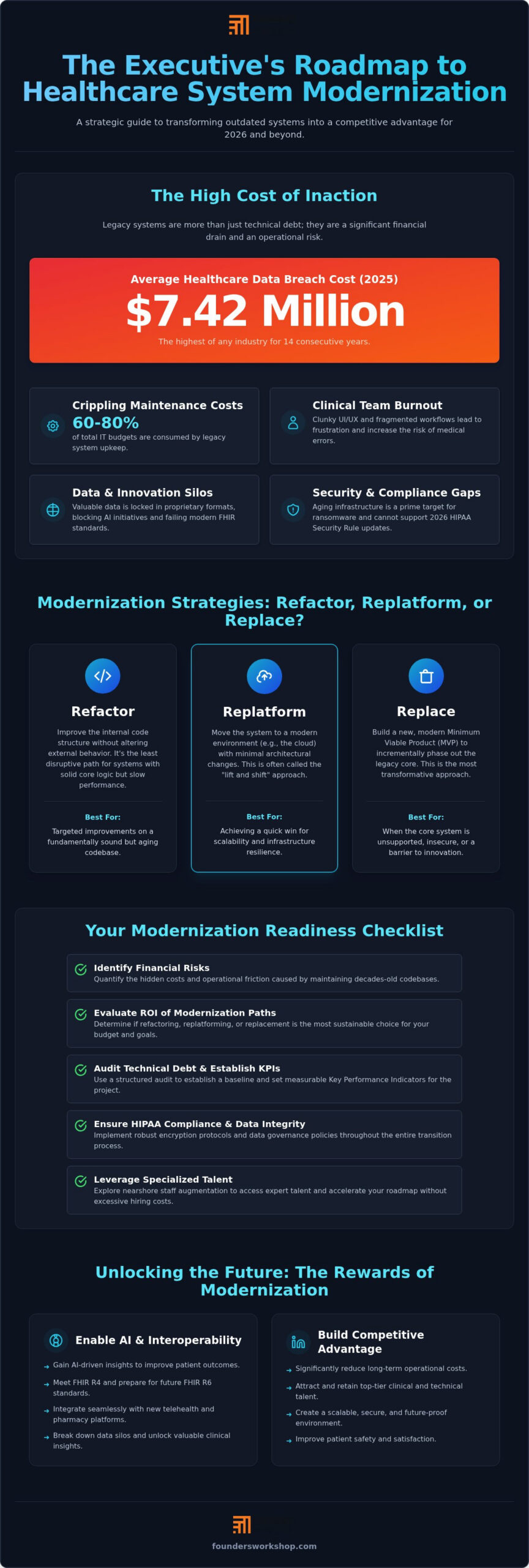
Did you know that the average healthcare data breach cost reached $7.42 million in 2025, marking the highest of any industry for 14 consecutive years? For many executive leaders, the risk isn’t just the price of a breach; it’s the invisible weight of technical debt. You’ve likely felt the friction of high maintenance costs for aging infrastructure and the frustration of a clinical team struggling with clunky UI/UX that leads to burnout. It’s a difficult position when you want to innovate with AI but find your data locked in silos that can’t speak the language of modern FHIR standards.
We understand that the prospect of legacy healthcare system modernization feels like performing surgery on a moving vehicle. You need a path forward that ensures zero downtime and unwavering HIPAA compliance. This comprehensive guide serves as your executive roadmap and technical checklist for 2026. We’ll walk through a disciplined strategy to reduce operational costs, secure your code against 2026 regulatory changes, and build a scalable environment that attracts top-tier clinical talent. From implementing the “strangler fig” pattern to preparing for FHIR R6, you’ll learn how to transform your outdated systems into a competitive advantage.
Key Takeaways
- Identify the hidden financial risks and operational friction caused by maintaining codebases that are decades old.
- Evaluate the ROI of specific modernization paths to determine whether refactoring or replatforming is the most sustainable choice for your budget.
- Use a structured readiness checklist to audit technical debt and establish measurable KPIs for your legacy healthcare system modernization project.
- Ensure continuous HIPAA compliance and data integrity by implementing robust encryption protocols throughout the transition process.
- Discover how to leverage nearshore staff augmentation to access specialized talent and accelerate your roadmap without the high costs of local hiring.
Beyond Technical Debt: The High Cost of Legacy Healthcare Systems
Legacy systems in the US healthcare landscape represent more than just outdated technology; they are structural barriers that stifle innovation and compromise patient safety. When an organization relies on codebases that are 10 to 20 years old, they aren’t just dealing with slow performance. They are managing a hidden financial drain. Industry data shows that legacy maintenance costs often consume 60% to 80% of total IT expenditures, leaving little room for growth. Beyond the balance sheet, clunky UI and fragmented workflows are direct contributors to physician burnout and increased medical errors. Prioritizing legacy healthcare system modernization allows leaders to reclaim their budgets and protect their clinical staff.
The cost of inaction is rising at an alarming rate. Between January 1 and April 30, 2026, 252 large healthcare data breaches were reported in the US. This isn’t just a technical issue; it’s a systemic failure of aging infrastructure that cannot keep pace with modern threats. Modernization is a strategic necessity for 2026 regulatory compliance and operational survival. It’s the difference between a system that serves the patient and one that serves as a liability. Much like how Mold Pros Phoenix provides critical resources for identifying and remediating physical hazards in aging buildings, healthcare leaders must address the ‘digital rot’ of legacy systems to ensure patient safety.
The Security and Compliance Vulnerability Gap
Aging infrastructure creates a massive target for healthcare ransomware. Unsupported platforms often lack the architecture needed to implement modern security controls like multi-factor authentication (MFA) or granular network segmentation, both of which are central to the 2026 HIPAA Security Rule updates. Maintaining compliance on these systems is becoming prohibitively expensive. Some organizations spend upwards of $800,000 annually just to keep a single legacy claims system audit-ready. In this context, technical debt is the accumulated risk of non-compliance and security failure that grows every day a patch is unavailable or a system remains unmonitored. Leaders must adopt proactive software modernization strategies to close these gaps before they result in a multi-million dollar breach.
Incompatibility with Modern AI and Interoperability Standards
The most significant reward for legacy healthcare system modernization is the ability to leverage AI. However, legacy systems act as data silos, locking away valuable clinical insights in proprietary formats. These systems frequently fail to meet current FHIR R4 requirements or prepare for the upcoming FHIR R6 standards expected in late 2026. Without interoperability, your organization remains isolated from the broader digital health ecosystem. This creates a competitive disadvantage where you can’t integrate with new telehealth tools or pharmacy platforms. Modernizing your stack is the only way to ensure your data flows seamlessly across platforms, allowing for the faster, AI-driven insights that improve patient outcomes.
Modernization Strategies: Refactor, Replatform, or Replace?
Choosing the right path for legacy healthcare system modernization is a high-stakes decision that dictates your ROI for years. It isn’t a one-size-fits-all scenario. We typically categorize these moves into three strategic buckets: refactoring, replatforming, or full replacement. Refactoring involves improving the internal code structure without altering external behavior. It’s often the least disruptive path for systems with solid core logic. Replatforming moves the system to the cloud with minimal architectural changes, offering a quick win for scalability. Replacement involves building a modern MVP to phase out the legacy core entirely. This comprehensive guide to modernization provides an excellent framework for evaluating these choices against your specific business goals.
A full replacement strategy often begins with a lean, functional MVP. This allows you to test new features in a live environment while the legacy system continues to handle the heavy lifting of back-office records. It’s a pragmatic way to innovate without risking the stability of your entire operation. This approach ensures that you don’t over-invest in features that your clinical staff might not actually use.
When to Refactor vs. When to Rebuild
Deciding between saving a codebase or starting fresh requires a cold-eyed audit of your technical debt. If the core logic is sound but the delivery is slow, refactoring might be the answer. However, if the underlying language is unsupported or security vulnerabilities are baked into the foundation, a rebuild is often safer. Many organizations find success with the “Strangler Fig” pattern. This involves incrementally replacing legacy modules with new services until the old system is eventually “strangled” and retired. It’s a disciplined way to manage risk while maintaining clinical operations. If you’re unsure which path fits your current infrastructure, our team at Founders Workshop can help you conduct a technical audit to determine the most cost-effective roadmap.
The Role of Cloud-Native Architecture in Healthcare
Moving to a cloud-native environment on AWS or Azure is no longer optional for 2026. It’s the foundation for scalability and disaster recovery. Cloud platforms offer built-in high availability, ensuring that critical patient data remains accessible even during localized outages. Beyond uptime, cloud migration facilitates easier system integrations through robust API management. This transition simplifies the process of connecting to external diagnostic tools or wearable data. By shifting from on-premise servers to managed cloud services, you reduce the burden on your internal IT team and gain access to advanced security tools that are updated in real-time. This shift is a primary driver for legacy healthcare system modernization, allowing organizations to leverage scalability and cost control that on-premise hardware simply can’t match.
The Healthcare System Modernization Readiness Checklist
Preparation is eighty percent of the battle in any large-scale technical transition. For legacy healthcare system modernization to succeed, you need more than a budget; you need a structured framework that accounts for both clinical workflows and technical dependencies. Jumping into development without a clear audit often leads to scope creep and unexpected downtime. A successful roadmap begins by documenting every integration point and identifying which parts of your infrastructure are truly mission-critical. This process ensures that when you flip the switch, patient care remains uninterrupted.
To keep the project on track, your team must establish clear, measurable KPIs from day one. These shouldn’t just be technical metrics like system latency or uptime. They should include human-centered goals such as user satisfaction scores from your nursing staff and the time required to complete standard clinical documentation. Securing buy-in across clinical, financial, and IT departments is essential to prevent internal friction. When every stakeholder understands how the new system reduces their specific pain points, the path to adoption becomes much smoother.
Your readiness checklist should include these core pillars:
- Technical Debt Audit: Document all third-party dependencies and unsupported code libraries.
- KPI Definition: Set benchmarks for latency, clinician clicks per task, and system recovery times.
- Stakeholder Alignment: Host cross-departmental workshops to define “success” for each team.
- Data Flow Mapping: Visualize how data moves from the point of care to the billing office to ensure zero loss.
- Security Baseline: Establish a HIPAA-compliant foundation that includes multi-factor authentication and network segmentation as required by the 2026 standards.
Phase 1: Discovery and Strategic Alignment
The first step is identifying “low-hanging fruit.” These are small technical wins that provide immediate, visible value to clinicians, such as faster login times or simplified search functions. While these are implemented, assess your current team’s capacity. Modernization is a heavy lift that often requires external support to maintain daily operations. Your technical roadmap must align with your long-term AI strategy. If your data isn’t structured correctly now, you’ll find it impossible to leverage predictive analytics later.
Phase 2: Technical Execution and Data Migration
Execution requires standardizing all data formats to meet FHIR R4 and HL7 requirements. This interoperability is what allows your system to communicate with the broader digital health ecosystem. Always create a robust fallback plan for every stage of the migration process. If a data transfer fails, you must be able to revert to the previous state instantly. Data cleansing before migration is the critical filter that prevents legacy errors from polluting your new, high-performance architecture.
Ensuring Compliance and Security During the Transition
Security during a transition isn’t just a technical requirement; it’s a legal obligation that becomes more complex when data is in motion. During legacy healthcare system modernization, your organization is at its most vulnerable. Protecting patient records while they move between old databases and new cloud environments requires a zero trust architecture. You must maintain continuous HIPAA compliance by ensuring that data in transit is protected with the same rigor as data at rest. This involves more than simple encryption; it requires a disciplined approach to network segmentation and the implementation of multi-factor authentication (MFA) across every access point.
The 2026 updates to the HIPAA Security Rule transition many previously “addressable” safeguards into mandatory requirements. This means defined audit schedules and regular penetration testing are no longer optional best practices; they are now core components of your modernization lifecycle. Implementing Role-Based Access Control (RBAC) ensures that only authorized personnel can access sensitive clinical data, reducing the risk of internal breaches. If you’re concerned about maintaining these standards during a complex migration, our team provides HIPAA-compliant healthcare software development to help you navigate these regulatory hurdles safely.
Interoperability: The Key to Future-Proofing
Building a modern system is an opportunity to break down the silos that have traditionally isolated healthcare data. A successful legacy healthcare system modernization project ensures your system can communicate effortlessly with third-party labs, pharmacies, and imaging centers. This connectivity is driven by robust APIs that create a unified healthcare ecosystem. When your data is accessible and standardized, you can offer significantly better patient portal experiences. Patients can view their results faster, schedule appointments more easily, and engage with their care plans in real-time, which ultimately drives higher patient retention and satisfaction.
Human-Centered Design for Clinical Adoption
Technical success doesn’t matter if your clinical staff rejects the new system. We focus on human-centered design to reduce the steep learning curve often associated with new software. By involving physicians and nurses in the beta testing phase, you can identify UI/UX friction points before the full rollout. This collaborative approach ensures the interface is intuitive and supports existing clinical workflows rather than hindering them. Better software design does more than just reduce burnout; it directly improves patient outcomes by minimizing the risk of documentation errors and allowing clinicians to spend more time with their patients.
Executing Your Roadmap: How Founders Workshop Bridges the Gap
Success in legacy healthcare system modernization requires more than just technical proficiency; it demands a partner who has navigated multiple eras of technology. At Founders Workshop, we bring over 30 years of leadership experience to every project. We don’t view modernization as a “rip-and-replace” event but as a strategic de-risking of your business. Our approach is grounded in accountability, ensuring that every technical decision aligns with your long-term clinical and financial goals. We bridge the gap between where your system is today and where it needs to be to support the next decade of growth.
We understand that the stakes are high. A failed transition can disrupt patient care and damage your reputation. That’s why our methodology is methodical and highly structured. We move logically from identifying your strategic needs to explaining a clear execution path. This disciplined focus on business outcomes ensures that your technology serves your people, not the other way around. By removing technical friction, we allow your healthcare organization to focus on what matters most: improving patient lives.
The Nearshore Advantage for Healthcare Modernization
Finding specialized talent in the US is increasingly difficult and expensive. We solve this through nearshore staff augmentation, providing access to high-quality tech talent in Latin America. Because our teams work in US timezones, they integrate seamlessly into your existing workflows. This alignment is critical for agile healthcare software development, where real-time communication prevents the bottlenecks common with offshore models. Our developers aren’t just external contractors; they are dedicated personnel who function as a true extension of your team, sharing your commitment to human-centered results and HIPAA-compliant excellence.
From Legacy to AI-Ready: The Founders Roadmap
The ultimate reward for legacy healthcare system modernization is the ability to unlock the value of your data. Once we’ve cleared your technical debt, we help you implement an AI strategy that turns static records into predictive insights. We’ve seen this transformation firsthand when modernizing internal business software for efficiency, where cleaner data structures led to faster decision-making and reduced operational friction. We are committed to building scalable systems that allow you to attract top-tier clinical talent and provide superior patient care through faster, data-driven insights.
Ready to take the first step toward a more resilient infrastructure? Schedule a Modernization Strategy Session with our veteran team today. We’ll help you audit your current technical debt and build a pragmatic roadmap that delivers measurable ROI while keeping your clinical operations stable.
Securing Your Healthcare Legacy for a Digital-First Future
The shift toward a modern infrastructure is a strategic commitment to clinical excellence and operational longevity. By moving beyond technical debt, you’re not just updating software; you’re creating a scalable foundation for AI-driven insights and seamless interoperability. Successful legacy healthcare system modernization requires a disciplined roadmap that balances technical execution with human-centered design to ensure your clinical staff thrives in a friction-free environment.
Navigating this transition alone places a significant burden on internal teams. We offer a steady hand rooted in 30+ years of executive-led leadership and specialized healthcare tech development expertise. Our nearshore talent model provides the high-quality engineering you need in your own US timezone, ensuring agile collaboration without the friction of offshore delays. We’re here to help you bridge the gap between outdated code and a future-proof ecosystem that prioritizes patient safety and data security.
Partner with Founders Workshop for Your Legacy Modernization and turn your technical liabilities into a lasting competitive advantage. Your clinical team and your patients deserve a system that works as hard as they do.
Frequently Asked Questions
What are the biggest risks of legacy healthcare system modernization?
The primary risks include data migration errors, clinical workflow disruption, and unexpected budget expansion. Organizations must also navigate the risk of non-compliance if the new architecture fails to meet the 2026 HIPAA Security Rule updates. Proper planning and a phased rollout are essential to mitigate these vulnerabilities and ensure patient care remains stable throughout the transition.
How long does a typical healthcare software modernization project take?
Project timelines vary based on the complexity of the legacy codebase and the chosen strategy. An incremental refactoring project might span 6 to 18 months, while a full system rebuild can take 24 months or longer. We recommend a phase-based approach that delivers functional MVPs early to provide immediate value while the larger transition continues in the background.
Can we modernize our legacy system without a total shutdown?
Yes, you can maintain clinical operations by using the “Strangler Fig” pattern to replace modules incrementally. This approach allows the legacy system to handle core tasks while new features are rolled out in parallel. By avoiding a “big bang” migration, you reduce the risk of downtime and ensure that critical patient data remains accessible at all times.
What is the difference between refactoring and replatforming in healthcare?
Refactoring involves restructuring the existing code to improve performance and maintainability without changing how the system looks to the user. Replatforming focuses on moving the application to a cloud environment, such as AWS or Azure, with minimal changes to the core architecture. Both are effective tactics within a broader legacy healthcare system modernization strategy depending on your specific ROI goals.
How does legacy modernization improve HIPAA compliance?
Modernization replaces outdated security protocols with advanced controls like multi-factor authentication, granular role-based access, and end-to-end encryption. These updates are necessary to meet 2026 regulatory standards that require stricter audit schedules and network segmentation. A modern system provides the transparency and logging capabilities needed to pass rigorous compliance audits that legacy code simply can’t support.
Why should we consider nearshore staff augmentation for our modernization project?
Nearshore staff augmentation provides access to high-tier engineering talent in Latin America while maintaining full timezone alignment with US-based clinical teams. This model is more cost-effective than hiring local US talent and offers better collaboration than offshore teams in distant timezones. It allows you to scale your modernization efforts quickly with dedicated experts who understand the nuances of healthcare technology.
What role does AI play in the modernization of healthcare systems?
AI serves as the strategic reward for modernizing legacy data silos into interoperable, FHIR-compliant structures. Once data is cleaned and standardized, AI can be deployed for predictive analytics, automated documentation, and clinical decision support. Modernization is the prerequisite that allows these advanced tools to access the data they need to improve patient outcomes and operational efficiency.
How much does legacy system modernization cost in 2026?
Costs are determined by the scale of the infrastructure and the level of technical debt present in the existing system. While the initial investment is significant, it’s balanced against the fact that legacy maintenance typically consumes 60% to 80% of total IT budgets. Strategic modernization is designed to reduce these long-term operational expenditures and prevent the massive costs associated with data breaches and regulatory fines. To plan your budget effectively, you may also want to explore Professional service fees for accessibility remediation and recurring monitoring subscriptions to ensure your new system is compliant with all digital standards.