Most engineering leaders treat nearshoring as a simple procurement task when it is actually a deep cultural transformation. If you’ve ever felt like your external developers are operating in a “black box,” you aren’t alone. Many US-based firms struggle with nearshore team integration challenges that manifest as communication lags and missed sprint requirements. It is a frustrating cycle that drains your resources, slows down your velocity, and creates a visible divide between your internal and external teams.
We understand that the goal isn’t just to hire talented developers; it’s to build a unified engineering engine that delivers predictably and scales with your vision. You want your Latin American talent to function as a natural, high-velocity extension of your core team. This guide provides a strategic 2026 roadmap to bridge those operational gaps. We will explore how to eliminate technical friction, increase project visibility, and foster a borderless company culture that drives long-term innovation and business growth.
Key Takeaways
- Move beyond the vendor-client model by adopting an integration mindset that treats nearshore developers as a core part of your engineering engine.
- Identify and bridge the “invisible walls” of communication by solving nearshore team integration challenges through context fluency and cultural alignment.
- Maximize operational velocity by utilizing the LatAm timezone advantage to maintain synchronous workflows and eliminate the delays typical of offshore development.
- Follow a structured engineering roadmap that prioritizes internal readiness and an integrated onboarding experience to ensure high velocity from day one.
- Scale your technical capabilities with a human-centered approach that prioritizes long-term partnership and accountability over simple staff augmentation.
Beyond Outsourcing: The Strategic Shift to Nearshore Team Integration
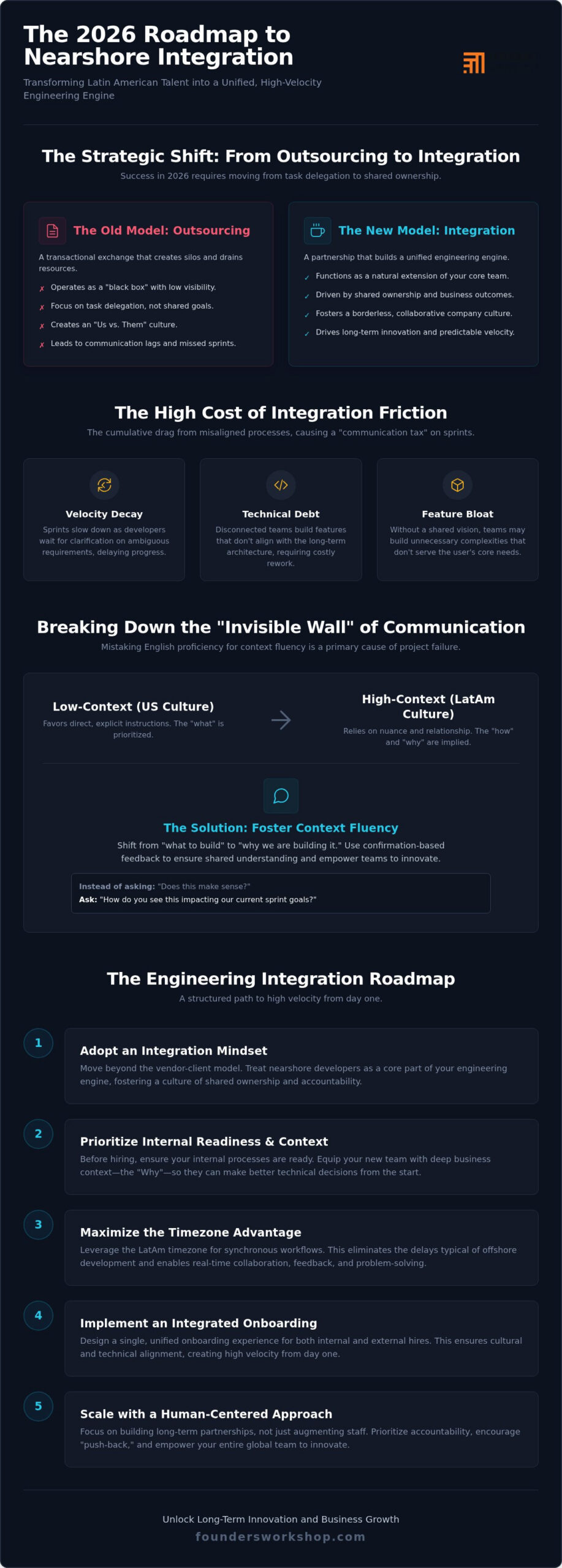
Traditional outsourcing is often a transactional exchange where you send a ticket and eventually receive code. By 2026, this model has become a liability for high-growth startups. Success now requires a fundamental shift toward team integration. While a basic understanding of what is nearshoring provides the geographic context, the modern executive must view these partners as a direct extension of their internal engineering culture. Integration is about shared ownership, whereas outsourcing is about task delegation.
The most persistent nearshore team integration challenges usually stem from a mindset of separation. When US engineering leaders treat their Latin American counterparts as “external help,” they inadvertently build silos. This “Us vs. Them” trap creates a lack of accountability and visibility. Strategic alignment occurs only when every developer understands the “Why” behind the product roadmap. When your nearshore team is connected to the business outcomes of an MVP, they make better technical decisions. This clarity protects your ROI by reducing the need for costly rework and management friction.
The Evolution of Staff Augmentation in 2026
The Latin American talent pool has matured into a hub of “product-thinkers” who do more than just execute commands. They provide strategic value by identifying potential technical debt before it reaches production. This shift is why nearshore staff augmentation has become the preferred model for scaling startups that require high agility. Senior leadership plays a critical role here. By setting a tone of cross-border collaboration, you ensure that your global team feels empowered to innovate rather than just follow a backlog.
Identifying the Cost of Integration Friction
Poor integration isn’t just a minor inconvenience; it’s an expensive drain on your resources. We often see a “communication tax” levied on development sprints when context is lost between borders. This friction leads to several measurable problems:
- Velocity Decay: Sprints slow down as developers wait for clarification on ambiguous requirements.
- Technical Debt: Disconnected teams often build features that don’t align with the long term architecture.
- Feature Bloat: Without a shared vision, teams may build unnecessary complexities that don’t serve the user.
Integration Friction is the primary barrier to engineering velocity, representing the cumulative drag caused by misaligned processes and cultural silos.
At Founders Workshop, we’ve spent 30 years helping leaders navigate these complexities. We know that removing technical friction is the only way to allow for true business growth. When you treat integration as a structural evolution rather than a hiring task, you unlock the full potential of your nearshore partnership.
Navigating the Three Invisible Walls of Remote Collaboration
Successful integration requires more than just shared access to a GitHub repository. Even with timezone alignment, teams often hit “invisible walls” that derail productivity. These barriers aren’t technical; they’re human. If your US-based leaders don’t proactively dismantle these walls, you’ll find that nearshore team integration challenges quickly evolve from minor delays into systemic project failures.
The first wall is the Communication Gap. Many leaders mistake English proficiency for “context fluency.” Context fluency is the ability to understand the underlying business logic behind a technical requirement. Without it, a developer might build exactly what you asked for, but not what the user actually needs. Breaking this wall requires shifting from “What to build” to “Why we are building it.” This ensures that every line of code serves the broader product vision.
High-Context vs. Low-Context Communication
Communication styles in Latin America often lean toward “high-context,” where the relationship and the nuance of the interaction carry significant weight. In contrast, US engineering culture is typically “low-context,” favoring direct and explicit instructions. This mismatch can lead to misunderstandings during feedback loops. To navigate this, US leaders should adopt a “confirmation-based” feedback framework. Instead of asking “Does this make sense?”, ask “How do you see this impacting our current sprint goals?”
Encouraging “push-back” is essential for long-term velocity. If your nearshore team feels they must agree with every onshore decision, you lose their expertise. Use daily stand-ups as a cultural bridge. These meetings should be spaces where proactive problem-solving is rewarded and where personal rapport is built alongside technical updates. This creates the psychological safety needed for engineers to voice concerns early, preventing small issues from becoming major bottlenecks.
Building Domain Expertise at a Distance
A lack of business domain knowledge is the third wall that stalls technical execution. When developers don’t understand the industry they’re building for, they can’t anticipate edge cases. You can bridge this gap by including nearshore developers in strategic MVP development and product discovery sessions. This involvement ensures that the technical architecture remains aligned with your business growth goals from the start.
One effective method is the “Shadowing” technique. Allow your remote team to observe user testing or listen to customer success calls. Immersing them in the user’s actual pain points transforms them from external contractors into product-thinkers. If you are struggling to align your distributed team, our experts can help you establish a unified engineering culture that removes these collaboration barriers for good.
Maximizing the Timezone Advantage: Tools and Synchronous Workflows
The geographic proximity of Latin America offers more than just convenient meeting times; it provides a structural foundation for high-velocity engineering. One of the most significant nearshore team integration challenges is the friction caused by delayed feedback. In offshore models, a developer might spend half a day waiting for a clarification from a US architect. By the time the answer arrives, the developer has lost their flow state. Nearshoring eliminates this 12 hour feedback loop. While some firms attempt a “Follow-the-Sun” model, true velocity comes from real-time collaboration that doesn’t sacrifice the team’s shared context. When your teams work in the same or adjacent timezones, they operate in a shared rhythm that allows for immediate course correction and continuous delivery.
100% synchronous work hours are the “secret sauce” of this model. It allows for spontaneous collaboration that mimics the environment of a physical office. This real-time interaction is vital for maintaining a single source of truth across a distributed team. It ensures that everyone is working from the same context, which directly mitigates the risk of technical drift. When your developers can jump on a call and solve a blocker in minutes rather than days, your delivery cycles become predictable and resilient.
The Synchronous vs. Asynchronous Balance
Effective integration requires a disciplined approach to communication. While Slack and Teams are excellent for low stakes updates, high complexity problems require immediate voice or video interaction. We recommend jumping on a “Huddle” or a quick call whenever a discussion exceeds three messages. This prevents the ambiguity that often stalls progress. It’s a simple rule that saves hours of unnecessary back-and-forth.
Structure the workday to maximize “Golden Hours,” the four to six hours of total overlap where pair programming and collaborative architecture reviews occur. During these windows, prioritize synchronous tasks that require high cognitive alignment. Outside of these hours, focus on deep work and documentation. Robust documentation is the backbone of a unified engineering engine; it ensures that decisions made during “Golden Hours” are accessible to everyone at any time.
AI-Enhanced Integration Strategies
By 2026, AI has become a mandatory layer in the integration stack. Modern teams use AI-driven tools for real-time code reviews and automated knowledge sharing. These tools can scan pull requests and provide instant feedback based on your specific architectural standards, effectively acting as an automated mentor for new team members. This speeds up onboarding and ensures consistency across the codebase.
Integrating these tools requires a deliberate roadmap. Engaging in AI strategy consulting can help you identify specific automation opportunities that reduce administrative overhead in your integration workflow. These implementations not only speed up delivery but also improve data security and IP protection by ensuring that AI assistants operate within a private, distributed environment. This proactive stance on technology allows you to scale with certainty while maintaining the human-centered focus that defines successful partnerships.
The Engineering Integration Roadmap: From Day 1 to High Velocity
Building a high-velocity engineering team isn’t a one-time event; it’s a series of deliberate, strategic steps. While workforce solutions experts like Human Bees can help you source talent across various sectors, many nearshore team integration challenges arise because companies skip the “ready” phase and attempt to hire talent before their own internal processes are mature. To achieve seamless collaboration, you must move beyond the mindset of “adding heads” and focus on building a unified operational foundation.
Treating nearshore hires like local employees is a non-negotiable requirement for success. They shouldn’t feel like a separate entity or a vendor. Instead, they need the same access to Slack channels, company town halls, and internal documentation as your US-based staff from day one. This inclusive approach builds the cultural affinity and psychological safety necessary for long-term retention and high performance.
Before you expand, audit your technical foundation. This often involves refactoring legacy code to ensure that new developers aren’t inheriting a mess that stalls their initial momentum. If your codebase is a “black box” to you, it’ll be impossible for a remote team to navigate it efficiently. Standardize your development environments to ensure a “one-click” setup. A developer in Medellin should have the exact same environment as your lead in the US.
Appoint an “Integration Lead” within your US team to champion the partnership. This person isn’t just a project manager; they’re the bridge between cultures and timezones. Their role is to ensure that the nearshore team never feels like an afterthought and that technical blockers are cleared in real-time. This leadership role is vital for maintaining the “founder mindset” as the team scales.
Measuring What Matters: Beyond Lines of Code
Traditional metrics like “lines of code” or “tickets closed” are vanity numbers that don’t reflect the health of your integration. Instead, track “Time to First PR.” This measures how quickly your onboarding process actually works. A high-velocity team should be able to contribute meaningful code within their first week. You should also measure “Collaboration Density,” which tracks how often US and LatAm engineers interact without a manager present. High density indicates a healthy, integrated team that’s solving problems organically.
Success must be tied to broader business outcomes. Align your engineering KPIs with the goals of your custom software development projects. When your team sees how their code impacts the bottom line, they become more than just coders; they become strategic partners. This transition from “ticket-takers” to “product-thinkers” is what allows for sustainable growth and predictable delivery cycles.
If you’re ready to bridge the gap between your US and LatAm teams, explore our nearshore staff augmentation services to build a unified engineering engine today.
Scaling with Certainty: The Founders Workshop Approach to LatAm Talent
Executing a successful integration requires more than just a checklist; it demands a partner who has navigated the shifting tides of technology for decades. At Founders Workshop, we bring 30 years of leadership experience to every partnership. We’ve seen how tools and frameworks evolve, but the core of successful engineering remains human centered. We don’t just provide a list of available developers. We design our services to specifically neutralize the nearshore team integration challenges that often stall high-growth companies. This seasoned perspective allows us to act as an executive guide, helping you avoid common pitfalls before they impact your burn rate.
Our philosophy is rooted in accountability and partnership. We prioritize developers who fit your specific culture as much as your technical stack. Tools are secondary to business outcomes. By focusing on engineers who take ownership of the product, we ensure that your nearshore team isn’t just executing tasks but actively contributing to your strategic vision. Our monthly retainer model provides the flexibility you need to scale without the administrative risk or the overhead of managing independent contractors. It’s a professional commitment designed to give you peace of mind while removing technical friction.
Vetted for Vision, Not Just Syntax
Our proprietary vetting process for Latin American talent goes beyond a simple code test. We’ve developed a LATAM-specific methodology that evaluates a candidate’s business acumen and their ability to operate within a US-based engineering culture. We look for “product-thinkers” who understand the “Why” behind a feature. This focus on soft skills and context fluency is what allows our engineers to integrate seamlessly into your existing team. We bridge the gap between high-tier LatAm talent and US startups by ensuring that every hire is prepared for the collaborative demands of a modern, distributed environment.
Long-term success depends on alignment. We vet for engineers who are disciplined, pragmatic, and empathetic to the struggles of scaling a company. This ensures that when you face a technical pivot or a tight deadline, your team has the resilience to navigate the challenge alongside you. We don’t believe in “black box” development; we believe in transparent, integrated partnerships that drive sustainable growth.
Your Strategic Partner in Growth
Managing a distributed team shouldn’t be an additional burden on your executive suite. Our role is to provide the steady hand needed to maintain operational velocity. We handle the complexities of vetting, onboarding, and ongoing performance coaching so you can focus on high-level strategy. This partnership model allows you to scale your technical capabilities with certainty, knowing that your engineering engine is built on a foundation of 30 years of industry experience.
Whether you’re building a new MVP or expanding an existing internal team, we offer the strategic support needed to ensure your technology serves your business goals. We are here to help you bridge the gap between your current capacity and your future vision. Scale your engineering team with LatAm’s best talent today.
Building Your Borderless Engineering Engine
Transitioning from a traditional vendor model to a fully integrated nearshore partnership is the most strategic move a US engineering leader can make. By focusing on cultural alignment and operational velocity, you transform your distributed team from a distant resource into a high-performance engine. Successfully navigating nearshore team integration challenges requires a deliberate blend of technical readiness and human-centered leadership. When you prioritize context fluency and maximize synchronous work hours, you eliminate the friction that typically slows down innovation.
Founders Workshop provides the steady hand you need to execute this transition with confidence. With over 30 years of executive leadership and a proprietary LatAm vetting process, we ensure your developers are 100% US-timezone aligned and ready to take ownership of your product vision. You don’t have to navigate these complexities alone; we handle the operational scaling so you can focus on high-level growth. It’s time to stop managing outsourced help and start leading a unified, global team that delivers with certainty.
Scale your engineering team with vetted LatAm talent—Schedule a Consultation
Frequently Asked Questions
What are the most common mistakes when integrating nearshore teams?
The most common mistake is failing to treat the nearshore team as a core part of the internal engineering engine. Leaders often skip the necessary onshore readiness, such as auditing documentation and refactoring legacy code. This creates a “black box” effect where external developers lack the context needed for technical execution. Avoiding these nearshore team integration challenges requires a shift from transactional delegation to strategic partnership from day one.
How do we handle cultural differences between US and Latin American developers?
Handling cultural differences requires moving beyond language fluency to “context fluency.” Latin American cultures are often high-context, meaning feedback loops should be direct yet inclusive. We recommend using a “confirmation-based” framework during daily stand-ups. This encourages developers to push back and provide proactive solutions. Building psychological safety ensures that cultural nuances enhance collaboration rather than creating invisible walls that stall your development sprints.
Is nearshore team integration more expensive than traditional offshoring?
While hourly rates in Latin America may be higher than some distant offshore regions, nearshoring is often more cost-effective when measuring total ROI. The primary savings come from eliminating the “communication tax” and the 12-hour feedback loop. Reduced rework and higher operational velocity mean projects reach the market faster. We focus on providing high-quality talent that reduces the executive burden and long-term management friction.
How can we ensure data security and IP protection with a nearshore partner?
We ensure data security by implementing strict NDAs and utilizing secure, distributed development environments. Our proprietary vetting process for Latin American talent includes background checks and security training tailored for US standards. We recommend using enterprise-grade collaboration tools that maintain a single source of truth and protect your intellectual property. This approach provides peace of mind while allowing your team to scale technical capabilities safely.
What tools are essential for managing an integrated nearshore engineering team?
A unified engineering engine relies on tools that support real-time collaboration and transparency. Slack or Microsoft Teams are essential for synchronous “Golden Hours,” while Jira and GitHub provide the necessary documentation for asynchronous work. By 2026, AI-driven code review and knowledge-sharing platforms have become mandatory for maintaining architectural standards. These tools ensure that every developer, regardless of location, has access to the same business logic and technical requirements.
How long does it typically take for a nearshore team to reach full velocity?
A well-integrated nearshore team typically reaches full velocity within two to four weeks. This timeline depends heavily on your onshore foundation and onboarding roadmap. If you provide a “one-click” development environment and clear documentation, developers can contribute their first PR within days. Our human-centered approach focuses on high-tier talent who can navigate complex technical and strategic pivots quickly, reducing the time spent in the learning phase.
Can nearshore developers help with our AI strategy and implementation?
Yes, our nearshore developers are specifically vetted for their ability to contribute to AI strategy and implementation. We specialize in identifying automation opportunities and building custom predictive analytics tools that integrate into your existing workflows. This allows you to scale your technical capabilities while leveraging the latest AI-augmented delivery methods. Our leadership team provides the strategic vision needed to ensure these AI initiatives drive measurable business growth.
How do we maintain company culture with a distributed team in different countries?
Maintaining a unified culture requires including nearshore developers in all major company events, from town halls to product discovery sessions. You should treat them as local employees by providing the same access to internal communication channels and professional development opportunities. Shared goals and a “founder’s mindset” help bridge geographic gaps. This inclusive strategy ensures that your team remains aligned with your core values and long-term business objectives.