

By 2026, the sticker price on a senior engineer’s salary is only the first chapter of a very expensive story. If you’ve looked at the market recently, you already know that the base salary is just the tip of the iceberg. The total cost of hiring a software developer in the US now involves a complex web of recruitment fees, premium benefit packages, and the heavy tax of employee churn. It’s a reality that can leave even the most seasoned founders questioning their scaling strategy as they try to balance technical velocity with fiscal discipline.
We understand the pressure to move fast without draining your capital. This article provides a transparent breakdown of every line item you need to budget for, from payroll taxes to the hidden costs of technical friction. You’ll learn how to optimize your development spend and discover strategic alternatives that maintain high quality without the domestic price tag. We’ll map out a path to help you scale your team with the precision and long term reliability your business deserves.
Key Takeaways
- Calculate the true total cost of employment by applying the 1.25x to 1.4x multiplier to base salaries for a realistic budget.
- Learn how niche specializations in AI and cloud architecture impact the current cost of hiring a software developer in the US.
- Recognize why timezone alignment is a better predictor of project success than lower hourly rates from offshore teams.
- Evaluate the trade-offs between in-house hiring, freelance marketplaces, and nearshore staff augmentation models to find your ideal fit.
- Discover how to vet talent for strategic alignment to ensure your technical team supports long-term business outcomes.
The 2026 Landscape: Software Developer Salaries in the US
The 2026 tech market is defined by a paradox. While automation tools have multiplied, the shortage of high-tier engineering talent remains a primary constraint on business growth. The era of finding “discount” talent in secondary US markets has ended. Remote work has effectively nationalized the cost of hiring a software developer in the US. A senior engineer in a mid-sized city now commands a salary that mirrors coastal hubs, as they are no longer limited to local employers. If you are hiring domestically, you are competing with every tech giant in the country for the same pool of talent. To understand how these professionals are differentiating themselves, you can learn more about LYNKP and the way they build comprehensive digital career identities.
Specialization is the primary driver of price in this landscape. A generalist developer is no longer sufficient for companies looking to maintain a competitive edge. Roles involving cloud architecture, system integrations, and cybersecurity have seen the steepest increases. Founders must now weigh the immediate need for velocity against the long-term sustainability of a high-cost domestic team.
Salary Benchmarks by Experience and Stack
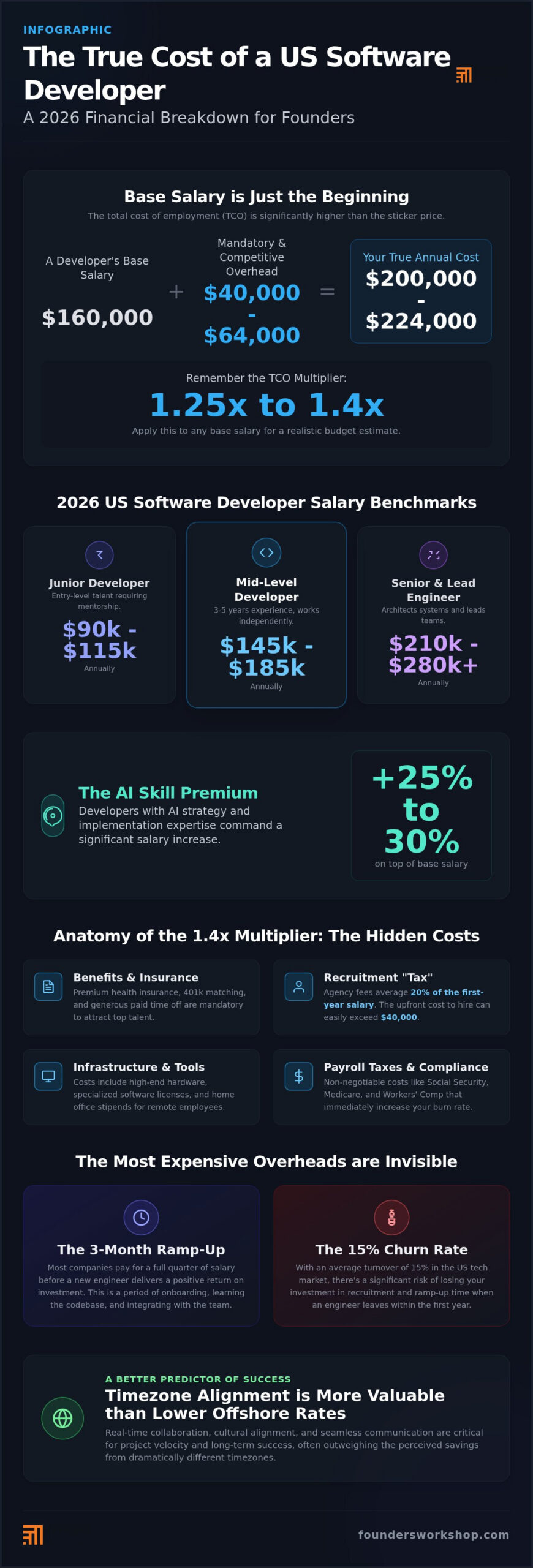
The total cost of hiring a software developer in the US is influenced heavily by their stack and years of practical problem-solving. By 2026, baseline expectations for annual salaries have stabilized at these levels:
- Junior Developers: Entry-level talent with high potential usually starts between $90,000 and $115,000. While their base pay is lower, they require significant mentorship from your senior staff, which is a hidden cost often overlooked in early budgeting.
- Mid-level Developers: Engineers with 3 to 5 years of experience are the most sought after, typically commanding $145,000 to $185,000. These professionals are expected to work independently and contribute to feature development immediately.
- Senior and Lead Engineers: For those who can architect complex systems and lead teams, base salaries frequently exceed $210,000, often reaching $280,000 for those with specialized expertise in AI or healthcare tech development.
The Premium on AI Strategy and Implementation Skills
AI is the great differentiator in 2026. A developer who can merely write code is a commodity, but those who understand AI strategy and implementation command a 25% to 30% premium. This isn’t just about using an API; it’s about building scalable, secure AI integrations that align with business goals. Founders often fall into the trap of “AI-washing,” where candidates claim expertise based on superficial use of generative tools rather than deep architectural knowledge. Distinguishing between these two requires a level of technical vetting that most internal HR teams don’t possess.
Founders Workshop helps bridge this AI talent gap. Our 30 plus years of leadership experience allow us to see through the hype. We focus on human-centered results, providing nearshore staff augmentation that matches technical skills with your specific business outcomes. This approach allows you to secure genuine engineering talent without the inflated domestic salary bubble, ensuring your development budget is spent on results rather than overhead.
Beyond Salary: The Total Cost of Employment (TCO)
Focusing solely on base salary is a common trap for founders. While the numbers we discussed in the previous section are high, they don’t represent the full financial commitment. In 2026, the true cost of hiring a software developer in the US follows the 1.25x to 1.4x rule. This means a developer with a $160,000 salary actually costs your business between $200,000 and $224,000 annually. This multiplier accounts for the mandatory and competitive layers required to keep a domestic team operational and compliant.
Competitive benefits are no longer optional. To attract top talent, you’re looking at premium health insurance, 401k matching, and generous PTO. Beyond compensation, you must factor in infrastructure. High end hardware, specialized software licenses, and home office stipends for remote workers add thousands to your per head expenditure. Then there’s the ‘Recruitment Tax.’ Standard agency fees typically hover around 20% of the candidate’s first year salary. When you add the internal hours your senior team spends on technical interviews, the upfront cost to simply get a person in a seat can exceed $40,000.
The Invisible Costs of US Hiring
Payroll taxes and Workers’ Comp are non-negotiable line items that immediately inflate your burn rate. However, the most significant invisible cost is the ‘Ramp up Period.’ It’s rare for a new hire to be fully productive on day one. Most companies pay for three months of salary before an engineer provides a positive return on investment. If that hire leaves within a year, which is common given the 15% average turnover rate in the US tech market, you’ve essentially subsidized their professional development for a competitor. This high churn rate is a financial disaster for lean startups.
The Cost of Vacancy: What an Empty Seat Costs Your Startup
An empty seat isn’t just a missing name on Slack; it’s a hole in your roadmap. Calculating the cost of vacancy requires looking at lost opportunity. If a delayed feature could have generated $10,000 in monthly recurring revenue and your hiring search takes four months, that’s a $40,000 loss before the developer even starts. Meanwhile, your remaining team members often face ‘Developer Burnout’ as they pick up the slack, which risks even more churn. Founders often find that nearshore staff augmentation provides the necessary speed to fill these gaps without the administrative overhead and long term commitment of domestic W2 management. This model allows you to maintain velocity while keeping your internal team focused on core strategic goals.
Comparing Hiring Models: Freelance, In-House, and Agency
Choosing a hiring model is as much a strategic decision as it is a financial one. While the base cost of hiring a software developer in the US is high, the model you choose dictates whether that investment scales or stagnates. In-house hiring remains the gold standard for control and cultural alignment. However, as established with the 1.4x TCO rule, it’s also the most expensive path. It requires a long term commitment that many startups aren’t ready to make when their product roadmap is still evolving. If you hire a full time W2 employee, you’re married to that specific skill set regardless of how your technical needs shift.
Project-Based Development vs. Staff Augmentation
The choice between these two depends on your business stage. A project based model is ideal for a defined MVP launch where the scope is clear and the deadline is fixed. It provides budget predictability when you need it most. Once your product is live, you should shift to staff augmentation or a monthly retainer. This allows for continuous product evolution and feature iteration. Founders Workshop aligns our model to your specific stage, whether you’re building a legacy modernization project or scaling a new AI strategy. We ensure the partnership evolves as your technical requirements become more complex.
The Management Overhead Trap
Founders often overlook the Total Cost of Management (TCM). Managing a fragmented team of freelancers can consume 20% to 30% of a CTO’s weekly capacity. That’s time taken away from high level strategy and architecture. A managed nearshore team reduces this burden significantly. Because the provider handles the vetting, payroll, and cultural integration, your internal leaders can focus on outcomes rather than administration. This reduction in technical friction is a primary driver of ROI, allowing your team to maintain a high velocity without the burn out associated with domestic talent shortages.
The Nearshore Advantage: Cost-Effective Developers in Your Timezone
Many founders treat “remote work” as a monolith. This is a strategic mistake that often leads to project stagnation. While the high cost of hiring a software developer in the US drives many companies to look abroad, where they look matters as much as the rate they pay. Timezone alignment is the single most important predictor of success for a distributed engineering team. If your developers aren’t working while you’re working, you aren’t just saving money; you’re paying a “hidden tax” of communication lag that can destroy your development velocity.
Offshore models in Asia or Eastern Europe often present a 10 to 12 hour time gap. This creates a 24 hour delay cycle for even the simplest code reviews. If a developer has a question at the end of their day, it sits in your inbox while you sleep. By the time you answer, they’ve already signed off for their night. Latin America (LATAM) has emerged as the premier source for tech talent because it eliminates this friction. When your team in Medellín or Buenos Aires is online at the same time as your team in New York or Phoenix, you maintain the synchronous collaboration required for modern agile development.
Why Nearshore Outperforms Offshore Outsourcing
Real time collaboration is the lifeblood of a healthy technical team. Nearshore talent allows for synchronous standups, pair programming, and immediate troubleshooting. You don’t have to wait until the next morning to realize a sprint has gone off the rails. Beyond the clock, Latin American tech hubs offer high English proficiency and a cultural alignment with US business practices that is often missing in offshore models. This reduced communication friction means you ship code faster and with fewer misunderstandings, directly addressing the technical friction that plagues many scaling startups.
The ROI of Nearshore Staff Augmentation
The financial math is compelling. By leveraging nearshore talent, you can often secure two senior engineers for the same total investment as one domestic hire. This isn’t about finding “cheap” labor; it’s about accessing high quality talent in a market where the cost of living hasn’t yet inflated salaries to US levels. You can achieve 40% to 60% savings on your per head cost while maintaining the same quality standards you’d expect from a Silicon Valley veteran. Before committing to a model, founders benefit from understanding the full picture of nearshore software development rates and how they compare across different LATAM markets.
This model also provides the flexibility to scale your engineering budget according to your funding cycles or product roadmap. Founders Workshop ensures this transition is seamless through a rigorous vetting process that focuses on “US standard” engineering and strategic alignment. If you’re ready to optimize your budget without sacrificing velocity, explore how our nearshore staff augmentation can bridge your talent gap and accelerate your growth.
Optimizing Your Development ROI with Founders Workshop
The high cost of hiring a software developer in the US doesn’t have to be a barrier to your company’s growth. At Founders Workshop, we leverage over 30 years of leadership experience to help you navigate these financial and technical challenges. We don’t just provide developers; we provide strategic alignment. Our human-centered approach ensures that every engineer we place or project we lead is focused on your specific business outcomes rather than just shipping lines of code. This perspective is vital for founders who need to bridge the gap between high level strategy and technical execution.
Many of our partners come to us burdened by technical debt that slows their velocity. Through legacy modernization and AI strategy development, we’ve helped companies transition from maintenance mode to aggressive growth. We’ve seen firsthand how the right talent, vetted through a founder’s lens, can transform a stagnant product into a market leader. By focusing on the removal of technical friction, we allow you to regain the peace of mind necessary to lead your business forward.
Building Your MVP with a Strategic Partner
Launching a new product requires more than just technical skill; it requires a roadmap. We guide you from initial wireframes to a launch ready product with a focus on long term sustainability. To provide the budget predictability you need, we offer fixed fee Startup MVP Development. This approach eliminates the uncertainty of variable hourly rates. It ensures your capital is used efficiently to reach your next milestone without the sticker shock often associated with domestic development cycles.
Seamless Scaling with Nearshore Talent
Scaling shouldn’t mean increasing your administrative workload. We integrate our nearshore developers directly into your existing US based workflow, maintaining the timezone alignment we’ve identified as critical for success. Our team handles the complexities of HR, payroll, and international compliance. This allows you to focus on your core product rather than the logistics of the cost of hiring a software developer in the US. This model provides the reliability of a stable partnership without the friction of domestic employment laws. If you’re ready to optimize your budget and increase your technical capacity, you can schedule an AI strategy or staffing consultation with our team today. We’ll help you build a development plan that balances cost, quality, and speed.
Strategic Growth Beyond the Domestic Bubble
Navigating the tech landscape in 2026 requires more than just a budget; it requires a vision for sustainable scaling. We’ve explored how the true cost of hiring a software developer in the US extends far beyond a base salary, encompassing everything from recruitment friction to the invisible tax of vacancy. By shifting your focus toward timezone aligned nearshore talent, you can reclaim your development velocity and protect your capital without sacrificing code quality.
Founders Workshop brings 30 plus years of executive leadership to every partnership. Our proprietary vetting process for Latin American talent ensures you get engineers who understand both technical excellence and strategic business outcomes. Whether you’re modernizing legacy systems or executing a complex AI strategy, we’re here to remove technical friction. Scale your engineering team with vetted nearshore talent from Founders Workshop and start building with the confidence your business deserves. You’ve mapped the path; now it’s time to move forward.
Frequently Asked Questions
How much does it cost to hire a senior software developer in the US in 2026?
A senior software developer in the US typically commands a base salary between $210,000 and $280,000 in 2026. However, your actual budget must account for the total cost of employment, which includes taxes, benefits, and equity. For high-demand specializations like AI or cloud architecture, the total annual expenditure often exceeds $300,000 per head.
Is it cheaper to hire a software development agency or an in-house developer?
Hiring an agency is generally more cost-effective for defined project phases or scaling periods because it eliminates the 1.4x overhead multiplier of a W2 employee. In-house hires require long-term commitments to payroll taxes, health insurance, and 401k matching. Agencies provide immediate access to a full team, allowing you to avoid the steep recruitment fees and the three-month ramp-up period associated with domestic hires.
What are the hidden costs of hiring a software developer?
The most significant hidden cost of hiring a software developer in the US involves recruitment fees, which average 20% of the first-year salary. You must also factor in hardware stipends, software licenses, and the cost of vacancy. This cost of vacancy represents the lost revenue and product delays that occur while a seat remains empty during a four-month talent search.
What is nearshore staff augmentation and how does it save money?
Nearshore staff augmentation is a model where you hire talent from nearby regions, such as Latin America, to work as an extension of your internal team. It saves money by leveraging lower costs of living in LATAM while maintaining high engineering standards. This approach reduces the cost of hiring a software developer in the US by 40% to 60% without the communication lag of offshore models.
How do Latin American developer rates compare to US salaries?
Latin American developer rates are substantially lower than US salaries, often allowing founders to hire two senior engineers for the price of one domestic hire. While a senior US dev might earn $220,000, a nearshore developer with identical technical proficiency and English fluency costs significantly less. This allows startups to extend their runway while maintaining the technical velocity needed for rapid growth.
Why is timezone alignment important for software development outsourcing?
Timezone alignment is the primary predictor of remote team success because it enables synchronous collaboration and real-time problem solving. Offshore teams with a 12-hour gap create a 24-hour delay cycle for every code review or simple question. Nearshore teams work your exact hours, allowing for immediate feedback and synchronous standups that keep your product roadmap on schedule.
What is the average recruitment fee for hiring a software engineer in the US?
Standard recruitment fees in the US tech market typically range from 20% to 25% of the candidate’s starting base salary. If you’re hiring a senior lead at a $200,000 salary, you’ll pay an upfront fee of at least $40,000 to the search firm. This is a non-refundable capital drain that makes domestic hiring particularly risky for early-stage startups with limited funding.
How can a startup founder reduce the cost of building an MVP?
Founders can reduce MVP costs by opting for fixed-fee development roadmaps and focusing on human-centered results rather than technical novelty. Partnering with a seasoned guide allows you to avoid the technical debt often created by unmanaged freelancers. By prioritizing core features and using specialized nearshore teams, you can reach a launch-ready state faster and with significantly less capital investment.