
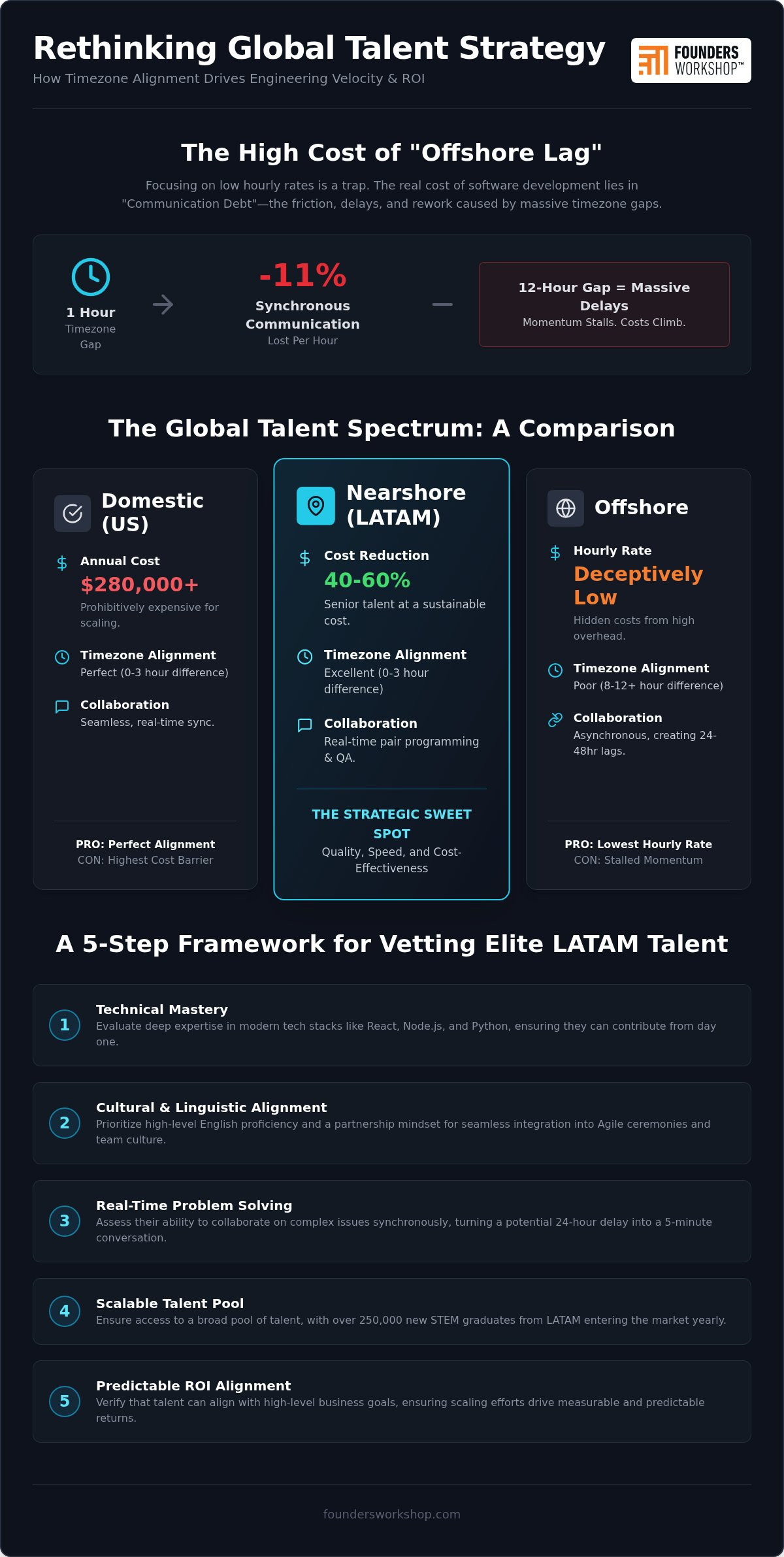
Every hour of timezone distance can reduce your team’s synchronous communication by 11 percent; yet many leaders still accept 12-hour delays as the standard price of scaling. If your burn rate is climbing while your sprint velocity stalls due to “offshore lag,” it’s time to rethink your talent strategy. Understanding the benefits of nearshore staff augmentation isn’t just about finding lower costs. It’s about reclaiming your workday by integrating senior LATAM talent into your existing workflows to eliminate the friction that kills momentum in traditional outsourcing models.
You likely already know that domestic hiring for senior roles has become prohibitively expensive, with all-in costs for a single US developer often reaching $280,000 annually. This guide will show you how to scale your engineering team with high-quality LATAM talent while reducing costs by 40 to 60 percent without the communication debt of offshore models. We’ll explore the technical ROI of timezone alignment, the 2026 market trends for senior engineers, and a proven framework for building a scalable pool of technical talent that feels like a natural extension of your home team.
Key Takeaways
- Learn why “communication debt” from massive timezone gaps often makes cheap offshore rates more expensive than senior nearshore talent.
- Discover the strategic benefits of nearshore staff augmentation and how real-time collaboration with LATAM teams eliminates the 12-hour delays that kill momentum.
- Identify the “Sweet Spot” of global hiring to secure senior-level engineering quality at 40 to 60 percent less than domestic US salaries.
- Gain a 5-step vetting framework to evaluate developers for technical mastery and the cultural alignment required for a long-term partnership.
- Understand how to align your engineering talent with high-level business goals to ensure your scaling efforts drive predictable ROI.
The Real Cost of Software Development: Why Hourly Rates are Deceptive
Focusing solely on hourly rates is a trap that many founders fall into when trying to scale. While a $30 per hour developer in a 12-hour timezone gap looks efficient on a spreadsheet, the invoice rarely reflects the actual cost of delivery. This discrepancy is driven by “Communication Debt,” which is the accumulation of friction, misunderstandings, and idle time caused by asynchronous workflows. When your team can’t resolve a simple technical blocker in real time, the project’s momentum stalls. One of the primary benefits of nearshore staff augmentation is the elimination of this hidden tax by aligning talent with your actual business hours.
To understand the true price of your build, you must look at the Total Cost of Ownership (TCO). This framework accounts for recruitment, management overhead, code quality, and the speed at which features reach the market. High-performing teams often find that a $65 per hour nearshore developer is significantly more cost-effective than a cheaper offshore alternative because they produce higher-quality code with less supervision. This strategic approach ensures that your Strategic MVPs are built on a foundation of reliability rather than just low-cost labor. It’s also vital to distinguish between “outsourcing” as a generic term and the specific advantages of nearshore models, which prioritize partnership over mere task delegation.
The Hidden Tax of Timezone Gaps
In an offshore model, a simple clarifying question asked at 4:00 PM during your business hours won’t be answered until the following morning. If the answer requires further discussion, you’ve lost 24 to 48 hours of development time on a single ticket. This lag destroys Agile ceremonies. Scrum relies on synchronous participation; when stand-ups become one-way status reports because half the team is exhausted or just starting their day, the collaborative spirit of the SDLC vanishes. Timezone Lag is the systematic delay in feedback loops that compounds technical debt and erodes engineering velocity.
Management Overhead vs. Engineering Velocity
The burden of bridging massive timezone gaps usually falls on your most expensive US-based managers. They end up working “double shifts,” staying online late for hand-offs and waking up early for “emergency” fixes. This leads to rapid burnout and high turnover. By utilizing the benefits of nearshore staff augmentation, you reduce the need for middle-management intermediaries who exist only to translate requirements across timezones. Without the constant need to manage “Follow-the-Fix” cycles, where your domestic team spends the day repairing what was broken overnight, your engineering velocity stays high and predictable. You gain a team that works with you, not just for you, allowing your leadership to focus on higher-level strategy and data-driven insights with the help of Momentum One.
The Nearshore Advantage: Why US Timezone Alignment Wins
While offshore models often feel like a transaction, nearshore partnerships function as a strategic extension of your internal team. Latin America (LATAM) has become the gold standard for US firms because it solves the fragmentation inherent in global hiring. The “Culture, Timezone, and Language” trifecta ensures that your external talent isn’t just taking tickets; they’re participating in the creative process. One of the primary benefits of nearshore staff augmentation is that it aligns your developers with your core business hours, eliminating the friction that typically slows down complex engineering builds.
When your developers share the same workday, you gain the ability to perform true pair programming and real-time QA cycles. This synchronous collaboration enables teams to ship features 30 to 50 percent faster than those struggling with 12-hour delays. It’s the difference between a project that evolves through daily interaction and one that stalls because of a single unanswered Slack message. If you want to see how these dynamics play out across different regions, our 2026 Nearshore Staff Augmentation Guide for Engineering provides a deeper dive into regional talent specifics.
Latin America: The Strategic Hub for US Growth
The tech talent boom in Mexico, Colombia, and Argentina isn’t an accident. These regions have developed a talent pool of over 2 million skilled professionals, with 250,000 new STEM graduates entering the market every year. Educational alignment is a major factor here; local universities have tailored their curricula to match modern US tech stacks like React, Node.js, and Python. This means your new hires arrive with a deep understanding of the tools your team already uses. Because these developers are often only one or two timezones away, the “sync gap” is virtually non-existent, allowing for a seamless integration into your existing sprint cycles.
Synchronous Collaboration in Agile Environments
Agile development doesn’t work in a vacuum; it requires constant feedback. In a nearshore model, your senior developers are active in Slack and Teams during your core hours. They aren’t just names on a dashboard; they’re peers who can jump on a quick huddle to resolve an architectural ambiguity before it becomes a bug. This environment fosters a “single team” mentality, breaking down the psychological “us vs. them” barrier that often plagues traditional outsourcing. Engineering Velocity is the ultimate metric for nearshore success, representing the speed at which your team delivers production-ready features without the drag of communication delays. If you’re looking to optimize your roadmap, considering how nearshore staff augmentation can bridge your talent gaps is a logical next step for any scaling organization.
Comparing US, Nearshore, and Offshore Models
Selecting the right talent model requires a framework that looks beyond the initial contract price. To make a strategic decision, you must evaluate vendors across four critical pillars: Cost, Quality, Timezone Alignment, and Cultural Synergy. While domestic US hiring offers the highest level of alignment, the scarcity of senior talent often leads to astronomical salaries and long recruitment cycles. Conversely, offshore models provide the lowest entry price but frequently fail due to high management debt and poor code quality. One of the primary benefits of nearshore staff augmentation is its ability to hit the “sweet spot” by providing approximately 80 percent of US engineering quality at 40 to 50 percent of the total cost.
The risks associated with offshore development often outweigh the savings. When you factor in the 12-hour timezone gap and the resulting communication friction, the “cheap” offshore developer often takes twice as long to ship the same feature as a nearshore peer. For a detailed breakdown of these dynamics, you can explore our analysis on Nearshore vs Offshore: Why Timezone Alignment Wins. By choosing a nearshore model, you’re investing in a partner who understands your business context and works within your operational rhythm.
The ROI of Nearshore Staff Augmentation
The math behind nearshore ROI is compelling in the 2026 market. A senior US developer typically commands an all-in cost between $230,000 and $280,000 per year when you include benefits and overhead. In contrast, a senior LATAM developer through a staff augmentation partner ranges from $70,000 to $120,000. This isn’t just about salary savings; it’s about productivity gains. Because your team can collaborate in real time, you avoid the “waiting tax” that stalls development. This model is particularly effective for complex initiatives like AI strategy consulting, where constant iteration and strategic alignment are mandatory for success. From a founder’s perspective, this allows you to protect your capital runway while simultaneously accelerating your product roadmap.
When to Choose Each Model
No single model fits every scenario. A balanced approach involves matching the project’s complexity to the talent location:
- Use US-based teams for: Projects requiring ultra-high security clearances, government contracts, or local physical hardware integration that necessitates on-site presence.
- Use Nearshore teams for: Core product development, building scalable MVPs, and rapidly expanding your engineering capacity without sacrificing velocity.
- Use Offshore teams for: Low-complexity, non-critical maintenance tasks or legacy documentation where zero deadline sensitivity exists and real-time collaboration isn’t required.
How to Source and Vet High-Performing Developers in LATAM
Finding the right talent in Latin America requires more than a simple keyword search on LinkedIn. In 2026, the market is saturated with mid-level developers claiming senior expertise, making a rigorous vetting process essential. One of the core benefits of nearshore staff augmentation is the ability to leverage a partner’s pre-existing talent pipeline, which has already been scrubbed for technical and cultural fit. This eliminates the risk of hiring a “paper tiger” who can code but can’t communicate or solve complex business problems. Resumes are often misleading; actual performance in a live environment is the only metric that matters.
Technical and Cultural Vetting Framework
Our 5-step vetting framework focuses on long-term sustainability rather than just immediate capacity. We look for engineers who don’t just write code but understand the business utility of the features they build. The process includes:
- Deep Technical Assessment: We conduct live coding sessions within a US timezone environment to observe how a developer handles pressure and solves problems in real time.
- Strategic Thinking Interview: We look for engineers who understand the “why” behind the code, ensuring they align with your business goals.
- Stack Verification: We verify hands-on experience with modern tech like React, Python, and AI/ML implementations to ensure they can hit the ground running.
- English for Business: We distinguish between “English for Tech” and “English for Business.” While knowing technical terms is basic, the ability to negotiate, explain complex concepts, and participate in strategic debates is what defines a senior hire.
- Cultural Alignment: We assess soft skills like empathy, accountability, and the ability to work within a US-based corporate culture.
The Managed Team vs. Individual Freelancer Debate
Many founders are tempted by the lower prices of freelance marketplaces, but this often leads to significant technical friction. Freelancers often lack accountability and are prone to “ghosting” when a more lucrative project appears. A managed nearshore partner handles the human-centered aspects of talent retention, providing a layer of stability that a marketplace cannot match. They manage the administrative friction, including local payroll, compliance, and equipment logistics, which are often overlooked by founders hiring through marketplaces.
To maximize the benefits of nearshore staff augmentation, you need a partner who prioritizes human-centered integration over simple seat-filling. At Founders Workshop, we ensure our developers are integrated into your culture, not just your Jira board. If you are ready to build a high-performing team without the management overhead, you can explore our nearshore staff augmentation services to find your next senior hire.
Scaling Your Engineering Velocity with Founders Workshop
Scaling a technical organization requires more than just adding developers; it requires a partner who understands that code is a means to a business end. We bridge the gap between high-level executive strategy and technical execution by applying 30 years of leadership experience to every engagement. The Founders Workshop Managed Nearshore Model is designed to provide the benefits of nearshore staff augmentation with the reliability of US-based accountability. We don’t just provide talent; we provide a disciplined framework for growth that ensures your technical roadmap stays aligned with your commercial objectives.
Our legacy is rooted in helping founders navigate the complexities of product development without losing sight of their runway. By integrating senior LATAM talent into your workflow, we help you maintain the speed of a startup with the architectural rigor of an enterprise. This model ensures that you aren’t just filling seats; you’re building a sustainable engineering culture that can adapt to changing market demands. Whether you’re a veteran leader or a first-time founder, our seasoned guidance provides the peace of mind needed to scale with confidence.
Human-Centered Solutions for Complex Problems
Building software is a human endeavor. Whether you’re launching Strategic MVPs or modernizing a complex system, our leadership team treats your product with the same discipline we apply to our own ventures. Our deep expertise in Healthcare Tech and AI implementation allows us to navigate highly regulated and technically demanding environments with ease. If your growth is currently hampered by technical debt, our approach to Refactoring Legacy Code ensures that your existing systems become a foundation for innovation rather than a bottleneck. We focus on human-centered solutions that prioritize the end-user experience while maintaining architectural integrity.
Getting Started: From Fractional Support to Dedicated Teams
Every company’s scaling needs are unique, which is why we offer flexible engagement models tailored to your specific stage of growth. You can choose from fixed-fee projects for defined scopes or monthly staff augmentation retainers for ongoing development capacity. We handle the heavy lifting of onboarding and cultural integration, ensuring your new nearshore talent understands your mission from day one. This methodical approach removes the friction of hiring and allows you to focus on your core business priorities. If you’re ready to unlock the benefits of nearshore staff augmentation and accelerate your engineering velocity, you can schedule a strategy session with Founders Workshop today. We’ll help you evaluate your current roadmap and identify the most efficient path forward.
Building a Sustainable Path to Engineering Excellence
Scaling a modern technology company requires more than just adding headcount; it demands a strategic alignment of talent, timezone, and business objectives. By moving away from high-friction offshore models and embracing the benefits of nearshore staff augmentation, you eliminate the communication debt that stalls product roadmaps. You’ve seen how real-time collaboration with senior LATAM developers allows you to maintain high quality while reducing operational costs by 40 to 60 percent. This isn’t just a cost-saving tactic. It’s a fundamental shift toward building a more resilient and responsive engineering culture.
Founders Workshop brings over 30 years of software leadership experience to your partnership. We specialize in launching Strategic MVPs and modernizing legacy systems using LATAM talent specifically vetted for US timezone alignment. Our managed model ensures that your technical builds remain human-centered and results-driven, providing the stability you need to innovate without friction. If you’re ready to stop managing “timezone lag” and start shipping features, it’s time to act. Build your high-velocity engineering team with Founders Workshop today and secure your product’s future growth. Your next era of engineering velocity starts with the right partner by your side.
Frequently Asked Questions
Why is timezone alignment so important for Agile software development?
Agile relies on synchronous feedback loops and real-time collaboration to maintain momentum. When developers work in the same timezone, they can participate in daily stand-ups, pair programming, and immediate bug resolution without waiting 12 hours for a response. This alignment prevents the communication debt that often occurs in asynchronous models, ensuring that sprint velocities remain high and predictable throughout the software development lifecycle. It’s about removing the friction that kills innovation.
How much can I save by hiring nearshore developers in Latin America compared to US hires?
US companies typically save between 40 and 60 percent on engineering costs by utilizing the benefits of nearshore staff augmentation. While a senior US developer might cost $230,000 to $280,000 annually when factoring in benefits and overhead, a comparable senior developer in Latin America through a managed partner ranges from $70,000 to $120,000. These savings allow founders to extend their capital runway while accessing high-quality technical expertise without compromising on quality.
Is the English proficiency of LATAM developers high enough for US business needs?
Senior LATAM developers are vetted specifically for English for Business, ensuring they can participate in strategic planning and complex technical debates. Unlike offshore regions where language barriers can lead to architectural misunderstandings, the nearshore talent pool in countries like Mexico and Colombia has a high degree of cultural and linguistic alignment with the US. This ensures that developers can explain the reasoning behind their code during team huddles and stakeholder meetings.
How do I manage a remote nearshore team effectively across US timezones?
Effective management involves integrating nearshore talent directly into your existing communication tools like Slack, Jira, and Teams. Because they share your workday, you should treat them as a natural extension of your domestic team rather than a separate vendor. Establishing clear documentation, maintaining regular synchronous meetings, and fostering a culture of accountability are key strategies. A managed partner often assists with this cultural integration and helps streamline the operational onboarding process.
What are the risks of hiring offshore developers with a 10+ hour time difference?
The primary risks of offshore models include high management overhead, significant communication delays, and poor code quality due to timezone lag. A 10-hour gap means a single clarifying question can delay a project by 24 hours, leading to missed deadlines and increased technical debt. Additionally, the lack of real-time collaboration often results in Follow-the-Fix cycles, where domestic teams spend their mornings repairing errors made by the offshore team overnight.
Can nearshore developers handle complex AI and healthcare technology projects?
Nearshore developers in Latin America are highly skilled in modern tech stacks, including React, Python, and AI/ML implementations. Many have extensive experience in specialized sectors like Healthcare Tech, where they navigate complex regulatory requirements and system integrations. Because LATAM universities have aligned their STEM curricula with US industry standards, these engineers possess the technical depth required to build sophisticated, secure, and scalable enterprise-level applications that drive real business outcomes.
What is the difference between staff augmentation and project-based outsourcing?
Staff augmentation involves adding specific developers to your internal team under your direct management, whereas project-based outsourcing involves handing off an entire scope of work to an external vendor. One of the key benefits of nearshore staff augmentation is the control it provides over the development process. Your augmented developers use your tools and participate in your daily rituals, ensuring long-term institutional knowledge stays within your company rather than with a vendor.
How does Founders Workshop ensure the quality of its nearshore developers?
Founders Workshop ensures quality through a rigorous 5-step vetting process that includes live coding assessments and strategic thinking interviews. We leverage our 30 years of leadership experience to identify senior talent who can bridge the gap between business strategy and technical execution. By acting as a managed partner, we handle the human-centered aspects of retention and compliance, ensuring every developer is culturally aligned and technically prepared for your specific project needs.