

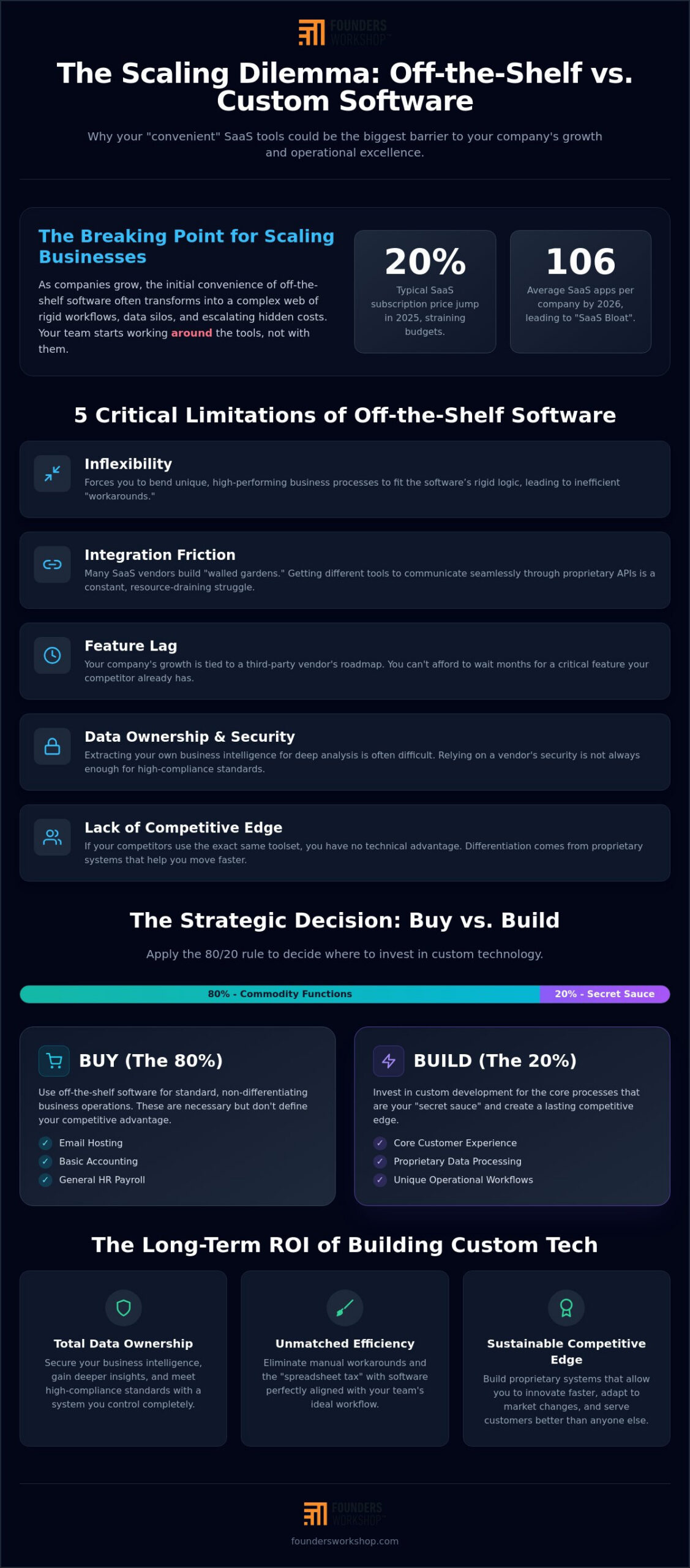
In 2025, subscription costs for major SaaS vendors jumped by as much as 20%, yet many businesses found themselves more constrained than ever by rigid workflows. If you feel like your team is constantly working around your tools rather than with them, you’ve likely hit the strategic limitations of off the shelf software. It’s a common friction point where the convenience of a ready-made product becomes a barrier to operational excellence. You’ve probably noticed that as your company scales, the per-seat pricing model and lack of deep integration create a mounting technical debt that drains your resources.
We understand that choosing between a quick fix and a long-term investment is a high-stakes decision for any executive. You want the peace of mind that comes with a system built to match your specific vision. This article will help you identify the exact moment your company needs a custom solution to break through growth ceilings. We’ll examine the shift toward usage-based pricing in 2026 and provide a clear framework for the Buy vs. Build decision, ensuring you can justify the ROI of proprietary technology to your stakeholders.
Key Takeaways
- Identify how rigid workflows and “walled garden” ecosystems represent the primary limitations of off the shelf software as your business operations evolve.
- Calculate the true cost of “cheap” subscriptions by uncovering the hidden expenses of manual workarounds and what we call the “spreadsheet tax.”
- Use the 80/20 rule to decide whether a tool serves a commodity function or if it touches the “secret sauce” that defines your competitive advantage.
- Explore how human-centered design and rapid MVP iterations allow you to build custom internal software that aligns perfectly with your team’s needs.
- Justify your investment in proprietary tech by focusing on long-term ROI, data ownership, and the removal of technical friction.
Defining Off-the-Shelf Software: The Promise vs. The Reality
Commercial off-the-shelf (COTS) software is built to solve common problems for the broadest possible audience. It’s the “buy” in the classic buy-versus-build dilemma. For a startup or a business in its early stages, the low-friction promise is undeniably attractive. You get rapid deployment and a manageable entry price without the lead time or capital expenditure of a full development cycle.
However, the reality often diverges from the glossy sales pitch. When you buy a license, you aren’t just purchasing a tool; you’re renting someone else’s product roadmap. If the vendor decides to pivot, raise prices by 20%—as many did in 2025—or ignore a feature critical to your workflow, you have no recourse. This lack of control is one of the fundamental limitations of off the shelf software. It forces your unique business processes to bend to the software’s logic, rather than the other way around. For specialized industries like healthcare or high-compliance finance, this “one-size-fits-all” model eventually breaks. It cannot accommodate the granular data privacy or operational resilience standards required by 2026 regulations like the EU Digital Operational Resilience Act (DORA).
The Commodity Trap: When Generic is Good Enough
Pragmatic leaders know that not every internal process requires a custom-built engine. Processes like email hosting, basic accounting, or general HR payroll are “commodities.” They’re necessary for operation but don’t differentiate you from your competitors. In these cases, you should almost always buy. The danger arises when you apply this same logic to your primary value proposition. If your core customer experience or data processing is handled by the same generic tool your competitors use, you’ve traded your competitive advantage for a small savings in upfront costs.
The SaaS Ecosystem Illusion
Many teams try to fix the limitations of off the shelf software by stitching together a “best-of-breed” toolkit. They rely on “Zapier-led” architectures to bridge gaps, but this creates a house of cards. By 2026, companies are using an average of 106 SaaS applications, which leads to significant fragmentation. SaaS Bloat is the operational friction caused by a fragmented ecosystem of tools that create data silos, ultimately dragging down 2026 operational efficiency through manual oversight and decision paralysis. Instead of a unified engine, you end up with a collection of disparate parts that never quite fit together.
5 Critical Limitations of Off-the-Shelf Software That Stifle Scaling
Scaling a business requires a level of agility that rigid, pre-packaged solutions simply cannot provide. While we’ve discussed the initial allure of COTS, the long-term reality is often a series of roadblocks. Understanding the limitations of off the shelf software is vital for any leader planning a multi-year growth strategy. When your operations reach a certain level of complexity, these five friction points become impossible to ignore.
- Inflexibility: You’re forced to bend your unique, high-performing business processes to fit the software’s rigid logic. This often results in “workarounds” that decrease efficiency.
- Integration Friction: Many SaaS vendors build “walled gardens.” Even with 106 applications being the 2026 company average, getting those tools to talk to each other through proprietary APIs remains a constant struggle.
- Feature Lag: Your growth shouldn’t depend on a third-party vendor’s roadmap. If you need a specific capability to beat a competitor, you can’t afford to wait months for a vendor to prioritize it.
- Data Ownership: Extracting your own business intelligence for deep analysis is often difficult. In a high-compliance environment, relying on a vendor’s security and auditability isn’t always enough to meet 2026 standards.
- Lack of Competitive Edge: If your competitors use the exact same toolset, you have no technical advantage. True differentiation comes from proprietary systems that allow you to move faster or serve customers better than anyone else.
If you find your team spending more time managing your tools than serving your clients, our experts can help you design internal software development strategies that eliminate these bottlenecks.
The AI Readiness Gap: Why SaaS Limits Your Innovation
In 2026, AI is the primary driver of business growth, but most off-the-shelf platforms are “black boxes.” You cannot easily train custom LLMs or predictive models on your proprietary data when it’s locked in a generic ecosystem. Custom software acts as a clean data foundation. It allows you to implement AI strategy and development that uses your specific data to create a moat around your business. Without this control, you’re just another company using the same basic AI features as everyone else.
The Hidden Cost of Feature Overload
There is a significant cognitive load associated with “bloated” commercial applications. Most teams only use about 20% of a tool’s features, yet you’re paying for 100% of the complexity. This overhead degrades employee productivity as staff navigate cluttered interfaces to find the few buttons they actually need. By building custom, you remove this technical friction, providing your team with a streamlined tool designed solely for their success.
The Hidden Cost of ‘Cheap’: ROI and Long-Term Technical Debt
The initial price tag of a pre-built solution is often a distraction from the total cost of ownership. While a monthly subscription fee feels manageable on a balance sheet, it represents a front-loaded savings that often turns into a long-term liability. As your organization scales, the limitations of off the shelf software manifest as financial leaks that drain your margins and stall your momentum.
- Subscription Creep: Per-seat pricing models are designed to extract more value as you grow. With many SaaS vendors raising costs by 10% to 20% in 2025, and California’s new digital product tax taking effect in 2027, these “predictable” fees are becoming increasingly volatile.
- The Spreadsheet Tax: When software is too rigid, employees bridge the gap with manual workarounds. Every hour spent moving data between disconnected tools or managing complex Excel sheets is an opportunity cost that never appears on a SaaS invoice but quietly erodes your bottom line.
- Technical Debt: Relying on a rigid system for too long creates a “locked-in” effect. The cost of eventually migrating your data and retraining your staff once the tool finally breaks under the weight of your growth is far higher than investing in a scalable solution early on.
- Security Risks: Popular commercial tools are high-profile targets for cyberattacks because a single vulnerability can grant access to thousands of companies. Custom internal software allows you to stay “quiet,” reducing your surface area for automated attacks while allowing for granular security controls.
Calculating the Real Cost of Ownership (TCO)
A true TCO analysis must look beyond the license fee. You have to account for the specialized training required to navigate bloated interfaces and the ongoing support costs for tools that don’t quite fit your workflow. There is also the hidden danger of “Shadow IT.” When official tools are inadequate, employees often adopt their own unauthorized applications to get the job done, creating significant security and data silos. To calculate the five-year ROI of a custom build, subtract the total cost of development and maintenance from the sum of eliminated subscription fees, recovered labor hours from automated workflows, and the projected revenue increase driven by proprietary features.
Modernization vs. Replacement
Sometimes, the answer isn’t a brand-new tool but the evolution of what you already own. If you have a legacy system that holds your core business logic, modernizing it can be more cost-effective than starting over with a generic COTS product. At Founders Workshop, we specialize in internal software development that bridges the gap between old and new. We focus on legacy application modernization to transform stagnant systems into agile cloud solutions. This approach allows you to retain your unique business logic while eliminating the technical friction that stops you from scaling.
Buy vs. Build Framework: Identifying Your Competitive Advantage
Deciding whether to purchase a license or invest in a custom build is a high-stakes strategic pivot point. For many leaders, the choice is clouded by immediate budget concerns, but a seasoned executive knows that tools are secondary to business outcomes. To make an objective decision, you need a framework that separates tactical utilities from strategic assets. If a software solution manages a commodity process, buying is almost always the right move. However, when a process defines your market position, the limitations of off the shelf software quickly become a ceiling on your potential.
We recommend using the 80/20 rule as a primary filter. If a commercial tool meets 80% of your operational needs, it’s a strong candidate for purchase. The critical question lies in the remaining 20%. If that missing functionality represents your “secret sauce,” your proprietary logic, or your unique customer experience, then building is the only way to protect your intellectual property. As you scale, you must also watch for the scalability threshold. This is the moment when the cumulative cost of monthly per-seat fees—which reached record highs in 2025—exceeds the long-term investment of developing a proprietary system you own outright.
The “Secret Sauce” Test
Is this process why your customers choose you over a competitor? If the answer is yes, you cannot afford to outsource that logic to a generic vendor. In healthcare tech development, for example, a custom patient-management interface can be the difference between a high-friction experience and a life-saving efficiency. Similarly, a custom internal sales platform that leverages your specific lead-scoring data provides a technical advantage that no off-the-shelf CRM can replicate. Proprietary business logic deserves a proprietary platform.
The Hybrid Approach: Customizing the Foundation
You don’t always have to choose one or the other. A hybrid strategy often provides the best ROI by using system integrations to connect custom-built modules to reliable COTS basics. You might keep a standard accounting tool but build a custom “wrapper” around your legacy data to enable better AI-driven decision-making. To accelerate this transition without the overhead of a massive local team, many founders are turning to nearshore staff augmentation. This allows you to build custom assets cost-effectively while maintaining the strategic control required to outpace your competition.
Ready to build a tool that actually fits your business? Explore how our nearshore staff augmentation can help you develop proprietary software without the hiring friction.
Strategic Custom Development: Engineering for Sustainable ROI
Transitioning from a generic tool to a proprietary asset requires more than just code; it requires a shift in how you view your team’s relationship with technology. While we’ve explored the limitations of off the shelf software in terms of rigidity and cost, the ultimate solution lies in engineering for sustainable ROI. This starts with human-centered design. Instead of forcing your staff to navigate complex, bloated menu hierarchies, we build interfaces that mirror their actual daily tasks. This approach removes the technical friction that often leads to burnout and the adoption of unauthorized shadow IT tools.
Speed is a critical competitive advantage. We utilize the power of the Startup MVP to help you launch fast and iterate based on real user data rather than boardroom assumptions. You don’t need a finished masterpiece to start seeing value; you need a functional core that solves your most pressing bottleneck. To sustain this momentum, many organizations leverage nearshore staff augmentation. This model provides access to high-tier talent in Latin America, allowing you to scale your development team without the prohibitive overhead of US-based hiring. Founders Workshop acts as your partner, bridging the gap between high-level innovation and disciplined technical execution.
Building for the Future: AI and Scalability
Every custom build today must be AI-ready from day one. This means designing a cloud-native architecture that can handle the data requirements of predictive models and custom LLMs. We favor microservices to ensure your system can scale 10x without requiring a complete rewrite. Engineering velocity also depends on communication. Timezone-aligned development ensures that your engineering team works the same hours you do, allowing for real-time collaboration and faster deployment cycles. By moving past the limitations of off the shelf software, you reclaim control over your data and your future.
Getting Started: The Discovery Phase
Success is determined before the first line of code is written. Every custom project should start with a strategic workshop to define clear success metrics and technical requirements. This discovery phase ensures that your internal software development project remains focused on business outcomes rather than technical novelty. It’s about building a foundation that allows your company to grow without the artificial ceilings imposed by generic platforms. We bring 30 years of leadership experience to help you navigate this transition with seasoned confidence.
Schedule an AI Strategy Consultation with Founders Workshop to begin defining your technical roadmap for 2026 and beyond.
Reclaiming Control of Your Technical Roadmap
At Founders Workshop, we bring 30 years of software engineering expertise to help you build that foundation. We specialize in AI and healthcare technology, using a human-centered design philosophy to ensure your tools actually empower your people. You don’t have to navigate this transition alone. Start your custom software journey with a Founders Workshop MVP and turn your technical debt into a competitive advantage. It’s time to build a platform that scales as fast as your ambition.
Frequently Asked Questions
What are the main disadvantages of off-the-shelf software for startups?
Startups often face the strategic limitations of off the shelf software when generic tools fail to support their unique value proposition. Rigid workflows force small, agile teams to work around the software’s logic, leading to significant operational friction. As the company scales, per-seat pricing models can quickly erode margins, making it difficult to maintain a lean burn rate while expanding the headcount.
When is custom software development worth the investment?
Custom software is worth the investment when a specific process represents your competitive advantage or core intellectual property. If the missing functionality of a commercial tool is what makes your customer experience better than your competitor’s, building is the only way to protect that edge. It’s also the right choice when your current tools create data silos that prevent real-time decision-making.
How do I calculate the ROI of custom software vs. a SaaS subscription?
To calculate ROI, compare the five-year total cost of development and maintenance against the cumulative cost of SaaS subscriptions and recovered labor hours. You must account for the “spreadsheet tax” of manual workarounds and the projected revenue gains from proprietary features. Often, the upfront cost of custom tech is offset within three years by the elimination of seat-based fees and improved operational efficiency.
Can custom software be built as fast as implementing off-the-shelf tools?
While off-the-shelf tools offer immediate access, a custom Startup MVP can often be launched in as little as 90 days to address your most critical bottlenecks. Commercial tools frequently require months of complex configuration and staff training to align with your specific workflows. Iterative custom development allows you to solve the most painful problems first while building a scalable foundation for the future.
What are the security risks associated with commercial off-the-shelf software?
One of the major limitations of off the shelf software is that popular tools are “louder” targets for automated cyberattacks. Vulnerabilities in a widely used platform put thousands of businesses at risk simultaneously. Custom internal software reduces your attack surface and allows for granular security controls that meet the specific compliance needs of highly regulated industries like healthcare or finance.
How does data ownership work with off-the-shelf software?
With off-the-shelf software, you generally own the data but the vendor owns the architecture, which makes extraction and deep analysis difficult. Many SaaS products act as “black boxes,” limiting your ability to feed proprietary data into custom AI models. Custom builds ensure you own the entire data ecosystem, providing the transparency required for advanced business intelligence and long-term regulatory compliance.
What is the “Buy vs. Build” decision framework for CEOs?
CEOs should use the 80/20 rule: if a commercial tool meets 80% of your needs and the remaining 20% is non-essential, buy it. If that missing 20% touches your customer experience or proprietary logic, you must build. This framework ensures you invest capital in strategic assets that drive growth rather than just paying for tactical utilities used by everyone else in your industry.
How can nearshore staff augmentation reduce the cost of custom software?
Nearshore staff augmentation allows you to access high-tier engineering talent in Latin America without the overhead of US-based salaries. This model maintains timezone alignment, which is critical for maintaining high engineering velocity and real-time collaboration. By integrating these experts into your team, you can accelerate custom development and modernize legacy systems at a much more sustainable price point.