
Did you know that over a five year lifespan, the cost of maintaining your application will likely equal or even exceed the amount you spent to build it? For many strategic leaders, the initial invoice is just the tip of the iceberg. If you don’t account for the 30% to 50% in hidden costs that typically emerge in the first year, your technical investment can quickly shift from a growth driver to a financial burden. Understanding the total cost of ownership for custom software is no longer just a line item for the CTO; it’s a critical survival metric for any organization scaling in 2026.
You’ve likely felt the frustration of technical debt slowing down your feature releases or watched management overhead eat into your margins. It’s a common struggle, but it doesn’t have to be your reality. This guide will show you how to master the hidden variables of software longevity to transform your technical investment into a scalable growth engine. We’ll explore how to build a predictable five year budget, the impact of AI tooling on developer overhead, and how the right architectural choices today prevent you from outgrowing your systems tomorrow.
Key Takeaways
- Learn why the initial build represents only 30% of your software’s lifecycle costs and how to visualize the hidden variables beneath the surface.
- Master a strategic framework to calculate the total cost of ownership for custom software, ensuring your five year budget remains predictable and scalable.
- Discover how nearshore staff augmentation reduces the “management tax” and eliminates the hidden financial drain of mismatched timezones.
- Identify and eliminate “zombie” costs by auditing technical debt and aligning your initial architecture with long term growth goals.
- Apply veteran insights from 30 years of industry leadership to move beyond technical novelty and focus on human centered business results.
What is the Total Cost of Ownership (TCO) for Custom Software?
Many leaders focus on the initial estimate provided by a vendor, but a seasoned founder knows that the price tag on a proposal is rarely the final bill. Total cost of ownership (TCO) is the comprehensive sum of all direct and indirect expenses incurred throughout the software’s entire lifecycle. It captures every dollar spent from the first line of code to the final decommissioning of the system. Understanding the total cost of ownership for custom software is the difference between a project that scales and one that stalls under its own weight.
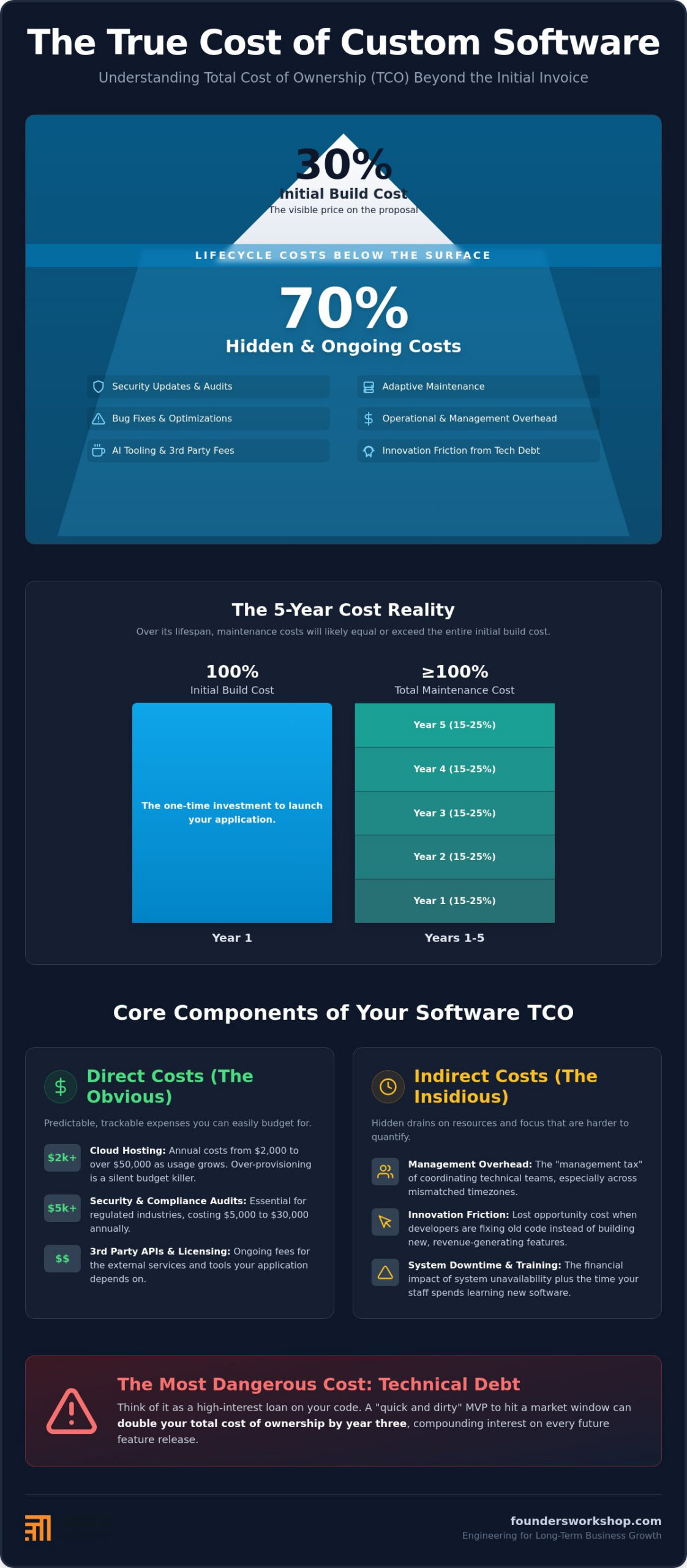
Think of your technical investment as an iceberg. The initial development phase is the 30% visible above the waterline. Below the surface lies the remaining 70%, consisting of maintenance, security updates, and operational overhead. In 2026, market dynamics have made this invisible portion even more volatile. New variables like AI tooling overhead, which adds $200 to $600 per developer each month, and stricter security compliance requirements have shifted the financial landscape. Price is the immediate transaction; cost is the long term drain on your resources and focus.
The 70/30 Rule of Software Lifecycles
The 70/30 rule is a standard benchmark for strategic planning. It suggests that 70% of your total spend will occur after the software launches. During the first 12 to 24 months, you’ll face expenses for user feedback loops, server optimizations, and bug fixes that typically cost 15% to 25% of the initial build price annually. Total cost of ownership for custom software serves as a strategic roadmap that ensures your technical infrastructure supports, rather than stifles, long term business scalability.
Direct vs. Indirect Costs in 2026
Direct costs are the line items you can easily track in a ledger. These include cloud hosting, which can range from $2,000 to $50,000 annually, and annual security audits that cost between $5,000 and $30,000. You also need to account for third party API fees and licensing. These numbers are predictable if you plan for them early.
Indirect costs are more insidious and often harder to quantify. They include the time your staff spends learning the new system, the revenue lost during any potential downtime, and the management overhead of coordinating technical teams. One of the most significant indirect costs is “innovation friction.” This happens when technical debt becomes so heavy that your team spends all their time fixing old code instead of building new features. When your developers can’t move fast, you’re paying a high price in lost opportunity. Avoiding these hidden traps requires a partner who understands that code is a business tool, not just a technical output.
The Core Components of Your Software Budget
Budgeting for the long term requires looking far past the launch date. Strategic leaders use Gartner’s TCO methodology to categorize expenses into manageable buckets. This approach prevents the sticker shock that often hits companies eighteen months into their digital journey. When you calculate the total cost of ownership for custom software, you must account for infrastructure, adaptive maintenance, and the hidden weight of technical debt.
Infrastructure: The Cost of Scalability
Infrastructure isn’t just a monthly server bill; it’s a dynamic cost center that fluctuates with your success. In 2026, moving toward serverless models ensures you only pay for what you use. However, without proper DevOps oversight, cloud hosting costs can spiral from $2,000 to over $50,000 annually as your user base grows. Over-provisioning is a silent budget killer. It occurs when teams reserve more capacity than necessary just to be safe, inflating your monthly burn without adding any functional value to the product.
Maintenance is often misunderstood as simple bug fixing. In reality, bug fixes are only a fraction of the ongoing effort. Adaptive support includes updating libraries, ensuring compatibility with new OS versions, and refining the user experience based on real world data. For those in highly regulated sectors like healthcare or fintech, security and compliance audits add another $5,000 to $30,000 to the annual tally. These are not optional extras; they are the price of staying in business and protecting your brand’s reputation.
Technical Debt: Compounding Interest on Code
The most dangerous component of any budget is technical debt. For a non-technical founder, think of this as a high interest loan. If you built a quick and dirty MVP to hit a specific market window, you’ve essentially taken out a technical mortgage. By year three, this debt can double your total cost of ownership for custom software as developers spend more time navigating old, brittle code than building new features. The interest on this debt manifests as slower release cycles and increased developer frustration.
Modernizing legacy systems is the most effective way to lower this internal interest rate. It allows your team to focus on innovation rather than firefighting. If you’re struggling with a platform that feels like it’s slowing down, it might be time to look at modernizing your internal software development to regain your strategic momentum. Balancing speed to market with architectural integrity is difficult, but it’s the only way to ensure your software remains a scalable growth engine rather than a financial anchor.
How Sourcing Models Impact TCO: Nearshore vs. Offshore
Many leaders fall into the trap of looking only at hourly rates when selecting a development partner. A $30 per hour offshore developer seems like a bargain until you factor in the “Management Tax.” This invisible surcharge includes the hours your US based managers spend clarifying requirements, fixing bugs caused by cultural misunderstandings, and managing complex handoffs. When you analyze the total cost of ownership for custom software, the cheaper hourly rate often results in a higher final bill due to decreased efficiency and increased rework.
Cultural and language synergy further reduces this tax. When your technical team understands the business context and user expectations of the North American market, the cost of misunderstood requirements drops significantly. Nearshore staff augmentation provides access to Latin American talent that shares similar business values and communication styles, allowing your engineering team to focus on innovation rather than translation.
The Hidden Cost of Timezone Gaps
Timezone alignment is a silent profit driver. When your team works in the same window, feedback loops are measured in minutes, not days. A 12-hour feedback loop means a simple question asked on Monday afternoon isn’t answered until Tuesday morning. If that answer needs clarification, you’ve lost 48 hours on a single task. While “follow the sun” models sound efficient on paper, they often fail in agile environments that require constant communication. Real time collaboration ensures high engineering velocity, which directly lowers the long term TCO by getting features to market faster.
Staff Augmentation vs. Managed Teams
Hiring senior US based talent is a massive undertaking. The TCO of local hiring includes aggressive recruiting fees, lengthy onboarding, and the constant risk of turnover in a saturated market. Using dedicated Latin American developers through nearshore staff augmentation allows you to bypass these hurdles. This model integrates high quality talent into your existing team, optimizing the ROI of your North American strategy without the overhead of domestic expansion. Founders Workshop bridges the gap between high level business strategy and nearshore execution, providing the steady hand needed to navigate these complex sourcing decisions.
A 5-Step Framework to Calculate and Reduce TCO
Calculating the total cost of ownership for custom software requires a shift from short term budgeting to long term strategic planning. You cannot treat software as a static asset; it’s a living system that demands consistent investment to remain relevant. To move from a cost center to a growth engine, follow this structured framework designed for the realities of the 2026 market.
- Step 1: Define the 5-Year Vision. Map the journey from MVP to full scale. Anticipate how your user base and feature set will evolve to prevent expensive architectural pivots later.
- Step 2: Audit Technical Debt. Identify legacy constraints early. Use this audit to kill “zombie” costs that drain your budget without adding value.
- Step 3: Quantify Management Overhead. Factor in the time your internal team spends on coordination. As discussed previously, choosing a nearshore model can significantly lower this “management tax.”
- Step 4: Integrate AI for Efficiency. Account for the $200 to $600 monthly overhead per developer for AI tooling, but balance this against the productivity gains in testing and deployment.
- Step 5: Select a Partner for the Lifecycle. Choose a vendor based on their ability to provide ongoing support and strategic guidance, not just the lowest build price.
Leveraging AI Strategy to Lower TCO
Modern AI tools do more than just write code; they optimize the entire software lifecycle. By implementing a custom AI strategy early, you can automate internal business workflows that previously required manual intervention. Predictive analytics can also identify potential system failures before they cause downtime, saving thousands in lost revenue. Integrating these capabilities during the initial development phase prevents the need for expensive retrofitting as AI becomes standard in enterprise operations. If you’re ready to build a more efficient future, our AI strategy and development services can help you identify the highest ROI opportunities.
Optimizing the MVP for ROI
The “Founder’s Roadmap” focuses on building only what provides immediate value to your users. This disciplined approach prevents feature bloat, which is a primary driver of high maintenance costs. Using feature flags allows your team to ship code faster and test new ideas with minimal risk, lowering regression costs during updates. Prioritizing human-centered design during the initial build drastically reduces user-error costs and the need for expensive post-launch training. To further optimize user adoption, you can explore Bespoke eLearning Content Design to ensure your workforce is prepared for the new technical environment. When the interface is intuitive, your support burden drops, directly improving the total cost of ownership for custom software over its first three years of life.
Founders Workshop: Engineering for Long-Term Business Growth
Founders Workshop isn’t just a development firm; we’re a partner built on 30 years of leadership experience. When you’re calculating the total cost of ownership for custom software, you need a guide who has navigated multiple technology cycles. We understand how architectural choices made today will impact your margins in 2030. Our approach focuses on human-centered solutions that align technical execution with your specific strategic growth. By prioritizing business outcomes over pure code, we ensure your investment remains a scalable engine rather than a technical burden.
Our nearshore model in Latin America provides high-quality talent within your own timezone. This geographic alignment eliminates the communication friction that often inflates the “Management Tax” in offshore projects. Whether you’re building startup MVPs or modernizing legacy systems, our methodology ensures every dollar spent contributes to long-term reliability. We bridge the gap between North American strategy and nearshore execution, offering the steady hand needed to navigate the entire software journey from inception to maturity.
Strategic Partnership Over Transactional Development
We act as a technical partner for founders who need to focus on their business, not their server logs. Our commitment to transparency means we provide a clear view of your long-term planning and TCO from day one. We don’t just build features; we build assets that deliver a measurable ROI. This partnership is grounded in accountability. We make sure your technical roadmap is always synchronized with your financial goals, removing the friction that usually slows down scaling companies.
Next Steps: Auditing Your Current TCO
Is your current system a “zombie” asset? If you’re spending more on maintenance than on new feature development, your technical debt is likely eroding your profits. Identifying these hidden costs is the first step toward regaining your technical momentum. Whether you need a fresh AI strategy to boost operational efficiency or nearshore staff augmentation to scale your internal team, we can help you find the right path forward.
Schedule a TCO Audit with Founders Workshop to uncover the hidden variables in your budget and build a roadmap for sustainable, predictable growth.
Securing Your Technical Future for 2026 and Beyond
Managing the total cost of ownership for custom software isn’t about cutting corners; it’s about making informed, strategic decisions that protect your margins for years to come. You’ve seen how the initial build is just a fraction of the lifecycle cost and how choosing the right sourcing model can drastically reduce your management overhead. By addressing technical debt early and leveraging a proactive AI strategy, you shift your software from a draining cost center to a high performing growth engine.
Founders Workshop brings 30+ years of executive leadership and specialized nearshore Latin American talent to every partnership. Our human centered development philosophy ensures that your technology remains aligned with your business goals, providing the steady hand needed to navigate complex scaling challenges. Don’t let hidden variables dictate your technical roadmap.
Ready to optimize your software ROI? Book a Strategic TCO Consultation with Founders Workshop today.
Frequently Asked Questions
What is the average annual maintenance cost for custom software in 2026?
Plan to allocate between 15% and 25% of your initial development cost annually for maintenance and support. For organizations in highly regulated sectors like healthcare or fintech, these costs can rise to 40% or 60% due to frequent security and compliance updates. This budget covers essential bug fixes, library patches, and environment optimizations required to keep the system stable.
How does technical debt affect the total cost of ownership?
Technical debt acts as a compounding financial liability that can double the total cost of ownership for custom software by its third year. When code is optimized for speed over stability, your team eventually spends more time fixing old issues than building new features. This “innovation friction” increases your cost per release and significantly slows your ability to respond to market changes.
Why is nearshore development considered more cost-effective than offshore?
Nearshore development is more cost-effective because it eliminates the 12-hour feedback loop and cultural gaps that drive up “Management Tax.” While offshore hourly rates might appear lower, the hidden costs of rework and communication delays often result in a higher final bill. Working in similar timezones ensures real-time collaboration, which maintains high engineering velocity and reduces project overhead.
Can AI strategy actually reduce the long-term cost of software?
A proactive AI strategy reduces costs by automating internal workflows and streamlining the testing process. While AI tooling introduces a monthly overhead of $200 to $600 per developer, the resulting productivity gains help prevent the accumulation of technical debt. Implementing AI early also allows for predictive maintenance, which identifies potential system failures before they result in expensive downtime.
What are the most common hidden costs in custom software development?
The most frequent hidden costs include fluctuating cloud hosting fees, third-party API subscriptions, and the internal time required for staff training. Many leaders also overlook the cost of annual security audits, which typically range from $5,000 to $30,000. These variables can add 30% to 50% to your first-year budget if they aren’t identified during the initial planning phase.
How often should a legacy system be modernized to maintain a healthy TCO?
Most strategic leaders conduct a comprehensive technical audit every 18 to 24 months to identify “zombie” costs. You don’t always need a full replacement; incremental modernization of critical modules can keep your total cost of ownership for custom software manageable. Regular updates ensure your architecture remains compatible with modern cloud standards and prevents technical debt from reaching a breaking point.
Does building an MVP first always lower the total cost of ownership?
Starting with an MVP lowers TCO by preventing the development of features that don’t provide immediate business value. This disciplined approach can save 40% to 60% of wasted development effort by testing core assumptions before committing to a full build. It ensures that your long-term investment is focused only on the functionality that drives user engagement and revenue.
What is the difference between TCO and ROI in software projects?
TCO measures the sum of all direct and indirect expenses over the software’s lifecycle, while ROI calculates the value or profit generated by that investment. A low TCO is beneficial, but it doesn’t guarantee success if the software fails to solve a core business problem. Strategic leaders optimize for TCO to ensure that the resulting ROI is not eroded by unpredictable maintenance or operational friction.