For founders and SMBs, the pressure is real — but so is the confusion. Where does conversational AI fit? What does it actually cost? And can a business without a dedicated AI team realistically deploy it?
This article answers those questions directly: what conversational AI is in 2026, the concrete benefits it delivers, where it creates the most value by industry, how it works under the hood, and how to implement it without overbuilding.
Key Takeaways
- Conversational AI uses NLP, machine learning, and large language models to hold natural, context-aware conversations via text, voice, or messaging
- For SMBs, the biggest wins are 24/7 availability, reduced support costs, faster lead qualification, and personalized experiences at scale
- High-value use cases span e-commerce, healthcare, financial services, real estate, and internal operations
- Implementation works best when you start narrow, train on real business data, and build in human handoff from day one
- Proactive, emotionally aware, and agentic AI systems are now in production — the pace of change is accelerating
What Is Conversational AI (and How It's Different in 2026)?
Conversational AI is software that understands and responds to human language — text or voice — using NLP, machine learning, and large language models. Unlike older chatbots, it infers meaning from context rather than matching inputs to a fixed script.
From "If-Then" Bots to Intent-Aware Systems
A rule-based chatbot breaks the moment a customer phrases something unexpectedly. Ask it "what's my order status?" and it works. Say "any update on the thing I ordered last Tuesday?" and it fails. Conversational AI handles both — and the thousands of phrasings in between — because it's modeling intent, not keywords.
Gartner defines conversational AI platforms as systems that leverage composite AI, including generative AI and natural language technologies, to simulate human conversation across channels and media. These systems improve with every interaction — no manual script updates needed.
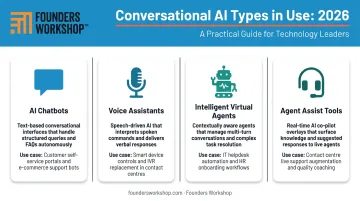
Four Types Businesses Are Deploying in 2026
| Type | What It Does |
|---|---|
| AI Chatbots | Text-based assistants handling support, FAQs, and sales on web and messaging platforms |
| Voice Assistants | Phone or device-based agents managing calls, scheduling, and inquiries by voice |
| Intelligent Virtual Agents (IVAs) | Transaction-capable agents that can process returns, book appointments, or update account info |
| Agent Assist Tools | Real-time AI support for human agents — surfacing answers, summarizing context, flagging sentiment |
Key Benefits of Conversational AI for Customer Engagement
24/7 Availability Without Proportional Cost Increases
Salesloft's analysis of 30 million+ B2B conversations found 39% of conversations happen outside standard business hours and 41% of meetings booked through automated platforms occur outside the 9-to-5 window. Without AI, those leads either wait until morning or find a competitor who responds immediately.
AI handles the overnight queue without adding headcount. Every inquiry gets acknowledged, triaged, or resolved — regardless of when it arrives.
Personalization at Scale
McKinsey's research is direct: 71% of consumers expect personalized interactions, and 76% get frustrated when that doesn't happen. Faster-growing companies derive 40% more revenue from personalization than slower-growing competitors.
Conversational AI makes this practical by pulling from CRM data, purchase history, and prior conversation context in real time. Customers feel recognized rather than processed — a distinction that shows up in retention and lifetime value.
Operational Efficiency and Agent Empowerment
The efficiency case is well-documented:
- HubSpot reports service professionals save more than 2.2 hours per day using AI chatbots
- McKinsey found AI-enabled customer service can deliver a 40–50% reduction in service interactions and a 20%+ reduction in cost-to-serve
- AI can resolve 21–40% of customer requests without human involvement
Agents aren't replaced — they're freed from the repetitive volume that consumes most of their day and redirected to complex, high-stakes interactions.
Measurable ROI
Independent research puts concrete numbers behind the business case:
- Forrester's Zendesk TEI study: 301% ROI with a 25% contact-rate reduction over three years
- Forrester's Agentforce TEI study: 396% ROI and $2.2M net present value for the composite organization
- ServBank (financial services): 80% call deflection rate using AI in loan servicing, per Celent
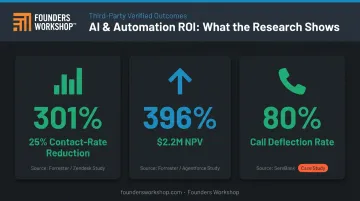
For SMBs, ROI typically comes through deflection savings, faster lead qualification, and reduced time-to-resolution — not headcount cuts alone.
Where Conversational AI Creates Real Business Value: Top Use Cases
E-Commerce and Retail
AI assistants handle product discovery, inventory questions, and post-purchase support — reducing support volume while improving conversion. Sephora's on-site chatbot illustrates what's possible at scale: NRF reported that chatbot usage tripled since 2025 and customers adding products directly from a chat session had 30% higher basket sizes. With 78% of Gen Z using retail websites for exploration rather than specific searches, guided discovery is now a conversion lever, not a nice-to-have.
Healthcare and Senior Care
Conversational AI handles scheduling, intake forms, medication reminders, and basic triage — freeing clinical staff for patient-facing work. HIMSS research indicates average no-show rates for primary care appointments run just under 20%, with notification systems producing documented reductions across multiple studies.
Compliance isn't optional here. Any conversational AI system that creates, receives, maintains, or transmits electronic protected health information (ePHI) for a covered entity requires HIPAA safeguards and a business associate agreement with the vendor.
This means architecture decisions matter from day one — not during a compliance review six months post-launch. Founders Workshop addresses this at the system design level for healthcare clients, building compliant patient communication into the platform structure rather than bolting it on later.
Financial Services and Fintech
AI handles balance inquiries, loan eligibility questions, and fraud alerts around the clock. Two findings from Capgemini capture the current state well:
- 37% of banking customers prefer digital channels over branch visits
- 61% still contact human agents because they're unhappy with chatbot resolutions
That gap is a design problem, not a fundamental limitation of the technology. The CFPB's issue spotlight on chatbots in consumer finance identified real risks: inaccurate information and failure to recognize disputes. Compliance-sensitive deployments need mandatory disclosure flows and clear escalation paths baked into the conversation design.
Real Estate
Speed is the entire game in real estate lead qualification. NAR advises agents to respond within five minutes of an initial inquiry, and research on inbound lead conversion shows rates drop sharply after that window closes. An AI that responds instantly to property inquiries, qualifies buyer intent, and schedules showings at 11pm on a Sunday has moved from differentiator to table stakes in most markets.
Internal Operations
Conversational AI isn't only customer-facing. Businesses use it for internal help desks, HR self-service, and employee onboarding — reducing the load on HR and IT teams while giving employees faster answers. The ROI is real: faster answers mean fewer interruptions for senior staff, and consistent self-service reduces ticket volume before it accumulates.
How Conversational AI Actually Works
The technical foundation has three layers. Understanding each one helps non-technical founders make smarter implementation decisions.
- NLP (Natural Language Processing): Breaks down language structure — grammar, syntax, word relationships. Think of it as the system learning to "read."
- NLU (Natural Language Understanding): Extracts intent and context from what was read. This is what lets the AI distinguish "I want to cancel" (intent: cancellation) from "I want to cancel but I'm not sure" (intent: retention opportunity).
- NLG (Natural Language Generation): Produces a coherent, contextually appropriate response. This is the "writing" layer.
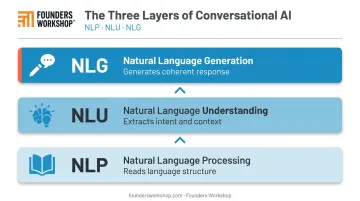
A simple example: a customer types "can I get a refund for my order from last week?" NLP parses the sentence. NLU identifies the intent (refund request) and the time reference (last week). NLG generates a response that checks order eligibility and either confirms the process or routes to an agent.
Conversational AI vs. Generative AI
Founders often confuse these two categories. Conversational AI is the customer-engagement interface — it's designed to understand and respond accurately within a defined scope. Generative AI creates new content. Modern systems increasingly combine both, but the distinction matters: a well-configured conversational AI stays on-brand and on-scope. Generative capabilities can be layered in for richer responses without letting the system drift into off-topic territory.
The system improves continuously. Machine learning models analyze patterns across thousands of interactions, getting better at predicting intent and generating relevant responses over time. The earlier you deploy, the more interaction data you accumulate — and that data directly improves accuracy, deflection rates, and customer satisfaction over time.
Best Practices for Implementing Conversational AI
Start With One Specific, Measurable Goal
The most common implementation failure: deploying a generic chatbot without a defined purpose. Pick one use case first — after-hours lead capture, FAQ deflection, or appointment scheduling — and define success metrics before choosing a platform.
Good starting metrics:
- Deflection rate (% of inquiries resolved without human handoff)
- Response time (average time to first meaningful response)
- Conversion rate (for sales-focused deployments)
- CSAT or satisfaction score on AI-handled interactions
Train on Real Business Data
The AI is only as good as what it's trained on. Connect it to your actual knowledge base, product catalog, current pricing, and CRM — not the generic defaults that ship with most platforms. Build in a regular data audit cadence; as products and policies change, stale training data produces wrong answers fast.
Design for the Handoff
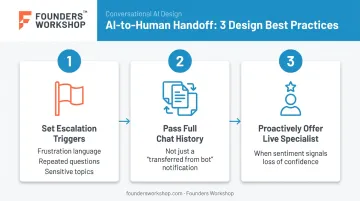
One of the most common user frustrations is when AI fails to escalate gracefully. Best practices for human-in-the-loop design:
- Set escalation triggers for frustration language, repeated questions, and sensitive topics
- Pass the full chat history to the agent — not just a "transferred from bot" notification
- Proactively offer a live specialist when sentiment signals indicate the customer is losing confidence
Build or Buy: Know the Trade-offs
Building a custom solution gives brand alignment and deeper integration but requires time and engineering resources. Buying a platform offers faster time to value. For startups and SMBs without in-house AI teams, a development partner like Founders Workshop can fill that gap — delivering custom AI-integrated solutions through a structured process that covers everything from initial discovery to deployment and ongoing support.
Measure, Iterate, and Expand
Successful deployments treat AI as a living system, not a finished product. The feedback loop looks like this:
- Review conversation gaps
- Identify where the AI failed
- Update the knowledge base
- Test and redeploy
Monitor weekly in the first 90 days. Gaps in the first month are normal; gaps in month six are a process failure.
What's Next: Emerging Trends for 2026 and Beyond
Emotionally Aware and Multimodal AI
A 2025 IEEE paper on chatbot responsiveness documented integrated systems that combine text-based sentiment analysis, voice features, and optional facial-expression inputs. The practical result: AI that can detect frustration in tone before a customer types "I want to speak to a manager." Multimodal inputs — voice, text, and image — are becoming standard in new deployments, making interactions feel more contextually intelligent.
Proactive and Agentic AI
The shift from reactive (customer asks, AI responds) to proactive (AI anticipates and initiates) is accelerating. Gartner predicts that by 2029, agentic AI will autonomously resolve 80% of common customer service issues without human intervention, leading to a 30% reduction in operational costs. Systems that can independently book appointments, process returns, and follow up on leads are no longer speculative.
That shift is already reshaping where customers begin their service journey. Gartner projects that by 2028, at least 70% of customers will open a conversational AI interface before ever reaching a human — making investment now a matter of competitive positioning, not experimentation.
AI Ethics, Privacy, and Trust as Competitive Differentiators
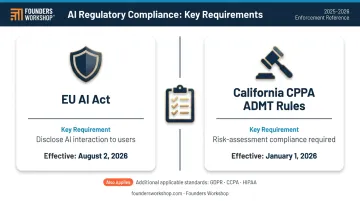
Regulation is accelerating alongside capability. Two major frameworks took effect in quick succession:
- EU AI Act: Requires disclosure that users are interacting with AI — applies from August 2, 2026
- California CPPA (ADMT rules): Finalized in 2025, with risk-assessment compliance beginning January 1, 2026
The trust gap is real: IAPP research found 60% of individuals have already lost trust in organizations due to AI practices. Businesses that disclose AI use upfront, honor privacy preferences, and meet applicable standards — GDPR, CCPA, HIPAA in healthcare and financial services — earn measurably stronger customer loyalty. Compliance isn't a moat, but transparency increasingly is.
Frequently Asked Questions
What are the benefits of conversational AI?
Conversational AI delivers 24/7 availability, personalized interactions at scale, reduced support costs, faster response times, and actionable data from every customer interaction. For most SMBs, the operational efficiency gains alone (agents typically save 2+ hours per day) justify the investment.
How is conversational AI different from a traditional chatbot?
Rule-based chatbots follow fixed scripts and break when customers phrase questions unexpectedly. Conversational AI understands intent and context, learns from interactions, and handles a much broader range of inputs naturally, including variations, follow-ups, and multi-turn conversations.
Can small businesses actually afford to implement conversational AI?
The cost landscape has shifted significantly. Modern platforms and development partners offer accessible entry points, and ROI through deflection savings, faster lead conversion, and operational efficiency typically offsets investment within the first year. Most SMBs who delay find competitors have already captured the efficiency and conversion advantages.
How long does it take to implement conversational AI?
Basic use cases — FAQ bots, appointment schedulers — can go live in 2–6 weeks with the right platform and data preparation. Complex integrations connecting CRM, knowledge bases, and multiple channels typically take 6–12 weeks depending on scope and data readiness.
Can conversational AI replace human customer service agents?
No — and that's not the goal. Conversational AI handles high-volume routine queries so agents can focus on complex, emotionally sensitive interactions that require genuine empathy and judgment. The model works best as augmentation, not replacement.
Which industries benefit most from conversational AI?
E-commerce, healthcare, financial services, real estate, and hospitality consistently deliver the highest ROI. Any business relying on customer interaction and support has meaningful efficiency and conversion gains within reach, regardless of industry.