Introduction
Gartner predicts conversational AI will reduce contact center agent labor costs by $80 billion by 2026 — a figure that makes sense when you consider labor accounts for up to 95% of total contact center costs.
For startups and SMBs, the pressure is more immediate. Salesforce found that 76% of service organizations anticipate higher case volume, with budgets expected to rise 23% on average — and 65% of agents reporting their cases are more complex than a year ago. You can't simply hire your way through that curve.
That's where conversational AI should close the gap — but it doesn't do so automatically. Costs become excessive because of poor deployment decisions, mismatched tooling, and absent post-launch management. When the technology is deployed correctly, the savings are real. This guide covers exactly where those costs originate and what to do about them.
Key Takeaways
- Conversational AI cuts costs by automating high-volume, low-complexity queries — scope it narrowly to what it handles well
- The largest savings often come from hiring avoidance and reduced agent turnover, not just per-ticket labor reduction
- Most implementations underdeliver due to weak knowledge bases, over-broad scoping, and missing escalation logic — decisions made before launch
- Incremental expansion after hitting accuracy benchmarks outperforms large upfront automation attempts
- Sustainable cost reduction requires treating conversational AI as ongoing infrastructure, not a one-time deployment
How Conversational AI Customer Service Costs Build Up
Most businesses expect one implementation invoice. What they actually get is a cost structure that accumulates across multiple categories over time.
Where costs accumulate:
- Platform licensing and integration fees
- Knowledge base preparation and ongoing maintenance
- Failed containment — queries the AI mishandles that escalate to human agents anyway
- Eventual re-scoping or re-implementation when the initial deployment is too narrow or too broad
The pattern is both gradual and episodic. Gradual degradation happens when product information and policy documentation go stale, causing resolution accuracy to drift downward. Episodic cost spikes happen when a poorly scoped deployment reaches a breaking point and requires significant rework.
The hidden cost dimension is the one most businesses discover too late. A chatbot resolving queries incorrectly at scale generates real expense through misdirected escalations, repeat contacts from frustrated customers, and retention losses — none of which show up on the licensing invoice.
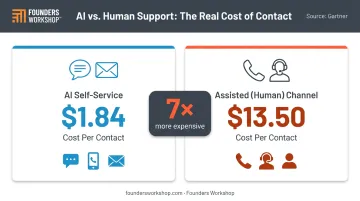
Gartner's benchmark data puts median cost per contact at $1.84 for self-service versus $13.50 for assisted channels. The cost difference between getting containment right and getting it wrong is not marginal.
Key Cost Drivers for Conversational AI in Customer Service
Most conversational AI deployments don't fail because the technology is wrong — they fail because of four recurring cost drivers that are entirely avoidable.
Scope Misalignment
The dominant cost driver is deploying AI against queries it isn't equipped to handle. When businesses automate complex, judgment-dependent interactions too early — complaints requiring policy interpretation, multi-intent queries, emotionally charged conversations — resolution failure rates climb. Each failure generates an escalation that costs more than the original human-agent interaction would have.
Automating routine queries first — order status, password resets, billing questions, basic FAQ — produces the highest containment rates because resolution paths are predictable and well-documented. Complex queries require human judgment and should enter the queue that way from the start.
Knowledge Base Quality
AI accuracy is directly tied to the quality of its underlying documentation. As Salesforce notes in its AI grounding guidance, a company's knowledge base determines how accurate and specific AI-generated responses actually are. Thin, outdated, or inconsistently organized documentation produces wrong answers — and wrong answers at scale cost more to recover from than not automating at all.
Platform and Integration Choices
Platform selection produces costs in either direction:
- Over-investing in enterprise-grade platforms that exceed current scale, paying for complexity and configuration overhead that delivers no operational benefit at SMB volume
- Under-investing in tools that can't handle future query volume or integrate with existing CRM and support systems
Either mistake forces a costly rebuild. The right platform is matched to your current scale and near-term trajectory — not to what a vendor's largest enterprise customers use.
Channel Routing Decisions
Not all channels carry equal cost structures. Voice interactions are significantly more expensive to handle than messaging channels, and AI containment rates vary substantially by channel. Routing query volume to channels where AI performs best — chat, in-app messaging, structured web forms — affects the cost base before AI performance is even optimized.
Cost-Reduction Strategies for Conversational AI in Customer Service
Strategies for reducing costs fall into three categories depending on where in the deployment lifecycle costs originate: decisions made before launch, management practices during operation, and the broader context in which the AI operates.
Strategies That Reduce Costs by Changing Decisions
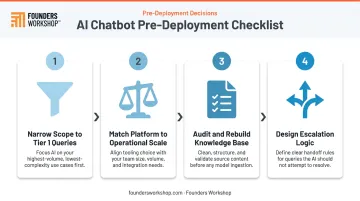
Pre-deployment decisions carry the highest leverage. Getting four things right before launch determines whether the deployment generates savings or triggers expensive rework.
1. Narrow automation scope to Tier 1 queries first. High-volume, low-complexity, well-documented query types — order status, password resets, billing inquiries, account setup, FAQ-style questions — have predictable resolution paths and minimal need for human judgment. Starting here produces the strongest containment rates with the lowest failure risk. Expand scope only after proving accuracy at this tier.
2. Match platform complexity to current operational scale. SMBs and startups frequently overpay by selecting enterprise-grade conversational AI platforms when lighter, more configurable tools (or custom-built solutions designed around specific workflows) deliver equivalent containment at lower total cost. The right choice depends on actual scale and support workflow, not a projected enterprise use case.
3. Audit and rebuild the knowledge base before deployment. Every query type targeted for automation needs a complete, current, and well-structured documentation source. Gaps in documentation translate directly into resolution failures and escalation costs. A knowledge base audit is not optional pre-work — it determines what can actually be automated successfully on day one.
4. Design escalation logic before going live. Predefined escalation triggers (frustration signals, billing disputes, cancellation intent, multi-intent queries) prevent the AI from mishandling sensitive conversations. These interactions carry outsized downstream costs in churn risk and recovery effort. Escalation logic built into the deployment protects against the highest-cost failure modes.
Founders Workshop works with startups and SMBs on exactly this pre-deployment evaluation: assessing whether an off-the-shelf platform, a configured solution, or a purpose-built conversational AI system fits the actual operation rather than an aspirational enterprise use case.
Strategies That Reduce Costs by Changing How It Is Managed
Most deployment cost overruns are not launch failures. They're slow degradation failures caused by inadequate post-launch management.
Track a focused weekly metric set. Containment rate, AI resolution accuracy, escalation rate, and first response time need weekly visibility. Knowledge gaps from product updates, policy changes, and new query patterns emerge continuously and compound quickly when not caught early. Monthly reporting cycles miss drift that becomes expensive by the time it surfaces.
Expand automation scope incrementally, only after accuracy thresholds are met. A rule-based expansion model prevents over-expanding before the system is stable: add new query types only after existing ones hit a defined accuracy benchmark. IBM's 2020 virtual agent study reported a 64% average containment rate as a baseline for deployed systems; Gartner forecasts agentic AI reaching 80% autonomous resolution of common issues by 2029. Use these as directional benchmarks, but set internal thresholds per query type based on your own measured accuracy.
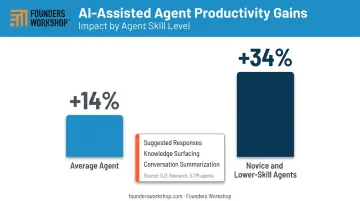
Use AI copilot tools to reduce the cost of human handling. Research published in the Quarterly Journal of Economics studied 5,179 customer-support agents and found generative AI assistance increased productivity by 14% on average — and by 34% for novice and lower-skill workers. Suggested responses, knowledge base surfacing, and conversation summarization reduce average handle time for escalated queries and shorten new agent onboarding ramp. This affects the portion of interactions that still require human resolution — a cost lever most businesses overlook when evaluating AI investment.
Founders Workshop builds these agent-assist capabilities as part of its AI services offering, including call transcription and summarization, sentiment analysis, and custom GPT tools. Post-launch support is structured through tiered maintenance packages that keep the system current as workflows evolve.
Run scheduled knowledge base maintenance cycles. AI accuracy degrades predictably when documentation isn't updated after product or policy changes. Tying maintenance cycles to product and policy change calendars prevents the reactive re-training or re-scoping that results from letting documentation drift.
Strategies That Reduce Costs by Changing the Context Around It
In many cases, the environment surrounding the AI is a larger cost driver than the AI itself.
Shift query volume toward messaging channels. Gartner's benchmark data shows self-service contacts at $1.84 versus $13.50 for assisted channels. Proactively directing customers toward chat, in-app messaging, or WhatsApp — rather than waiting for them to choose the channel — lowers the cost base structurally, independent of AI performance improvements.
Align self-service content with the AI's resolution model. Help centers, FAQ pages, and onboarding documentation designed for AI consumption (structured, searchable, specific) reduce resolution failures and lower escalation volume. Content that works for human readers doesn't always work as an AI grounding source. Restructuring it for AI consumption is a supporting cost lever that requires no platform changes.
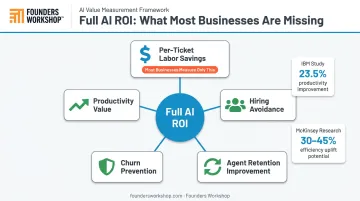
Reframe ROI to include non-labor cost dimensions. Businesses that measure only per-ticket labor savings systematically undervalue their AI deployment. The full cost picture includes:
- Hiring avoidance — not scaling headcount linearly as ticket volume grows
- Agent retention improvement — AI handling repetitive Tier 1 volume reduces burnout-driven turnover
- Churn prevention — faster resolution improves customer retention rates
IBM cites a 23.5% average cost-per-contact reduction from conversational AI, and McKinsey estimates 30% to 45% productivity value in customer care functions. The businesses capturing that full range are measuring all five dimensions, not just one.
Evaluate whether a custom-built solution fits better than an off-the-shelf platform. Generic platforms carry ongoing licensing costs and often require extensive configuration to match niche support workflows. Purpose-built solutions designed around a company's specific query types and customer context can deliver higher containment at lower total cost over a multi-year horizon. The break-even calculation depends on query volume, workflow complexity, and how far a standard platform needs to be customized to perform. Founders Workshop conducts this scoping analysis during its Discovery phase, helping clients determine whether a generic platform or purpose-built system makes financial sense for their specific operation.
Conclusion
The businesses overpaying for conversational AI customer service aren't failing because the technology doesn't work. They're failing because they misidentify where costs originate — blaming the platform when the real problem is pre-launch scoping, a degraded knowledge base, or an absent measurement cadence.
The organizations capturing the largest savings treat conversational AI as operational infrastructure — scoped against the right queries, managed with weekly visibility, expanded incrementally as accuracy proves out, and maintained so the system stays current. Getting that right is an ongoing operational commitment, not a one-time deployment decision.
Frequently Asked Questions
How does conversational AI improve customer experience?
Conversational AI improves customer experience by delivering instant, 24/7 responses to routine queries, reducing wait times, and freeing human agents for complex, high-empathy interactions. Customers get faster resolutions; agents focus where their judgment actually matters.
What is a realistic cost reduction percentage from conversational AI in customer service?
IBM cites a 23.5% average cost-per-contact reduction, while McKinsey estimates 30% to 45% productivity value in customer care functions. Total economic impact — including hiring avoidance, reduced agent turnover, and churn prevention — typically exceeds per-ticket labor savings alone.
What types of customer service interactions are best suited for conversational AI automation?
High-volume, low-complexity, well-documented query types are the strongest candidates: order tracking, billing questions, password resets, account setup, and FAQ-style inquiries. These follow predictable resolution paths with minimal need for human judgment — which is exactly where automation delivers the highest containment rates.
How long does it take to see ROI from a conversational AI implementation?
Salesforce research found that 70% of customer service organizations adopting AI agents observe measurable value within 60 days. Timelines vary based on deployment scope and knowledge base completeness, but that 60-day window is a reasonable baseline for initial validation.
Can conversational AI replace human customer service agents entirely?
No. Conversational AI handles routine, repeatable queries at scale but cannot replace human judgment for complex complaints, high-stakes account decisions, or emotionally sensitive conversations. The effective model is AI handling Tier 1 volume while human agents focus on interactions requiring empathy and contextual reasoning.
What are the biggest mistakes companies make when implementing conversational AI?
Four failure modes come up repeatedly:
- Deploying before the knowledge base is complete
- Automating too broad a query scope before accuracy is proven
- Skipping post-launch measurement cycles
- Measuring ROI only on per-ticket labor cost, not the full economic picture