That tension is what's pushing conversational AI from a speculative investment to an operational baseline. Forrester research found that 55% of US online adults will abandon a purchase if they can't find a quick answer — and with cart abandonment running at 70.22% across the industry, the cost of slow or absent support isn't abstract.
This article covers what conversational AI chatbots actually do for e-commerce operations, which benefits are backed by credible evidence, and the specific practices that separate deployments that deliver ROI from those that stall after launch.
Key Takeaways
- Conversational AI reads shopper intent using NLP and machine learning — a fundamental difference from rule-based bots
- Top benefits: 24/7 support without added staffing costs, personalized recommendations, and cart abandonment recovery
- 70.22% of online shopping carts are abandoned — even modest recovery has material revenue impact
- Successful deployment starts with high-volume use cases, stack integration, and ongoing performance monitoring
What Is a Conversational AI Chatbot for E-Commerce?
A conversational AI chatbot is software that uses Natural Language Processing (NLP) and machine learning to understand what a customer is actually asking — in their own words — and respond meaningfully. No fixed menu. No preset script the shopper has to navigate around.
Gartner defines conversational AI platforms as products that enable applications simulating human conversation. The practical distinction from older chatbots matters more than the definition.
Conversational AI vs. Rule-Based Bots
| Feature | Rule-Based Bot | Conversational AI |
|---|---|---|
| Language handling | Fixed triggers and keywords | Understands intent, typos, slang |
| Failure mode | Breaks on unmatched queries | Interprets ambiguous phrasing |
| Learning | Static — needs manual updates | Improves from each interaction |
| Scope | FAQ menus, basic routing | Product discovery through post-purchase |
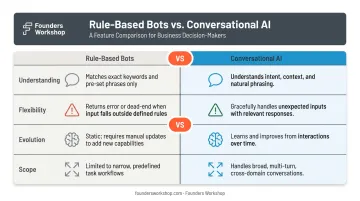
That scope difference translates directly into deployment reach. According to IBM's overview of conversational AI use cases, AI-powered chatbots handle the kind of open-ended, unstructured queries that rule-based systems simply can't process.
For e-commerce, that means coverage across websites, mobile apps, WhatsApp, SMS, and social channels. A shopper can describe what they're looking for in plain language, ask about return policies mid-checkout, or check an order status after hours — and get a useful response each time.
That range matters. This is a revenue and efficiency tool, not just a support widget.
Key Benefits of Conversational AI Chatbots for E-Commerce
The advantages below tie directly to metrics e-commerce teams actually track: cost per interaction, conversion rate, cart abandonment rate, customer satisfaction, and support ticket volume. No vendor claims without independent backing appear here. Each benefit maps to one of three areas — availability and cost, personalization and conversion, and post-purchase retention — where conversational AI consistently moves the needle.
24/7 Availability and Support Cost Reduction
Online shoppers don't operate on business hours. ECDB's analysis of shopping behavior shows peak activity in the US around 3 p.m., with UK and German shoppers concentrated between 8 p.m. and 10 p.m. — hours when most support teams are either understaffed or offline entirely.
Conversational AI eliminates that gap. It handles inquiries at 2 a.m. on Black Friday the same way it handles them on a Tuesday afternoon — no queue, no wait, no "we'll get back to you."
What this looks like in practice:
- Order tracking questions answered instantly, without a ticket
- Return and refund policy queries resolved without agent involvement
- Product availability checks handled in real time
- Volume spikes during flash sales or peak seasons absorbed without emergency staffing
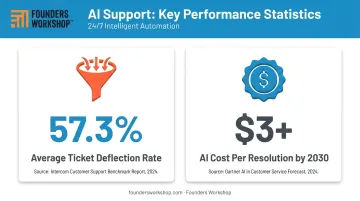
On the cost side, Gartner predicts that generative AI cost per customer service resolution will exceed $3 by 2030 — still meaningful savings relative to fully loaded human agent costs, particularly for high-volume, routine queries.
The deflection numbers back this up: Freshworks' 2024 benchmark data shows most businesses achieve at least 57.3% deflection with chatbots, meaning more than half of incoming contacts never reach a human agent.
This matters most for: SMBs and growth-stage e-commerce brands where support headcount can't scale proportionally with order volume, and for any business facing predictable traffic spikes they can't staff up for cost-effectively.
KPIs impacted: Cost per support interaction, ticket deflection rate, first-contact resolution rate, agent capacity for complex cases.
Personalization at Scale and Conversion Lift
Static product recommendation engines show the same suggestions to everyone who views a category. Conversational AI does something different: it guides shoppers through discovery using what they actually say, adjusting recommendations mid-conversation based on their responses.
A shopper who types "I need running shoes for trail, not pavement, and I overpronate" gets a different result than someone searching "running shoes." The conversation itself becomes the filter.
McKinsey research shows personalization drives 10% to 15% revenue lift on average, with company-specific results ranging from 5% to 25%. Epsilon found that 80% of consumers are more likely to purchase when brands offer personalized experiences — though both figures cover personalization broadly — not chatbot interactions specifically.
Peer-reviewed studies on AI chatbots in e-commerce do link chatbot interactions to purchase intention — but a single reliable conversion-lift benchmark doesn't exist in the academic literature. Vendor claims of "25% conversion lift" rarely include methodology. Treat them accordingly.
This matters most for: Catalogs with hundreds or thousands of SKUs — apparel, electronics, home goods — where product discovery without guidance leads to overwhelm and exit. Also for brands competing on experience rather than price, where the quality of the shopping interaction is itself a differentiator.
KPIs it moves: Conversion rate, average order value, time-to-purchase, upsell and cross-sell revenue, CSAT.
Cart Abandonment Recovery and Post-Purchase Retention
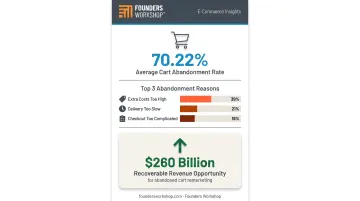
Baymard Institute's analysis of 50 studies puts average cart abandonment at 70.22%. The most common reasons: extra costs too high (39%), delivery too slow (21%), checkout too long or complicated (18%).
Notice that two of the top three reasons are informational — shoppers hesitated because they didn't have answers they needed. That's exactly the gap conversational AI can close.
When a shopper stalls on a checkout page or triggers an exit signal, a well-configured AI can open a targeted conversation — zeroing in on what stopped them. That means "Need help with sizing before you check out?" or "Want to see our return policy?" instead of a generic pop-up.
Post-abandonment recovery via WhatsApp, SMS, or in-app messaging can re-engage shoppers with context from their session already intact. No independent primary source with verified recovery rate percentages exists — ignore vendor claims of specific recovery percentages without methodology.
The post-purchase side matters equally. Research linking delivery performance to online review ratings confirms that a poor post-purchase experience directly damages reputation. Conversational AI handling returns, refund status updates, and exchange requests turns a typically frustrating touchpoint into one that builds loyalty rather than erodes it.
Baymard estimates that improving checkout processes could recover $260 billion in abandoned orders across US and EU e-commerce. Chat alone won't close that gap — but it's one of the few tools that targets the informational hesitations driving the majority of exits.
KPIs impacted: Cart abandonment rate, checkout completion rate, return/refund resolution time, repeat purchase rate, customer lifetime value.
What Happens When E-Commerce Businesses Skip Conversational AI
Every unanswered query after hours, every shopper who gives up on product discovery, and every abandoned cart with no recovery attempt is direct, measurable revenue lost. These gaps compound — they don't stay constant as order volume grows.
The operational consequences are specific:
- High agent load on routine queries — order tracking, returns, and shipping questions consume human support capacity that could go toward complex issues
- Slow response times — shoppers who don't get fast answers leave — and most don't come back
- Inconsistent post-purchase experiences — returns and order updates handled poorly generate repeat contacts, negative reviews, and churn
- Inability to scale during peaks — Black Friday, holiday seasons, and flash sales become operational crises instead of revenue opportunities
- Unrecovered cart abandonment — without proactive intervention, 70%+ abandonment is simply accepted as normal
Forrester's 2025 analysis of agentic commerce notes that current generative AI shopping experiences remain immature in some implementations — producing unintuitive conversations or nonsensical results when poorly configured. The risk isn't the technology itself — it's deploying without the right configuration and guardrails in place. Businesses that skip the technology entirely cede ground to competitors who are getting the implementation right.
Best Practices for Getting the Most from Conversational AI in E-Commerce
Conversational AI delivers its best results when deployment is deliberate. Switching it on isn't the hard part — the real work is configuring it to match actual customer behavior, existing systems, and clear success metrics.
Start with High-Volume, Low-Complexity Use Cases
Audit your support tickets and chat logs before building anything. Identify the top 5–10 query types by volume:
- Order status and tracking
- Return and refund policy questions
- Product availability
- Shipping timelines and costs
- Size guides or product specifications
These become your first automation targets. They offer the fastest containment gains with the lowest failure risk. Trying to automate complex, nuanced queries on day one is how deployments earn a bad reputation internally before they've had a chance to prove value.
Integrate with Your E-Commerce Stack Before Launch
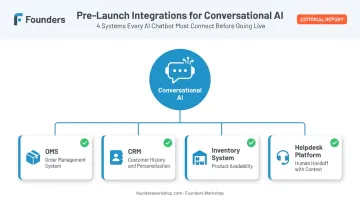
A chatbot that can't access real data is a liability. Before going live, integrations with the following systems need to be in place:
- OMS (Order Management System) — for real-time order status
- CRM — for customer history and personalization context
- Inventory system — for accurate product availability
- Helpdesk platform — for seamless human handoff with context
Skipping integrations is one of the most common causes of chatbot underperformance. A bot that responds "I don't have that information" to an order tracking question creates frustration while consuming the customer's time — and that's a worse outcome than no bot at all.
Integration architecture should be scoped before a line of code is written — not retrofitted after the fact.
Design for Smooth Human Handoff
Even well-configured AI will encounter queries it can't resolve. The best implementations detect when a conversation exceeds scope and transfer to a human agent with full conversation context intact. The trigger can be a sentiment signal, a complexity threshold, or a direct customer request.
A good handoff means the agent already knows what the customer tried, what the bot said, and where the conversation stalled. Customers should never have to repeat themselves. Key principles for smooth handoff design:
- Transfer full conversation transcript to the agent on escalation
- Set clear escalation triggers (negative sentiment, repeated failed intents, explicit requests)
- Acknowledge the transition explicitly ("Connecting you with a support specialist now")
- Avoid dead ends where escalation isn't available
Train Continuously and Monitor KPIs Weekly
Launch is the starting line. Track these metrics on a weekly cadence:
- Containment rate — what percentage of conversations resolve without human involvement
- CSAT scores from bot-handled interactions
- Average handling time — where is the bot taking too long?
- Assisted revenue — are chatbot-guided sessions converting?
- Failed intents — which questions is the bot consistently getting wrong?
Chatbots that aren't actively maintained degrade. Products change, policies update, and customer language evolves. A bot trained on last season's catalog and last year's return policy will frustrate shoppers and reflect badly on the brand.
Evaluate Whether Off-the-Shelf or Custom-Built Is Right for Your Business
Off-the-shelf platforms like Tidio, Intercom, and ManyChat work well for standard e-commerce workflows on Shopify or WooCommerce. For many SMBs, they're the right starting point.
But businesses with proprietary order management systems, complex fulfillment logic, or customer journeys that don't fit standard templates often find that off-the-shelf tools create as many problems as they solve. The integrations are shallow, the customization hits hard limits, and the bot ends up handling only the queries that don't require real system access.
Custom-built solutions integrate directly with the business's specific stack. For e-commerce operations with non-standard workflows, that depth of integration is what separates a bot that answers generic FAQs from one that can actually resolve customer issues end-to-end.
Founders Workshop's AI Services practice takes an integration-first approach to conversational AI. The 5D Process scopes API connections during Discovery — before any build begins — so the solution fits your existing stack rather than requiring you to work around its limitations.
Conclusion
Conversational AI chatbots deliver consistent ROI when treated as operational infrastructure — not a feature you ship once and forget. The businesses seeing clear results started narrow (high-volume, low-complexity use cases), integrated deeply with their tech stack, and iterated based on real performance data.
That performance data only tells the full story when the implementation actually fits the business. For founders and SMBs with custom requirements or complex order flows, a generic off-the-shelf deployment often underdelivers — it lacks the integrations and context the business actually needs.
Founders Workshop's AI-first development practice helps scope, build, and integrate conversational AI solutions built around how the business operates. Every engagement starts with Discovery: defining integrations, use cases, and success metrics before any development begins.
Frequently Asked Questions
What is a conversational AI chatbot for e-commerce?
It's an AI-powered system that uses NLP and machine learning to engage shoppers in natural dialogue — helping them find products, track orders, and resolve issues across web, mobile, and messaging channels without requiring a human agent for every interaction.
How is conversational AI different from a traditional chatbot?
Traditional chatbots follow fixed decision trees and fail when a query doesn't match a preset trigger. Conversational AI understands intent and context, handles casual or ambiguous language, and gets smarter as it's trained on your actual customer conversations and product catalog.
What are the most important use cases for conversational AI in e-commerce?
The highest-impact use cases include:
- 24/7 FAQ and order tracking support
- Personalized product recommendations through natural dialogue
- Proactive cart abandonment recovery
- Post-purchase support covering returns and refund processing
How do I measure the ROI of a conversational AI chatbot?
Track five core KPIs: containment rate, CSAT, average handling time, first-contact resolution rate, and assisted revenue. Most e-commerce teams can establish a clear ROI baseline within 90 days of go-live.
What are the biggest mistakes e-commerce businesses make when deploying chatbots?
The three most common failure points: launching without mapping top customer intents first, failing to integrate with the OMS and CRM before go-live, and treating deployment as a one-time project rather than an ongoing system that requires regular maintenance.
Do I need a custom-built chatbot or can I use an off-the-shelf solution?
Off-the-shelf tools work well for standard Shopify or WooCommerce workflows. Businesses with proprietary systems, complex order logic, or non-standard customer journeys typically get better long-term results from a custom-built solution designed around their specific stack.