Introduction
Picture this: a traveler's connecting flight gets canceled at 11 PM. They need to rebook immediately — hotel, flight, ground transfer. The travel company's support line is closed, the chatbot offers only an FAQ link, and the airline app shows a three-hour wait. That's when travel businesses lose customers permanently — and it's entirely preventable.
According to Skift and Allianz research, 61% of travelers would pay more for 24/7 customer service — making responsiveness a direct revenue differentiator. Meanwhile, over half of travelers abandon online bookings due to poor user experience, often because they can't get a fast answer when they need one.
Basic chatbots and understaffed support teams can't bridge that gap anymore. Conversational AI can.
This guide covers what conversational AI actually means for travel businesses today, the concrete benefits it delivers, where it creates the most value, and how to build and deploy it without common pitfalls.
TLDR
- 61% of travelers would pay more for 24/7 service — responsiveness is now a revenue differentiator
- Conversational AI handles natural language, retains context, and executes real actions — beyond what rule-based chatbots can do
- Top use cases: pre-booking queries, disruption rebooking, time-triggered upsells, and post-trip engagement
- Deployments fail without live API integrations — static data kills traveler trust fast
- Start with one high-volume use case, measure weekly, and expand from there
What Is Conversational AI for Travel — And How Is It Different From a Basic Chatbot?
The Core Distinction
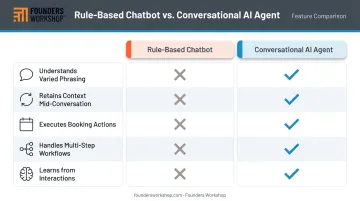
A rule-based chatbot recognizes keywords and follows fixed decision trees. Ask it something outside its script — "Can I change my outbound leg but keep the return?" — and it either fails, redirects to an FAQ, or escalates to a human who wasn't available in the first place.
Conversational AI works differently. It understands intent, maintains context across a multi-turn dialogue, and can execute actions inside connected systems — rebooking a flight, updating a reservation record, or surfacing a relevant upsell based on your travel profile.
The practical difference for a travel business owner:
| Feature | Rule-Based Chatbot | Conversational AI Agent |
|---|---|---|
| Understands varied phrasing | ❌ | ✅ |
| Retains context mid-conversation | ❌ | ✅ |
| Executes booking/modification actions | ❌ | ✅ |
| Handles multi-step workflows | ❌ | ✅ |
| Learns from real user interactions | ❌ | ✅ |
Why This Matters Now — Even for Smaller Travel Brands
Large airlines and OTAs have always had the resources to build customer experience infrastructure. That capability gap — once manageable — is now a competitive liability for smaller travel brands, and the timeline is compressing fast.
Google's AI Mode now builds full itineraries using real-time flight and hotel data from Search, with follow-up questions to refine plans. That's compressing the traditional search-compare-book funnel into a single AI interaction.
Expedia Group's research shows 68% of travelers still prefer booking with established travel brands over AI chatbots — which is actually good news. Travelers want to book with you. But if your brand can't deliver fast, accurate, personalized responses when they ask questions, that preference erodes quickly.
Key Benefits of Conversational AI for Travel Businesses
24/7 Availability During the Moments That Matter Most
Demand for support spikes precisely when human teams aren't available: overnight flight disruptions, last-minute booking changes, peak holiday weekends. Conversational AI eliminates those gaps.
Travelers have made their expectations clear:
- 61% would pay more for 24/7 service (Skift/Allianz)
- 57% of disrupted passengers wanted more detailed information during delays
- 56% wanted more frequent communication from airlines during disruptions
- Only 10% felt fully informed of their rights when a flight was disrupted
An AI agent that contacts affected travelers with rebooking options at 2 AM protects loyalty when it's most at risk — during the disruptions travelers remember longest.
Operational Cost Reduction Through Automation
The highest-volume travel support interactions are also the most repetitive: availability checks, cancellation policy questions, baggage allowances, loyalty program balances, booking status updates.
Real-world deployment data shows what's achievable at scale:
- AX Hotels: 93% automation rate across the guest journey
- Entourage sur-le-Lac: 94% of guest inquiries automated, saving 440 staff hours
- Lake District Hotels: 70% reduction in incoming calls
Automating that volume frees your support team for the work that requires human judgment: complex group bookings, escalated service recovery, and high-value guest relationships.
Personalized Experiences That Drive Upsell and Repeat Bookings
Generic offers get ignored. A room upgrade pitch to a solo business traveler staying one night is noise; the same pitch to a couple celebrating their anniversary converts. The difference is context — and that's where AI earns its place in the revenue stack.
Conversational AI pulls from CRM profiles, booking history, and behavioral signals to make recommendations feel relevant. Oracle and Skift's hospitality research found 75% of travelers expressed interest in AI-driven personalization, and 51.5% of hotel executives planned to use AI for personalized marketing by 2025.
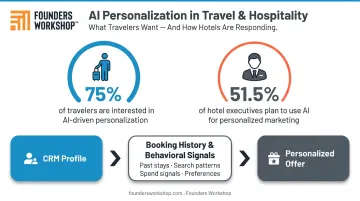
The business result shows up in ancillary revenue: automated pre-arrival upsell emails averaged $95 per booking in Revinate's 2025 Hospitality Benchmark data.
Multilingual Support Without Proportional Staffing Costs
International travelers expect to communicate in their own language. Hiring multilingual agents for every channel at adequate coverage hours is expensive and operationally complex.
Conversational AI handles multiple languages natively across web chat, WhatsApp, email, and SMS — serving an international audience without adding headcount for each language market.
Core Use Cases: Where Conversational AI Delivers the Most Value
Pre-Booking and Booking Support
Pre-booking is where the most abandonment happens. Travel cart abandonment rates run above 81% industrywide, and over half of travelers say poor user experience caused them to leave a booking mid-process.
The typical failure point: a traveler has a specific question — visa requirements, pet policies, two-room family configurations — and the booking flow can't answer it. They leave to search, find a competitor, and don't come back.
An AI agent connected to live inventory and policy data keeps them in the funnel. It answers availability questions in real time, surfaces package details, and handles comparisons — all without a support agent needing to intervene. One hotel operator using AI-assisted booking saw 12% more direct bookings versus periods without automated engagement.
Post-Booking Changes and Disruption Handling
Keeping travelers in the funnel is only half the equation. Once a booking is confirmed, the real test is what happens when plans change.
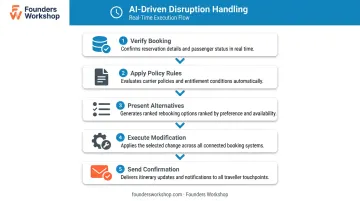
When a traveler needs to change an outbound flight, cancel a hotel night, or rebook after a disruption, a well-integrated AI agent can:
- Verify the booking against live reservation data
- Apply the correct policy rules (refundable, non-refundable, change fee structure)
- Present available alternatives from live inventory
- Execute the modification and update reservation records
- Send confirmation without routing through a human
During mass disruption events — weather cancellations, operational meltdowns — human agents get overwhelmed instantly. AirAsia's AI assistant handled over 43 million queries during the 2020 pandemic peak alone. That scale isn't achievable with a human-only support model.
Upselling and Ancillary Revenue
Timing and relevance are everything. The same upgrade offer converts at completely different rates depending on when it's sent and how relevant it is to that specific traveler.
Effective time-triggered upsell sequences:
- T-72 hours: Room upgrade or category enhancement
- T-24 hours: Airport transfer or early check-in
- Day 2 of stay: Local tours, spa, dining reservations
- Post-checkout: Re-booking prompt, loyalty offer
Upsells delivered in a concierge voice — "Based on your last stay, you might enjoy..." — consistently outperform transactional sales pitches. Automated pre-arrival upsell campaigns in hospitality currently average $95 per booking, while cart abandonment re-engagement campaigns convert at 6.8%, according to Revinate's benchmark data.
In-Trip and Post-Trip Support
The relationship doesn't end at check-in. In-trip support keeps travelers informed and reduces pressure on front desk staff. Common in-trip AI touchpoints include:
- Gate and flight status updates
- Local restaurant and activity recommendations
- Special requests routed directly to housekeeping or concierge
- Real-time itinerary adjustments
Post-trip, conversational AI handles feedback collection, loyalty program questions, and re-booking prompts while the experience is still fresh — a window that a follow-up email three weeks later simply can't replicate.
Best Practices for Building and Deploying Conversational AI in Travel
Start With One High-Volume Use Case
Resist the urge to automate everything at once. Pick the single most frequent and repetitive interaction in your current support queue — often pre-booking FAQs or booking modification requests — and build one well-integrated workflow before expanding.
A focused, well-tested deployment earns traveler trust. Rolling out too broadly before the system is ready will cost you more than launching nothing at all.
Integrate Live Data First — Then Build the Conversation
Conversational AI is only as reliable as its data. An agent quoting yesterday's inventory or a cached cancellation policy will give travelers wrong information, and that erodes trust faster than no AI at all.
Before building conversation flows, confirm:
- Live API or webhook connectivity to your booking engine, PMS, or reservation platform
- Real-time pricing and availability sync (not daily batch updates)
- Policy data that reflects current rules, not static documentation
The Air Canada case is the clearest cautionary example: their chatbot gave incorrect bereavement fare information, and a tribunal ruled Air Canada was fully liable for the misleading output. Organizations are accountable for what their AI systems tell customers.
Design for Human Handoff, Not Just Automation
Define clear escalation rules before you launch:
- Complex group booking modifications
- VIP or high-value customer interactions
- Sensitive service recovery situations
- Edge-case policy questions requiring judgment
When escalation triggers, the full conversation context — every message, every action taken — must transfer to the human agent. Travelers should never have to explain themselves twice.
Build With the Right Development Partner
For travel businesses without in-house AI engineering, building a custom conversational AI solution means combining NLP, live data integrations, multi-channel deployment, and escalation logic into a single coherent product — that's a wide surface area to manage without guidance.
Founders Workshop has delivered 200+ custom AI-integrated software solutions using their 5D Process (Discovery, Definition, Development, Deployment, and Dedicated support), which covers each phase from requirements scoping through post-launch iteration. For travel startups and SMBs, a single-use-case MVP can typically reach functional deployment within that framework without requiring a technical co-founder.
Measure Weekly and Iterate Over 60–90 Days
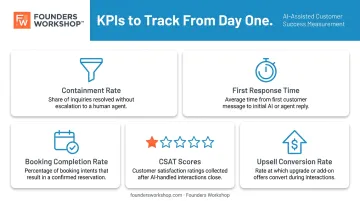
Track these KPIs from day one:
- Containment rate: queries resolved without human escalation
- First response time: seconds, not minutes
- Booking completion rate: before and after AI deployment
- Upsell conversion rate: by offer type and timing
- CSAT scores: post-interaction satisfaction
Use the data to refine intent training, adjust conversation flows, and expand automation scope. Treat the first 90 days as active iteration — patterns will emerge quickly, and the teams that act on them early see the fastest performance gains.
Common Pitfalls to Avoid
Deploying on static data. If availability and pricing aren't live, your AI will confidently present inaccurate information. There's no workaround: shift to real-time webhook-based API calls before launch, not after travelers start complaining.
Overly aggressive upselling. Irrelevant or excessive offers erode trust fast. A spa package pitched to a business traveler or travel insurance surfaced mid-trip signals that your AI isn't paying attention. To avoid this:
- Set frequency caps on outbound offers
- Use a concierge tone, not a sales tone
- Filter recommendations through CRM profile data
Underestimating language and phrasing variability. Real travelers phrase requests in unexpected ways. "Can I push my arrival back a day?" and "I need to change my check-in to Thursday" mean the same thing — but rigid keyword mapping may not recognize that. The fix is intent-based training: use real customer query data, cover diverse phrasings, and test thoroughly before launch.
Frequently Asked Questions
What is conversational AI in the travel industry?
Conversational AI in travel refers to AI systems that understand natural language, maintain context across a multi-turn dialogue, and execute real actions — like modifying a booking, checking live availability, or upselling an upgrade — across digital channels. It goes well beyond scripted chatbot responses that can only answer predefined questions.
How is conversational AI different from a basic travel chatbot?
Rule-based chatbots follow fixed decision trees, match keywords, and can't access live systems. Conversational AI agents understand intent, retain context throughout the conversation, and can execute multi-step workflows — like canceling one leg of a trip and rebooking it — within connected booking or reservation platforms.
What are the most valuable use cases for conversational AI in travel?
The highest-value use cases are pre-booking FAQ automation, booking modifications and disruption rebooking, time-triggered personalized upselling, and in-trip or post-trip support. High-volume, repetitive interactions are the best starting point because they deliver quick ROI and build AI training data fast.
How do travel businesses integrate conversational AI with existing booking systems?
Integration requires live API or webhook connections to your booking engine, PMS, or reservation platform. Static or batch-updated data is not an option: accuracy failures erode traveler trust quickly and can create legal liability.
How do you ensure the AI hands off to a human agent when needed?
Effective deployments define clear escalation rules covering complex cases, VIP customers, and sensitive policy situations. The full conversation history should transfer to the human agent automatically so travelers never need to repeat themselves.
How long does it take to build and deploy a conversational AI solution for a travel business?
Starting with a focused single use case, a functional MVP typically takes three to six months from Discovery through Deployment. Integration complexity and scope drive that timeline: a pre-booking FAQ automation moves faster than a full disruption rebooking workflow with multi-channel deployment.