Introduction
Building a healthcare product puts founders in an uncomfortable position from day one. Investors want traction, users want something that works, and regulators want full compliance. The clock is always running.
U.S. digital health startups raised $10.1 billion across 497 deals in 2024, with 86% of those deals at Seed, Series A, or Series B. The market has never been more active. So has the complexity that comes with it.
That complexity is exactly what most MVP guides skip. Healthcare is not like building a SaaS tool or consumer app:
- Compliance is non-negotiable from the start
- Architecture decisions made in week two have consequences two years later
- A single data breach costs an average of $7.42 million in the healthcare sector
This guide is for founders building their first healthcare product. It covers what makes healthcare MVP development different, what compliance actually requires in practice, how to scope and build your product, what it costs, and how to choose a development partner who won't leave you with a rebuild on your hands.
Key Takeaways
- Healthcare MVPs require HIPAA compliance, EHR integration readiness, and security-first architecture from day one — not as an afterthought.
- Scope your MVP ruthlessly: solve one specific problem for one defined user type before adding anything else.
- Budget $40,000 to $100,000+ depending on complexity, compliance requirements, and your development team's location.
- The right development partner — one with real healthcare experience — protects you from costly rebuilds and compliance exposure.
- Nearshore development teams deliver comparable quality at roughly one-third the cost of US-based teams.
What Makes Healthcare MVP Development Different
The core MVP principle applies here as anywhere: build the minimum needed to validate a real-world hypothesis before committing full resources. What changes in healthcare is everything surrounding that principle.
A consumer app MVP can cut corners on security, iterate publicly, and fix issues post-launch. A healthcare MVP cannot. The moment your product touches Protected Health Information (PHI) — patient records, diagnoses, treatment data — you are operating in a regulated environment with legal obligations that don't bend for early-stage startups.
The key differences from a generic SaaS MVP:
- HIPAA compliance is mandatory from day one, not a post-launch retrofit
- Data architecture decisions are difficult and expensive to reverse
- Integration with existing clinical systems requires specific standards (HL7, FHIR)
- User populations include clinicians and patients, each with distinct usability needs
- A breach or compliance failure carries financial and reputational consequences most startups cannot survive
Every healthcare founder faces two competing pressures simultaneously. Speed matters: early users and investor interest depend on moving fast. But getting the architecture wrong means a costly rebuild later, or a compliance exposure that ends the company.
The path forward is not choosing one over the other. It is building fast inside a compliance-ready structure from day one — where security, data handling, and regulatory requirements are baked into the foundation, not bolted on afterward.
Compliance Requirements Every Healthcare MVP Must Meet
HIPAA: The Non-Negotiable Foundation
HIPAA is the primary US federal regulation governing how PHI must be handled. Any product that creates, receives, stores, or transmits PHI must comply with three core rules:
- Privacy Rule — Governs how PHI can be used and disclosed
- Security Rule — Requires administrative, physical, and technical safeguards for electronic PHI (ePHI)
- Breach Notification Rule — Requires covered entities and business associates to notify affected parties after an unsecured PHI breach, with business associates required to notify covered entities within 60 days of discovery
In practical terms for a software product, HIPAA compliance means:
- Encryption at rest and in transit
- Role-based access controls
- Audit logs for all PHI access
- Business Associate Agreements (BAAs) with every vendor that touches ePHI — including cloud providers
That last point catches many founders off guard. HHS confirms that a cloud service provider is a business associate the moment it stores or processes ePHI, even if the data is encrypted and the provider cannot read it. AWS, Google Cloud, and Azure all offer HIPAA-eligible services — but each requires a signed BAA before you can use them for PHI.
GDPR and Why US Founders Should Pay Attention
GDPR is the EU's data privacy regulation. It applies to US companies in two situations:
- Your product is offered to EU residents or monitors their behavior
- EU investors are conducting due diligence on your business
Health data falls under Article 9's special category protections, which means stricter treatment than standard personal data — explicit consent requirements, tighter processing restrictions, and mandatory data protection impact assessments.
If EU user acquisition is anywhere in your roadmap, understanding GDPR now costs far less than retrofitting compliance later.
EHR Integration Standards: HL7 and FHIR
Not every MVP requires EHR integration on day one, but the planning phase should address whether it will be needed. The ONC's Cures Act Final Rule mandates HL7 FHIR Release 4 as the standard for certified health IT APIs, making FHIR the default for any new product that will connect to clinical systems.
A team that never planned for FHIR will face a significant rebuild the moment the product needs to pull patient data from a clinical system. That's an avoidable cost.
Build Compliance In, Not On
The most expensive compliance mistake is treating it as a final review. Retrofitting HIPAA-compliant architecture into a product built without it means revisiting database design, encryption approach, access controls, and API structure. The average healthcare data breach now costs $7.42 million — a figure that makes the upfront cost of compliance-first architecture look modest.
Practical steps during MVP development:
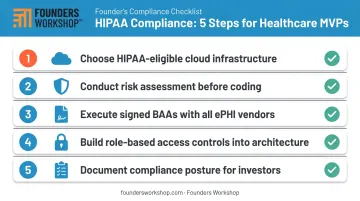
- Choose HIPAA-eligible cloud infrastructure from day one (AWS, Azure, or Google Cloud all offer this)
- Conduct a risk assessment before writing code
- Execute signed BAAs with all vendors that will touch ePHI
- Build role-based access controls into the initial architecture
- Document your compliance posture — investors and health system partners will ask for it
Must-Have Features for a Healthcare MVP
Start With One Problem, One User
The most common mistake in healthcare MVP scoping is building for every possible user and every possible use case simultaneously. The goal is to identify the single most important problem your product solves — for patients, providers, or administrators — and build only what delivers that solution.
Wellpsyche, a mental health platform and long-term Founders Workshop client, is a clear example of staying focused: start with the core service delivery workflow before expanding into additional features.
The Non-Negotiable Foundation
Regardless of your specific niche, most healthcare MVPs share a common baseline:
- Secure authentication with role-based access — Patients, providers, and admins each need different permissions and data visibility
- Data dashboard or record-keeping function — The core reason users return to the product
- Communication or scheduling mechanism — Required for any product involving provider-patient interaction
These are not optional features to add later. They need to be in the architecture from the beginning because they affect data access patterns and compliance posture.
Healthcare-Specific UX Considerations
Compliance architecture shapes what your users can see and do — which means UX decisions and security decisions are inseparable from the start. Your users include clinicians working under time pressure, patients who may be anxious or unwell, and administrators managing complex workflows. Good healthcare UX means:
- Clear data visualization for test results, metrics, and reports
- Intuitive onboarding that does not assume technical literacy
- Accessible design for older adults and users with limited device familiarity — Nielsen Norman Group research shows users 65+ face distinct challenges that thoughtful design must address
Section 508 and WCAG 2.1 standards set the accessibility baseline for any healthcare application serving federally-funded programs — and building to that standard from day one is far cheaper than retrofitting it later.
What to Save for Version 2
Several features are genuinely valuable but belong in a later release. Each one adds development time, cost, and compliance surface area:
- AI-driven diagnostics
- Wearable device integrations
- Advanced analytics dashboards
- Multi-language support
Build a prioritized roadmap and park these in version 2. A tighter MVP ships faster, costs less, and gives you real user data before you invest in the complex stuff.
The Healthcare MVP Development Process: Step by Step
Step 1 — Discovery and Problem Definition
No code gets written before this phase is complete. Discovery defines the problem being solved, the target user, the regulatory scope, and the core value proposition. A structured process — stakeholder interviews, competitive analysis, and clinical workflow mapping — produces a product brief that guides every downstream decision.
This is where Founders Workshop's 5D Process begins. The Discovery phase (2–4 weeks) works with a dedicated Project Champion to scope the most valuable features, identify integration requirements, and address risks before development starts.
Steps 2 & 3 — Design and Architecture
Step 2 — UX/UI Design and Prototyping
Wireframes and clickable prototypes come before development. This lets the team validate user flows and surface compliance issues in the interface design. For healthcare, this matters: a confusing intake form or inaccessible dashboard creates compliance risk alongside a poor user experience.
Step 3 — Compliant Architecture Planning
The technical architecture must be designed to support HIPAA-compliant data storage, scalable cloud infrastructure, and EHR integration readiness where applicable. Database design, encryption approach, and API structure are all decided here. These are not easy to change later — and getting them right in the Definition phase (4–6 weeks) is far less expensive than revisiting them mid-build.
Steps 4 & 5 — Build, Test, and Launch
Step 4 — Agile Development and Testing
Development follows an agile, sprint-based process: build one feature, test it, refine it, move to the next. Security testing and compliance validation happen throughout development, not as a final pre-launch checkpoint.
Founders Workshop uses AI-accelerated development tools to compress timelines, automating repetitive code generation and testing tasks. In practice, this means faster iteration cycles without cutting corners on compliance.
Step 5 — Launch and Feedback Loop
The MVP launch is the beginning of the learning cycle, not the end. Post-launch metrics that matter most for a healthcare MVP:
- User retention and session frequency
- Task completion rates for core workflows
- Engagement with the primary feature set
- Error rates and any adverse event reporting
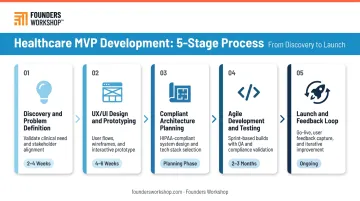
This feedback loop is what turns an MVP into a fundable product. Founders Workshop's D5 Dedicated Developer phase provides 80–160 hours per month of ongoing support to drive that iteration.
Healthcare MVP Development Costs: What to Budget For
Cost Ranges by Complexity
According to GoodFirms, healthcare MVP and app development costs break down roughly as follows:
| Project Type | Estimated Cost Range |
|---|---|
| Basic healthcare MVP | $40,000 – $80,000 |
| Mid-complexity healthcare app | $80,000 – $150,000 |
| Complex platform (EHR integration, telemedicine) | $150,000 – $300,000+ |
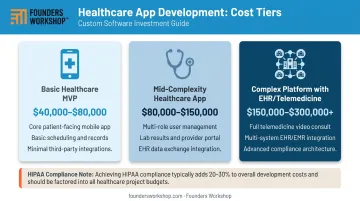
HIPAA-compliant development adds approximately 20–30% to project costs, and ongoing maintenance typically requires 15–25% of the initial development budget annually.
For context, Founders Workshop's fully managed healthcare MVP engagements fall between $80,000 and $350,000 — varying by feature scope, compliance requirements, and integration complexity.
The Nearshore Advantage
US-based development teams charge $150–$200+ per hour. Nearshore Latin American developers in the same time zone deliver comparable quality at roughly one-third that cost — with no communication gaps or scheduling friction from a distant offshore team.
Founders Workshop's model is structured around this cost structure. Clients get access to senior developers at significantly lower rates than domestic teams, with real-time collaboration built in.
Hidden Costs to Budget From Day One
Healthcare founders consistently underestimate these line items:
- HIPAA-compliant cloud infrastructure — AWS, Azure, and Google Cloud each charge for HIPAA-eligible services; pricing is usage-based and varies by service
- Communications APIs — Twilio requires a Business Associate Addendum for any PHI-containing communication workflow
- Compliance audits and security testing — Plan for these as recurring costs, not one-time events
- BAA administration — Legal review of vendor agreements adds time and cost
- Post-launch maintenance — Plan for 15–25% of initial development cost annually
How to Choose the Right MVP Development Partner for Your Healthcare Startup
Non-Negotiable Evaluation Criteria
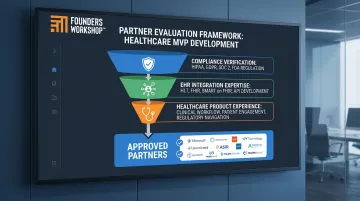
Not every software firm can build a healthcare product that works in the real world. When evaluating partners, look for:
- Healthcare-specific experience: EMR integrations, patient portals, telemedicine, and HIPAA-compliant workflows — not just general app development
- Compliance built in from day one, not retrofitted after the architecture is already set
- FHIR R4 fluency: EHR integration is table stakes; the partner should scope and implement it confidently
- A clear path from MVP to production without requiring a full rebuild when you're ready to scale
Once you've confirmed a partner meets these criteria, the next question most founders face isn't about features — it's about equity.
The Technical Co-Founder Question
Many early-stage founders consider bringing on a technical co-founder instead of a development partner. This path typically means giving up up to 50% equity at the earliest, most equity-sensitive stage of building.
Founders Workshop is built for exactly this situation. With 200+ products built since 2008 — including healthcare clients like Wellpsyche and Verisma — the firm delivers the same technical execution a co-founder would provide: full team, proven process, healthcare experience. Without the equity trade-off.
Questions to Ask Any Potential Partner
Before signing with any development firm, ask:
- How many healthcare products have you shipped?
- Walk me through your HIPAA compliance approach — what happens in Discovery?
- How do you handle EHR integration scoping and FHIR implementation?
- What does post-launch support look like, and what's included?
- How do you price your work — fixed, time-and-materials, or hybrid?
- Can you scale this from MVP to a full production system without a rebuild?
Frequently Asked Questions
What are MVP development services?
MVP development services cover the full process of taking a product idea from discovery through to a functional, tested, and launched minimum viable product. This includes business analysis, UX/UI design, architecture, development, QA, and post-launch iteration support.
How much does it cost to develop an MVP app?
Healthcare MVPs typically range from $40,000 for a basic patient-tracking app to $100,000+ for more complex platforms with EHR integration or telemedicine features. Key cost variables include:
- HIPAA compliance requirements
- Feature scope and integration complexity
- Whether your team is US-based or nearshore
How long does it take to build a healthcare MVP?
A typical healthcare MVP takes 3–6 months from discovery to launch. The breakdown is roughly 2–4 weeks for discovery, 4–6 weeks for definition and design, 2–3 months for development, and one month for deployment.
What compliance requirements must a healthcare MVP meet?
HIPAA is the primary US requirement for any product handling protected health information — covering the Privacy Rule, Security Rule, and Breach Notification Rule. GDPR applies for products with EU users. Both must be designed into the architecture from day one, not retrofitted after launch.
How do you develop an MVP for a mobile app?
The core process follows five steps:
- Define the problem and target user
- Design and prototype the core user flow
- Build and test iteratively in agile sprints
- Launch to a limited audience
- Refine based on real user feedback
For healthcare apps, compliance scoping and architecture planning come before any development begins.