Introduction
There's a version of AI adoption that looks like progress but isn't. A founder signs up for three AI tools, gets excited for two weeks, and then watches them collect digital dust because nothing actually changed in how the business operates.
Sound familiar? You're not alone. That pattern plays out across industries. Over 80% of AI projects fail, according to RAND — roughly twice the failure rate of non-AI IT projects. The culprit usually isn't the technology. It's that the business wasn't ready to absorb it.
AI readiness isn't about budget size or having a data science team on staff. It's about whether your operations, goals, data, and culture can actually support what AI delivers.
This post walks through 7 concrete signs that your business is more ready than you think, along with what to do once you start checking those boxes.
Key Takeaways
- AI readiness is about business foundations — strategy, data, processes, and people — not just the tools you've already subscribed to.
- Most founders and SMBs are further along than they realize.
- The 7 signs span strategy, operations, data, and mindset.
- Checking 3 or more signs means you're ready to start an AI pilot today, not next quarter.
- Gaps in the list point to exactly where to focus before your first AI investment.
What AI Readiness Really Means for Founders and SMBs
Here's a useful distinction that most AI vendor pitches skip entirely: there's a difference between being tool-ready and being business-ready.
Tool-ready means you've created accounts, watched a few demos, maybe even generated some content. Business-ready is harder to fake — your operations can point AI at real problems, act on what it produces, and tell whether it's actually working.
AI amplifies what already works. It doesn't fix what's broken.
For enterprise companies, that distinction is managed by dedicated AI teams and transformation budgets. For founders and SMBs operating lean, the stakes are different. A failed AI initiative doesn't just waste budget — it burns team trust and sets adoption back months.
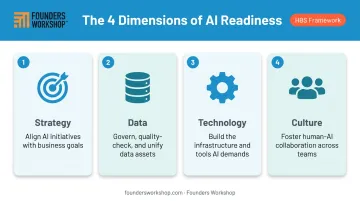
HBS defines AI readiness as having the right strategy, data, technology, and culture to adopt AI responsibly. Technology is just one of four factors:
- Strategy — a clear problem worth solving with AI
- Data — accessible, usable information to feed it
- Technology — the tools and infrastructure to run it
- Culture — a team willing to adopt and adapt
Most founders have more of these than they give themselves credit for.
The 7 signs below are a practical check against those fundamentals.
The 7 Signs Your Business Is Ready for AI
Sign 1: You Have Specific Business Goals AI Could Accelerate
This is the clearest sign of readiness — and the most commonly skipped step.
"We want to use AI" is not a goal. "We want to cut the time our sales team spends on manual lead scoring from 4 hours a week to under 30 minutes" is a goal. That specificity gives AI a defined job instead of a vague mandate.
Two examples of what this looks like in practice:
- A service business wants to stop manually drafting follow-up emails after every sales call. They can map this directly to a conversational AI or GPT-based automation that generates first drafts from call notes.
- A retail or e-commerce SMB wants to stop manually tagging and writing product descriptions. Generative AI handles that workflow in minutes rather than hours.
In both cases, the AI solution didn't require a data science team or a six-figure platform. It required a clearly stated problem.
If you can finish this sentence — "AI could help us [specific outcome] by [specific task]" — you've cleared the first bar.
Sign 2: Your Business Data Is Being Collected — Even Imperfectly
A lot of founders disqualify themselves from AI before even starting, assuming they need a clean data warehouse and years of structured history. That's simply not true for most early-stage AI use cases.
If your business captures any of the following, you have usable raw material:
- Customer records in a CRM (even a basic one like HubSpot or Zoho)
- Transaction history from a POS system or e-commerce platform
- Email and support ticket logs
- Spreadsheets tracking leads, jobs, or orders
The relevant distinction isn't perfect data versus imperfect data. It's data that needs cleanup versus data that's structurally unusable. Duplicate entries, inconsistent formatting, or gaps in records are fixable. Data that was never collected — or exists only in someone's head — is a structural gap that requires different work first.
For most AI use cases at the SMB level — especially off-the-shelf tools and API-based solutions — the volume requirements are far lower than building a custom model from scratch. The key is matching the use case to the data you actually have.
Starting with imperfect data is not a liability. It's the norm.
Sign 3: Your Core Processes Are Documented or Repeatable
AI handles repetition exceptionally well. Novelty, not so much.
If your team follows a consistent workflow — even one that's never been formally documented — AI can assist, accelerate, or automate it. If every instance is handled differently based on who's working that day, AI has nothing stable to anchor to.
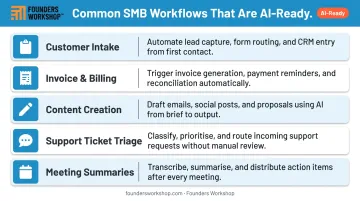
Common SMB workflows that are naturally AI-ready:
- Customer intake: standard questions, eligibility checks, data collection
- Invoice generation and recurring billing with consistent formats
- Content creation — product descriptions, blog posts, social updates with predictable structure
- Support ticket triage, routing common questions to predefined answers
- Meeting summaries: transcription and action-item extraction from recurring calls
You don't need a process manual. You need the process to be recognizable. If two different team members handle the same task in roughly the same way, that's repeatable enough to start.
Sign 4: Your Leadership Is Aligned on Where the Business Is Headed
Leadership alignment doesn't require a formal AI strategy document. It requires that the founders or decision-makers in your business agree on where the company is going — and are willing to invest in tools that serve that direction.
This matters more than most founders realize. RAND's research on AI project failures points to leadership-driven causes as the single most common reason AI initiatives stall — specifically, miscommunicating the problem and the required success metrics to execution teams.
The pattern is predictable: a founder gets excited about AI, launches a pilot, but the rest of the team doesn't understand the objective. Without a clear owner and a clear definition of success, the initiative fades.
Alignment doesn't need to be deep. It needs to cover:
- What problem are we solving?
- Who owns this initiative?
- How will we know if it's working?
Three questions. If your leadership can answer them consistently, you're aligned enough to move.
Sign 5: Your Team Is Curious About New Tools, Not Afraid of Them
Culture matters more than technical skill here.
A curious team doesn't need to know how AI works — they just need to be willing to try things. Signs of a curious team include:
- People already experiment with productivity tools on their own
- New software adoption happens without sustained resistance
- Someone has probably been using ChatGPT for something without being asked
The fear is real and worth naming directly: about one-third of U.S. workers believe AI will reduce job opportunities for them.
For SMBs specifically, the reality tends to be different. AI at this scale is typically additive — it handles low-value repetitive work so the team can shift toward higher-impact tasks. The businesses that succeed with AI implementation are usually the ones that frame it as removing the tedious stuff, not replacing the people doing the valuable stuff.
If your team asks "how could we use this?" when they see a new tool rather than "does this mean we're getting replaced?" — that's a healthy signal.
Sign 6: You've Already Identified Pain Points AI Could Solve
You don't need a long list. One concrete, felt pain point is enough.
Having a specific problem in mind means AI won't be adopted in a vacuum. It'll be applied to something with real stakes — which gives you a natural before/after comparison and a reason for the team to care whether it works.
Common SMB pain points well-suited to AI:
- Manually processing inbound leads and deciding which ones to prioritize
- Creating weekly or monthly performance reports from scattered data
- Answering the same 10 customer questions repeatedly via email or chat
- Writing first drafts of proposals, contracts, or marketing copy
- Scheduling, rescheduling, and following up on appointments
QuickBooks research shows that 74% of small businesses using AI report a productivity boost, with marketing (43%), customer service (36%), and administrative tasks (33%) leading the use cases. If any of those categories overlap with where your team spends the most time on repetitive work — that's your starting point.
Sign 7: You're Willing to Start Small and Measure What Happens
The businesses that consistently get value from AI share one trait: they treat it as a series of testable hypotheses, not a one-time transformation.
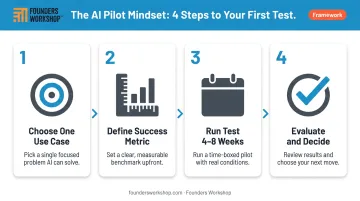
The pilot mindset looks like this:
- Choose one use case with a clear before-state (e.g., "it takes 3 hours/week to do X")
- Define a specific success metric (e.g., "reduce that to under 45 minutes")
- Run the test for 4–8 weeks
- Evaluate honestly and decide whether to expand, adjust, or move on
This approach doesn't require overhauling your tech stack or training your entire team. It requires scoping discipline — and the willingness to accept that a "failed" pilot is still useful information.
The SBA explicitly advises small businesses to start small with AI, noting that many tools offer free or lower-cost basic tiers specifically for this purpose. One well-scoped pilot with a defined metric is enough to generate evidence, build internal confidence, and earn buy-in for the next step.
What to Do When You're Showing These Signs
Readiness isn't a destination. It's a green light.
If several of these signs apply to your business, the right next move isn't another assessment. It's picking one high-value use case and scoping a focused pilot with a clear success metric. That first test — small, measurable, low-risk — is how businesses move from "AI-ready" to "AI-launched."
The competitive window is real. The U.S. Chamber reports that small business generative AI adoption jumped from 23% in 2023 to 58% in 2025. The gap between early movers and late adopters is widening quickly.
That's where Founders Workshop comes in. Its AI-first development approach and field-tested 5D Process — Discovery, Definition, Development, Deployment, and Dedicated Support — is built to help founders and SMBs move from business goals to working AI solutions without hiring a full-time technical team or giving up equity.
The Discovery phase includes an AI Integration Exploration component that maps your specific business objectives to feasible AI use cases before a single line of code is written.
For founders who know they're ready but aren't sure where to start, that structured first step makes all the difference.
Frequently Asked Questions
How do you evaluate AI readiness?
Audit your business across five dimensions: strategy clarity, data quality and accessibility, process documentation, team and culture openness, and leadership alignment. A straightforward self-assessment against these areas reveals where you're strong and where you need to prepare before investing in AI tools.
What is the 30% rule for AI?
McKinsey research estimates that by 2030, up to 30% of U.S. work hours could be automated. For SMBs, this is a planning signal — identify which tasks in your business fall into that automatable category and start building readiness now.
What is the 10-20-70 rule for AI?
BCG's framework for AI deployment success: roughly 10% of effort goes into the AI algorithms, 20% into data and technology, and 70% into people, culture, and change management. For founders, the key takeaway is that most AI failures come down to people and process, not technology.
Can a small business with limited data still benefit from AI?
Yes. Most off-the-shelf and API-based AI tools require far less data than building a custom model. The key is matching the use case to the data you actually have, and starting with tools designed for smaller data environments rather than enterprise-scale infrastructure.
What's the difference between being AI-ready and being AI-enabled?
AI-ready means your business foundations (data, processes, culture, and strategy) can support successful AI adoption. AI-enabled means you've already deployed AI tools that are actively generating value. Think of readiness as the foundation and enablement as what you build on top of it.
How long does it take for an SMB to go from AI-ready to AI-launched?
With a focused use case and proper scoping, many SMBs can move from assessment to a working pilot in 4–12 weeks. The timeline depends on use case complexity, existing data quality, and whether the team is integrating existing tools or building something from scratch.