Introduction
Most AI guides assume you have an IT department, a dedicated budget line, and a project manager who does nothing else. If you run a small business, none of that is true.
The result? You know AI matters, you've probably tried a few tools, and you still don't have a clear plan for making it work inside your actual business — not someone else's hypothetical company.
According to the U.S. Chamber of Commerce's 2025 report, 58% of U.S. small businesses now use generative AI, up from just 23% in 2023. Adoption nearly tripled in two years. Businesses that haven't started are no longer early — they're late.
This guide walks through what AI implementation actually looks like for small businesses: how to find the right starting point, how to structure a rollout that produces real ROI, and how to avoid the mistakes that cause most SMB AI projects to stall out after significant time and money spent.
Key Takeaways
- Start with one high-volume, repetitive process — not a company-wide overhaul
- Readiness assessments before tool selection prevent wasted spending
- Use the 70-20-10 rule to balance quick wins against longer-term AI bets
- Pilot projects in a single workflow produce faster ROI than broad deployment
- The right implementation partner starts with discovery, not a product pitch
Why AI Is No Longer Optional for Small Businesses
The competitive pressure is no longer theoretical. The same U.S. Chamber report found that 80% of small businesses accelerated their AI adoption because competitors were already using it, and 83% said technology platforms helped them compete with larger companies — up from 70% the year before.
The businesses using AI are reporting real results too: 87% of AI-adopting SMBs reported increased operational efficiency, 85% reported increased sales, and 84% reported increased profits.
The top barriers holding non-adopters back aren't skepticism — they're practical:
- 33% worry about tool quality
- 30% cite implementation cost
- 27% flag legal and compliance concerns
- 25% say they don't know enough to start
- 22% can't see how AI fits their specific business
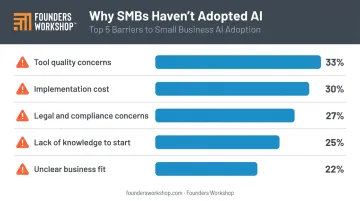
Notice what's missing: lack of awareness. Every small business owner knows AI exists. The real gap is a clear, usable starting point — which means the barrier to entry is lower than most owners assume.
The goal is targeted, not transformational. Find the specific bottlenecks costing you the most time and money each week, and address those first.
What AI Implementation Actually Includes
AI implementation isn't "buy a tool and figure it out." It's a four-phase process — and skipping the first two phases is the most common reason SMB AI projects fail before they produce anything useful.
Gartner predicted that at least 30% of generative AI projects would be abandoned after proof of concept by end of 2025 due to poor data quality, escalating costs, or unclear business value. Those failures aren't random — they're predictable when the foundation work gets skipped.
Readiness Assessment
A readiness assessment evaluates four things:
- Current workflows — where time is actually going
- Data availability — whether you have the inputs AI needs to work
- Team capacity — who will own adoption and ongoing use
- Technology infrastructure — what systems need to integrate
The output is a list of AI opportunities ranked by potential impact and implementation complexity. Not "use ChatGPT" — specific use cases, ranked by feasibility and ROI potential.
Strategy and Tool Selection
Strategy development translates assessment findings into a concrete plan: which tools or custom solutions to build, how they connect to your existing systems (CRM, accounting software, operations platforms), and what success looks like in measurable terms.
The critical discipline here is tool selection following strategy, not preceding it. Tool-first bias — picking a trending AI product and then reverse-engineering a use case — is one of the most common and expensive mistakes SMBs make. The tool should solve a defined problem, not create a solution looking for one.
Pilot Deployment
A pilot is a focused implementation of one or two AI use cases in a single department or workflow, monitored over 30 to 60 days. The purpose is threefold:
- Prove value before committing to broader rollout
- Build team confidence with real results
- Surface integration issues while they're still cheap to fix
One important note on team training: the challenge is almost never technical skills. It's workflow adoption — getting people to actually use the new process instead of reverting to the old one. That requires:
- Clear ownership of the new process
- Simple documentation people will actually reference
- A defined parallel-run period where both old and new workflows operate simultaneously
Scale-Up
Once the pilot proves measurable value, the rollout expands to additional use cases or departments — with the advantage that integration issues and adoption barriers are already understood.
That's where having a structured framework pays off — you're scaling a proven model, not repeating the trial-and-error of the pilot. Founders Workshop's 5D Process (Discovery, Definition, Development, Deployment, and Dedicated Developer Support) is built around this logic: the Discovery phase maps out where AI fits before any build begins, so every subsequent phase stays anchored to measurable business outcomes.
How to Identify Where AI Fits First in Your Business
Most small businesses don't lack AI options — they lack a starting point. The simplest diagnostic: map your week and identify where your team's hours are going.
That distinction is what separates a useful pilot from a wasted investment:
| Task Type | Characteristics | AI Role |
|---|---|---|
| High-volume, low-judgment | Data entry, scheduling, FAQ responses, report generation | Strong pilot candidate |
| Low-volume, high-judgment | Strategy, client relationships, custom problem-solving | Keep human-led |
Workflow Audit Framework
Run a simple three-column exercise:
- Task: List tasks consuming the most team hours per week
- Judgment Required? Note whether each task requires judgment or follows a repeatable pattern
- Time Cost: Estimate the cost of that time in dollars (hours × hourly rate)
The rows with the highest time cost and the lowest judgment requirement are your highest-priority AI candidates. Start there.
High-Impact Use Cases by Business Function
Four functions consistently produce fast, measurable results:
- Customer service: AI chatbots handling FAQs and appointment scheduling. 51% of U.S. small businesses have already integrated AI here, making it the most proven SMB starting point.
- Marketing: AI-assisted email and ad copy generation, audience segmentation. Low integration complexity, fast to implement, outcomes directly measurable.
- Operations: Automated inventory alerts, predictive scheduling. High ROI potential where manual tracking currently eats staff time.
- Finance and administration: Automated invoice processing, expense categorization. Repeatable inputs, clear accuracy metrics, easily auditable.
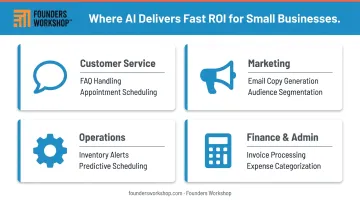
Start narrow: one process, one department, one measurable goal. Resist the pull toward multiple simultaneous initiatives.
Common Prioritization Mistakes
Three mistakes come up consistently when SMBs choose their first AI use case:
- Choosing "exciting" over "costly" — picking a use case that sounds impressive rather than one that solves an actual time or money problem
- Selecting a use case with poor data — if the data feeding the AI is incomplete, inconsistent, or hard to access, the tool will underperform regardless of quality
- Underestimating change management — even simple automation fails if the team doesn't adopt it; the technology is rarely the bottleneck
Each of these has the same root cause: skipping the diagnostic work before picking a tool. The audit framework above exists precisely to close that gap.
The 70-20-10 Rule for AI Implementation
Borrowed from innovation portfolio management, the 70-20-10 framework gives small businesses a structured way to allocate AI effort — balancing quick operational wins against longer-horizon bets without overextending resources.
The split:
- 70% on automating and improving existing core processes
- 20% on experimenting with adjacent AI capabilities
- 10% on exploratory, longer-horizon bets
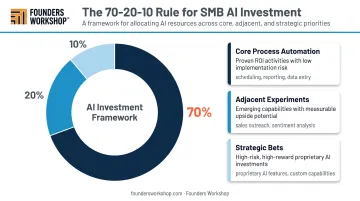
The 70%: Core Process Automation
This is where the fastest ROI lives. The 70% bucket covers automation of proven, repeatable workflows:
- Customer communication sequences
- Report generation
- Scheduling and calendar management
- Data entry and record updates
- Routine document processing
Most small businesses should spend the majority of their first-year AI budget here. These processes already work; AI removes the manual labor without introducing operational risk.
The 20%: Adjacent Experiments
The 20% covers AI applications that are adjacent to core operations but not yet mission-critical. Examples:
- AI-assisted sales outreach and follow-up sequencing
- Predictive inventory management
- Customer sentiment analysis from reviews or support tickets
These experiments generate real data about what works in your specific business context. That evidence informs smarter 70% investments down the road — without putting core operations at risk.
The 10%: Strategic Bets
The 10% bucket covers higher-risk, longer-horizon initiatives. Examples include:
- Building a proprietary AI-powered feature into your product
- Developing a custom AI capability that becomes a competitive differentiator
- Creating AI-driven workflows that can't be replicated with off-the-shelf tools
Don't fund this bucket until the 70% work is producing measurable ROI. Off-the-shelf tools stop being sufficient here — strategic bets require custom development to fit a unique business model, integrate deeply with existing systems, and produce something competitors can't easily copy.
This is where a development partner like Founders Workshop becomes relevant. Their team handles custom GPT creation, AI RPA solutions, and generative AI integration — and their nearshore model brings those builds in at roughly one-third of U.S. agency rates, making the 10% tier genuinely accessible for small businesses.
How to Choose the Right AI Implementation Partner
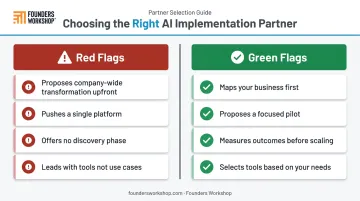
The single most important qualification isn't a technology certification or a list of platforms. It's whether the partner starts with discovery before prescribing solutions.
Red flags that signal a vendor-first approach:
- Proposes a company-wide transformation before understanding your current workflows
- Pushes a single platform regardless of your specific situation
- Offers no assessment or discovery phase
- Leads with tools and follows with use cases (backwards)
What a legitimate implementation partner does instead:
- Maps your business first
- Proposes a focused pilot with a defined success metric
- Measures outcomes and adjusts before scaling
- Selects tools based on your requirements, not their partnerships
Industry-relevant experience also matters more than it sounds. A partner who has worked with healthcare practices understands HIPAA constraints. One with retail experience understands seasonal demand patterns. One with fintech clients understands the compliance overlay that shapes every implementation decision. Generic AI consulting doesn't account for these realities.
Founders Workshop brings a specific advantage here: their leadership team has collectively owned or operated 31 companies. That shapes how they evaluate AI integration — they're asking whether something actually works for a business, not just whether it's technically impressive. Combined with their 5D Process and a nearshore Latin American team at roughly one-third of U.S. agency costs, the value proposition is concrete.
For small businesses, the first engagement typically starts with their Discovery phase — a 2-4 week process that maps your goals, identifies integration requirements, and defines what a pilot would actually look like before any build begins.
What to Expect: Costs, Timelines, and ROI
Realistic Timelines by Phase
| Phase | Typical Duration |
|---|---|
| Readiness assessment / Discovery | 2–4 weeks |
| Strategy and roadmap (Definition) | 4–6 weeks |
| Focused pilot deployment | 6–12 weeks |
| Full multi-use-case deployment | 3–6 months |
The fastest ROI comes from starting with the narrowest, highest-impact use case. Quick-win automation — customer communication workflows, report generation, data entry — typically shows measurable time savings within the first 30 to 60 days of a working pilot.
Cost Drivers to Understand
Reliable SMB-specific pricing benchmarks for AI implementation don't exist in any verified form. Anyone quoting precise price ranges is working from estimates. What holds consistently across projects is that costs vary based on:
- Off-the-shelf configuration vs. custom build — configuring an existing tool is significantly cheaper than building a bespoke solution
- Integration complexity — connecting AI to multiple existing systems costs more than a standalone deployment
- Data readiness — if data cleanup is required before AI can work, that adds scope
- Team support requirements — heavier change management and training needs add to total cost
The lowest-cost entry point is almost always a scoped assessment, not a full build. That's also where the DIY vs. guided-build question gets answered honestly.
The DIY Question
Should you just use ChatGPT yourself and skip the consultant? For some tasks, yes. Content drafting, meeting summarization, basic customer email templates — these work well out of the box with off-the-shelf tools. The U.S. Chamber found 63% of small businesses using AI rely entirely on externally developed tools without custom builds.
Custom consulting or a full build makes sense when:
- The use case requires integration with existing systems
- Data quality needs to be addressed before AI can function
- Your team is struggling to adopt tools without structured support
- You want to build a proprietary AI capability that competitors can't replicate
If none of those four apply, start with off-the-shelf tools and reassess once you've hit their limits.
Frequently Asked Questions
How much does an AI implementation consultant for a small local business cost?
Most small businesses start with a readiness assessment — the lowest-cost entry point, typically spanning 2–4 weeks. Pilot implementations run higher depending on whether the solution requires custom development or off-the-shelf configuration. Starting with a scoped assessment before committing to a larger build is the standard approach.
What can an AI implementation consultant do for small local businesses?
A consultant covers the full implementation cycle:
- Maps current workflows and identifies highest-ROI AI opportunities
- Recommends, integrates, and configures the right tools
- Trains your team on adoption and monitors outcomes
The value is translating AI from concept into daily operations — not just recommending software.
How can small local businesses implement AI with the help of a consultant?
The core phases are assessment, strategy, pilot, and scale. A good consultant handles integration, troubleshoots adoption issues, and keeps each phase tied to measurable business goals — no in-house technical expertise required.
What is the 70-20-10 rule for AI implementation?
Allocate 70% of AI effort to automating proven core processes, 20% to experimenting with adjacent capabilities, and 10% to exploratory strategic bets. The framework helps SMBs generate near-term ROI while still making progress on longer-horizon AI opportunities.
Should small businesses build custom AI or use off-the-shelf tools?
Off-the-shelf tools work well for common tasks like content generation, basic chatbots, and reporting. Custom AI makes sense when the use case requires deep system integration, involves proprietary data, or becomes a competitive product feature that off-the-shelf tools can't replicate.
How long does AI implementation typically take for a small business?
A readiness assessment takes 2–4 weeks, a focused pilot takes 6–12 weeks, and a full multi-use-case deployment spans 3–6 months. The fastest ROI comes from starting with the narrowest, highest-impact use case first — not attempting everything simultaneously.