
If your legacy systems are consuming up to 80% of your total IT budget just to stay operational, you aren’t just paying for maintenance; you’re paying a “stagnation tax” that prevents you from competing with AI-native startups. You likely feel the weight of data trapped in siloed formats and the technical friction of integrating AI into legacy systems. It’s a common challenge for established leaders who want to innovate but cannot risk discarding decades of reliable infrastructure and institutional knowledge.
The good news is that you don’t have to choose between stability and innovation. This 2026 strategic guide shows you how to breathe new life into your software by strategically adding intelligence to your existing stack. You’ll learn how to build a layer that turns your existing data into a competitive moat while driving measurable ROI and operational efficiency.
We’ve designed this roadmap to help you navigate incremental modernization. We will move from identifying high-impact automation opportunities to deploying domain-specific models that lower your operational costs and provide a steady hand for your business growth.
Key Takeaways
- Understand the “intelligence layer” approach to modernization, allowing you to leverage current software without the disruption of a complete replacement.
- Map out your path for integrating AI into legacy systems by identifying high-volume data silos and workflows where automation provides the fastest return.
- Compare execution models like custom development and nearshore augmentation to find the right balance between speed, cost, and intellectual property protection.
- Implement a structured 5-step roadmap that bridges the gap between aging architecture and modern AI capabilities through strategic API modernization.
- Shift your perspective on maintenance from a sunk cost to a growth engine by tracking hard metrics like reduced error rates and faster decision cycles.
What is AI Integration for Legacy Systems in 2026?
By 2026, the era of experimental AI has shifted into a period of financial rigor. High-level analysts now predict a market correction for companies that failed to bridge the gap between AI hype and actual utility. For the seasoned leader, integrating AI into legacy systems isn’t about chasing a trend; it’s about building an “intelligence layer.” This layer acts as a cognitive wrapper that sits on top of your existing architecture. It allows you to extract value from your core systems without the high-risk, high-cost process of a total rebuild.
The 2026 imperative is clear: waiting is now more expensive than incremental modernization. With legacy maintenance consuming up to 80% of IT budgets, every month you delay is a month of lost innovation. You must decide between predictive AI, which forecasts outcomes like customer churn or inventory needs, and generative AI, which can summarize decades of unstructured data. This transition marks the move from a “System of Record” that merely stores data to a “System of Intelligence” that actively informs your next move.
Why Legacy Systems are Your Secret AI Advantage
Your aging software contains something an AI-native startup can’t buy: decades of proprietary data. While a new competitor might have a modern interface, they don’t have twenty years of specific customer behavioral patterns. By integrating AI into legacy systems, you turn this historical record into a competitive moat. You’ve already spent years refining your workflows. Automating a proven, established process is far more effective than inventing a new one from scratch. This foundation of historical data also allows you to provide hyper-personalized experiences that build deep customer trust, leveraging your long-term industry presence.
The Cost of Technical Debt in the AI Era
Outdated codebases act as a silent tax on your growth. Every new feature you try to deploy is slowed down by the friction of legacy logic. This is why a sophisticated approach to AI systems integration is essential. AI integration is a strategic evolution of existing business value, not a replacement of it. However, the greatest risk lies in data silos. If your AI cannot reach your data because it’s trapped in a non-accessible format, the model is effectively blind. Since data preparation can consume up to 45% of your total project effort, addressing these silos is your first priority in the modernization journey.
Auditing Your Infrastructure: Is Your Legacy System AI-Ready?
Before you commit capital to integrating AI into legacy systems, you must understand the current state of your technical foundations. An effective audit isn’t just a hardware inventory; it’s a deep dive into the volume, variety, and velocity of your historical records. Smart companies are strategically integrating AI by first ensuring their data is clean and accessible. Since data preparation can consume up to 45% of the total project effort, identifying these gaps early prevents costly delays during the development phase.
Your audit should also pinpoint “AI-ready” workflows where automation provides the highest immediate impact. Focus on repetitive, data-heavy tasks that currently require manual intervention. While you assess these opportunities, keep 2026 regulatory requirements at the forefront. For example, most obligations for high-risk systems under the EU AI Act came into force on August 2, 2026. Similarly, California’s CCPA risk assessment requirements are now in full effect. Ensuring your integration doesn’t violate these privacy standards is as critical as the technology itself.
Modernizing APIs for AI Connectivity
Connecting an LLM to a decades-old database requires a modern bridge. We’ve found that refactoring legacy code is often the non-negotiable prerequisite for AI success. By moving from a monolithic architecture to microservices, you create the scalability needed for AI model inference. Middleware plays a vital role here, acting as a translator between your stable core systems and the fast-moving world of AI agents. If you’re struggling to visualize this bridge, our AI strategy and development experts can help align your architecture with your business goals.
Data Governance and Ethics in 2026
Integrity is the lifeblood of any intelligence system. You must establish a “Ground Truth” for your models by rigorously labeling and cleaning your historical data. This is particularly vital for specialized fields like predictive healthcare models, where data accuracy directly impacts human outcomes. In 2026, transparency isn’t just a best practice; it’s a legal mandate. Laws like the California AI Training Data Transparency Act now require developers to publish summaries of their datasets, making robust data governance a cornerstone of your modernization strategy.
Execution Models: Build vs. Buy vs. Nearshore Augmentation
Choosing the right delivery model is as vital as the technology itself. When you’re integrating AI into legacy systems, you’ll likely face the “build vs. buy” dilemma. Off-the-shelf AI solutions offer the fastest path to deployment, but they rarely provide a unique competitive edge. If your competitors are using the same generic tools, your proprietary data advantage remains untapped. Conversely, custom AI development offers maximum control and total intellectual property protection, though it demands a higher upfront commitment of time and capital.
Most mid-market leaders find success in a hybrid reality. This involves using established models for general tasks while building proprietary layers for core business logic. This approach is supported by the ACT-IAC guide on AI for legacy systems, which emphasizes a strategic framework for modernization. You don’t need to reinvent the wheel; you just need to ensure the wheel fits your specific carriage. Avoid the trap of hiring a full-time team of AI researchers. Mid-market firms rarely need permanent academic staff; they need pragmatic engineers who can translate business requirements into functional code.
The Nearshore Advantage for AI Modernization
The iterative nature of AI development requires constant communication. Timezone alignment is critical because it eliminates the “overnight lag” that kills momentum in complex software projects. By accessing top-tier talent in Latin America, you bridge the domestic engineering shortage without the logistical headaches of offshore models. This nearshore approach allows for cost-effective scaling. You get senior-level expertise and seamless integration with your internal team without the inflated price tags found in major US tech hubs.
Finding a Strategic Technical Partner
You need a partner who understands that tools are secondary to business outcomes. Look for a “Founder-to-Founder” relationship where the guidance is rooted in shared accountability and seasoned experience. It’s essential to evaluate vendors based on their strategic MVP development track record. A partner who has successfully navigated multiple technology eras will help you maintain ownership of your AI roadmap. This ensures that as you continue integrating AI into legacy systems, your intellectual property remains a protected asset that drives long-term valuation.
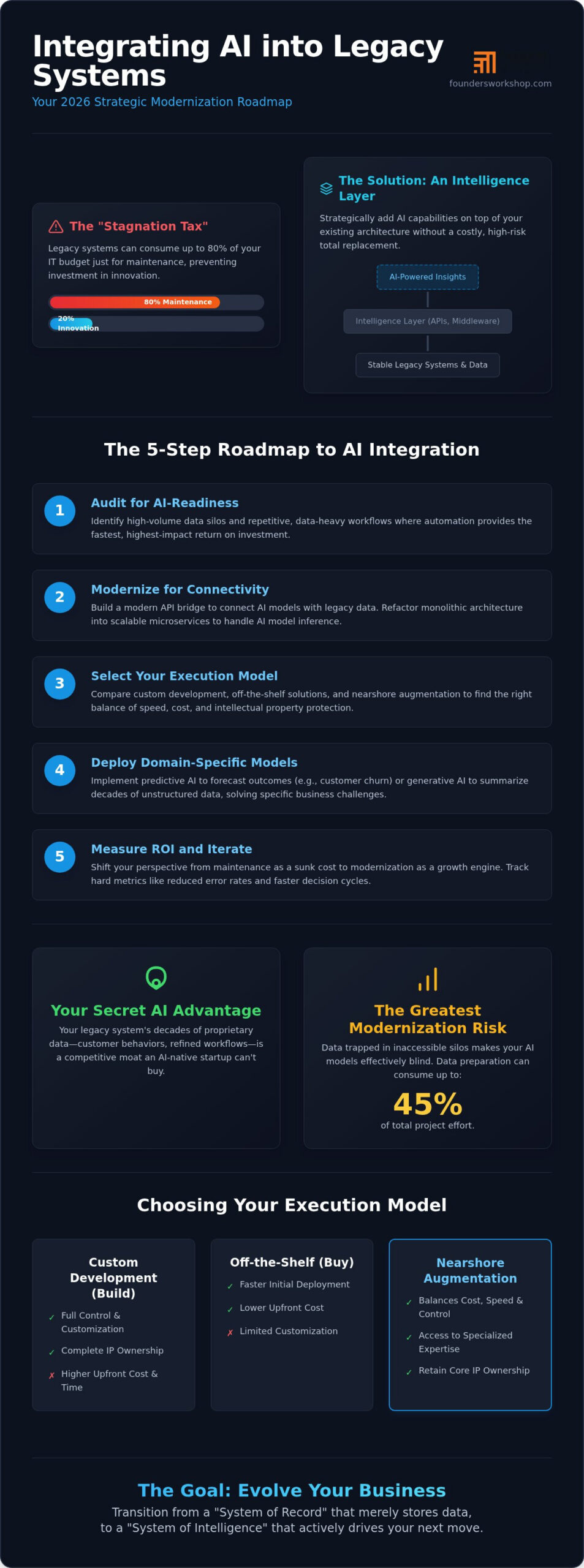
The 5-Step Roadmap for Integrating AI into Legacy Systems
Success in integrating AI into legacy systems requires a methodical approach that prioritizes quick wins over massive, high-risk overhauls. Start with discovery and opportunity mapping to identify “low-hanging AI fruit.” These are usually repetitive, high-volume tasks like automated ticket triage or data entry validation. Once you’ve mapped the opportunity, move to data extraction and API modernization. You aren’t rebuilding the core; you’re building a secure, high-speed bridge that allows modern AI models to communicate with your stable historical databases.
To help identify and implement these quick wins, you can discover AuraWeb and their expertise in building custom AI solutions for small businesses.
The next phase is the Proof of Concept (PoC). Validate your model using a controlled subset of data to ensure accuracy before a full rollout. Following a successful PoC, begin a phased integration. This allows you to deploy your new intelligence layer incrementally; it ensures that core operations remain undisturbed. Finally, establish robust monitoring and feedback loops. AI isn’t a “set it and forget it” tool. It requires continuous fine-tuning to account for model drift and evolving business needs.
Starting with an AI-Enabled MVP
Focus on one specific business problem first. When building AI features into SaaS or internal legacy platforms, the MVP mindset is your best defense against scope creep. Define what “winning” looks like early. Is it a 20% reduction in processing time or a 15% improvement in data accuracy? Clear success metrics allow you to justify further investment. If you’re ready to map your specific path, our team provides expert AI strategy and development to help you launch with confidence.
Managing the Change: The Human Element
Modernization is as much about people as it is about code. You must train your team to work alongside these new AI agents. Position the technology as a co-pilot rather than a replacement. Address “automation anxiety” through transparent, proactive communication. By designing user-friendly interfaces for complex AI outputs, you ensure that your staff can interpret and act on machine-generated insights without needing a degree in data science. This human-centered approach ensures that your technical investments translate into actual operational efficiency.
For organizations looking to find out more about building a synthetic workforce and successfully deploying AI agents, specialized GenAI coaching can help ensure a smooth transition.
Measuring ROI: Turning Modernization into a Growth Engine
The ultimate validation of integrating AI into legacy systems lies in the shift from defensive maintenance to offensive growth. You can’t just look at the initial investment; you must measure the hard metrics that define operational excellence. For many organizations, this manifests as a significant reduction in processing time for high-volume data tasks and a measurable drop in error rates. These direct cost savings provide the capital needed to fund further innovation, effectively ending the stagnation tax that previously drained your resources.
Beyond the balance sheet, you’ll see soft metrics that are equally vital for a resilient enterprise. Faster decision-making cycles allow you to respond to market shifts in days rather than months. Employee satisfaction often rises as your team is freed from the drudgery of manual data reconciliation, allowing them to focus on high-value strategic work. When calculating your Total Cost of Ownership (TCO), remember that annual maintenance for these systems typically ranges from 15% to 25% of the initial build cost. This is a predictable, manageable expense compared to the ballooning costs of unoptimized legacy code.
Sustainability and Long-Term AI Governance
Maintaining your competitive edge requires vigilant governance. You must actively prevent model drift, which occurs when your AI stays static while your real-world data evolves. Managing token costs and API usage is also essential to ensure your new intelligence layer remains profitable as it scales. We believe that AI should be viewed as a sustainable, human-centered tool for long-term business resilience. This perspective ensures that your technology serves your people and your strategy, rather than the other way around.
Your Next Step: From Strategy to Execution
In 2026, the biggest risk your business faces isn’t a technical failure; it’s inaction. As worldwide AI spending reaches $2.52 trillion, the gap between those who modernized and those who waited is becoming an unbridgeable chasm. A seasoned partner understands that integrating AI into legacy systems is a journey of partnership and accountability. We remove the technical friction so you can focus on scaling your operations and securing your market position. If you’re ready to turn your aging software into a modern growth engine, contact Founders Workshop to begin your legacy modernization journey.
Securing Your Competitive Moat in the AI Era
The transition from a system of record to a system of intelligence is no longer a luxury for mid-market firms. By integrating AI into legacy systems through a structured roadmap, you protect your existing software investments while unlocking proprietary data that startups simply don’t have. You’ve seen that the right execution model, particularly timezone-aligned nearshore augmentation, allows you to scale without the friction of a domestic talent shortage.
At Founders Workshop, we bring over 30 years of software engineering leadership to every partnership. We specialize in human-centered AI strategy that aligns technical execution with your specific business growth. Whether you’re refactoring code or building a custom intelligence layer, we provide the steady hand needed to navigate this evolution. Our nearshore talent model ensures your team stays synchronized and your project stays on track.
Ready to modernize? Let’s build your AI roadmap.
The future of your software isn’t written in its past; it’s waiting in the intelligence you add today. You already have the data and the foundation. Now is the time to build the growth engine your business deserves.
Frequently Asked Questions
Can AI be integrated into a legacy system that is 10+ years old?
Yes, you can integrate AI into systems regardless of their age by building a modern intelligence layer on top of the existing architecture. The primary barrier isn’t the age of the code, but the accessibility of the data it holds. If you can extract data through APIs or middleware, you can begin integrating AI into legacy systems without the risk of a total rebuild.
What is the first step in auditing a legacy system for AI readiness?
The first step is a comprehensive data audit to assess the volume, variety, and velocity of your historical records. You need to determine if your data is trapped in siloed, non-accessible formats or if it’s clean enough to train a model. Since data preparation can consume up to 45% of an AI project’s total effort, identifying these gaps early is essential for setting a realistic budget and roadmap.
How much does it cost to integrate AI into existing software?
Costs vary significantly based on the complexity of your architecture and the depth of the integration. A simple AI wrapper is generally more cost-effective than a full phased modernization of fragile mainframes or COBOL-based systems. Instead of focusing on a single number, consider that legacy systems typically consume 58% to 80% of total IT budgets, making AI integration a strategic path to reducing that long-term maintenance tax.
Do I need to move all my data to the cloud before using AI?
You don’t always need a full cloud migration, but a modern data environment is usually required to handle the processing demands of AI. Many enterprises opt for a hybrid approach where sensitive data stays on-premises while the AI processing layer lives in a secure cloud. This allows you to leverage modern GPU power and scalability without compromising your core security protocols or data residency requirements.
How long does a typical AI legacy integration project take?
Project timelines depend on the scope of the modernization. Industry benchmarks from 2026 suggest that an AI wrapper can be deployed in 10 to 16 weeks, while incremental refactoring typically takes 16 to 28 weeks. For deeply fragile systems requiring a full phased modernization, you should plan for a timeline of 6 to 18 months to ensure operational stability and regulatory compliance.
What are the biggest security risks when connecting AI to legacy databases?
The primary risks involve data privacy and compliance with modern regulations like the EU AI Act or California’s CCPA. When integrating AI into legacy systems, you must ensure the model doesn’t expose sensitive information or create new entry points for unauthorized access. Robust encryption, strict access controls, and automated risk assessments are non-negotiable prerequisites for any secure integration project.
Do I need to hire a full-time AI specialist to manage the system?
Most mid-market firms don’t need a full-time, in-house AI researcher to manage their systems. It’s often more pragmatic to use a nearshore staff augmentation model or a strategic technical partner for the initial build and ongoing maintenance. This gives you access to senior-level expertise and timezone-aligned talent without the high overhead and recruitment challenges of building a specialized internal department.
How do I choose between building a custom AI model or using a third-party API?
Choose a custom model if the AI will interact with proprietary data that provides a unique competitive advantage for your business. Third-party APIs are excellent for generic functions like language translation or basic sentiment analysis because they’re fast to deploy. However, for core business logic and workflows, custom development ensures you maintain full ownership of your intellectual property and your long-term product roadmap.