

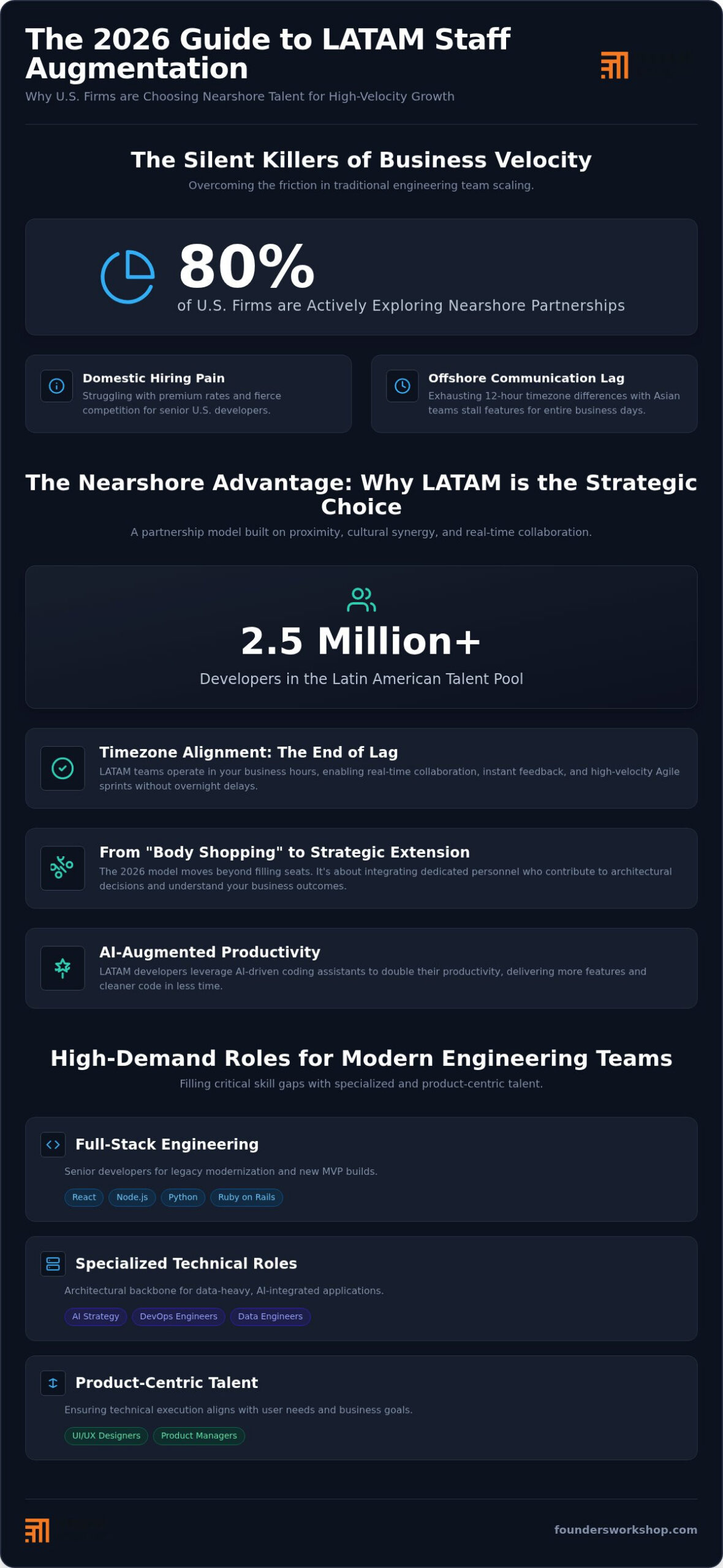
Over 80% of U.S. firms are now actively exploring nearshore partnerships because technical friction is the silent killer of business velocity. You’ve likely felt the frustration of paying premium rates for domestic senior developers or dealing with the exhausting communication lag that comes with offshore teams in Asia. It’s a common struggle for leaders who need to scale quickly without sacrificing code quality or cultural alignment. You know that finding the right talent isn’t just about filling a seat; it’s about finding a partner who understands your strategic vision.
By utilizing staff augmentation Latin America, you can access a talent pool of over 2.5 million developers who work within your specific timezone. This guide provides the strategic framework you need to scale your engineering team with elite talent while achieving significant cost savings compared to U.S. hires. We’ll break down the 2026 landscape of hourly rates, navigate complex regional labor laws, and show you how to integrate dedicated personnel who act as a true extension of your team. You’ll gain the peace of mind that comes from a steady, high-velocity delivery model designed for long-term reliability.
Key Takeaways
- Learn why 2026 marks the end of simple “body shopping” and the rise of staff augmentation Latin America as a model for long-term strategic team extension.
- Understand how cultural synergy and real-time timezone alignment eliminate the communication friction common in traditional offshore models.
- Identify the critical differences between filling internal skill gaps and deploying fully managed nearshore dedicated development teams to meet specific project milestones.
- Discover how to vet for a “product mindset” to ensure your new engineers prioritize business outcomes and user value over simply closing technical tickets.
- Gain insights into leveraging veteran leadership to bridge the gap between high-level U.S. business strategy and technical execution in the field.
What is Staff Augmentation in Latin America?
Staff augmentation Latin America is an agile outsourcing model where U.S. companies integrate external engineering talent directly into their existing internal workflows. Unlike traditional project-based outsourcing, this model allows you to maintain full control over your development processes while scaling your capacity on demand. To understand the foundational mechanics, many leaders ask What is Staff Augmentation and how it differs from managed services; essentially, it’s about adding specific skills to your roster rather than offloading entire projects to a third party.
By 2026, the market has moved decisively away from “body shopping,” where firms simply provided warm bodies to fill seats. Today, the focus is on “strategic team extension.” This means developers aren’t just writing code; they’re participating in your standups, contributing to architectural decisions, and understanding your business outcomes. Companies in high-stakes sectors like SaaS, Healthcare, and Fintech lead this demand because they require high-velocity delivery without the prohibitive cost of hiring a software developer in the US. This approach allows you to secure senior talent that integrates seamlessly into your culture and mission.
The Evolution of Nearshoring in 2026
Market dynamics in 2026 favor Latin America because quality has become the non-negotiable metric for scaling firms. North American brands have largely moved away from the “Offshore” label, which often carried connotations of communication friction and technical debt. “Nearshore” represents a commitment to high-fidelity collaboration and timezone alignment. AI now plays a massive role here too. Augmented developers in LATAM are leveraging AI-driven coding assistants to double their productivity, ensuring that your investment yields more features and cleaner code in less time. It’s no longer just about finding a developer; it’s about finding a tech-forward partner who can navigate the latest era of automation.
Core Roles Typically Augmented
Building a modern engineering organization requires a mix of foundational and specialized expertise. We see the highest demand for the following roles:
- Full-stack Engineering: Senior developers proficient in React, Node, Python, and Ruby on Rails who can jump into legacy modernization or new MVP builds without a steep learning curve.
- Specialized Technical Roles: AI strategy consultants, DevOps engineers, and Data Engineers who provide the architectural backbone for 2026’s data-heavy, AI-integrated applications.
- Product-Centric Talent: UI/UX designers and Product Managers who ensure the technical execution aligns with user needs and long-term business goals.
By focusing on these core roles, businesses can fill specific skill gaps while maintaining the agility needed to pivot in a fast-moving market. This model ensures that your team remains lean, focused, and capable of handling complex integrations or system modernizations as they arise.
Why LATAM is the Strategic Choice for Nearshore Engineering
Latin America has evolved into a cornerstone of modern software development because it solves the two biggest problems in remote scaling: distance and disconnect. Unlike offshore models that rely on late-night handoffs, staff augmentation Latin America offers a partnership based on proximity. This shift is part of a larger trend where the economic benefits of nearshoring are projected to add billions in value to regional exports, signaling a massive infrastructure investment that benefits North American firms. Tech hubs in Mexico, Colombia, and Argentina have matured into world-class centers of excellence, providing a deep well of senior talent for those who follow the 2026 Nearshore Staff Augmentation Guide for Engineering.
Timezone Alignment: The End of the 12-Hour Lag
The “wait-and-see” model of offshore development is a relic of the past. When your engineering team is 12 hours ahead, a simple question about a pull request can stall a feature for an entire business day. Nearshore teams operate in your same window. This real-time collaboration is the engine behind high Agile sprint velocity. You don’t have to wait for the morning to sync; you can hop on a call or a Slack thread instantly. This synchronicity removes the hidden costs of management overhead that typically plague long-distance partnerships. It’s about maintaining momentum. When your team works together in the same sun, friction disappears.
High English Proficiency and Cultural Fit
Technical skill is only half the battle. Successful scaling requires developers who can articulate complex ideas and challenge assumptions. Major hubs like Medellin, Buenos Aires, and Mexico City have prioritized English proficiency, creating a workforce that communicates with nuance and clarity. This shared linguistic foundation supports a deeper cultural synergy. Latin American engineers often share the same proactive problem-solving mindset and transparency valued in U.S. professional environments. This alignment is why integrating nearshore engineering teams feels more like a natural expansion than a forced outsourcing project.
If you’re looking to bridge the gap between high-level strategy and technical execution, Founders Workshop can help you navigate these regional nuances. By focusing on human-centered results, you ensure that your team isn’t just closing tickets but actually driving business growth. This pragmatic approach to partnership is what allows a business to scale without the usual technical friction.
Comparing Staff Augmentation vs. Managed Teams
Choosing the right engagement model is a strategic decision that impacts both your balance sheet and your product roadmap. While staff augmentation Latin America is often the preferred route for rapid scaling, it’s essential to understand how it contrasts with a managed services unit. The primary differentiator is management responsibility. In one model, you act as the conductor directing every note. In the other, you’re the architect reviewing the finished structure. Deciding between them requires an honest assessment of your internal leadership bandwidth and the complexity of the project at hand.
Staff Augmentation: Flexibility and Integration
This model is best for companies that already have strong engineering leadership in place. If you have a CTO and senior leads who need specific expertise, such as a Python specialist or a React expert, augmentation is the logical path. It allows you to plug talent directly into your existing sprints. You maintain direct control over every daily task, ensuring the new hires adopt your specific coding standards and cultural norms immediately. However, this control comes at a price; your internal team must dedicate time to onboarding and daily management. It’s a high-touch model that yields high-fidelity results when you have the capacity to lead.
- Pros: Direct control, seamless integration, and maximum flexibility to pivot tasks.
- Cons: High demand on internal management bandwidth and lead developer time.
Managed Teams: End-to-End Ownership
A nearshore dedicated development team operates as a self-contained unit. This is the “turnkey” solution for founders who need to build a new MVP or modernize a legacy system without distracting their core staff. The partner agency provides the project manager, the developers, and the QA engineers. They’re responsible for the delivery of the roadmap, not just the hours worked. While this model typically carries a higher price point due to the added layers of management and oversight, it provides the peace of mind that comes from offloading technical execution to a veteran partner.
- Pros: Reduced management overhead and clear accountability for project milestones.
- Cons: Less direct control over granular daily tasks and a higher initial investment.
For growth-stage startups, the financial implications are significant. Many firms begin with staff augmentation Latin America to keep costs lean while they find product-market fit. As the product matures and the core team becomes stretched, shifting specific modules to a managed team can actually improve ROI. It reduces the “management tax” on your most expensive domestic leaders, allowing them to focus on high-level strategy rather than reviewing every pull request.
Vetting and Onboarding: Ensuring Technical and Cultural Alignment
By 2026, the standard for successful staff augmentation Latin America has evolved far beyond a simple portfolio review or a standard LeetCode test. Technical proficiency is now the baseline, not the differentiator. To build a team that actually moves the needle, you must vet for a “Product Mindset.” This means ensuring that every developer understands the “why” behind the feature they are building. When an engineer can connect a line of code to a specific business outcome, they stop being a ticket-taker and start being a strategic asset. High-growth firms now prioritize this alignment to avoid the technical debt that stems from a lack of product context.
The 4-Step Vetting Framework
A disciplined vetting process is your best defense against team friction. While many agencies offer pre-vetted talent, you should maintain a final layer of internal verification to ensure the fit is precise. We recommend a structured four-step approach:
Security and compliance are equally critical, especially for firms in regulated industries. You must verify that your partner agency adheres to SOC2 or HIPAA standards. This ensures that your intellectual property and user data remain protected as you scale across borders.
Successful Onboarding Strategies
Integration should be immediate and total. Augmented staff shouldn’t feel like “the contractors” but rather like core members of your engineering organization. This starts with Day 1 access to Slack, Jira, and your internal documentation. Set clear KPIs and establish communication protocols early to remove any ambiguity about expectations. A trial period, or an “onboarding sprint,” is an excellent way to test team chemistry before making a long-term commitment. It allows both parties to evaluate the workflow in a low-risk environment.
Product Engineering is the deliberate alignment of technical code with specific user needs and business objectives. When you prioritize this during onboarding, you ensure that your new developers are building for the user, not just the compiler. If you are ready to see how a veteran-led team handles this process with precision, explore our nearshore staff augmentation services and let’s discuss your roadmap.
Scaling with Founders Workshop: The Strategic Partner Approach
Founders Workshop acts as the essential bridge between high-level U.S. business strategy and technical execution in the field. With over 30 years of leadership experience, we understand that technology is a means to an end, not the end itself. Our approach to staff augmentation Latin America focuses on human-centered solutions where developers are selected for their ability to think like founders. This veteran perspective ensures that your team isn’t just closing tickets; they’re actively driving business outcomes and removing technical friction from your daily operations.
Whether your goal is building a new MVP or undertaking complex legacy application modernization, we provide the architectural oversight needed for sustainable success. We integrate AI strategy and development into our workflows to boost team efficiency, ensuring that your nearshore resources are as productive as possible. This isn’t just about adding headcount; it’s about adding a strategic vision that aligns with your long-term roadmap. By choosing staff augmentation Latin America through a partner who has navigated multiple eras of technology, you gain a steady hand to help you scale with confidence.
Human-Centered Technical Solutions
We prioritize developers who possess a product-first mindset. Our AI strategy consulting further refines this efficiency by equipping augmented teams with the latest tools to accelerate delivery cycles and improve code quality. By acting as a seasoned executive guide, we help you navigate the complexities of scaling without the usual growing pains. It’s about providing peace of mind through accountability and a shared commitment to your business growth. We focus on bridging the gap between what is technically possible and what is commercially viable.
From MVP to Enterprise Scale
We support the full lifecycle of your digital product, from the initial prototype to enterprise-grade systems. For instance, we’ve successfully scaled healthcare platforms by integrating elite LATAM talent that understands the strict regulatory and security requirements of the industry. This long-term partnership approach ensures that your technical team remains aligned with your evolving roadmap as you grow. To plan your next phase of growth, you can explore our nearshore software development rates for a detailed breakdown of costs and resource planning. This transparency allows you to scale your engineering team with a clear understanding of the investment required for high-velocity delivery.
Executing Your 2026 Growth Roadmap
Scaling an engineering team requires more than just finding available talent; it requires finding the right strategic alignment. You’ve seen how timezone proximity and cultural synergy eliminate the friction that often plagues traditional offshore models. By embracing staff augmentation Latin America, you can secure senior talent that functions as a true extension of your internal team. This model allows you to maintain high-velocity delivery while managing costs effectively without sacrificing quality or control.
At Founders Workshop, we bring 30+ years of software engineering leadership to every partnership. We focus on high-retention, dedicated nearshore personnel who understand the nuances of your business goals. Whether you need specialized expertise in AI or healthcare tech development, our human-centered approach ensures your roadmap stays on track. It’s time to move beyond simple ticket closing and start building for long-term sustainability. We’re ready to help you navigate this path with a steady hand and proven expertise.
Schedule a Strategic Consultation to Scale Your Engineering Team. We look forward to helping you remove technical friction and turn your vision into a scalable reality.
Frequently Asked Questions
What are the typical rates for staff augmentation in Latin America in 2026?
Mid-level developers typically range from $35 to $70 per hour, while senior engineers fall between $60 and $80. These 2026 rates represent a significant cost saving compared to domestic U.S. hiring. While specialized roles can reach up to $140 per hour, the average partnership provides elite talent at roughly 40-60% of the cost of a local hire. This allows for sustainable scaling without compromising on the seniority of your technical team.
How do you handle IP protection and security with LATAM developers?
We secure intellectual property through master service agreements governed by U.S. law, ensuring all code remains your exclusive property. Our partner agencies also adhere to modern security standards such as SOC2 or HIPAA. This framework includes rigorous background checks and data encryption protocols. By establishing these legal and technical safeguards early, you can scale with the peace of mind that your proprietary systems and user data are fully protected.
Can Latin American developers work during my specific US timezone?
Yes, a primary benefit of staff augmentation Latin America is the 6-8 hour overlap with U.S. working hours. Developers in hubs like Mexico, Colombia, and Argentina work in real-time alongside your domestic team. This synchronization supports Agile methodologies and immediate communication through Slack or Zoom. You won’t have to wait for the next day to resolve a blocker, which significantly increases your overall sprint velocity and project momentum.
What is the difference between staff augmentation and a freelance marketplace?
Freelance marketplaces focus on short-term tasks and individual transactions, whereas staff augmentation provides dedicated personnel who integrate into your company culture. Augmented developers are long-term partners who understand your product roadmap and strategic goals. Unlike freelancers who may juggle multiple clients, these engineers are focused exclusively on your project. This model ensures higher accountability, better code consistency, and a deeper understanding of your specific business outcomes over time.
How long does it typically take to onboard a new augmented developer?
A new developer can typically be integrated into your workflow within two to four weeks. This timeline includes technical vetting, cultural interviews, and administrative setup. We prioritize a streamlined process to minimize downtime and ensure that the transition is seamless for your existing leads. By using a structured onboarding sprint, you can quickly assess team chemistry and ensure the new hire is contributing to your codebase without unnecessary delays.
Do I need to manage the payroll and taxes for augmented staff in LATAM?
No, the staff augmentation partner typically handles all payroll, local taxes, and mandatory benefits. Many U.S. firms use an Employer of Record to navigate the complex labor laws in countries like Brazil or Mexico. This includes managing statutory requirements like the 13th-month bonus, known as “Aguinaldo” in Mexico. This arrangement allows you to focus on engineering leadership while the administrative and compliance burdens are managed by regional experts.
What happens if a developer is not a good fit for my team?
If a developer isn’t meeting your technical or cultural expectations, the partner agency provides a replacement as part of the engagement model. We typically include a notice period and a transition plan to ensure that project knowledge is transferred effectively. This flexibility is a core advantage of the model, allowing you to refine your team composition without the legal complexities or severance costs associated with direct domestic employment.
How does Founders Workshop ensure the quality of their LATAM talent pool?
Founders Workshop leverages 30+ years of engineering leadership to vet developers for a “Product Mindset” rather than just coding ability. We look for candidates who understand why they are building a feature and how it impacts the user. Our rigorous process includes live coding, architectural reviews, and soft skills assessments. This ensures that every member of the talent pool is equipped to handle the high-velocity demands of modern SaaS, healthcare, and fintech environments.