

What if the primary bottleneck in your product roadmap isn’t a lack of talent, but the operational friction of how you’ve structured your team? Many leaders have already felt the hidden costs of offshore expansion, such as midnight meetings that drain energy or code reviews that stall due to cultural misalignment. Learning how to integrate nearshore developers effectively is no longer just a hiring tactic. It’s a core competitive advantage for any organization looking to scale in 2026.
We agree that the traditional vendor mindset is often the root cause of project failure. When you treat Latin American engineers as a detached resource, you invite high turnover and mounting technical debt. This guide offers a strategic framework to embed nearshore talent directly into your core engineering workflows. You’ll learn to achieve same-day collaboration and predictable velocity by treating your nearshore partners as a seamless extension of your internal culture. We’ll walk through the specific steps to align your communication rhythms, technical standards, and long-term vision to build a truly scalable engineering engine.
Key Takeaways
- Shift from a vendor mindset to a strategic partnership model to ensure nearshore talent becomes a core extension of your engineering culture.
- Master how to integrate nearshore developers by aligning operational tools, such as Jira workflows and CI/CD pipelines, for seamless daily collaboration.
- Proactively resolve cultural friction and “Us vs. Them” mentalities by synchronizing business expectations with Latin American work styles.
- Follow a disciplined 30-60-90 day roadmap to transition new hires from initial environment setup to full immersion in your sprint cycles.
- Eliminate technical debt and knowledge silos by embedding nearshore teams into peer-led code reviews and long-term strategic planning.
The Strategic Shift: Why Nearshore Integration is the 2026 Engineering Standard
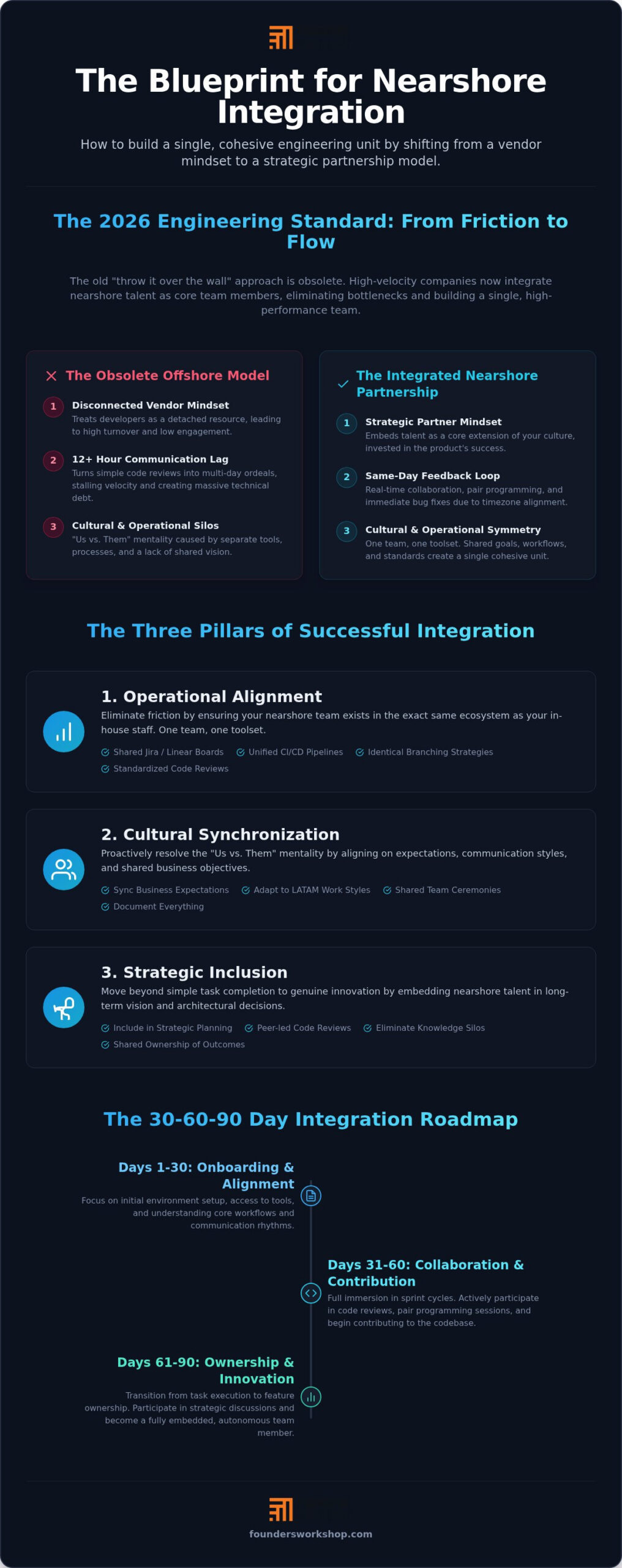
Engineering leadership has evolved beyond the binary choice of hiring local or outsourcing tasks. In 2026, the industry standard is nearshore integration. This is the deliberate process of blending Latin American talent into US engineering cultures so they function as a single, cohesive unit. To understand what is nearshoring in a modern context, you have to look past simple geographic proximity. It’s about cultural and operational symmetry. It moves your organization away from a “rent-a-coder” mentality and toward a strategic partnership where every developer is invested in the product’s success.
The US entered 2026 still grappling with the aftermath of 1.4 million unfilled technical positions reported in previous years. Relying solely on local hiring is no longer a safe bet; it’s a scaling bottleneck. Leaders who have successfully navigated this talent crunch have stopped looking for temporary contractors. Instead, they’ve mastered how to integrate nearshore developers as core team members who share the same business objectives and technical standards as their internal staff. This shift is what separates high-growth companies from those bogged down by recruitment cycles.
The Death of the Offshore “Hand-off” Model
The old “throw it over the wall” approach, common with offshore teams in distant timezones, is effectively obsolete. High-velocity startups can’t afford a 12-hour communication lag that turns a simple code review into a two-day ordeal. Nearshore integration creates a “Same-Day Feedback Loop” that mirrors the experience of having a developer in the next room. Because your LATAM team works your hours, you can engage in real-time pair programming and immediate bug fixes. This synchronous collaboration eliminates the massive technical debt that often accumulates when developers work in isolation without immediate peer feedback.
Economic Realities: Balancing Growth and Burn Rate
Strategic growth requires a disciplined balance between aggressive scaling and sustainable burn rates. When you analyze the real cost of hiring a US software developer in 2026, the numbers often make an onshore-only model difficult to justify for every role. Nearshore talent typically costs 40-65% less than US equivalents, but the true value isn’t just the hourly rate. It’s the ROI of stability. A well-integrated nearshore team provides a predictable development velocity that allows you to commit to long-term product roadmaps with confidence. By learning how to integrate nearshore developers effectively, you protect your margins while maintaining the high-quality code output necessary for market leadership.
The Three Pillars of Successful Nearshore Integration
Building a high-performing distributed team requires more than just a shared Slack channel and a signed contract. True integration is a deliberate architectural choice for your organization. If you want to move beyond simple task completion and toward genuine innovation, you must address three specific pillars: operational alignment, cultural synchronization, and strategic inclusion. These pillars ensure that when you learn how to integrate nearshore developers, you aren’t just adding headcount; you’re expanding your company’s core capabilities.
Documentation serves as the connective tissue in this hybrid-first engineering environment. In a distributed model, “tribal knowledge” is a liability that leads to bottlenecks and technical debt. Every architectural decision, API contract, and deployment procedure must be documented with the assumption that the reader is not in the room with you. This discipline creates a transparent environment where Latin American talent can contribute with the same autonomy as your local staff.
Operational Alignment: One Team, One Toolset
Operational friction is the silent killer of engineering velocity. To eliminate it, your nearshore team must exist within the exact same ecosystem as your in-house staff. This means sharing the same Jira or Linear boards, participating in the same CI/CD pipelines, and adhering to identical branching strategies. When developers use different communication channels or separate project management tools, you inadvertently create a “us versus them” dynamic. Standardizing code review processes ensures that quality remains universal, regardless of where the code is written. Regular shared ceremonies, such as daily stand-ups and sprint retrospectives, reinforce this unity by keeping everyone aligned on the immediate goals and long-term vision.
Cultural Synchronization: Beyond Language Proficiency
Language is rarely the primary barrier in nearshore partnerships; cultural communication styles are. US business culture is typically “low context,” meaning communication is direct and explicit. Many Latin American cultures are “high context,” where relationships and subtle cues hold more weight. Bridging this gap requires intentional effort to build psychological safety. Nearshore developers must feel empowered to flag risks or challenge technical decisions without fear of overstepping. You can foster this trust by creating informal “water cooler” moments and ensuring that your nearshore dedicated development teams are treated as strategic partners rather than just contractors.
Strategic inclusion is the final, often overlooked, piece of the puzzle. Developers perform best when they understand the “Why” behind the “What.” By involving your nearshore team in high-level product discussions and business goal setting, you transform them from ticket-takers into problem-solvers. This level of transparency is a hallmark of strategies for effective nearshore partnerships that lead to long-term success. When you master how to integrate nearshore developers through these three pillars, you create a resilient, scalable engineering engine that can navigate the complexities of the 2026 tech landscape with confidence.
Common Integration Friction Points and How to Resolve Them
Even with the right strategic framework, friction is an inevitable part of scaling a distributed engineering organization. It’s rarely a result of poor intent. Instead, friction usually stems from invisible barriers in communication or misaligned internal perceptions. One of the most persistent challenges is the “Us vs. Them” mentality. If your in-house team views augmented staff as a threat to their job security or a burden on their bandwidth, collaboration will suffer. You can resolve this by framing nearshore talent as a force multiplier. When your core team realizes that nearshore partners handle the heavy lifting of feature parity or maintenance, they’re freed up to focus on high-level architecture and innovation.
Shadow IT also presents a significant risk to cohesive integration. When distributed teams begin using unauthorized tools or “quick-fix” communication channels to bypass perceived bottlenecks, you lose visibility into the development process. Consistent tool usage is mandatory. Every developer, regardless of their location, must adhere to the same stack and security protocols. This level of discipline ensures that your operational standards remain intact as you scale, preventing the fragmented workflows that often lead to technical debt. A well-structured nearshore staff augmentation strategy can help you establish these standards from day one, ensuring every new team member is integrated into a consistent, secure workflow.
Bridging the Knowledge Gap
Security and Access Management
When you evaluate how to integrate nearshore developers into sensitive environments, security must be a foundational requirement rather than an afterthought. If you’re operating within HIPAA or SOC2 compliant workflows, your nearshore team must be fully integrated into your Identity and Access Management (IAM) systems. This involves standardizing VPN protocols and hardware security requirements across all regions. Role-based access control (RBAC) allows you to grant the precise level of access needed for a specific sprint without exposing your entire infrastructure. By ensuring that your nearshore partners follow the same audit trails and compliance checks as your internal staff, you maintain a secure, unified environment. Mastering how to integrate nearshore developers with this level of technical rigor is essential for protecting your intellectual property while driving growth.
The 30-60-90 Day Nearshore Integration Roadmap
A successful partnership isn’t measured by the date a contract is signed, but by the productivity of the team three months later. The first 90 days are critical for establishing the trust and technical baseline required for long-term retention. By following a structured roadmap, you move from a state of supervised onboarding to a model of full engineering ownership. This progression is the most reliable way to master how to integrate nearshore developers while protecting your development velocity. If you’re looking for a partner to help navigate this transition, Founders Workshop specializes in building these integrated, high-performing teams.
Phase 1: Technical and Social Foundations
The initial 30 days should focus on removing technical blockers and building social capital. Assigning an “Integration Buddy” from your in-house team is one of the most effective ways to accelerate this process. This peer-level connection provides the nearshore developer with a safe space to ask “dumb” questions about the codebase or internal culture. During this phase, you must verify local environment parity immediately. If your new developers spend their first week fighting configuration issues that don’t exist on your local machines, you’ve already lost momentum. Set clear expectations for communication response times early to establish a rhythm that respects the “Same-Day Feedback Loop” discussed earlier.
Phase 2: Deepening Workflow Integration
Between days 31 and 60, the focus shifts from isolated “quick win” tickets to collaborative feature development. This is the immersion phase. Your nearshore developers should now be fully integrated into daily sprint cycles and participating in peer-led code reviews. It’s also the time to encourage their input on technical debt discussions. When developers feel their expertise is valued in architectural decisions, their sense of ownership increases. As you deepen this integration, it’s wise to periodically review nearshore software development rates. This ensures your resource allocation remains aligned with the increasing output and complexity of the work being delivered.
By the 90-day mark, your nearshore team should reach the ownership phase. At this point, they aren’t just completing tasks; they’re leading features and contributing to high-level architectural discussions. You can measure the success of this integration using DORA metrics. Track deployment frequency and lead time for changes to see if the new team members are contributing to a faster, more stable release cycle. Don’t forget to run team sentiment surveys. A high-performing team is one where both in-house and nearshore developers feel like they’re working toward a shared mission. Mastering how to integrate nearshore developers through this disciplined timeline transforms a temporary staffing solution into a permanent strategic asset. For a comprehensive overview of the regional talent landscape and 2026 hourly rates, the staff augmentation Latin America strategic resource guide provides the data-driven context you need to make informed hiring decisions.
Founders Workshop: Your Partner in Strategic Engineering Growth
Scaling a technical organization is a challenge that requires more than just code; it requires a deep understanding of how business outcomes drive technical decisions. At Founders Workshop, we draw on over 30 years of leadership experience to help you navigate the complexities of modern engineering. We understand that the question of how to integrate nearshore developers is ultimately a question of trust and alignment. Our approach is designed to remove technical friction, allowing you to focus on the strategic vision that will define your company’s future in 2026 and beyond.
We take full accountability for the heavy lifting of building a distributed team. This includes rigorous recruitment, cultural vetting, and navigating the increasingly complex regulatory landscape, such as Mexico’s REPSE reforms or the new state-level privacy laws taking effect this year. By handling these operational hurdles, we ensure that your nearshore dedicated development teams are ready to contribute from day one. Our focus remains on human-centered solutions, ensuring that every developer we place is not just a technical expert, but a cultural fit for your specific organization.
Beyond Staff Augmentation: A Managed Approach
Traditional staff augmentation often fails because it lacks a strategic layer. We provide a managed approach that bridges the gap between high-level strategy and daily execution. Our Phoenix-based executive team provides national coverage, offering a steady hand to guide your engineering roadmap. Whether you are building startup MVPs or scaling a complex healthcare tech platform, we ensure our developers are fully prepared to integrate into your existing Agile culture. This managed model has allowed our partners to scale rapidly without the typical communication gaps or quality drops associated with offshore models. We have seen how timezone alignment and shared values can transform a struggling project into a market-leading product.
Ready to Scale Your Engineering Velocity?
If you are a founder or VP of Engineering tired of the high turnover and technical debt that often comes with poorly integrated contractors, it’s time for a different approach. We invite you to engage with us for an AI strategy session or a comprehensive engineering audit to identify where your current workflows are stalling. Our goal is to provide you with the peace of mind that comes from knowing your technical engine is built for sustainability and growth. We have been where you are. We’ve navigated multiple eras of technology, and we know the path forward. Let’s discuss how to integrate nearshore developers into your core team to build something exceptional together.
Future-Proofing Your Engineering Velocity
Mastering how to integrate nearshore developers is the final step in transforming your engineering department from a bottleneck into a growth engine. By moving past the “rent-a-coder” mindset and embracing a disciplined 30-60-90 day roadmap, you create a team that doesn’t just execute tickets; they actively contribute to architectural excellence. Successful integration relies on the three pillars of operational alignment, cultural synchronization, and strategic inclusion. When these elements are in place, geographic distance disappears, leaving only high-velocity output and shared business goals.
At Founders Workshop, we bring 30+ years of technical leadership and a human-centered engineering strategy to every partnership. We don’t just provide talent. We provide a specialized LATAM talent pool that is fully vetted for your specific Agile environment and business objectives. This ensures your growth is sustainable, your technical debt remains under control, and your product roadmap stays on track.
Scale your engineering team with a nearshore dedicated team from Founders Workshop.
The path to a frictionless, distributed team is clear. It’s time to lead your organization with the confidence that comes from a well-integrated, high-performing engineering partner. Your next phase of growth starts here.
Frequently Asked Questions
What is the difference between nearshore and offshore development?
Nearshore development focuses on geographic and timezone proximity, typically within one to three hours of your home office. Offshore development usually involves significant timezone gaps of ten to twelve hours. While offshore models might offer lower base hourly rates, nearshore partnerships provide superior real-time collaboration and cultural alignment. This proximity reduces the hidden communication tax that often stalls distant outsourcing projects.
How do you handle cultural differences when integrating LATAM developers?
Successful integration starts with building psychological safety and understanding communication styles. Latin American tech hubs share many business values with the US, but subtle differences in high-context communication can exist. We resolve this by fostering an environment where every team member feels empowered to challenge technical decisions. Regular video syncs and shared social channels help bridge these gaps and build long-term trust.
Do nearshore developers work in the same timezone as my US team?
Yes, nearshore developers in Latin America typically work within a zero to three hour window of US timezones. This overlap allows for a full day of synchronous collaboration, which is essential for Agile ceremonies and pair programming. When you evaluate how to integrate nearshore developers, this timezone alignment is the single most important factor in maintaining a high-velocity development cycle without the lag of offshore models.
How do I ensure the security of my intellectual property with nearshore developers?
Security is managed through a combination of rigorous legal contracts and technical safeguards. We implement role-based access control and ensure all developers work within secure, encrypted environments. Our teams also adhere to international standards such as SOC2 and HIPAA when required. This structured approach protects your intellectual property while allowing developers the precise level of access they need to remain productive and compliant.
What communication tools are best for managing a nearshore engineering team?
How long does it typically take to fully integrate a nearshore developer?
A full integration typically follows a ninety-day cycle. The first thirty days focus on environment setup and small “quick win” tasks. By day sixty, the developer is usually immersed in full sprint cycles. By the ninety-day mark, they should reach the ownership phase where they lead feature development and contribute to architectural discussions. This disciplined timeline is the gold standard for how to integrate nearshore developers effectively.
Can nearshore developers help with legacy software modernization?
Nearshore teams are highly effective for modernization projects that require deep technical context and frequent collaboration. Modernizing legacy systems involves significant risk and requires constant communication between the developers and business stakeholders. Because nearshore teams work your hours, they can navigate these complex migrations with fewer delays than offshore teams. This proximity ensures a more stable transition to modern, scalable architectures.
Is nearshore development more expensive than offshore?
Nearshore rates are generally higher than offshore, but the total cost of ownership is often lower. You pay a slight premium for timezone alignment and cultural proximity, but you save significantly by avoiding the communication friction and rework common with offshore models. When you factor in the increased development velocity and higher code quality, nearshore remains a more sustainable economic choice for long-term strategic growth. For a deeper look at how to scale your team cost-effectively while maintaining quality, explore our 2026 nearshore staff augmentation guide for engineering teams.