
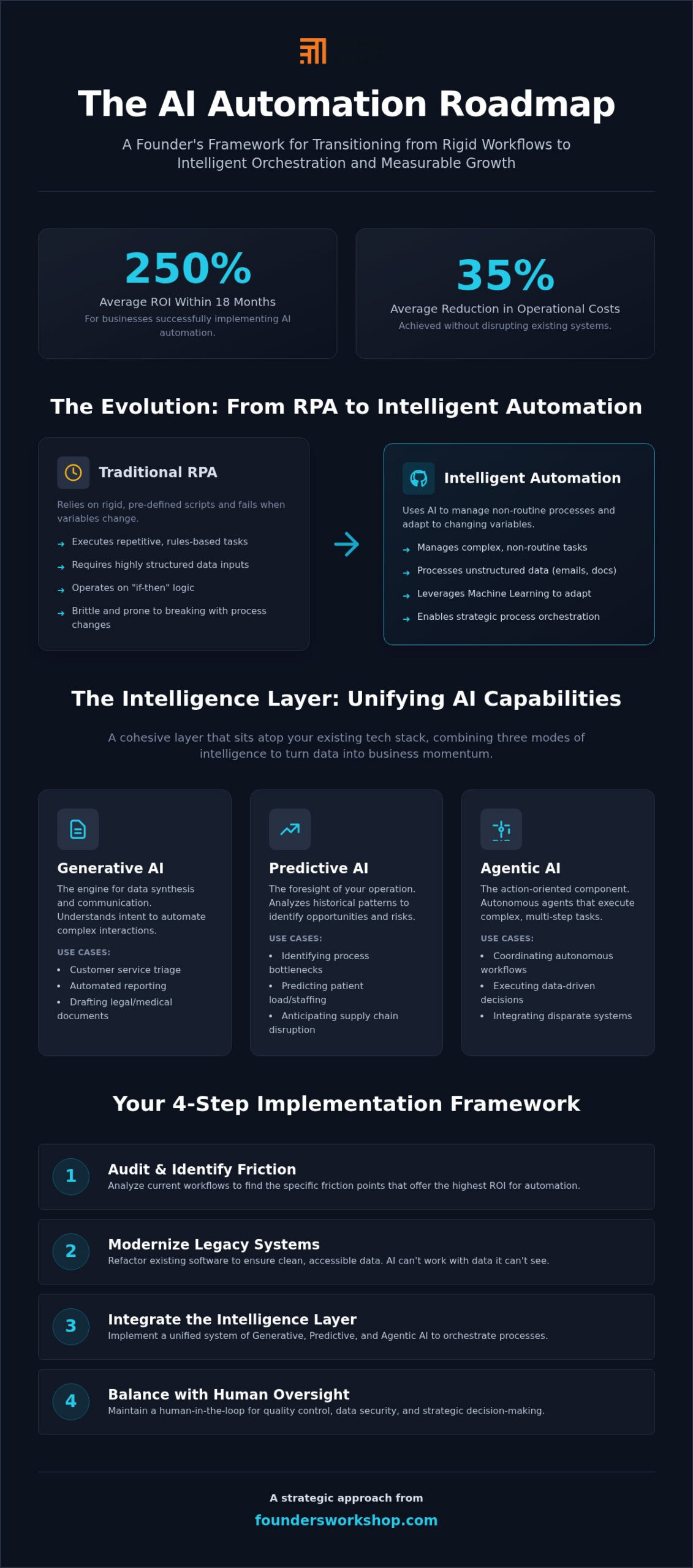
By mid-2026, businesses successfully implementing AI for business process automation have reported an average ROI of 250% within their first eighteen months. This isn’t just about replacing a few manual tasks with scripts; it’s about a fundamental shift in how your organization functions. You’ve likely felt the growing friction between your reliable legacy software and the need for modern, intelligent tools. It’s a common struggle for leaders who want to scale but fear losing human oversight or compromising data security in the process.
This guide provides the strategic roadmap you need to transition from rigid workflows to an intelligent orchestration layer that delivers measurable results. We’ll show you how to identify the specific processes that yield the highest returns and how to reduce operational costs by an average of 35% without breaking your existing systems. We’ll explore the practical steps of AI implementation, from modernizing your data readiness to utilizing nearshore staff augmentation for the human-in-the-loop oversight that current regulations demand. You’ll gain the clarity needed to turn technical friction into a sustainable engine for growth.
Key Takeaways
- Learn why shifting from basic Robotic Process Automation (RPA) to intelligent automation is essential for managing non-routine tasks and complex decision-making.
- Discover how to implement AI for business process automation as a unified Intelligence Layer that orchestrates generative, predictive, and agentic capabilities.
- Understand the strategic importance of refactoring legacy code to remove technical friction and prepare your existing software for AI-driven orchestration.
- Access a practical framework for auditing your current workflows and identifying the specific friction points that offer the highest ROI for automation.
- Explore a human-centered approach to technical execution that balances intelligent automation with necessary human oversight and data security.
Beyond RPA: The Evolution of AI for Business Process Automation
2026 is the definitive tipping point for corporate workflows. In previous years, automation was often viewed as a luxury or a siloed IT project, but it’s now a core requirement for organizations that want to remain competitive. Modern AI for business process automation utilizes machine learning and Large Language Models (LLMs) to handle non-routine tasks that previously demanded constant human intervention. While traditional Business process automation (BPA) focused on digitizing manual tasks, we’ve moved into an era where systems can interpret intent and make data-driven decisions.
We’ve moved past the limitations of traditional Robotic Process Automation (RPA), which relies on rigid, pre-defined scripts. Instead, we’ve entered the age of Intelligent Automation (IA). The difference is fundamental to your growth strategy:
- Traditional RPA: Executes repetitive, rules-based tasks using structured data and “if-then” logic.
- Intelligent Automation: Manages non-routine processes using unstructured data and machine learning to adapt to changing variables.
Process Orchestration is the strategic coordination of autonomous AI agents and human oversight to ensure complex workflows remain reliable and scalable. For those specifically managing PeopleSoft environments, you can click here to explore specialized automation options.
The Shift from Static Rules to Dynamic Intelligence
Traditional “if-then” logic fails in complex business environments where variability is the norm. If an invoice looks slightly different or a customer uses unexpected phrasing in an email, rules-based systems stop working. Context-aware AI handles these exceptions by understanding the nuance of the data it processes. However, these intelligent layers can’t function in a vacuum. Legacy application modernization is a critical prerequisite for AI success because AI tools require clean, accessible data from your underlying systems. You can’t build a high-performance engine on a crumbling chassis; your existing software must be refactored to provide the data transparency that modern AI requires.
The Business Case for Intelligent Orchestration
Strategic leaders are moving away from viewing automation as a simple way to reduce headcount. The real win is value creation. AI-driven processes lead to faster response times and higher accuracy, which directly improves the customer experience. Internally, it transforms the employee experience by removing the friction of manual data entry or routine ticket routing. This allows your best talent to focus on innovation rather than administration. This approach ensures that technical execution is always aligned with your strategic vision, creating a sustainable growth model where operations scale without a proportional increase in overhead.
The Intelligence Layer: Generative, Predictive, and Agentic AI
Successful AI for business process automation in 2026 isn’t a single application. It’s a cohesive Intelligence Layer that sits atop your existing technology stack. This layer combines three distinct but complementary modes of intelligence to transform raw data into business momentum. By unifying these capabilities, you move from simple task automation to a system that understands, anticipates, and acts on your behalf.
Generative AI in the Workflow
Generative AI has evolved beyond simple chat interfaces. In a professional ecosystem, it serves as the primary engine for data synthesis and communication. It handles customer service triage by understanding intent, drafts complex legal or medical documents based on internal datasets, and automates reporting that used to take days. While these tools are powerful, human-in-the-loop oversight remains a non-negotiable requirement for accuracy and security. Integrating these capabilities through custom internal software development allows you to maintain control over your proprietary data while leveraging the speed of large language models.
Predictive Analytics for Decision Support
If Generative AI is the voice of your automation, Predictive AI is the foresight. By analyzing historical patterns, these models identify potential bottlenecks before they impact your bottom line. In healthcare, this might mean predicting patient load to optimize staffing; in logistics, it’s about anticipating supply chain disruptions weeks in advance. This proactive approach turns passive data into a strategic asset. Investing in predictive analytics software development ensures your leadership team makes decisions based on probable outcomes rather than historical guesses. You can explore various intelligent automation use cases to see how predictive models reduce operational waste by up to 35%.
The Rise of Agentic AI Agents
The most significant shift in 2026 is the mainstream adoption of Agentic AI. Unlike standard bots that require constant prompting, AI agents are autonomous entities capable of executing multi-step workflows. They don’t just flag a low-inventory alert. They check vendor availability, compare prices, and draft a purchase order for approval. These agents interact directly with legacy APIs to bridge the gap between old databases and modern requirements. As you scale, the focus must shift toward auditability and governance. You need to know exactly why an agent made a specific decision. If you’re ready to build these autonomous systems, our team provides the AI strategy and development expertise needed to ensure your agents are both effective and secure.
Traditional Workflows vs. AI-Driven Orchestration: ROI Analysis
Many executives hesitate to move forward because of existing technical debt. However, AI is actually a catalyst for modernization. By applying specific refactoring legacy code strategies, you can clean up the underlying systems that currently hinder your agility. The cost of implementation is a controlled investment, while the cost of inaction is an escalating liability. As competitors adopt autonomous systems to reduce their operational costs by an average of 35%, staying tethered to manual processes becomes a significant competitive risk.
Identifying High-Impact Automation Candidates
Not every process deserves AI integration. We recommend using a “Complexity vs. Value” matrix to prioritize your efforts. While repetitive, high-volume data entry is the obvious starting point, it’s often just the tip of the iceberg. The highest ROI typically comes from non-routine tasks that involve high variability, such as intelligent triage or multi-step vendor coordination. You must carefully evaluate the risk profile of these high-stakes processes. Automating them requires robust guardrails to ensure data security and maintain the human oversight that 2026 regulations, like the EU AI Act, now demand.
Measuring Success Beyond Efficiency
Efficiency is your baseline, but true ROI shows up in deeper business metrics. You should track error reduction, cycle time, and “employee happiness” scores. When teams are freed from manual toil, their engagement increases and your engineering velocity improves, allowing you to ship new features and products faster. Many organizations utilize nearshore staff augmentation to bridge the skills gap during this transition. This approach provides the technical expertise needed to build and monitor your AI orchestration layer without the long lead times of local hiring, ensuring your transition is both rapid and sustainable.
Building Your AI Automation Roadmap: A Founder’s Framework
Moving from a conceptual understanding of AI for business process automation to functional implementation requires a disciplined framework. Many founders make the mistake of trying to automate everything at once, which often leads to technical bloat and fragmented data. A structured roadmap ensures that your automation efforts remain aligned with your business goals and deliver measurable value at every stage. It’s about building a foundation that supports long term scalability rather than chasing fleeting technical trends.
Your journey begins with a comprehensive audit of your existing workflows to identify where technical friction is highest. Once you’ve mapped these points, the next step is to develop a custom plan through AI strategy consulting that prioritizes high-impact areas. From there, you build a Minimum Viable Product (MVP) to test the automation of a single core process. Finally, you integrate and scale across the organization using a human-centered approach that keeps your team at the center of the intelligence layer. This methodical progression prevents the common pitfalls of over-engineering.
The MVP Approach to AI Automation
You should never try to “boil the ocean” when implementing AI. The most successful projects start with a narrow focus and clear success criteria. By selecting a pilot project that addresses a specific, recurring pain point, you can prove ROI quickly and build internal buy-in for broader initiatives. Leveraging strategic MVP development allows you to validate your assumptions about AI performance before committing to a full-scale rollout. This iterative process reduces financial risk and ensures that your automation architecture is built on a foundation of verified results.
Governance and Security Considerations
As you scale, protecting proprietary data becomes your top priority. In 2026, the regulatory landscape is more complex than ever, with laws like California’s AI Training Data Transparency Act (AB 2013) requiring strict oversight. You must build robust “guardrails” for your autonomous AI agents to prevent data leakage and ensure ethical decision-making. This is especially critical in regulated sectors like healthcare or finance, where compliance is non-negotiable. If you need an experienced partner to help navigate these complexities, our team provides the AI strategy and development expertise needed to ensure your systems are secure and compliant from day one.
Strategic Execution: Integrating AI into Your Business Ecosystem
Bridging the Talent Gap with Nearshore Teams
Building an intelligent orchestration layer requires specialized engineering talent that is often scarce or prohibitively expensive in local markets. Nearshore staff augmentation provides a pragmatic solution to this talent gap. By integrating developers from Latin America, you gain access to top-tier expertise while maintaining perfect timezone alignment. This synergy is critical for the real-time collaboration and engineering velocity needed to build, test, and monitor autonomous systems. It allows your organization to maintain momentum and scale operations without the operational friction or cultural disconnects common in traditional offshore models. Our teams become a seamless extension of your own, providing the stability and long-term reliability a growing business demands.
Future-Proofing Your Business for 2027 and Beyond
As we look toward 2027, the competitive landscape will shift from businesses that are merely “AI-enabled” to those that are “AI-native.” An AI-enabled company uses tools to improve existing tasks, but an AI-native organization builds its entire technical architecture around intelligent orchestration. Preparing your systems today ensures you aren’t just reacting to innovation but driving it. This level of future-proofing requires a technical partner who understands both the intricacies of the code and the demands of commerce. It’s about creating a sustainable foundation that can adapt as new models and regulations emerge. Schedule a consultation with our team to audit your current workflows and identify the highest-ROI opportunities for your automation roadmap.
Orchestrating Your Path to Scalable Growth
The transition from rigid, manual workflows to a unified intelligence layer is no longer a futuristic concept; it’s the 2026 standard for scaling a resilient organization. By moving beyond basic RPA and embracing agentic systems, you transform technical debt into a strategic asset that drives measurable ROI. We’ve explored how successful AI for business process automation requires a methodical roadmap, starting with legacy modernization and scaling through human-centered orchestration.
Founders Workshop brings over 30 years of leadership experience to your technical journey. We specialize in modernizing legacy systems and providing the nearshore talent necessary to build and maintain complex AI architectures. If you’re ready to remove technical friction and unlock sustainable growth, we’re here to help you navigate the complexities of implementation with confidence. Ready to automate? Schedule your AI Strategy Consultation with Founders Workshop today.
The opportunity to lead your industry through intelligent automation is within reach. It’s time to turn your strategic vision into a high-performance reality that scales with your ambition.
Frequently Asked Questions
How is AI business process automation different from RPA?
Traditional RPA follows static “if-then” rules to handle structured, repetitive tasks. In contrast, AI for business process automation uses machine learning and Large Language Models to interpret unstructured data and manage non-routine workflows. While RPA excels at simple data entry, AI-driven systems can handle complex triage, sentiment analysis, and multi-step decision making. This shift allows your organization to automate processes that previously required constant human intervention due to their high variability.
What processes should I automate first with AI?
You should prioritize processes that are high-volume but also high-variability. Look for workflows where your team spends significant time on initial data synthesis or triage, such as customer service routing, invoice reconciliation, or document drafting. These “intelligence-heavy” tasks offer the highest return on investment. By starting with a single core process as a Minimum Viable Product, you can validate success criteria and prove ROI before scaling across the entire organization.
Does AI automation require replacing our legacy software?
No, you don’t always need to replace your legacy software. In many cases, refactoring your existing code is a more strategic and cost-effective path to AI readiness. We focus on modernizing your current technical architecture so it can provide the clean, accessible data that modern AI agents require. This approach removes technical friction without the high risk and disruption of a total system overhaul, allowing you to build on your established foundation.
How do we ensure human oversight in autonomous AI workflows?
We implement a “human-in-the-loop” design to ensure that AI agents never operate in a complete vacuum. This involves building specific “checkpoints” where a human expert reviews or approves the AI’s output, especially for high-stakes decisions in healthcare or finance. By maintaining a robust audit trail and clear governance protocols, you ensure that your autonomous workflows remain transparent and accountable. This approach balances the speed of automation with the necessary judgment of your team.
What is the typical ROI for AI implementation in business processes?
Businesses using AI for business process automation in 2026 report an average ROI of 250% within the first eighteen months of implementation. These gains typically stem from a 35% reduction in operational costs and a significant increase in engineering velocity. Beyond direct financial returns, companies also see improved accuracy and higher employee retention as teams are freed from manual toil. These metrics demonstrate that intelligent orchestration is a primary driver of sustainable business growth.
How do I protect my company data when using Generative AI tools?
Protecting your proprietary data requires moving beyond public chat tools to secure, custom integrations. You can implement private instances of Large Language Models and establish strict data “guardrails” to prevent sensitive information from being used for external training. Additionally, staying compliant with 2026 regulations like California’s AI Transparency Act (SB 942) ensures your data handling meets the highest security standards. This disciplined approach provides the peace of mind needed to innovate safely.
Is AI for business process automation only for large enterprises?
No, adoption among small and medium-sized businesses (SMBs) has nearly doubled since 2024, reaching 38% in 2026. While large enterprises lead in overall adoption, the accessibility of modern AI tools has made automation a viable growth strategy for companies of all sizes. Smaller organizations often see faster results because they can implement changes with less bureaucratic friction. For any business looking to scale without a proportional increase in headcount, AI automation is now a necessity.
How can nearshore staff augmentation help with AI implementation?
Nearshore staff augmentation provides the specialized engineering talent needed to build and monitor your AI systems in your own timezone. Unlike offshore models, nearshore developers in Latin America offer real-time collaboration and cultural alignment, which are essential for complex AI projects. This approach allows you to scale your technical capacity quickly without the long lead times of local hiring. It ensures you have the “human-in-the-loop” oversight required to maintain secure and effective autonomous workflows.