

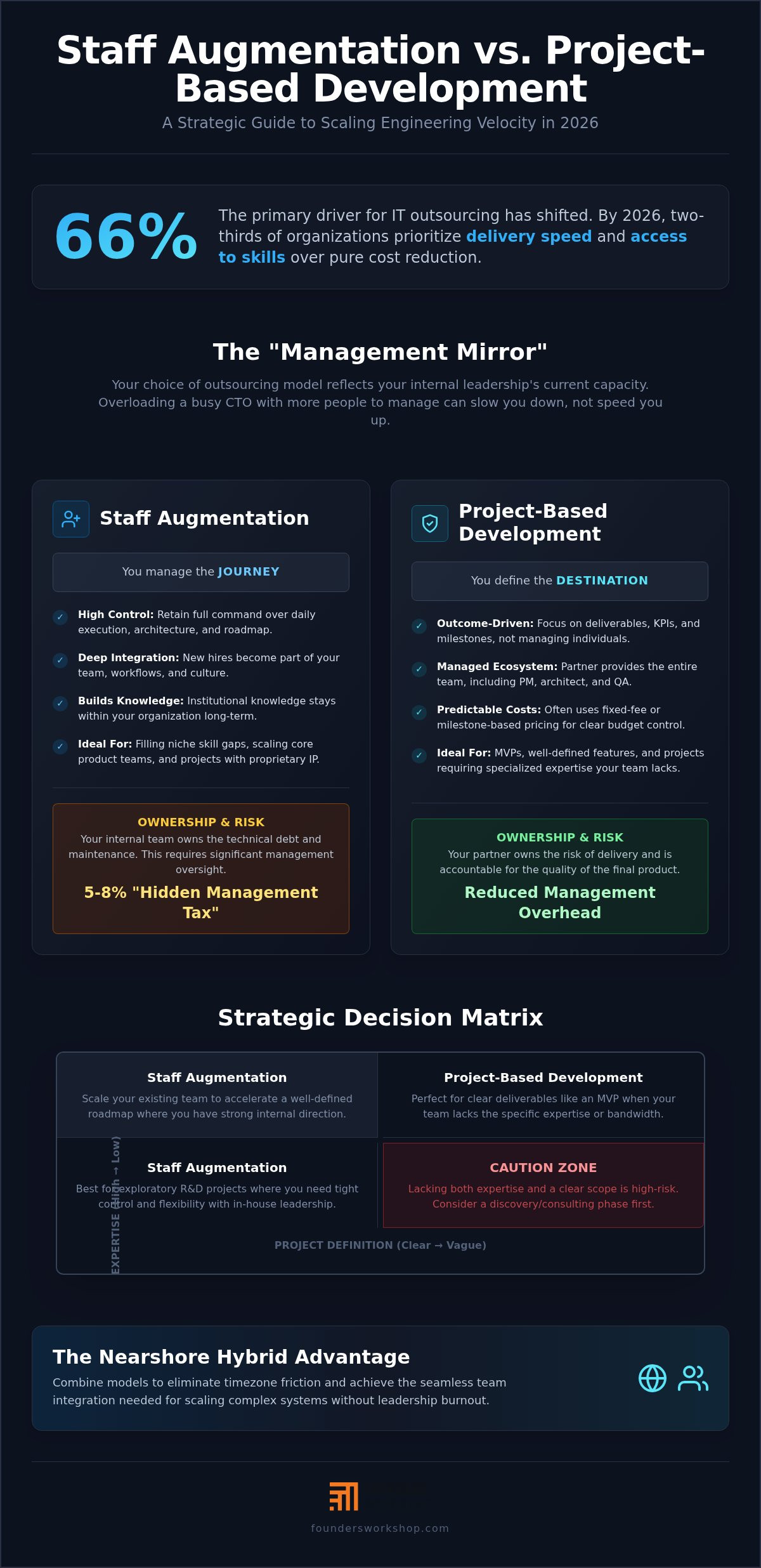
By 2026, the primary driver for IT outsourcing has flipped. Cost reduction is no longer the main goal for 66% of organizations who now prioritize delivery speed and access to specialized skills. You’ve likely felt the friction of US talent costs hitting the ceiling while your internal leadership battles burnout from managing fragmented remote workflows. It’s exhausting to trade your nights for timezone syncs only to end up with technical debt that stalls your next release.
This strategic guide will help you master the nuances of staff augmentation vs project-based development so you can choose a model that scales engineering velocity without sacrificing code quality. We’ll examine how the shift toward nearshore talent and AI-integrated workflows has redefined these two paths. You’ll learn to identify which strategy aligns with your current roadmap to ensure faster time-to-market and predictable development costs. We’ll break down the financial models, risk profiles, and the specific scenarios where a hybrid approach delivers the highest ROI for your business.
Key Takeaways
- Understand the fundamental shift from managing headcount to managing outcomes to protect your codebase from long-term technical debt.
- Evaluate the “Hidden Management Tax” associated with different models to ensure your internal leadership isn’t overwhelmed by oversight.
- Apply a strategic decision matrix for staff augmentation vs project-based development that balances project duration against your internal technical expertise.
- Compare fixed-fee MVPs and monthly retainers to optimize cash flow while maintaining the high engineering velocity required in 2026.
- Discover how a nearshore hybrid approach eliminates timezone friction and provides the seamless team integration necessary for scaling complex systems.
Defining the Models: Staff Augmentation vs. Project-Based Development
Choosing between staff augmentation vs project-based development is more than a budget exercise; it is an evaluation of your internal leadership capacity. I often refer to this as the “Management Mirror.” This concept suggests that your chosen outsourcing model will reflect the current state of your executive bandwidth. If your CTO is already juggling three major initiatives, adding five more developers via staff augmentation won’t speed things up; it will likely slow your entire department down as management bandwidth hits a hard ceiling. Conversely, if you have a robust management layer but lack specific technical hands, staff augmentation is the logical lever to pull.
The core difference rests entirely on roadmap ownership: in staff augmentation, you manage the journey; in project-based development, you define the destination and hold the partner accountable for the arrival.
The Mechanics of Staff Augmentation
When evaluating staff augmentation vs project-based development, it helps to start with a baseline definition. Staff augmentation is an outsourcing strategy where you hire skilled personnel to supplement your internal team based on specific technical needs. These individuals don’t operate in a vacuum. They integrate directly into your existing workflows, attend your daily standups, and communicate through your Slack channels. This model is ideal for filling niche skill gaps, such as AI strategy or specialized DevOps roles, where you need high-level expertise but want to retain total control over the daily execution. It builds institutional knowledge within your organization, making it a sustainable choice for long-term scaling.
The Scope of Project-Based Outsourcing
Project-based development is a fully managed, outcome-driven approach. Instead of managing individuals, you’re managing a contract for a specific deliverable. Your external partner provides the entire ecosystem required for success, including the project manager, lead architect, and QA engineers. This shifts the burden of technical execution and daily oversight away from your internal team. This model is particularly effective for well-defined builds, such as Strategic MVP Development, where the goal is to validate a concept quickly without distracting your core engineers from their primary roadmap. It offers a predictable path for businesses that need high-quality results but lack the time to oversee the granular details of the development lifecycle.
The Accountability vs. Control Trade-off
The decision between staff augmentation vs project-based development often hinges on a single question: who owns the technical debt? When you augment your team, you retain the steering wheel, but you also own the maintenance of every line of code produced. If a feature breaks six months later, it is your internal team’s responsibility to fix it. This model requires a high degree of internal oversight, often resulting in a “Hidden Management Tax.” Research indicates that managing external talent can add 5% to 8% to project costs in pure administrative overhead. You aren’t just paying for a developer; you’re paying for the time your CTO spends in 1:1s and code reviews. Understanding the nuances of staff augmentation vs. project-based outsourcing helps you decide if your leadership team has the bandwidth to absorb this tax.
When Control is Your Priority
If your product relies on a “secret sauce” or a highly proprietary architecture, staff augmentation is usually the safer bet. It allows you to keep core architectural decisions in-house while scaling your engineering velocity. Daily standups and deep cultural alignment ensure that augmented developers don’t just write code; they understand the “why” behind your product roadmap. This level of integration is vital when you’re building core product features that require long-term institutional knowledge. It’s about maintaining a tight grip on the technical execution to ensure the software remains scalable as you grow.
When Outcome is Your Priority
Project-based development shifts the risk of delivery to your partner. Instead of managing individual JIRA tickets, you manage by KPIs and milestones. This is particularly effective when you need to leverage specialized expertise that your internal team hasn’t mastered yet. For example, many founders use an external partner’s established AI Strategy Consulting to build out complex automation or predictive features. By offloading the entire project lifecycle, including QA and project management, you free your internal leaders to focus on high-level business growth rather than daily technical friction.
In 2026, the era of rigid, 100-page project scopes is ending. The speed of AI-driven iteration means that development needs to be fluid. Whether you choose staff augmentation vs project-based development, your strategy must allow for rapid pivots. If you’re unsure which path aligns with your current roadmap, a quick consultation with a seasoned nearshore partner can clarify your management capacity and help you avoid costly technical debt.
Financial Models: Cost-Efficiency and ROI Frameworks
In 2026, the financial logic behind outsourcing has shifted. While cost reduction was once the primary driver for 70% of organizations, that number has plummeted to 34% as leaders prioritize delivery speed and specialized skills. When you weigh staff augmentation vs project-based development, you aren’t just comparing invoices; you’re comparing how capital is deployed to generate velocity. A monthly retainer for an augmented team provides high agility but requires consistent cash flow. A fixed-fee project model offers the predictability that CFOs love, especially when launching a new initiative or modernizing a specific system.
The ROI of your choice is heavily influenced by timezone alignment. Nearshore models in Latin America offer real-time collaboration that offshore teams simply can’t match. When your developers work in your same window, you eliminate the “dead day” caused by a 12-hour lag. This synchronous communication reduces the need for expensive rework and keeps your roadmap on track. For businesses dealing with aging infrastructure, this productivity is essential for tasks like Refactoring Legacy Code, where constant feedback loops prevent new technical debt from piling up.
The True Cost of Staff Augmentation
Staff augmentation typically operates on a time and materials or monthly rate model. While the hourly rate for a senior nearshore engineer is significantly lower than a US-based equivalent, you must account for hidden overhead. This includes onboarding time, tool licenses, and the management hours your internal team spends on daily direction. The real value here is the agility lever. Startups can scale a team up for a three-month sprint and scale back down without the legal and financial friction of full-time layoffs. It’s a pragmatic way to access niche talent without a permanent increase in your payroll liabilities.
Predictability in Project-Based Pricing
The most successful founders in 2026 often employ a hybrid model. They start with a project-based engagement to build a high-quality MVP or modernize a legacy system. Once the architecture is stable and the roadmap is clear, they transition to staff augmentation to scale features. This strategy ensures that the “heavy lifting” of architectural design is handled by a partner who owns the outcome, while the long-term maintenance is handled by a team integrated into your daily culture. It’s a pragmatic way to bridge the gap between needing a technical strategist and needing raw engineering power.
Choose Staff Augmentation If…
- You have a mature internal engineering culture and the leadership to manage remote workflows effectively.
- You need to rapidly scale a specific department, such as Healthcare Tech, where deep domain expertise is required for the long haul.
- You want to integrate Nearshore Staff Augmentation into your existing timezone to facilitate real-time collaboration and standups.
- You’re focused on retaining institutional knowledge and want developers who feel like a permanent part of your brand.
Choose Project-Based Development If…
- You’re launching a new product from scratch and need a partner to own the technical strategy, QA, and delivery.
- You’re modernizing a legacy application with a defined end-date and don’t want to distract your core team from new feature development.
- You lack a full-time CTO or technical lead and need an external partner to provide the management layer and architectural oversight.
- You need a fixed-fee commitment to maintain strict budget predictability for a specific business initiative.
Every scaling journey is unique, and the right model depends on your specific technical debt and growth targets. If you’re ready to remove the friction from your development process, schedule a strategic consultation with Founders Workshop to determine which model will maximize your ROI in 2026.
The Nearshore Advantage: Founders Workshop’s Hybrid Approach
Many executives feel trapped between the unsustainable costs of local hiring and the exhausting management friction of traditional outsourcing. At Founders Workshop, we’ve spent 30 years refining a model that bridges North American strategic vision with high-caliber Latin American execution. When you evaluate staff augmentation vs project-based development, you shouldn’t have to choose between control and accountability. Our hybrid approach ensures that our developers feel like an organic extension of your own team. We focus on human-centered technical execution, ensuring that every line of code aligns with your broader business goals and strategic vision.
By combining our deep AI strategy expertise with hands-on nearshore talent, we provide the steady hand you need to navigate the complexities of modern software development. We aren’t just building code; we’re building the foundation for your next era of growth. This methodology allows you to remove technical friction from your daily operations so you can focus on scaling your business with confidence.
Why Latin America for US Engineering?
The most significant barrier to successful remote collaboration is often the clock. While traditional outsourcing models might offer lower rates, the massive timezone lag creates a “communication tax” that kills team momentum. Latin American nearshore talent operates in your timezone, allowing for real-time collaboration during your standard business hours. This alignment is critical for Agile workflows, daily standups, and rapid troubleshooting. Beyond the clock, the cultural alignment and high English proficiency in Latin American hubs ensure that nuance isn’t lost in translation. You get top-tier technical talent at nearshore price points, allowing you to scale your engineering velocity without the burnout associated with managing teams on the other side of the world.
Partnering for Long-Term Growth
We believe in moving past the “vendor” mindset toward a strategic partnership. This is where the choice between staff augmentation vs project-based development becomes a unified growth strategy. For many founders, we start by managing a high-stakes MVP launch or a complex legacy software modernization project. As the product matures and the roadmap stabilizes, we can seamlessly transition into a staff augmentation model to support continuous feature development. This flexibility allows you to access specialized skills exactly when you need them. Our goal is to act as your seasoned executive guide, providing the technical reliability required to turn your roadmap into a scalable reality.
Scaling Your Engineering Velocity for 2026
With over 30 years of leadership experience, Founders Workshop provides the Latin American nearshore expertise needed to bridge the gap between high-level strategy and human-centered technical execution. We help you remove the friction of timezone lags and management burnout so you can focus on sustainable growth. Schedule a Strategic Consultation to Scale Your Engineering Team and let’s build a roadmap that works for your business. You have the vision; we provide the seasoned, steady hand to make it a reality.
Frequently Asked Questions
What is the main difference between staff augmentation and project-based development?
The fundamental difference between staff augmentation vs project-based development lies in who owns the daily management and the final outcome. In staff augmentation, you integrate external developers into your existing team and direct their daily tasks. Project-based development involves a partner taking full responsibility for a specific deliverable, providing the project manager, architecture, and QA. It is the difference between hiring “arms and legs” to scale capacity and hiring an expert team to deliver a finished product.
How do I know if my company is ready for staff augmentation?
Your company is ready for staff augmentation when you have an established internal engineering culture and a technical leader capable of overseeing remote talent. You must have clear workflows, documentation, and communication tools like Slack or Jira already in place. If your CTO is already overwhelmed by daily management, adding more headcount without a managed structure will only increase friction. This model works best when you have the bandwidth to mentor and review code.
Is staff augmentation cheaper than project-based outsourcing?
Staff augmentation often appears cheaper on an hourly basis, but the total cost of ownership tells a different story. You must factor in the “Hidden Management Tax,” which includes the time your internal leads spend on onboarding and daily oversight. When comparing staff augmentation vs project-based development, project-based models offer higher budget predictability through fixed-fee contracts. While the upfront rate might be higher, you save on the administrative overhead and the risk of delivery failure.
Can I switch from a project-based model to staff augmentation later?
Switching from a project-based model to staff augmentation is a common strategic move once a product architecture is stable. Many founders use a project-based approach to launch a high-quality MVP or modernize a legacy system. Once the heavy lifting is done and the roadmap shifts to maintenance or incremental features, transitioning to an augmented team allows you to retain institutional knowledge while maintaining high engineering velocity at a lower monthly cost.
What are the risks of project-based development for a startup?
The primary risks of project-based development for a startup include scope creep and a lack of institutional knowledge retention. If the project scope isn’t tightly defined, costs can balloon through frequent change orders. Additionally, because the external partner manages the technical execution, your internal team might miss out on deep architectural context. Mitigate these risks by choosing a partner who prioritizes transparent documentation and human-centered technical execution throughout the entire build lifecycle.
How does timezone alignment affect the ROI of software outsourcing?
Timezone alignment significantly boosts ROI by eliminating the “dead day” lag found in offshore models. Nearshore teams in Latin America work during your standard business hours, facilitating real-time collaboration and immediate feedback loops. This synchronization reduces expensive rework and keeps your roadmap on track. When developers can attend your daily standups and resolve bugs instantly, you achieve a faster time-to-market compared to teams working twelve hours out of sync.
What roles are best suited for nearshore staff augmentation in 2026?
In 2026, roles requiring specialized expertise and deep integration are best suited for nearshore staff augmentation. This includes AI strategy specialists, healthcare tech developers, and DevOps engineers who must collaborate closely with your core team. These roles benefit most from the cultural alignment and English proficiency found in Latin American talent pools. Hiring for these positions nearshore allows you to access niche skills that are increasingly difficult and expensive to source within the US.
How do you ensure code quality in a project-based development model?
Ensuring code quality in a project-based model requires a partner with a disciplined methodology and a legacy of technical reliability. At Founders Workshop, we use a fully managed team that includes dedicated QA engineers and technical leads who perform regular code reviews. High-quality, scalable code is achieved through rigorous testing and human-centered execution. We focus on building software that isn’t just functional today but remains maintainable as your business scales over the next decade.