
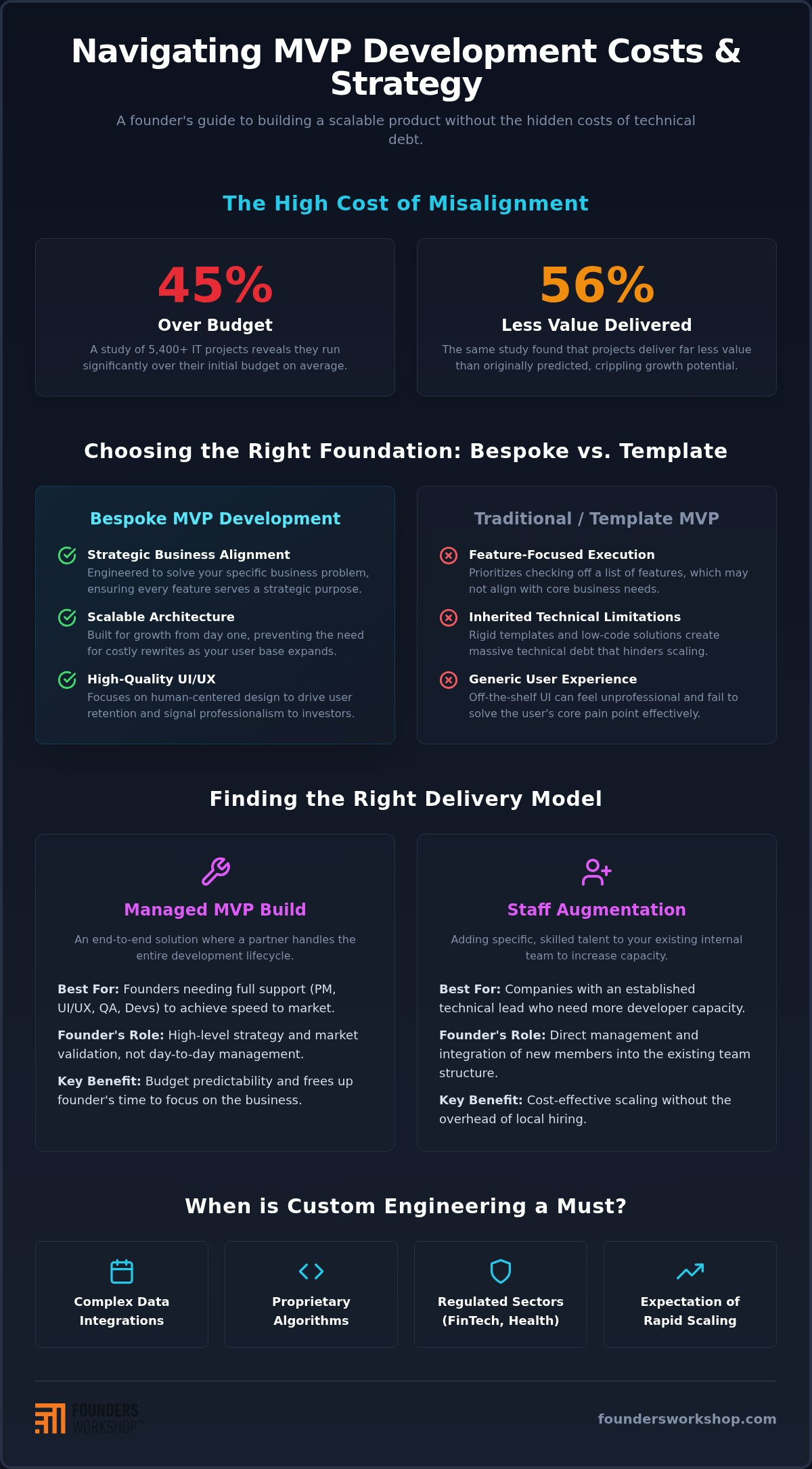
A study of over 5,400 IT projects found that they run an average of 45% over budget while delivering 56% less value than predicted. For a founder, these numbers aren’t just statistics. They represent the difference between a successful market entry and a costly, stalled launch. You likely already know that calculating the mvp development cost involves much more than just the initial invoice. It’s really about the friction that occurs when technical teams and business goals aren’t perfectly aligned. You need a product that works today without requiring a total rewrite the moment you start to scale.
This guide provides a strategic framework to help you navigate these complexities by aligning technical execution with your business growth. We’ll show you how to move beyond “cheap” development models that often hide massive technical debt and instead build a scalable architecture with a predictable budget. You’ll learn how to identify a technical partner who treats your vision as their own, ensuring your launch-ready product serves as a stable foundation for everything that comes next. We’ll explore how to bridge the gap between initial code and a long-term, sustainable business asset.
Key Takeaways
- Learn why bespoke development beats off-the-shelf templates by building a scalable architecture that evolves with your business goals.
- Compare managed project teams and nearshore staff augmentation to find the right balance of control and cost-effective scaling for your roadmap.
- Understand the variables that drive mvp development cost, from technical complexity to integrations, so you can plan a predictable budget.
- Discover how to select an AI-ready tech stack that prevents expensive technical debt and supports long-term growth.
- Identify the criteria for choosing a technical partner who bridges the gap between software execution and executive strategy.
What Are Bespoke MVP Development Services?
Bespoke MVP development is the process of building custom software specifically engineered to validate your core business hypotheses with real users. While many founders start by asking What is a Minimum Viable Product?, the answer for a serious business leader involves more than just a functional prototype. It’s about creating a stable, scalable foundation that aligns technical execution with your long-term growth strategy. Unlike generic templates, bespoke services ensure every line of code serves a strategic purpose. This focused approach helps you manage your initial mvp development cost by avoiding the expensive rework that inevitably follows “cheap” low-code prototypes or rigid off-the-shelf solutions.
Strategic alignment is the bridge between a founder’s vision and technical reality. Many projects fail because developers build exactly what they were told to build, rather than what the business actually needs to succeed. A bespoke approach uses human-centered design to ensure the product solves a real pain point for your target audience. When you prioritize how a user interacts with your core value proposition, you create a product that users actually value. This isn’t just about aesthetics; it’s about business utility and ensuring your technical roadmap supports your commercial objectives from the very first commit.
Bespoke vs. Traditional MVP Development
When Your Startup Needs Custom Engineering
Not every project requires a custom build from day one, but certain scenarios make it mandatory. If your product handles complex data integrations, proprietary algorithms, or operates in highly regulated sectors like healthcare and finance, custom engineering is non-negotiable. It provides the security, compliance, and precision that generic tools lack. Additionally, if you expect rapid scaling or high user concurrency, starting with a bespoke architecture prevents the technical friction that can stall a successful launch. With over 30 years of experience navigating these technical shifts, we’ve seen that early investment in custom engineering is often the most cost-effective path to a long-term market presence.
Service Models: Managed Projects vs. Staff Augmentation
Choosing the right delivery model is just as critical as the code itself. This decision directly influences your mvp development cost and determines how much daily oversight you’ll need to provide to the team. Most founders find themselves choosing between a managed project, where a partner handles the entire lifecycle, and staff augmentation, where you add specific talent to an existing internal team. Each model has distinct advantages depending on your current technical maturity and the speed at which you need to move.
A managed project model typically operates under a time-and-materials contract with a budget cap, providing the flexibility to adapt to user feedback without the rigidity of a fixed-fee agreement. Staff augmentation, on the other hand, is about scaling your capacity. It’s an ideal choice if you already have a technical lead but need more “hands on keyboard” to meet a deadline. At Founders Workshop, we often utilize nearshore staff augmentation to help businesses bridge these talent gaps with timezone-aligned developers who function as a seamless extension of your company.
The Managed MVP Build: Speed to Market
For founders who need an end-to-end solution, the managed build is usually the most efficient path. You aren’t just hiring developers; you’re gaining access to project managers, UI/UX designers, and QA engineers who work in sync. This model removes the burden of day-to-day management from your shoulders, allowing you to focus on high-level strategy and market validation. Because the partner is responsible for the final delivery, this approach often provides more budget predictability for early-stage startups that can’t afford scope creep.
Staff Augmentation: Scaling Your Internal Team
If you’ve already established a core engineering team, staff augmentation allows you to scale without the overhead of local US hiring. By integrating specialized developers from Latin America, you gain the benefits of timezone alignment and cultural fit that traditional offshore models lack. This approach is often more cost-effective than hiring full-time local employees, yet it offers much higher quality and accountability than a freelance marketplace. It’s a pragmatic way to accelerate your roadmap while maintaining full control over your technical standards and internal processes.
Many successful founders eventually adopt a hybrid approach. They start with a managed team to get the product to market quickly, then transition to a staff augmentation model to handle ongoing maintenance and incremental feature growth. This strategy ensures that your mvp development cost stays aligned with your revenue or funding stages, providing a sustainable path from initial launch to long-term market leadership.
The Anatomy of a High-Performance Bespoke MVP
Building a high-performance MVP requires a technical architecture designed for longevity. Selecting a cloud-native, AI-ready stack ensures that your initial mvp development cost translates into a sustainable asset rather than disposable code. This foundation allows you to incorporate predictive analytics or automation as your user base grows, creating a clear competitive advantage in a crowded market. When the underlying structure is sound, you avoid the technical friction that often stalls growth during the transition from pilot to full-scale operation.
User-centric UI/UX is equally vital. You only get one chance to make a first impression on your early adopters. If the interface is clunky or the workflow is confusing, users will churn before they ever discover your core value. This isn’t just about visual polish. It’s about reducing friction at every touchpoint. In sectors like healthcare or finance, security and compliance shouldn’t be treated as an afterthought. Integrating HIPAA or SOC2 standards from the first line of code protects your company from liability and builds the trust necessary to secure enterprise-level partnerships.
Strategic Product Roadmapping
Scope creep is the primary driver of budget overruns. By identifying “must-have” versus “nice-to-have” features, you focus resources on the core value proposition that validates your business model. Using wireframes as visual blueprints allows stakeholders to align on the user journey before any coding begins. This visual clarity prevents expensive mid-project pivots. Learn how to build an MVP the right way by prioritizing these foundational elements and maintaining a disciplined approach to feature selection.
Building for Scalability and Modernization
Technical debt is a silent killer for growing startups. Investing in clean code and thorough documentation early makes future legacy application modernization much simpler. It’s much easier to scale a product when the original engineers followed industry best practices. Additionally, your MVP shouldn’t exist in a vacuum. Robust system integrations allow your product to function within a cohesive tech ecosystem. This connectivity ensures that your data flows seamlessly across platforms, providing the executive-level insights you need to make informed business decisions as you scale.
Budgeting for Bespoke MVP Development
The mvp development cost is primarily determined by three variables: technical complexity, platform count, and the depth of third-party integrations. Building a single-platform web application with standard user flows is a different financial undertaking than launching a cross-platform mobile app that requires real-time data synchronization. While it’s tempting to focus solely on the initial invoice, seasoned founders prioritize the total cost of ownership. A bespoke build involves higher-quality early engineering, which significantly reduces long-term maintenance expenses and prevents the need for a total code rewrite as you scale.
Many organizations fall into the trap of “cheap” offshore development, only to encounter hidden costs like massive communication gaps and frustrating timezone lags. These frictions often lead to missed deadlines and poor code quality that requires expensive remediation later. Nearshore staff augmentation has emerged as a superior alternative for US companies because it provides a high cost-to-quality ratio while maintaining real-time collaboration. This model allows you to leverage expert talent in Latin America without sacrificing the cultural and temporal alignment necessary for agile development. Founders who want a structured approach to vendor selection and contract negotiation will find our guide on outsourcing MVP development an essential resource for navigating these decisions with confidence.
Understanding the Pricing Models
Pricing typically follows one of two paths depending on the project’s definition. Fixed-fee contracts work best for well-defined MVP scopes where the requirements are unlikely to shift during the build. For evolving products or ongoing needs, monthly retainer fees for dedicated nearshore developers offer more flexibility and consistent velocity. Founders Workshop provides transparent pricing for custom builds to ensure that your budget remains predictable from the first day of discovery to the final deployment. This transparency helps you manage the mvp development cost without the fear of unexpected overruns.
Estimating Your Development Timeline
A realistic timeline is essential for planning your market entry and managing stakeholder expectations. Most bespoke projects move through three distinct phases: a Discovery phase (2-4 weeks) to define requirements, a Design phase (4-6 weeks) for UI/UX, and a Development phase that typically spans 3-6 months. You can often accelerate your launch by utilizing agile methodologies and feature flags, which allow you to release core functionality to a subset of users while continuing to build out secondary features in the background.
If you’re ready to define your roadmap and secure a reliable technical partner, explore our strategic MVP development guide for scalable software to see how we align engineering with business growth. We help you navigate these budgeting decisions with the clarity that only 30+ years of industry experience can provide. To get started with a strategic consultation, contact Founders Workshop today and let’s discuss your vision.
Choosing the Right Technical Partner for Your Vision
For non-technical founders, the selection process is often the most daunting part of managing the mvp development cost. You need a partner who possesses over 30 years of executive experience to guide you through these high-stakes decisions. This isn’t just about technical proficiency; it’s about business alignment. A veteran partner understands that software is a tool for growth, not an end in itself. When you evaluate a potential agency, look past the visual polish of their portfolio. Instead, ask about the tangible business impact their previous builds achieved and how they managed the mvp development cost for those clients. You’re looking for a track record of solving technical friction, not just a collection of pretty interfaces.
In an industry frequently distracted by the latest technical novelty, human-centered solutions remain the most reliable path to sustainability. Your technical partner should prioritize how your product solves real-world problems rather than just implementing the newest frameworks for their own sake. Founders Workshop focuses on removing technical hurdles so you can concentrate on your core business objectives. For B2C leaders, working with a coach from Founder Freedom can provide the additional executive perspective needed to sharpen those objectives. We align every technical decision with your strategic vision. This ensures that the architecture we build today can support the company you plan to become tomorrow. It’s a pragmatic, disciplined approach to innovation that prioritizes human results over technical vanity.
Founders Workshop: Beyond Just Code
We believe in fostering long-term business sustainability rather than delivering one-off vendor projects. Our Latin American nearshore talent network provides the high-quality engineering you need with the timezone alignment that makes collaboration effortless. This relationship doesn’t end at the MVP launch. We specialize in transitioning our clients from the initial build into long-term staff augmentation support. This provides you with a consistent team that understands your codebase as you move into the scaling phase. It’s a commitment to your growth that mirrors a true business partnership.
Next Steps: From Idea to Execution
Preparing for your initial consultation requires more than just a feature list. Come prepared to discuss your market hypotheses and your long-term commercial goals. A value-driven AI strategy session can also help modernize your vision by identifying where automation or predictive analytics can provide the most leverage. These sessions help bridge the gap between abstract ideas and technical execution. Taking these steps ensures that your development partner can provide an accurate estimate and a robust roadmap. To begin this process, schedule a strategy session with Founders Workshop and take the first step toward a successful, scalable launch.
Building a Foundation for Sustainable Growth
Success in the early stages of product development depends on more than just code; it requires a deep alignment between your technical execution and your business strategy. By choosing a bespoke approach, you avoid the pitfalls of technical debt and ensure your architecture can scale as your user base expands. Understanding the true mvp development cost involves looking past the initial invoice to the long-term value of a product that’s built for sustainability. Whether you utilize a managed team or nearshore staff augmentation, the goal is to remove technical friction and focus on market validation. Founders who want to go deeper on this topic will find our founder’s guide to scalable MVP development in Phoenix and beyond an essential resource for planning a high-impact launch.
Founders Workshop leverages over 30 years of executive leadership experience to help you bridge the gap between vision and reality. We specialize in high-growth startup MVPs and legacy modernization, offering you access to the top 3% of nearshore Latin American tech talent. This partnership ensures that your product is a robust business asset designed for longevity rather than a one-off technical experiment. Ready to launch your vision? Schedule a Strategy Session with Founders Workshop. We’re here to help you navigate the path from initial idea to a scalable market presence.
Frequently Asked Questions
What is the difference between a bespoke MVP and a prototype?
A prototype is a visual representation or a non-functional mockup used for design validation, whereas a bespoke MVP is a fully engineered software product with a stable backend. While a prototype helps you visualize an idea, a bespoke MVP allows you to process real data and handle actual user transactions. This distinction is vital for founders who need to prove their business model to investors with functional software rather than just clickable slides.
How much do bespoke MVP development services typically cost?
The total mvp development cost varies significantly based on technical complexity, the number of platforms, and the depth of required integrations. Industry data suggests that a custom build involves a strategic discovery phase and high-quality engineering to prevent future technical debt. While exact figures depend on your specific requirements, focusing on a scalable architecture early on is more cost-effective than choosing a “cheap” model that requires a total rewrite after launch.
Why is nearshore development better than offshore for US startups?
Nearshore development offers real-time collaboration through timezone alignment and closer cultural proximity, which is often missing in traditional offshore models. For a US-based startup, having developers in Latin America means your team works the same hours as your internal stakeholders. This synchronization eliminates the 12-hour communication lag that frequently causes project delays and technical misunderstandings, allowing for a much more agile and responsive development process.
How long does it take to build a bespoke MVP?
A typical timeline for a bespoke MVP ranges from three to six months from the initial discovery phase to the final launch. This period includes several weeks of strategic design and prototyping to ensure the user experience is intuitive and goal-oriented. By following a disciplined roadmap, you can launch a polished version of your core value proposition while maintaining the flexibility to iterate based on actual user feedback collected during the pilot phase.
Can bespoke development services help with legacy software modernization?
Bespoke services are highly effective for modernizing legacy systems by incrementally replacing outdated components with modern, cloud-native architectures. This process allows you to improve system performance and security without disrupting your existing operations. By integrating new features into an older ecosystem, you can extend the life of your current assets while preparing your business for future scalability and more advanced technical integrations like AI or predictive analytics.
What should a non-technical founder look for in a development partner?
Non-technical founders should prioritize partners with extensive executive leadership experience who can translate business goals into technical requirements. Look for an agency that emphasizes human-centered design and has a proven track record of delivering measurable business outcomes. It’s essential to find a partner who acts as a strategic advisor, helping you navigate the mvp development cost and technical trade-offs, rather than just a vendor who follows instructions without providing strategic input.
Do I own the source code after the MVP is built?
You should always maintain full ownership of the source code and all intellectual property created during the development process. A professional development partner will provide you with all repository access and documentation upon completion of the project or as part of the ongoing engagement. This ownership is crucial for your company’s valuation and ensures you have the freedom to scale, modify, or transition the software as your business grows.
How does Founders Workshop handle AI integration in new MVPs?
Founders Workshop integrates AI by first conducting a strategic session to identify where automation or predictive analytics can provide the highest commercial leverage. We focus on practical applications that enhance the user experience or streamline operations rather than adding complexity for its own sake. Our approach ensures that any AI features are built on a secure, scalable foundation that aligns with your broader business objectives and long-term technical roadmap.