
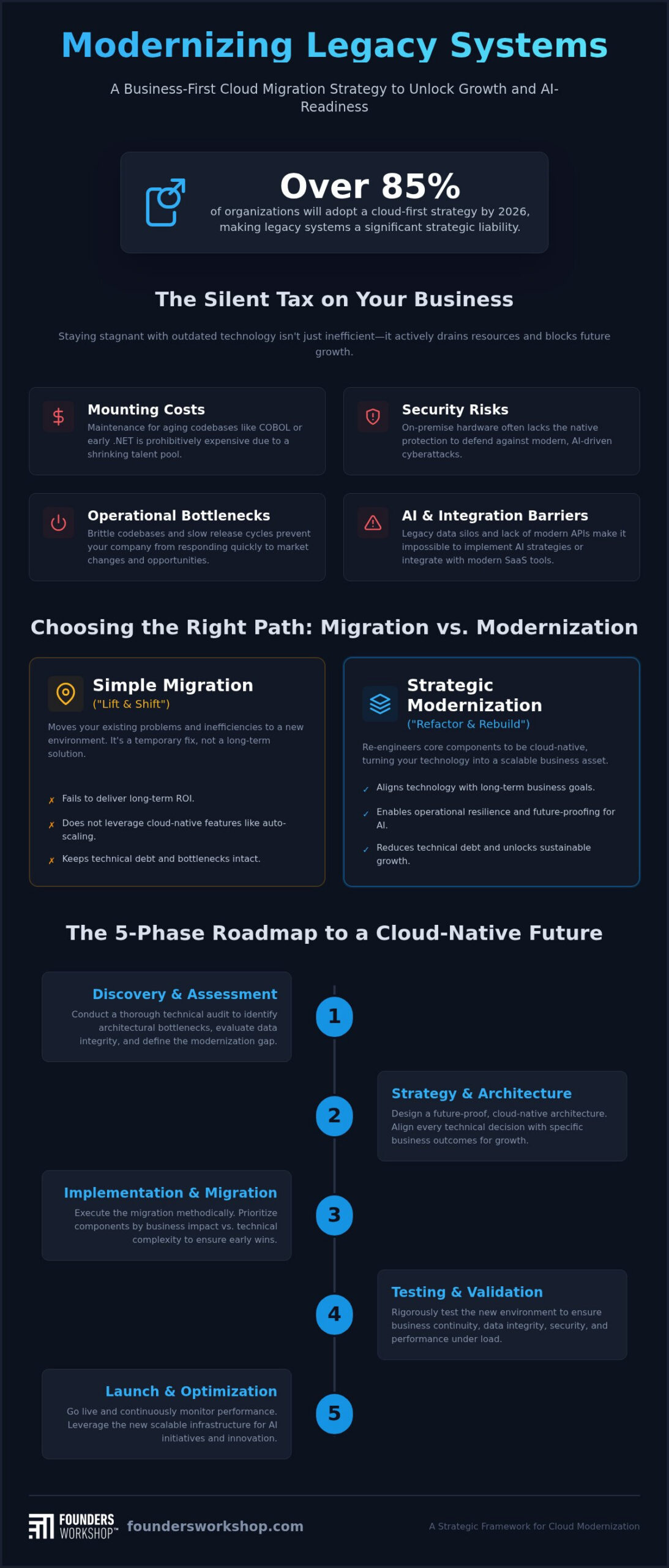
With over 85% of organizations adopting a cloud-first strategy by 2026, your legacy system is no longer just “old software”; it’s a strategic liability that prevents you from leveraging the AI-driven tools your competitors are already using. You likely feel the weight of mounting maintenance costs and the scarcity of developers who still understand your aging codebase. It’s a common frustration for leaders who want to scale but find themselves anchored by brittle technology that simply cannot integrate with modern SaaS ecosystems.
We understand that a total overhaul feels risky, but staying stagnant is even riskier. This guide provides a clear cloud migration strategy for legacy systems that prioritizes business continuity over technical novelty. You’ll learn how to replace outdated infrastructure with modern, scalable cloud software while keeping your daily operations running smoothly. We will explore a methodical framework to reduce technical debt, bridge the talent gap with nearshore expertise, and finally align your technology execution with your long-term growth vision.
Key Takeaways
- Learn why shifting from a purely technical mindset to a business-first approach is essential for a successful transition to the cloud.
- Discover how to build a robust cloud migration strategy for legacy systems that eliminates technical debt without stalling your daily operations.
- Master a five-phase roadmap designed to take you from initial discovery and architecture design to a fully realized cloud-native environment.
- Identify the “migration traps” that derail most projects, including how to manage feature creep and secure long-term executive buy-in.
- Evaluate the most effective ways to assemble your modernization team by balancing internal talent with specialized nearshore staff augmentation.
Beyond the 6 Rs: Why Your Cloud Migration Strategy Must Be Business-First
A successful cloud migration strategy for legacy systems is not a technical checklist; it is a strategic business evolution. Many organizations treat the transition to cloud computing as a back-office infrastructure task, but veteran founders recognize it as a fundamental product relaunch. Legacy Modernization is the process of transforming aging IT into a scalable business asset. When you view this transition through the lens of product engineering rather than just IT maintenance, you shift the focus from “moving servers” to “enabling growth.”
Technical debt acts as a silent tax on every new feature or business pivot you attempt. Every hour your team spends patching a brittle codebase is an hour they aren’t spending on market-facing innovation. This friction eventually becomes a bottleneck that prevents your company from responding to competitive threats or new opportunities. A business-first strategy identifies these bottlenecks early, ensuring that the migration actually solves the underlying structural issues that hold your operations back.
The High Cost of Maintaining Legacy Systems in 2026
The financial burden of aging technology has reached a tipping point. In 2026, the talent gap for developers who understand COBOL or early .NET versions has made maintenance prohibitively expensive. You aren’t just paying for the hardware; you’re paying a premium for specialized knowledge that is increasingly scarce. Beyond payroll, the opportunity cost of slow release cycles and frequent downtime can be devastating. On-premise legacy hardware also presents a significant security risk, as many of these systems lack the native protection required to stop modern, AI-driven cyberattacks.
Modernization vs. Simple Migration
Many executives are tempted by “Lift and Shift” (rehosting) because it seems fast and cheap. However, rehosting often fails to deliver long-term ROI because it simply moves your existing problems to a new environment. You end up paying cloud prices for inefficient, non-scalable software. Refactoring, while more intensive, allows you to rebuild core components to be cloud-native. This path ensures your software can actually take advantage of auto-scaling and modern integrations. By aligning these technical choices with your long-term strategic vision, you turn your cloud migration strategy for legacy systems into a catalyst for sustainable business expansion.
- Strategic Alignment: Ensure every technical change supports a specific business outcome.
- Operational Resilience: Move away from fragile on-premise setups to redundant cloud environments.
- Future-Proofing: Build an infrastructure that is ready for AI strategy implementation and modern SaaS integrations.
Assessing the Modernization Gap: Technical Debt vs. Strategic Scalability
Before moving a single line of code, you must understand the gap between your current technical state and your strategic goals. A thorough technical audit goes beyond listing servers; it identifies the architectural bottlenecks that slow down your entire team. You need to evaluate data integrity and portability to ensure that your business-critical information survives the move without corruption or loss. This phase of Legacy System Modernization is where you determine which parts of your stack still provide value and which are merely taking up space.
Your legacy system often dictates your customer experience (UX). If your front-end feels clunky or your back-end takes seconds to process a request, you’re losing customers to more agile competitors. Prioritize your migration components by weighing business impact against technical complexity. Focus first on the areas that offer the highest value to your users while presenting manageable risks. This balanced approach ensures your cloud migration strategy for legacy systems delivers visible wins early in the process without overwhelming your resources.
The AI Readiness Audit
Custom AI models require clean, accessible data. Legacy systems often house data in isolated silos that modern predictive analytics tools cannot reach. Without modern APIs to feed these automation tools, your data remains a dormant asset. Upgrading your infrastructure is a prerequisite for any meaningful AI Strategy and Development initiative. If you can’t access your own data in real-time, you’ll struggle to stay competitive in an increasingly automated market. Modernization clears the path for these advanced capabilities by creating a unified data layer.
Calculating the ROI of Replacing Legacy Systems
Comparing the upfront migration investment against three years of maintenance costs often reveals a clear financial winner. You must account for hidden savings like reduced server overhead, faster time-to-market for new features, and lower developer turnover. Using a human-centered lens, we also measure productivity gains. When your team stops fighting the tools and starts using them, the resulting efficiency often outweighs the initial project costs. For leaders who want to ensure these gains are realized, exploring specialized Internal Software Development can help bridge the gap between legacy limitations and modern potential.
- Data Integrity: Audit your databases for consistency before attempting migration.
- UX Impact: Identify specific legacy features that frustrate your end-users.
- Resource Allocation: Map out the technical complexity of each system component to avoid scope creep.
How to Replace Legacy System with Modern Software: A 5-Phase Roadmap
Moving from the assessment phase to actual execution requires a disciplined, structured framework. A successful cloud migration strategy for legacy systems is built on a 5-phase roadmap that prioritizes business continuity and long-term scalability. This roadmap ensures that you aren’t just moving old problems to a new environment, but rather rebuilding your system to serve as a growth engine. It’s a methodical transition that replaces brittle code with a resilient, cloud-native architecture.
- Phase 1: Discovery and Strategic Alignment. We define what success looks like for your specific business. This involves setting clear KPIs, such as reducing system latency or lowering maintenance overhead, to ensure the project remains focused on measurable outcomes.
- Phase 2: Architecture Design. This is where we create the cloud-native blueprint. We evaluate whether a microservices approach or a modernized monolith better suits your operational needs and long-term vision.
- Phase 3: Incremental Development. Using MVP principles, we migrate high-value features first. This allows your team to see immediate value and gather user feedback while the rest of the migration continues in the background.
- Phase 4: Testing and Data Migration. We focus on ensuring zero data loss and maintaining high performance. Rigorous validation ensures that your business-critical data remains accurate and accessible throughout the move.
- Phase 5: Optimization and Scaling. Once in the cloud, we focus on continuous improvement. This includes fine-tuning resource allocation and leveraging cloud-native tools to ensure your system scales effortlessly as your business grows.
Phase 1 and 2: Setting the Foundation
Building the right migration team is your first step toward success. This group must include both technical architects and business stakeholders to ensure that technical decisions align with operational realities. When choosing between providers like AWS, Azure, or GCP, consider your industry-specific requirements. For instance, projects involving Healthcare Tech Development often require specific compliance and security configurations that certain providers handle better than others. API-First Architecture is a design approach that treats the application programming interface as the primary product, ensuring every component can communicate seamlessly and adapt to future integrations.
Phase 3 and 4: Execution and Risk Mitigation
We strongly advocate for an agile migration approach rather than a “Big Bang” switchover. By moving features in stages, you reduce the risk of total system failure and allow for easier troubleshooting. Automated testing is a critical component of this phase; it prevents regressions in your core business logic and ensures that new updates don’t break existing functionality. To provide an ultimate safety net, we often employ a parallel run strategy. This involves running the legacy system and the new cloud system simultaneously to verify that the outputs match exactly before you decommission the old hardware.
Avoiding the Migration Trap: Common Pitfalls and Security Risks
The greatest threat to your modernization project isn’t a technical bug; it’s a lack of sustained executive commitment. If business priorities shift mid-stream, your cloud migration strategy for legacy systems will likely stall, leaving you with two half-finished environments to maintain. To support leaders in managing these complex organizational shifts, you can learn more about Simon Lead LLC and their executive coaching services. You must also guard against the “feature creep” trap. It’s tempting to add a dozen new capabilities while you’re under the hood, but trying to reinvent your business model while moving the plumbing often leads to missed deadlines and bloated budgets. Focus on the migration first, then innovate on top of your new, stable foundation.
Data cleanliness is another non-negotiable factor. Garbage in, garbage out. If you move disorganized or redundant records to a modern cloud database, you’re simply paying a premium to host digital clutter. You need to scrub your datasets before the transition to ensure your new system remains lean and performant. Maintaining compliance is equally critical. As of January 1, 2026, updated CCPA regulations require comprehensive privacy risk assessments for high-risk data processing. Failing to account for these legal requirements during your move can lead to significant penalties and loss of customer trust.
Security and Compliance in the Cloud
Modern cloud security requires a shift from traditional perimeter defenses to a Zero Trust architecture. In this model, no user or system is trusted by default, regardless of whether they’re inside or outside the network. You must also understand the shared responsibility model used by providers like AWS and Azure. While they secure the “cloud,” you’re responsible for securing your data “in” the cloud. During the ETL (Extract, Transform, Load) process, use a strict checklist: encrypt all data in transit, mask sensitive identifiers, and maintain detailed audit logs to satisfy CMMC or HIPAA requirements. If you’re concerned about maintaining security during a complex transition, our team can help you navigate System Integrations without compromising your data integrity.
The Human Element: Managing Change Resistance
Your team’s mindset is just as important as your tech stack. Employees who have used the same green-screen terminal for a decade may resist a new cloud interface. To mitigate this, invest in comprehensive training and prioritize UI/UX design. A system that’s intuitive and easy to use will naturally reduce friction and speed up adoption. At Founders Workshop, we use human-centered design to bridge the gap between old workflows and modern capabilities. By involving your staff early in the process, you turn potential skeptics into champions for the new system. This approach ensures that the transition feels like an upgrade to their daily lives rather than an obstacle to overcome.
- Executive Buy-in: Secure a long-term commitment to prevent project abandonment.
- Data Scrubbing: Clean your data before migration to optimize cloud performance.
- Regulatory Alignment: Ensure your new architecture meets 2026 privacy and security standards.
- User Experience: Prioritize intuitive design to minimize employee resistance.
Executing the Vision: Building the Right Team for Cloud Modernization
Executing a cloud migration strategy for legacy systems is a talent challenge as much as a technical one. To succeed, you need a precise blend of specialized roles: Cloud Architects to design the new environment, DevOps Engineers using specialized automation like Apptimized for software packaging and deployment pipelines, and Legacy Stack Experts who can untangle decades-old code without breaking core logic. Hiring this full spectrum of talent internally for a one-time migration project is often impractical. It’s difficult to find, vet, and onboard these specialists quickly, which is why many mid-market leaders look toward strategic partnerships to bridge the expertise gap.
While internal hiring offers deep institutional knowledge, external agency partnerships provide the “been there, done that” experience necessary to avoid expensive pitfalls. Nearshore staff augmentation has emerged as the “sweet spot” for US-based startups and mid-market firms seeking this balance. By tapping into Latin American talent, you gain access to high-quality developers who work in your own time zone. This proximity eliminates the communication delays found in offshore models, allowing for the real-time collaboration that complex architectural decisions demand. Latin American developers also offer a strong cultural fit and cost-efficiency, making them an ideal extension of your domestic team. Once your migration is complete, investing in robust system integration services ensures your newly modernized cloud environment connects seamlessly with the rest of your tech ecosystem.
Why Nearshore Teams Outperform Offshore for Modernization
Modernizing a legacy system isn’t a task you can simply “throw over the wall” to a team in a different hemisphere. The process requires constant feedback loops and tight alignment between technical execution and business goals. Founders Workshop connects businesses with elite tech talent in Latin America, focusing on professionals who understand both legacy limitations and modern cloud capabilities. Our Nearshore Staff Augmentation model provides dedicated personnel who integrate directly with your workflow. This ensures that the knowledge gained during the migration stays within your organization, providing a foundation for long-term system maintenance and scaling.
Partnering for Success: The Founders Workshop Approach
We position ourselves as the seasoned executive guide for your migration journey. With 30+ years of leadership experience, we’ve navigated multiple eras of technology and understand that tools are always secondary to business outcomes. Our approach focuses on replacing legacy systems with modern software while removing the technical friction that limits your growth. We don’t just provide code; we provide a partnership rooted in accountability and human-centered design. Ready to eliminate technical debt? Schedule a Legacy Modernization Consultation.
- Cloud Architects: Essential for building a resilient, scalable cloud blueprint.
- DevOps Engineers: Critical for continuous integration and rapid deployment.
- Legacy Experts: Necessary for untangling and documenting old system logic.
- Timezone Alignment: Nearshore teams ensure real-time collaboration and faster problem-solving.
Scaling Beyond Legacy Limitations in 2026
Modernizing your infrastructure is no longer a choice; it’s a prerequisite for staying competitive in an AI-driven market. By moving beyond simple rehosting and embracing a business-first roadmap, you transform your aging systems from cost centers into scalable assets. Success requires more than just new tools. It demands a disciplined approach to security, a focus on human-centered design, and a team that can bridge the gap between old and new stacks.
Implementing a comprehensive cloud migration strategy for legacy systems is a complex journey, but you don’t have to navigate it alone. Founders Workshop brings 30+ years of strategic tech leadership and specialized expertise in building AI-ready cloud architectures. Our high-quality Latin American nearshore talent ensures your project stays on track with real-time collaboration and perfect timezone alignment.
It’s time to stop managing technical debt and start fueling your business growth. For a broader perspective on how scaling business operations with software fits into your overall executive strategy, explore our 2026 guide before you begin your modernization journey. Schedule Your Legacy Modernization Roadmap Session today. We’re ready to help you build a future-proof foundation that empowers your team and drives long-term success.
Frequently Asked Questions
What is the most effective cloud migration strategy for legacy systems?
The most effective cloud migration strategy for legacy systems is a business-first approach that prioritizes refactoring or replatforming over simple rehosting. While rehosting is faster, it rarely addresses the underlying technical debt that slows your business down. By aligning your technical choices with specific growth goals, you ensure the migration delivers long-term ROI and enables the cloud-native scalability your organization needs to remain competitive.
How long does it typically take to replace a legacy system with modern software?
Most mid-market legacy modernization projects take between 6 and 18 months to complete. The exact timeline depends on the complexity of your existing codebase and the migration path you choose. Using agile methodologies and MVP principles allows you to migrate high-value features in increments, which provides measurable business value long before the entire system is fully transitioned to the cloud.
What are the biggest risks when migrating legacy data to the cloud?
Data corruption, security vulnerabilities, and “feature creep” are the primary risks you will face. Legacy data often lacks the clean structure required by modern cloud databases, making the extraction and transformation process a critical failure point. You must also transition from perimeter-based security to a Zero Trust model to ensure your data remains protected while both the old and new systems are active.
Is it better to refactor or rehost a legacy application?
Refactoring is generally superior for long-term sustainability, although rehosting is faster for immediate hardware retirement. Rehosting often results in higher cloud costs because inefficient software cannot leverage cloud-native features like auto-scaling. Refactoring allows you to rebuild core components as modern services, which is a necessary step if you plan to implement a custom AI strategy or integrate with modern SaaS tools.
How much does a cloud migration project cost for a mid-sized business?
Typical costs for mid-market migrations involving 100 to 500 servers range from $100,000 to over $500,000 based on industry data from June 2026. For smaller workloads of under 100 servers, you can expect costs between $20,000 and $100,000. These figures represent the one-time project investment, which is separate from the ongoing monthly cloud fees that vary based on your specific resource consumption and chosen provider.
How do I know if my legacy system is ready for AI integration?
Your system is ready for AI integration once your data is accessible through modern APIs and stored in a unified, clean data layer. Most legacy stacks house data in isolated silos that predictive analytics tools cannot effectively reach. A technical audit will determine if your current architecture can support the real-time data flow required for AI or if modernization is a required first step.
What is the difference between nearshore and offshore development for migration?
Nearshore development offers real-time collaboration within US time zones, whereas offshore models often deal with 10 to 12-hour communication delays. For complex architectural shifts, the ability to solve problems synchronously is vital. Nearshore teams in Latin America provide the cultural alignment and similar working hours needed to ensure your technical execution stays perfectly synchronized with your business strategy.
Can we migrate our legacy system without any downtime?
Yes, you can achieve near-zero downtime by using a “Parallel Run” or “Blue-Green” deployment strategy. This involves running your legacy system and the new cloud environment simultaneously while gradually shifting user traffic to the new software. This methodical approach ensures your business operations remain uninterrupted while you verify that the new system’s performance and output match your requirements exactly.