Introduction
Unplanned equipment failures are expensive — far more than most manufacturers budget for. According to Siemens' 2024 True Cost of Downtime report, unplanned downtime costs the world's 500 largest companies $1.4 trillion per year — roughly 11% of revenues. In automotive alone, one hour of downtime now costs $2.3 million, more than double the 2019 figure.
Predictive maintenance (PdM) promised to change this. It has helped. But static ML models that surface alerts for human engineers to action have a hard ceiling: they drift, they flood teams with false positives, and they still depend on people to act on every prediction.
Agentic AI is the next step. Unlike traditional PdM, it doesn't just flag a problem and wait — it perceives conditions, weighs context, and executes maintenance actions without waiting for a human to intervene.
What follows is a practical breakdown: the architecture behind agentic AI, how it fits into real maintenance workflows, and what it takes to implement it without disrupting operations.
Key Takeaways
- Agentic AI perceives real-time data, reasons about production context, and autonomously executes maintenance responses — no step-by-step human instruction needed.
- Traditional PdM generates alerts; agentic AI generates actions: work orders, parts orders, technician assignments.
- A four-layer architecture (data ingestion → anomaly detection → contextual decision-making → autonomous execution) handles the full maintenance workflow end-to-end.
- Key benefits include fewer false alarms, reduced unplanned downtime, and proactive supply chain coordination.
- Clean data pipelines, explainability guardrails, human-in-the-loop escalation, and ERP/CMMS integration are all required before deployment.
Why Traditional Predictive Maintenance Falls Short
Conventional PdM follows a straightforward pattern: IoT sensors feed data into ML models, models forecast failures, and engineers receive alerts to act on. That's a genuine improvement over time-based maintenance schedules. But it still leaves significant gaps.
Static Models Don't Keep Up
ML models trained on historical failure patterns struggle when conditions change. New failure modes, shifting production environments, or unusual operating conditions can cause predictions to drift — a problem researchers call concept drift. A 2025 study published in ScienceDirect identifies evolving data as a core challenge in mechanical failure prediction. Staying accurate requires incremental learning and active drift detection built into the model.
The result? False positives pile up. A 2022 heavy-industry case study found that adaptive correction models reduced false alarms by 90.25% on average compared to stand-alone outlier detection methods — suggesting that unaided baseline PdM systems produce a lot of noise that erodes technician trust over time.
The Human Bottleneck
False positives aside, even accurate predictions don't resolve themselves. A human still has to:
- Interpret the alert and verify it isn't a false positive
- Check spare parts inventory
- Review the production schedule for a viable maintenance window
- Decide on priority relative to other open work orders
- Create the work order and assign a technician
Each step takes time and introduces inconsistency. Across dozens of machines in multiple facilities, that bottleneck compounds fast. McKinsey reports that 70% of manufacturers haven't scaled beyond IoT pilots — comprehensive sensor coverage generates more signals than human decision-making can absorb.
What Is Agentic AI and How Is It Different?
Gartner defines agentic AI as software that embeds autonomous, goal-driven behavior to complete tasks on a user's behalf. McKinsey frames it as systems built on foundation models that can act in the real world and execute multistep processes — not just respond to direct inputs.
In manufacturing, that distinction changes what operators can actually delegate to software.
Reactive vs. Goal-Oriented
A traditional AI model in manufacturing is reactive: give it sensor readings, get a failure probability score. It does one thing well, within narrow boundaries — and the operator still owns every decision that follows.
Agentic AI is goal-oriented. An operator can express a high-level intent: "keep all CNC spindles running through the end-of-month production push." The system then decomposes that into specific conditions, targets, and actions, then executes without waiting for command-by-command direction. When conditions shift mid-shift, the system adjusts. When a repair prevents a failure, that outcome feeds directly back into future decisions.
Multi-Agent Architecture
Most production-ready implementations use a multi-agent system: specialized sub-agents that each handle a domain, coordinated by an orchestration layer.
| Agent Type | Responsibility |
|---|---|
| Data Agent | Continuous sensor ingestion from IoT devices, PLCs, SCADA |
| Anomaly Detection Agent | Time-series analysis, RUL estimation |
| Decision Agent | Context evaluation: inventory, schedule, cost of failure |
| Execution Agent | Work order generation, parts ordering, technician assignment |
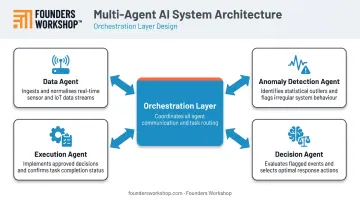
This modularity makes the system more accurate than any single model, since each agent is optimized for its domain and the orchestration layer coordinates their outputs into coherent actions.
Unlike static ML models that require manual retraining, agentic systems continuously learn from outcomes. A scheduled repair that prevents a failure isn't just a win — it's a data point that sharpens the next prediction automatically.
How Agentic AI Executes Predictive Maintenance: The Core Workflow
The four-layer architecture translates sensor signals into maintenance actions without requiring human intervention at each step.
Layer 1: Data Ingestion
Sensor agents continuously ingest real-time data from across the factory floor : vibration, temperature, pressure, and acoustic signals from IoT devices, alongside data from PLCs, SCADA systems, and historical CMMS maintenance logs. This raw data feeds every downstream decision.
Layer 2: Feature Processing and Anomaly Detection
Analytics agents process the raw stream using time-series transformations and contextual enrichment (shift data, ambient conditions, production mode). Deep learning models — time-series models like LSTMs estimate Remaining Useful Life (RUL) — detect anomalies and calculate how much operating life an asset has left before likely failure.
Layer 3: Contextual Decision-Making
This is where agentic AI diverges most sharply from conventional PdM. The decision agent doesn't just flag an anomaly. It:
- Checks current spare parts inventory
- Reviews the active production schedule for viable maintenance windows
- Evaluates technician availability
- Weighs the cost of early intervention against the cost of failure
Only after that full context evaluation does it determine the right course of action — and it does so in seconds, not hours.
Layer 4: Autonomous Action Execution
The execution layer integrates with ERP and CMMS platforms (SAP, IBM Maximo, and similar systems) to automatically generate work orders, trigger spare parts reordering, and assign technicians. Every action is logged with a full audit trail, and high-stakes decisions (like commanding a controlled equipment shutdown) route through a human-in-the-loop escalation path.
To see how all four layers work together, consider a real scenario.
A concrete example: A CNC machine spindle begins showing abnormal vibration. The anomaly detection agent flags it and queries historical failure data — similar patterns have preceded bearing failures within 72 hours. The decision agent confirms spare bearings are in stock, identifies that a high-priority production run ends Friday, and books the repair for Saturday morning. It pre-orders replacement stock and creates the work order automatically. The intervention happens before the failure does, and the production line never notices.
Key Benefits Manufacturers Are Seeing
Reduced Downtime and Smarter Scheduling
Moving from reactive and time-based maintenance to condition- and prediction-driven intervention means repairs happen when they should — neither premature nor overdue. According to Siemens' 2024 research, manufacturers implementing predictive maintenance programs have seen:
- 50% reduction in unplanned machine downtime
- 85% improvement in downtime forecasting accuracy
- 40% reduction in overall maintenance costs
- 55% increase in maintenance staff productivity
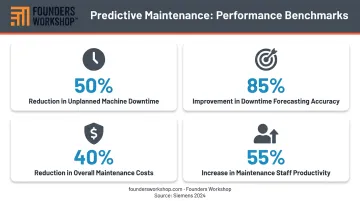
These are vendor-reported benchmarks and should be treated as directional rather than guaranteed, but the directional signal is consistent across multiple independent sources.
Fewer False Alarms
Agentic AI evaluates business context alongside sensor readings, rather than firing on raw threshold breaches alone. This significantly reduces false positives — and that has real operational consequences. When technicians get too many bad alerts, they start ignoring all of them, and the system loses its value entirely. Fewer false alarms means higher first-time fix rates and more credibility with the floor teams who actually use the system.
Scalability Across Plants and Assets
A federated multi-agent system can apply consistent decision logic across thousands of machines in multiple facilities simultaneously. Human-led maintenance programs can't match that. For manufacturers running distributed production networks or expanding operations, this scalability difference is significant — the same agent logic that governs one facility can govern ten without proportional headcount growth.
Proactive Supply Chain Coordination
Agentic AI can trigger spare-part reorders or supplier alerts before a component fails, aligning maintenance needs with procurement workflows. This eliminates emergency sourcing premiums and prevents schedule slippage caused by missing parts. As Deloitte has noted, predictive approaches allow manufacturers to keep fewer spares on hand while still meeting maintenance needs — reducing tied-up capital in inventory.
What It Takes to Implement Agentic AI for Predictive Maintenance
Start With Data Readiness
Data quality is the most critical prerequisite — and the most commonly underestimated. Sensor drift, gaps in historical maintenance logs, and inconsistent CMMS records will undermine model accuracy before the first agent is deployed. McKinsey recommends prioritizing assets that are operationally critical, have sufficient sensor coverage, and carry a history of failures or anomalies to train against.
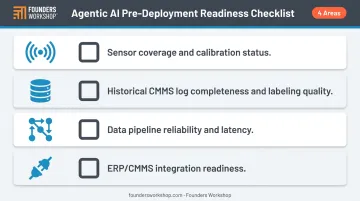
Before committing to an agentic build, manufacturers should audit:
- Sensor coverage and calibration status across target assets
- Historical CMMS log completeness and labeling quality
- Data pipeline reliability and latency characteristics
- Integration readiness of existing ERP/CMMS systems
Build In Guardrails From Day One
Agentic systems operating in production environments need governance mechanisms that aren't optional:
- Human-in-the-loop escalation for high-stakes decisions — shutting down a critical production line should require human approval, not autonomous action
- Explainable AI outputs that maintenance teams can audit and challenge, not just accept
- Secure OT/IT integration aligned with frameworks like NIST SP 800-82 and ISA/IEC 62443, which address the specific performance and safety requirements of operational technology environments
You Don't Have to Build It From Scratch
Most manufacturers, particularly mid-sized operators, don't have the in-house AI team to build a production-ready agentic maintenance system. Assembling one takes time and budget that most operations can't justify for a first deployment.
Working with a custom software development partner that specializes in AI-first applications is often the faster, more practical route. At Founders Workshop, we approach manufacturing engagements through a structured process: Discovery scopes the use case and data infrastructure, Definition maps the architecture and integrations, and Development delivers a working proof of concept before any facility-wide rollout. The ERP/CMMS integration layer, agent orchestration, and AI model development are handled end-to-end — and our nearshore model keeps project costs well below what an in-house build would require.
The recommended starting point: one high-value asset with good sensor coverage, a defined feedback loop, and a clear success metric. Prove the concept, then expand.
Frequently Asked Questions
Frequently Asked Questions
What is agentic AI in manufacturing?
Agentic AI in manufacturing refers to autonomous AI systems that process real-time machine data, interpret context, and act on it — scheduling maintenance, ordering parts, or halting equipment — without waiting for human input. Unlike traditional alert-and-notify tools, it closes the loop between prediction and response.
How does agentic AI contribute to predictive maintenance?
Rather than surfacing a failure prediction for a human to act on, agentic AI evaluates the full situation on its own. It weighs production schedules, inventory status, and intervention costs, then executes the optimal maintenance response without requiring a human decision at each step.
What are the 4 layers of agentic AI for predictive maintenance?
The four functional layers are: (1) data ingestion from sensors and operational systems, (2) feature processing and anomaly/RUL detection, (3) contextual reasoning and decision-making, and (4) autonomous action execution integrated with CMMS/ERP platforms.
How is agentic AI different from traditional AI in manufacturing?
Traditional AI models are reactive: they generate predictions that humans must interpret and act on. Agentic AI is proactive. It pursues goals, adapts to changing conditions, coordinates across specialized agents, and learns from outcomes over time without manual retraining.
What are the main implementation challenges?
The top challenges are poor data quality or inconsistent sensor coverage, the need for explainability and human-in-the-loop oversight for critical decisions, secure OT/IT integration, and connecting the agent layer to existing ERP and CMMS systems without disrupting production operations.
How do manufacturers get started?
Start with a data audit and sensor infrastructure review, then identify one high-value use case: a critical machine with solid sensor coverage and a documented failure history. Build a proof of concept with a defined feedback loop before expanding. A development partner experienced in AI-first systems can cut time-to-value and reduce build risk considerably.