Introduction
Conversational AI pricing spans an enormous range — from free tiers on entry-level chatbot tools to six-figure custom builds for regulated industries. The global conversational AI market is projected to reach $41.39 billion by 2030, growing at 23.7% annually. More vendors and more pricing models means more ways to miscalculate your budget.
The variables that drive cost — deployment type, conversation volume, voice vs. text, LLM model quality, and integration complexity — don't move independently. Change one, and the total bill can shift dramatically.
Gartner predicts over 40% of agentic AI projects will be canceled by end-2027 due to escalating costs and unclear ROI. That failure rate traces directly back to buyers who didn't model the full cost before committing.
To avoid that outcome, this guide breaks down actual cost tiers with verified pricing, explains what pushes prices up or down, compares the three main pricing models, and gives you a practical framework for building a defensible budget estimate.
Key Takeaways
- SaaS tools run $20–$150/user/month; enterprise or custom builds reach $150–$300+/user/month
- Voice AI runs 5.3× more than text — factor this in before choosing a voice-first channel
- Key price drivers: conversation volume, voice vs. text, LLM model tier, integration depth, compliance requirements
- Small teams on off-the-shelf SaaS with text chat and standard integrations pay the least
- Spend more when AI replaces measurable labor costs or drives direct revenue outcomes
How Much Does Conversational AI Cost?
Conversational AI has no fixed price tag. What you pay depends on how you deploy it, what features you need, how many conversations you're handling, and whether you're building from scratch or subscribing to a platform.
Tier 1: Entry-Level SaaS Tools
Entry-level platforms offer the fastest path to deployment with the lowest initial spend.
| Platform | Plan | Price | What's Included |
|---|---|---|---|
| Tidio | Starter | $24.17/month | 100 billable conversations, 10 seats, 50 Lyro AI sessions |
| Freshchat | Growth | $19/agent/month | 500 Freddy AI sessions included; add-ons billed separately |
| Manychat | Pro | $29/month | 2,500 active contacts, 3 users; AI add-on is $29/month extra |
Best for: Small businesses and startups testing AI-assisted support or lead capture at low volumes. The trade-off is that conversation limits are tight and AI features often cost extra once you exceed included sessions.
Tier 2: Mid-Range / API-Integrated Platforms
Mid-tier platforms combine a subscription base with usage-based billing — and this is where costs can stack up fast if you're not watching each line item.
- Intercom Fin: $0.99 per resolved outcome, plus seat plans from $29–$132/seat/month
- Amazon Lex: Pure usage-based — $0.00075/text request, $0.004/speech request, no minimums
- Google Conversational Agents: Flows chat at $0.007/count; Playbooks at $0.012/count; voice billed per second separately
LLM inference fees are typically not included in the base subscription. Budget them as a separate line.
Best for: Growing businesses handling moderate-to-high conversation volumes who need AI connected to existing tool stacks.
Tier 3: Enterprise / Custom-Built Conversational AI
Enterprise deployments involve either high-end SaaS configurations or fully custom builds. The two costs that matter most are setup and ongoing processing — both of which scale sharply for regulated industries like healthcare and fintech.
What enterprise builds typically include:
- Custom-trained or fine-tuned LLMs
- On-premise or private cloud deployment
- HIPAA/GDPR compliance configurations
- Dedicated infrastructure and support
- Full API access and custom workflow logic
Published quotes rarely tell the full story. These costs are frequently left out:
- LLM API usage fees
- Data migration and integration work
- WhatsApp/SMS channel charges
- Generative AI sessions above free-tier quotas
- Premium support tiers
Best for: Healthcare, fintech, and insurance organizations where off-the-shelf tools fall short on accuracy, compliance, or workflow complexity.
Key Factors That Drive Conversational AI Pricing
Two vendors can quote "similar" solutions at prices 10x apart. That gap reflects technical, operational, and compliance requirements — not just feature lists.
Voice vs. Text: A Real Cost Gap
Voice AI requires simultaneous, real-time processing across multiple steps: speech-to-text, intent recognition, response generation, and text-to-speech. None of it can be batched or paused.
The numbers reflect this directly. Amazon Lex charges $0.004 per speech request vs. $0.00075 per text request — voice costs 5.3x more per request. On Google Conversational Agents, one minute of Playbook voice usage equals $0.12 compared to $0.012 per chat count. The billing units differ across platforms, but the cost gap is consistent and substantial.
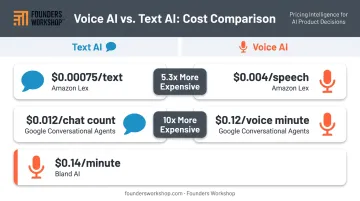
Dedicated voice platforms like Bland AI start at $0.14/connected minute. At 10,000 minutes per month, that's $1,400 in voice costs alone — before any platform fees.
Conversation Volume
Monthly volume is the single most direct cost multiplier. Most pricing models — whether per-seat, per-resolution, or per-API-call — scale linearly (or worse) with volume.
Watch for pricing cliffs: thresholds where costs jump sharply once you exceed plan limits. If your Tidio plan caps at 100 billable conversations and you hit 300, you're either paying overage rates or upgrading to the next tier.
LLM Model Quality
The underlying model determines both performance and cost. Here's what current input token pricing looks like:
| Model Tier | Model | Input Price (per 1M tokens) |
|---|---|---|
| Low-cost | GPT-4o mini | $0.15 |
| Low-cost | Gemini 2.5 Flash | $0.30 |
| Premium | GPT-4o | $2.50 |
| Premium | Claude Sonnet 4 | $3.00 |
| Premium | Claude Opus 4 | $15.00 |
| Fine-tuned | GPT-4o fine-tuned | $3.75 (inference) + $25/1M training tokens |
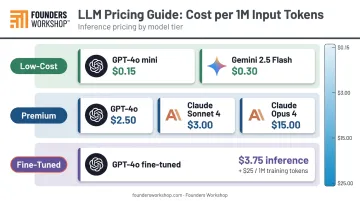
Generic models cost less but underperform in specialized domains. For healthcare or fintech use cases, the accuracy tradeoff can outweigh the savings.
Integration Depth and Compliance
Model selection only covers compute costs. What you connect the AI to often drives the larger budget line. Key cost drivers:
- Standard integrations (CRM, helpdesk plugins): minimal add-on cost
- Custom integrations into legacy systems or multi-tool stacks: substantial development time billed separately
- HIPAA/GDPR compliance: adds one-time setup costs for configuration, plus ongoing audit logging requirements
- Private cloud or on-premise deployment: higher infrastructure costs than cloud SaaS
Each additional integration point — payment processor, inventory system, EHR — requires premium API access billed as a separate line item.
Pricing Models: Subscription, Pay-As-You-Go, and Hybrid
Subscription
Fixed monthly cost per user or flat-rate platform fee. Predictable billing makes budgeting straightforward, but you pay full price during slow periods.
Example: Tidio Starter at $24.17/month covers 100 billable conversations and 10 seats. Clean and simple — until you exceed the conversation cap.
Pay-As-You-Go
Charges per minute, per message, or per resolved conversation. No minimum commitment, lower risk for variable or seasonal demand — but usage spikes can blow the budget in a single month.
Example: Amazon Lex charges purely per request with no upfront fees. Amazon Connect charges $0.038/minute for voice and $0.010/message for chat.
Hybrid
Combines a base platform fee covering a set interaction volume with usage charges above the threshold. Best for teams with a predictable baseline that occasionally spikes.
Example: Intercom charges $0.99 per resolved Fin outcome on top of seat plans starting at $29/seat/month. You're tracking two cost variables simultaneously, so plan your reporting accordingly.
Not sure which model fits? A quick rule of thumb:
- Subscription works when volume is consistent and predictable
- Pay-as-you-go fits seasonal or experimental deployments
- Hybrid makes sense once you have a reliable baseline but expect periodic demand spikes
How to Estimate the Right Budget
A Practical Budgeting Framework
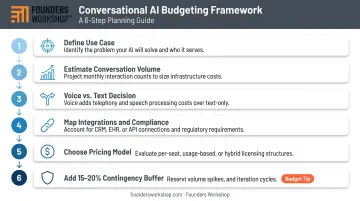
- Define the use case precisely — FAQ deflection, lead qualification, and post-sale support have different volume profiles and complexity requirements
- Estimate monthly conversation volume across low, medium, and high growth scenarios
- Determine voice vs. text — this decision alone can change your cost structure by 5x
- Map required integrations and compliance needs — each adds to deployment and ongoing cost
- Choose a pricing model aligned with your volume predictability
- Build in a 15–20% contingency buffer for overages, onboarding, and support upgrades
The Hidden Cost Problem
The most common budget mistake: treating the subscription price as the total bill.
A $50/month plan can reach $500+ once LLM inference fees, AI session overages, and channel costs stack up. Run the full calculation before committing:
Example: 5,000 conversations × 8 messages average × $0.00075/text request = $30 in Lex fees alone. Add platform subscription + voice minutes (if applicable) + integration costs. That's your real monthly number.
Platforms like Intercom, Google Conversational Agents, and Freshchat all charge separately for AI outcomes, generative sessions, WhatsApp messages, and storage above free quotas.
The Build vs. Buy Decision
SaaS tools offer faster deployment and lower upfront cost. Custom builds deliver lower per-interaction costs at scale and greater control over data, compliance, and workflow logic.
When SaaS per-interaction costs become prohibitive at volume — or when compliance and customization requirements exceed platform capabilities — a custom build often delivers better long-term economics.
That's where Founders Workshop comes in. We architect and build custom conversational AI solutions using a nearshore Latin American development model that runs at roughly one-third of US-based team rates. Our 5D Process (Discovery, Definition, Development, Deployment, Dedicated Support) takes 3–6 months from kickoff to launch, with a 2–4 week Discovery phase that produces a scoped plan and cost estimate before any full build commitment.
Building the ROI Case
Convert AI outcomes into operational terms your finance team can evaluate:
- Ticket deflection: deflected tickets × cost per agent-handled ticket
- Call avoidance: calls avoided × fully-loaded agent hour cost
- Resolution rate: Lightspeed reported up to 65% AI resolution after implementing Fin AI Agent
According to a Forrester TEI study on PolyAI, well-implemented conversational AI deployments can deliver 391% ROI with payback periods under 6 months. McKinsey research found generative AI could increase customer-care productivity by 30–45%.
Those numbers make the ROI case straightforward — the harder work is making sure your cost model accounts for every variable before you sign a contract.
Frequently Asked Questions
How much does conversational AI cost per month?
Entry-level SaaS starts at $20–$50/month flat-rate with limited conversation volumes. Mid-range platforms run $50–$150/user/month. Enterprise or custom solutions cost $150–$300+/user/month, with voice minutes and AI resolution fees billed on top in most cases.
How expensive is voice AI compared to text?
Voice AI costs considerably more due to continuous real-time processing requirements. Amazon Lex charges $0.004 per speech request vs. $0.00075 per text request — a 5.3x difference. Dedicated voice platforms like Bland AI start at $0.11–$0.14 per connected minute on top of any base platform costs.
What are the main conversational AI pricing models?
Three models dominate: subscription (fixed monthly fee, predictable but less flexible as volume grows), pay-as-you-go (billed per minute, message, or resolution — costs vary with usage), and hybrid (base fee plus overage charges above a set threshold). Most mid-tier and enterprise platforms use hybrid structures.
Is it cheaper to build custom conversational AI or use a SaaS tool?
SaaS has lower upfront costs and deploys faster. Custom builds deliver lower per-interaction costs at scale and greater control over data and compliance. The right choice comes down to how much volume you're processing and how tightly you need to control data.
What hidden costs should I watch for?
Watch for these common surprises:
- LLM API fees billed separately from your platform subscription
- Generative AI session charges once you exceed the free quota
- WhatsApp and SMS channel fees added per message
- Data migration and integration development costs
- Overage charges that can double per-unit costs past your monthly limit
How do I calculate whether conversational AI will deliver ROI?
Convert outcomes into labor cost equivalents — deflected tickets × cost per ticket handled, or calls avoided × fully-loaded agent hour. Compare monthly AI spend against those savings. Most deployments pay back within 6 months once conversation volume justifies the platform cost.