Adoption is accelerating fast. A McKinsey survey of healthcare leaders conducted in December 2024 found **85% were exploring or had already adopted generative AI**, with administrative efficiency and clinical productivity identified as the top opportunity areas.
Yet most clinicians and healthcare entrepreneurs still don't fully understand how AI treatment plan generation actually works — how data flows in, how plans get drafted, and how outputs get formatted for different audiences. That gap leads to poor vendor choices, failed integrations, and underused tools.
This article breaks down the full process, from data ingestion to clinician-ready output.
Key Takeaways
- AI pulls from EHRs, lab results, biometrics, and patient history to draft individualized care plans
- The pipeline follows a defined sequence: data ingestion → patient profiling → plan generation → formatting and delivery
- AI drafts and organizes; licensed clinicians review and approve before any plan goes live
- Key gains include reduced documentation burden, real-time plan adaptation, and consistent care plan formatting
- Building this requires HIPAA compliance, FHIR interoperability, and human oversight by design
What Is AI-Generated Treatment Planning?
AI-generated treatment planning uses machine learning models and natural language processing to automatically draft, structure, and format individualized patient care plans — pulling from multi-source clinical data rather than relying on a clinician to write each plan manually.
The problem it addresses is real and measurable. According to AMA data from 2023, physicians averaged 59 work hours per week, including 7.9 hours on administrative tasks, with 20.9% spending more than 8 hours per week on EHR work outside of normal hours. That's time not spent with patients.
What AI Treatment Planning Is — and Isn't
The category is often misrepresented, so the distinction matters.
What it does:
- Automated drafting of care plan text based on clinical data
- Structured formatting of goals, interventions, and follow-up tasks
- A documentation assistant that works within existing clinical workflows
What it doesn't do:
- Autonomous medical decision-making
- A diagnostic tool
- A replacement for physician oversight or licensure
Within that scope, two implementation models are common in practice:
- Static AI-assisted drafting — generates a care plan at a single point in time based on available data
- Adaptive AI planning — continuously updates the plan as new data arrives, such as remote monitoring readings, lab results, or medication changes
By 2025, this is not an experimental feature. Epic has over 60 AI use cases in development, and Oracle Health and athenahealth have both embedded AI documentation capabilities into their platforms. Major EHR vendors now treat AI plan generation as a core workflow component — not a future roadmap item.
How AI Generates and Formats Treatment Plans
The process follows a defined pipeline. Each stage determines the quality and clinical safety of the final output.
Data Ingestion and Patient Profiling
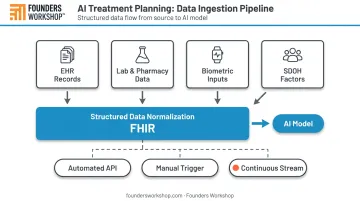
The pipeline starts with aggregating and structuring patient data from multiple sources:
- EHR records — diagnoses, encounter history, clinical notes
- Lab results and pharmacy records — current medications, recent test values
- Biometric inputs — remote patient monitoring devices feeding real-time readings
- Social determinants of health (SDOH) — food access, housing stability, transportation barriers
This ingestion layer can operate three ways: fully automated via EHR API integration, manually triggered by a clinician, or as a continuous stream for adaptive platforms monitoring incoming data in real time.
The technical backbone here is FHIR. HL7's Fast Healthcare Interoperability Resources standard structures patient data as exchangeable building blocks — demographics, problems, medications, allergies, labs, observations — and normalizes them before they reach the AI model. Any AI treatment planning system worth deploying needs a clean FHIR-based ingestion layer, not a free-text scrape.
Plan Generation and Personalization
Once the patient profile is structured, the AI model generates a draft plan using NLP and ML models trained on clinical guidelines, patient population data, and individual health records. A typical draft includes:
- Diagnosis context and problem summary
- Recommended interventions and care goals
- Medication guidance
- Follow-up schedules and monitoring thresholds
Personalization is where AI outperforms template-based plan generation. The model factors in chronic condition history, medication adherence patterns, genetic data where available, and lifestyle factors — producing a plan tailored to that specific patient rather than a condition category.
Most healthcare startups building these features don't build the underlying models from scratch. They work with development partners who handle LLM integration and clinical AI model configuration. Founders Workshop, for example, works with healthcare startups on custom AI-powered software — handling generative AI integration, custom GPT development, and model training so teams can ship AI planning features without rebuilding foundational infrastructure from the ground up.
Formatting and Output Delivery
The same underlying data gets formatted differently depending on who receives it:
| Audience | Format |
|---|---|
| Care team | Structured clinical documentation compatible with EHR systems |
| Patient | Plain-language summary of goals and next steps |
| Payers / compliance | Coded, structured data outputs for billing and audit purposes |
Once formatted, the output integrates downstream — pushing into the EHR and triggering tasks for care team members. In adaptive platforms, it also sets monitoring thresholds that trigger plan updates as patient conditions evolve.
Key Capabilities AI Brings to Treatment Planning
Real-Time Plan Adaptation
Static care plans go stale. A diabetic patient's glucose variability may warrant more frequent check-ins two weeks after their last visit — but that signal only surfaces if someone is watching. Adaptive AI platforms monitor incoming patient data continuously and recalibrate the plan accordingly: escalating outreach frequency when trends deteriorate, reducing intervention intensity as a patient stabilizes.
This closed-loop model moves from patient signal to risk flag to clinician review to documented plan update — a genuine improvement over periodic manual reviews. It doesn't replace clinical judgment; it ensures nothing falls through the gaps between appointments.
Documentation Automation and Predictive Flagging
Beyond plan drafting, AI generates compliance documentation, progress notes, and billing-relevant summaries from the same data pipeline — reducing double-entry for care managers.
That same data pipeline also powers predictive flagging. AI models detect early warning signals — medication non-adherence patterns, deteriorating biometric trends — and surface alerts before a clinical event occurs.
A 2024 JAMA Network Open cohort study found that AI-based early warning scoring identified more deteriorating patients with fewer false alerts than traditional non-AI scoring methods.
Population-Level Learning
AI platforms aggregate outcomes across patient cohorts to identify which interventions work for which patient profiles. Those patterns feed back into plan generation for future patients. No manual process can replicate this at scale. That's what separates AI-assisted care management from even the most rigorous human-only workflow.
The Clinician Oversight Layer
None of this operates autonomously. Well-designed AI treatment plan systems require human-in-the-loop review at every stage. The AI drafts and recommends; a licensed clinician reviews, modifies, and approves before any plan becomes active. That requirement reflects both regulatory standards and basic clinical safety — neither is negotiable.
Benefits for Healthcare Providers and Care Teams
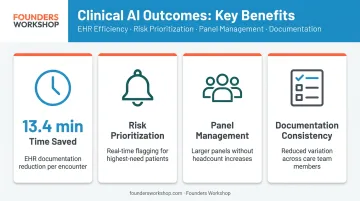
The efficiency gains are documented. A 2025 JAMA Network Open study across five academic medical centers found ambient AI scribes decreased total EHR time by 13.4 minutes and documentation time by 16.0 minutes per encounter. For care managers handling large patient panels, that compounds significantly across a workday.
Time savings are only part of the picture. Across care teams, AI-assisted planning also delivers:
- Real-time risk flagging lets care managers prioritize highest-need patients instead of working from a static schedule
- Larger patient panels become manageable without proportionally increasing headcount — directly relevant for CCM, RPM, and value-based care programs
- Structured AI-generated formatting reduces documentation variation across care team members
Those gains don't automatically translate into higher patient volume, though. KLAS's 2025 ambient speech outcomes report found over 80% of AI documentation users were not interested in adding more patients to their schedules. Most clinicians want the recaptured time back for recovery, deeper engagement, or reduced after-hours work — not more volume. Panel expansion claims need to be grounded in local staffing reality, not assumed as a default outcome.
Challenges and Compliance Considerations
Accuracy and Hallucination Risk
AI models can generate plausible-sounding but clinically incorrect recommendations. In a treatment plan context, this is a direct patient safety issue, not an abstract technical concern. Mitigating it requires:
- Grounding outputs in verified clinical guidelines and source-linked data
- Displaying confidence levels or uncertainty flags on AI-generated recommendations
- Requiring clinician sign-off before any plan is activated
- Ongoing post-deployment monitoring for output quality
The WHO's 2025 guidance on large multimodal models specifically warns that health AI outputs can be inaccurate, and the NIST AI Risk Management Framework provides the scaffolding for managing these risks systematically.
HIPAA Compliance and Data Governance
AI treatment planning systems process sensitive patient health information at scale. That triggers a specific compliance architecture:
- Business Associate Agreements (BAAs) with all AI vendors handling PHI
- Access controls and audit trails logging every prompt, data access, generated plan, clinician edit, and approval
- De-identification protocols before using patient data for model training or analytics
- Encryption and technical safeguards as required under the HIPAA Security Rule
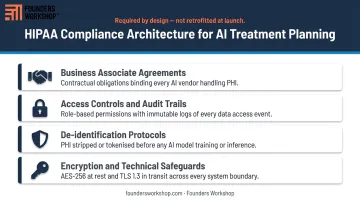
For healthcare startups building these tools, compliance isn't a legal appendix to address at launch. It shapes the architecture from day one. Teams that treat compliance as a design constraint — not an afterthought — avoid the costly retrofits that derail launches. Founders Workshop's 5D Process embeds this thinking in the Discovery and Definition phases, scoping requirements before a single line of code is written.
Bias and Fairness
AI models trained on non-representative patient populations can produce plans that systematically underserve certain demographic groups. A landmark 2019 Science study demonstrated this directly: a commercial population health algorithm reduced the number of Black patients flagged for additional care by more than half. The culprit was using healthcare cost as a proxy for health need, and less had historically been spent on Black patients with equivalent conditions.
Evaluating AI treatment plan outputs by race, ethnicity, language, payer status, and SDOH variables before scaling is not optional. Teams that skip this step don't just risk regulatory scrutiny — they risk embedding historical inequities into clinical workflows at scale.
Conclusion
AI treatment plan generation follows a structured pipeline — patient data comes in through FHIR integrations, clinical models produce a draft, and formatted outputs reach care teams, patients, and payers. Clinician review gates every step before anything becomes active. That structure is what makes responsible deployment possible.
The key checkpoints in that pipeline are:
- Data ingestion: structured EHR data via FHIR APIs
- Plan generation: AI models conditioned on clinical guidelines and patient history
- Output formatting: tailored versions for care teams, patients, and payers
- Human review: clinician approval before any plan is activated
Clinicians who understand how this pipeline works make sharper decisions: which tools are worth evaluating, where oversight checkpoints belong, and how to integrate AI without introducing new risk. The technology is mature enough to deploy responsibly. What separates successful implementations from problematic ones is whether the system was built with compliance architecture, clinical grounding, and human oversight baked in — not bolted on later.
Frequently Asked Questions
How is AI used in treatment planning?
AI pulls from EHR records, lab results, biometrics, and patient history to automatically draft, personalize, and format care plans. Adaptive AI platforms update these plans continuously as new patient data arrives, such as remote monitoring readings or new lab values.
Can AI replace doctors in creating treatment plans?
No. AI drafts and formats plans based on clinical data, but a licensed clinician must review, modify, and approve the plan before it becomes active. Human-in-the-loop oversight is both a regulatory requirement and a patient safety standard.
What data does AI need to generate a patient treatment plan?
The core inputs are EHR records, lab results, pharmacy data, biometric readings from remote monitoring devices, and full medical history. More sophisticated platforms also incorporate social determinants of health and, where available, genomic data.
How does AI format treatment plans for different audiences?
The same underlying data pipeline produces different outputs: structured clinical documentation for care teams, plain-language summaries for patients, and coded compliance-formatted outputs for payers. Each output is tailored to its audience without requiring separate data entry.
Is AI-generated treatment planning HIPAA compliant?
Compliance depends entirely on how the system is built. It requires proper data de-identification, access controls, audit trails, and signed BAAs with AI vendors. These controls must be designed into the architecture before development, not retrofitted after launch.
What are the limitations of AI in treatment planning?
Key limitations include hallucination risk (AI generating clinically incorrect recommendations), bias from non-representative training data, and dependency on clean, well-integrated inputs. Each requires ongoing human oversight and model governance — not as a one-time setup, but as a continuous operational practice.