
Introduction
Every startup founder knows this tension: you need to ship fast, but your budget can't support a full hiring ramp. Engineering roles take an average of 47–49 days to fill through traditional recruiting — and that's just to an accepted offer. Factor in notice periods and onboarding, and you're easily looking at three to six months before a new hire is productive.
Markets don't pause for hiring cycles.
IT staff augmentation has become the practical answer startups use to solve this. It's a deliberate operating model, not a stopgap. External developers, designers, QA engineers, and project managers slot directly into your team, under your direction, without the overhead of full-time employment.
What follows is a straight look at what staff augmentation actually changes — your cost structure, your speed to market, and the technical depth you can access from day one.
Key Takeaways
- Staff augmentation adds skilled developers, QA engineers, designers, and PMs to your team without full-time hiring overhead.
- Nearshore Latin American talent typically delivers senior-level output at roughly one-third of equivalent U.S. salaries.
- Key advantages: lower burn rate, faster time to market, and access to specialized skills — no equity required.
- Works best when requirements are defined upfront and augmented staff plug into your existing workflows immediately.
- Startups that skip it often burn more runway and miss their launch window.
What Is IT Staff Augmentation?
IT staff augmentation is a hiring model where external developers, designers, or engineers join and work inside your team — without becoming full-time employees.
The critical distinction from outsourcing: you retain full control. Sprint planning, tooling, priorities, and deliverables all stay with your team. Augmented staff simply extend your existing capacity. You're not handing off a project — you're adding people to your bench.
Traditional outsourcing transfers control to a vendor, creating dependency and communication overhead. Staff augmentation keeps the product vision, architecture decisions, and delivery cadence in your hands while giving you the capacity to execute it.
For startups, it sits between two costly alternatives — hiring full-time staff before you're ready, or handing equity to a technical co-founder just to fill a skills gap. Augmentation gives you the right talent at the right time, without long-term payroll commitments or cap table dilution.
Key Advantages of IT Staff Augmentation for Startups
The advantages below focus on outcomes you can track — cost, speed, quality, and risk — not abstract benefits.
Advantage 1: Significant Cost Reduction Without Compromising Quality
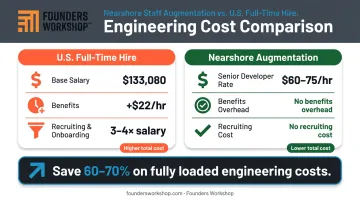
Full-time U.S.-based engineering hires carry costs well beyond base salary. The BLS reports the median annual wage for software developers was $133,080 in May 2024, with the top 10% earning over $211,450.
The fully loaded cost goes higher still. BLS employer cost data shows that for professional occupations, benefits add roughly $22 per hour on top of wages — covering insurance, retirement, and legally required contributions like Social Security and Medicare.
Then add recruiting. SHRM reports the average cost per hire was nearly $4,700, with broader estimates putting total hiring costs at 3–4 times the annual salary when you include onboarding time, productivity ramp, and soft costs.
The nearshore alternative changes the cost math entirely. According to Accelerance, Latin American senior developer rates run $60–$75 per hour in 2025, and North American companies can achieve cost savings of over 30% compared to U.S. rates.
Founders Workshop's nearshore model takes this further: their Latin American developers deliver senior-level output at approximately one-third the cost of equivalent U.S. hires, with full time-zone overlap and no language barrier. That cost structure has been validated across client engagements, including Wellpsyche, which has used Founders Workshop's nearshore staff augmentation for eight years, from startup through scaling stages.
Why this matters operationally:
- Reduces monthly burn rate directly
- Extends runway without cutting product scope
- Frees capital for go-to-market or customer acquisition
- Eliminates idle-capacity costs when sprint demand fluctuates
When it matters most: Pre-Series A, when runway conservation is critical. During product pivots, when committing to full-time hires for an uncertain direction is too risky.
Advantage 2: Faster Time to Market Through On-Demand Scalability
Traditional engineering hiring stretches 47–49 days just to an accepted offer. Add notice periods and onboarding, and the gap between "we need more capacity" and "someone is contributing" often exceeds three months. Staff augmentation compresses that window. Founders Workshop, for example, can have pre-vetted nearshore developers actively working on a client's project in as little as two weeks.
The model also creates genuine on-demand scalability that traditional hiring simply can't match:
- Spin up a sprint team for an MVP push without a permanent commitment
- Add QA engineers before a release, then scale back after
- Bring in a mobile developer for a new platform without hiring a full-time role you may not need in six months
- Replace a departing contractor quickly, without restarting a three-month search
Why this matters operationally: Faster launches mean earlier customer feedback, faster iteration, and competitive positioning. CB Insights found that 43% of VC-backed startups that shut down cited poor product-market fit — and the only way to test product-market fit is to ship. Every week a launch slips is a week without real user data.
KPIs impacted: Time to first release, sprint velocity, feature delivery rate.
When it matters most: Post-funding, when investors expect visible product progress. When a competitor ships and response speed becomes a survival question.
Advantage 3: Access to Specialized Talent Without Giving Up Equity
Startups often face a false choice: hire a technical co-founder (and give up significant equity) to get the skills they need, or build with a team that lacks critical expertise. Staff augmentation offers a third path.
The equity cost of that co-founder arrangement is real. Carta reports that by the seed round, the median founding team retains approximately 56% of fully diluted equity — dropping to 36% by Series A. Adding a technical co-founder before raising means that dilution starts from a smaller base. And Founders Workshop's own materials note that technical co-founder arrangements can result in surrendering up to 50% equity.
The alternative: access senior specialists through augmentation, for specific phases, at a fraction of the hiring cost. Consider the salary benchmarks for roles startups frequently need but rarely justify full-time:
| Role | Robert Half 2026 Midpoint Salary |
|---|---|
| AI/ML Engineer | $170,750 |
| DevOps Engineer | $145,750 |
| Data Engineer | $156,250 |
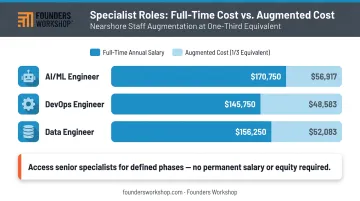
These are roles most early-stage startups need for defined phases — model training, infrastructure setup, data pipeline architecture — not indefinitely. Augmentation gives you access to these specialists without a permanent salary commitment or equity negotiation.
When it matters most: When you need deep expertise for one phase — an AI engineer for model training, a DevOps specialist to set up infrastructure — but the role doesn't justify a permanent hire or a co-founder arrangement.
What Happens When IT Staff Augmentation Is Ignored
Startups that default to slow traditional hiring during critical growth windows tend to fall into predictable patterns:
- Product timelines slip. Engineering capacity gaps don't pause sprints — they just extend them.
- Burn rate bloats. Over-hiring to cover temporary capacity needs locks in fixed costs that outlast the need.
- Equity gets spent unnecessarily. Technical co-founder arrangements made out of necessity, rather than strategic fit, are expensive and hard to undo.
- Skill gaps block launches. Missing one specialist role — QA, DevOps, mobile — can hold up an entire release.
CB Insights found that 70% of VC-backed startups that shut down cited running out of capital. Startup Genome's research shows that startups that scale properly grow about 20x faster than those that scale prematurely — which includes hiring full-time staff ahead of validated demand.
Missing a launch window rarely just delays the product. Delayed revenue shakes investor confidence, which pushes out the next funding round — and by then, a competitor has shipped.
How to Get the Most Value from IT Staff Augmentation
The model delivers its best results when three things are in place before you engage a provider.
1. Start with sharp requirements. Define the specific roles, skills, seniority levels, and project phases you need to cover before engaging a provider. Vague briefs produce mismatched talent. The clearer your brief, the faster a provider can place the right person.
2. Integrate augmented staff from day one. Augmented contributors shouldn't feel like outsiders. They need access to your tools, visibility into sprint priorities, and a clear point of contact within your team. Providers with structured onboarding processes close this gap faster. Founders Workshop's 5D Process, for example, systematically aligns every contributor to project goals before development begins. That upfront alignment cuts the ramp-up friction that often derails augmented team performance.
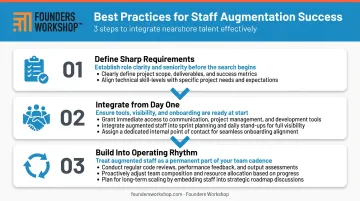
3. Build augmentation into your operating rhythm.
- Review output quality and sprint velocity regularly
- Adjust team composition as project phases shift
- Use augmentation proactively, not just when you're already behind
Startups that treat augmentation as a standing capability — sized up during growth sprints, scaled back between them — consistently outpace those who bring in outside help only after a deadline has slipped.
Conclusion
For startups under budget pressure and competitive timelines, IT staff augmentation delivers three things simultaneously that traditional hiring can't match: lower costs, faster access to talent, and specialized skills without equity sacrifice.
The advantages compound over time. Startups that build augmentation into their operating model — rather than reaching for it reactively — consistently outpace competitors relying on slow internal hiring cycles.
AI tools are accelerating this advantage further. McKinsey found developers can complete coding tasks up to 2x faster with generative AI — and that productivity gain only materializes if your team is already embedded in your stack, your timezone, and your workflow.
Augmented talent that's integrated from day one captures that gain immediately. At that point, you're not just saving on headcount costs — you're compressing your development timeline in ways a slow internal hire never could.
Frequently Asked Questions
What is the difference between IT staff augmentation and outsourcing?
Staff augmentation embeds external professionals directly into your team under your direction (you manage their work, tools, and priorities). Outsourcing transfers project control to an external vendor. For startups that want to retain control over their product development process, augmentation is the better fit.
How much can a startup realistically save with IT staff augmentation?
Nearshore augmentation models, particularly from Latin America, typically deliver senior-level engineering talent at roughly one-third the cost of equivalent U.S. full-time hires, once salary, benefits, and recruiting overhead are factored in. That represents roughly 60–70% savings on fully loaded engineering costs.
How quickly can augmented IT staff be ready to contribute?
Leading providers like Founders Workshop can place pre-vetted professionals and begin active work in as little as two weeks , compared to the three-to-six-month cycle typical of traditional engineering hires. Speed depends on how clearly the startup has defined its requirements upfront.
Is IT staff augmentation a good fit for early-stage startups?
It's particularly well-suited for early-stage startups. It avoids long-term salary commitments during uncertain phases, preserves runway, and provides access to specialized skills like AI/ML or DevOps, without requiring a full-time hire or co-founder equity arrangement.
What types of IT roles can startups fill through augmentation?
Common roles include full-stack and back-end developers, front-end engineers, QA testers, DevOps engineers, UI/UX designers, AI/ML specialists, data engineers, and project managers. The right provider should cover the specific stack and seniority level your project actually requires.
How do startups maintain quality control with augmented IT staff?
Quality is maintained through clear project briefs, sprint workflow integration, regular performance reviews, and providers that pre-vet candidates for both technical skills and communication. Founders Workshop adds an extra layer by pairing nearshore developers with U.S.-based business analysts and project managers who oversee delivery directly.