Introduction
In medical packaging manufacturing, there is no acceptable error rate. A single mislabeled surgical device pouch, a compromised blister seal, or an incomplete batch record can trigger an FDA recall, expose your company to significant legal liability, and — most critically — put patients at risk. The margin for error is zero.
What's changed is who can afford to act on it. AI automation is no longer the exclusive domain of pharmaceutical giants like AstraZeneca or Eli Lilly. Custom AI software now enables small and mid-sized medical packaging manufacturers to automate quality control, compliance documentation, and production workflows at a cost that makes business sense.
Here's what this guide covers:
- The key pressures pushing manufacturers toward AI adoption
- The most impactful applications on the plant floor
- How AI simplifies FDA and GMP compliance
- What realistic ROI looks like for small and mid-sized operations
- Why custom-built software outperforms off-the-shelf platforms in regulated environments
Key Takeaways
- AI automation reduces defects, improves throughput, and strengthens FDA/GMP compliance in medical packaging operations
- Key applications: AI vision inspection, predictive maintenance, automated documentation, and workflow management
- Compliance tools automate audit trails, label verification, and deviation alerts to meet 21 CFR Part 11 requirements
- Most operations recover costs within 12–24 months through labor savings, fewer defects, and avoided recalls
- Custom AI software, built around your specific workflows, outperforms generic platforms in regulated manufacturing environments
Why Medical Packaging Manufacturers Are Turning to AI Automation
Three converging pressures are making AI automation urgent for medical packaging manufacturers right now.
Regulatory complexity is increasing. FDA, ISO 13485, and EU MDR requirements demand documentation, traceability, and audit readiness at a level that manual processes struggle to sustain consistently. The compliance burden has grown, and it keeps growing.
Skilled labor is disappearing. According to Deloitte and the Manufacturing Institute, US manufacturers may need 3.8 million workers between 2024 and 2033, with up to 1.9 million positions potentially unfilled. ISPE separately reports that 80% of pharmaceutical manufacturers already see a mismatch between current workforce skills and evolving job requirements. Automating inspection, documentation, and quality checkpoints reduces dependency on labor that simply isn't available.
Market scale demands it. Pharmaceutical packaging equipment represents a $10.6 billion global market in 2025, projected to reach $14.3 billion by 2030 — a 6.3% CAGR that reflects how seriously the industry is treating packaging-line investment.
The zero-error tolerance in medical packaging adds another dimension. A defect in a sterile blister pack is a patient safety issue with direct FDA enforcement consequences. Unlike consumer goods manufacturing, there's no acceptable defect-per-million rate when the product goes into a surgical suite or into a patient's hands.
Manufacturers who automate gain measurable operational advantages:
- Faster product releases with reduced manual bottlenecks
- Lower cost-per-unit through consistent, repeatable processes
- Stronger audit readiness built into daily operations
Audit readiness is increasingly a prerequisite for winning contracts with healthcare customers and device OEMs — not just a compliance checkbox.
Key AI Automation Applications in Medical Packaging Manufacturing
AI-Powered Visual Inspection and Defect Detection
Manual visual inspection has real limits — inspector fatigue, lighting variability, and human reaction time all introduce inconsistency that regulators and customers notice. AI-driven computer vision eliminates these variables.
Modern systems scan packaging components in real time, detecting print defects, label mismatches, missing text, incorrect barcodes, and seal failures at speeds no human inspector can match. Two benchmarks illustrate the capability gap:
- Syntegon automated inspection: up to 600 vials per minute
- DWFritz Class 3 medical device system: up to 400 images per 12-second cycle at 11-micron resolution, detecting defects as small as 50 microns
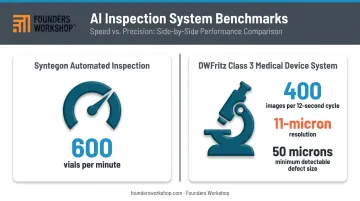
Beyond speed, the more important capability is accuracy differentiation. Machine learning models distinguish between acceptable cosmetic variation and defects that would trigger regulatory action. This reduces false rejects — which create unnecessary waste and batch investigations — while ensuring genuine errors don't slip through to release.
The FDA's own guidance on visible particulate inspection acknowledges that automated systems bring speed, precision, and consistency advantages over manual inspection. For regulated packaging lines, that framing matters: automation isn't replacing human judgment, it's providing a more reliable, auditable quality gate.
Predictive Maintenance for Packaging Equipment
An unplanned shutdown on a medical packaging line triggers more than lost production time. It raises batch integrity questions that require costly re-runs, batch record amendments, and deviation investigations — all before the line runs again.
AI predictive maintenance targets both problems at once.
By analyzing sensor data from filling machines, cartoners, and sealers, these systems forecast failures before they occur. The monitored signals include:
- Vibration patterns indicating bearing wear
- Temperature trends signaling motor stress
- Cycle counts approaching service thresholds
McKinsey reports that predictive maintenance typically reduces machine downtime by 30%–50% and extends machine life by 20%–40% across manufacturing environments. For medical packaging specifically, ISPE notes that digital predictive maintenance can directly mitigate lost-production costs from unplanned downtime — a qualified endorsement from within the pharmaceutical manufacturing standards community.
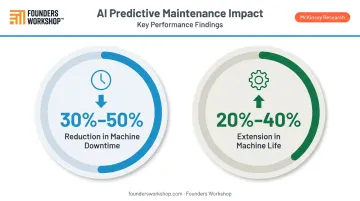
The preventive effect on compliance is what makes this particularly valuable in regulated environments. Fewer unexpected shutdowns mean fewer deviations to investigate, document, and close.
Automated Workflow and Production Management Software
Paper-based production management is slow, error-prone, and nearly impossible to audit at scale. When a regulator requests complete batch records across 18 months of production, the answer shouldn't involve a warehouse of binders.
Custom workflow management software automates:
- Material replenishment tracking and replenishment alerts
- Production job routing and scheduling
- Batch record creation and version control
- Quality checkpoint sign-offs and approval workflows
- Real-time deviation documentation
Real-time production dashboards give plant managers visibility into line performance, yield rates, and deviation alerts across multiple shifts — without adding headcount to compile reports.
OCR and data extraction tools address the transition problem that most manufacturers face: digitizing existing paper records. Scanning handwritten or printed production documents and automatically pulling that data into a central database removes manual consolidation steps and ensures nothing goes missing when auditors arrive.
How AI Automation Simplifies GMP and FDA Compliance in Medical Packaging
Compliance in medical packaging is unusually layered. A single production run may need to satisfy FDA 21 CFR Part 11, GMP documentation requirements, ISO 13485:2016, and — for EU-bound products — MDR labeling standards with UDI and member-state language rules.
Each framework demands detailed documentation, version control, and audit trails. Maintaining all of that manually across high-volume, high-SKU production is where things break down.
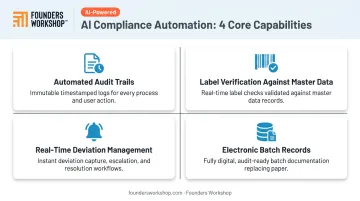
AI compliance software addresses this directly across four areas:
- Automated audit trails: Every production event — from material receipt through finished goods release — generates a tamper-evident, timestamped record. Audit packages become a report function, not a multi-day document hunt.
- Label verification against master data: AI platforms compare every printed label against approved specifications before packaging ships, catching deviations that manual proofreading routinely misses. Incorrect labels are among the most common triggers for FDA enforcement actions.
- Real-time deviation management: Production parameters are monitored continuously, with automated alerts triggered the moment a process drifts outside its validated range. Deviations are documented and escalated immediately — not discovered during end-of-batch QC when investigation options are limited.
- Electronic batch records: Replacing paper records with validated electronic systems satisfies Part 11 requirements while making records searchable, version-controlled, and accessible during both routine and unannounced inspections.
One enforcement example illustrates the stakes: FDA issued Warning Letter 633735 to Legacy Pharmaceutical Packaging LLC in 2022 for significant CGMP violations. The firm required years of remediation before FDA issued a close-out letter in 2024. That timeline — and the operational disruption it represents — is exactly what automated compliance systems are designed to prevent.
The Real ROI of AI Automation in Medical Packaging
ROI from AI automation in medical packaging flows through three channels, and the third one is consistently underestimated.
Direct operational savings include:
- Reduced labor hours for inspection, documentation, and reconciliation
- Less scrap and fewer rework batches from earlier defect detection
- Incremental batch capacity from faster line performance
A pharma packaging case study from Catalyx illustrates the scale: automated vial and syringe counting reduced reconciliation time by 50% and enabled 70 additional batches annually for one unnamed pharmaceutical manufacturer. That's a meaningful throughput gain without adding equipment or headcount.
Risk avoidance is where the math gets compelling. An FDA warning letter triggers investigation costs, remediation expenses, potential production holds, and reputational damage. A recall adds retrieval costs, replacement production, regulatory response, and potential legal exposure on top.
McKinsey estimates recoverable quality costs in medical devices at $6 billion to $11 billion per year industry-wide, representing 1.5%–3.0% of sales. For individual manufacturers, the cost of a single significant compliance failure often exceeds the total investment in the AI system that would have prevented it.
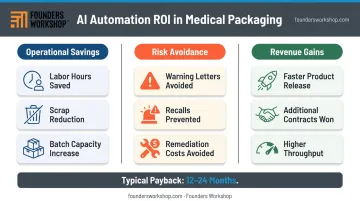
Revenue gains round out the picture:
- Faster product releases from cleaner documentation workflows
- Ability to take on more contracts with stronger audit readiness
- Higher throughput from reduced downtime and rework
For most well-scoped implementations, the combination of operational savings and avoided risk delivers payback within 12–24 months. The specific timeline depends on production volume, current defect rates, labor costs, and compliance workload — so ROI modeling that starts with your actual numbers will be far more reliable than any industry benchmark.
Building vs. Buying: Why Custom AI Software Wins for Medical Packaging
Off-the-shelf automation platforms carry a specific problem in regulated environments: they're designed for broad industries, not for the documentation requirements, device classification rules, or labeling logic of a medical packaging operation.
Gartner reports that by 2027, more than 70% of recently implemented ERP initiatives will fail to fully meet original business goals. In pharma quality control specifically, McKinsey warns that a poorly planned rollout can cost 5x–10x more and take 3x–5x longer than a well-scoped investment. The hidden costs of configuring generic software to fit a regulated workflow — validation documentation, change control, workarounds for missing functionality — routinely exceed what a system built for that specific workflow costs.
Custom-built AI software can do things packaged platforms cannot:
- Mirror your exact production workflow and documentation requirements
- Integrate directly with existing equipment PLCs and ERP systems
- Embed your GMP documentation templates and approval routing
- Scale across product lines without per-seat licensing constraints
- Support validation and audit trail requirements from the ground up, not as an afterthought
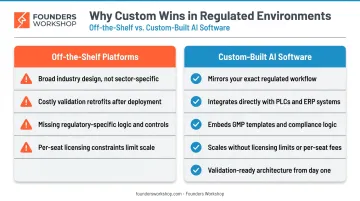
The FDA's Computer Software Assurance guidance applies to production and QMS software regardless of whether it's custom-built or purchased. But custom systems have one advantage: they can be designed with validation requirements built in from day one, rather than retrofitted onto a commercial platform that wasn't built with your regulatory environment in mind.
Founders Workshop builds AI-first custom software for healthcare and manufacturing clients using a structured 5D Process: Discovery, Definition, Development, Deployment, and Dedicated Support. For medical packaging manufacturers, that means the system is built around your workflow, your documentation standards, and your compliance requirements.
The firm's nearshore Latin American development model delivers this at approximately one-third the cost of US-based development teams, with the same timezone and language alignment that makes collaboration practical.
For SMBs without enterprise budgets, that cost structure matters. The entry point is straightforward: identify the single highest-pain workflow — label verification, batch record automation, or inspection documentation — and build a targeted solution there first. Prove ROI, then expand.
Frequently Asked Questions
What companies use AI for manufacturing?
Large enterprises including AstraZeneca, Siemens, and Stevanato Group have deployed AI across pharmaceutical and medical device manufacturing. OECD data shows 40% of large firms versus only 11.9% of small firms currently use AI — smaller manufacturers who adopt now gain a measurable head start before the gap closes.
What are the main AI use cases in medical packaging manufacturing?
The highest-impact applications include:
- AI vision inspection for real-time defect detection
- Predictive maintenance for packaging equipment
- Automated compliance documentation and audit trail generation
- Batch record creation via workflow management software
- Label verification against approved master data
How does AI automation help with FDA and GMP compliance in packaging?
AI systems automate audit trail creation, electronic batch records, real-time deviation alerts, and label verification against approved specifications — all of which directly support 21 CFR Part 11 and GMP documentation requirements. The result is audit preparation that takes hours instead of days, and deviations that are caught and documented immediately rather than discovered after batch release.
What is the ROI timeline for AI automation in medical packaging?
Well-implemented projects typically achieve payback within 12–24 months through labor savings, throughput gains, and avoided recall and compliance costs. The risk-avoidance dimension — preventing a single warning letter or recall — often contributes more to ROI than the operational savings alone.
How can small and mid-sized medical packaging manufacturers implement AI automation?
SMBs don't need enterprise budgets. A custom development partner can build a targeted tool for a single high-pain workflow — label verification, batch documentation, or inspection reporting — at a fraction of the cost of off-the-shelf platforms. Prove ROI on one workflow first, then expand.
What is the difference between AI automation software and traditional packaging automation?
Traditional automation handles physical tasks with fixed logic — conveyor speeds, fill volumes, seal temperatures. AI software adds adaptive intelligence: it learns from production data, detects anomalies fixed-logic systems miss, and makes real-time decisions without reprogramming for every new scenario.