Introduction
Picture this: it's peak booking season — spring break, summer holidays, or a flash sale you've been planning for weeks. Traffic spikes. Your booking platform slows to a crawl. A customer tries to reserve the last two seats on a tour, gets an error, refreshes, and the booking disappears. They go to a competitor and convert in 90 seconds.
That scenario plays out regularly for travel businesses running on generic software that wasn't built for their specific workflows, pricing models, or traffic patterns.
The online travel market exceeded $700 billion in 2025, with online channels generating more than 70% of total market revenue, according to Statista. Competition for that revenue is intense, and the gap between businesses running purpose-built platforms versus off-the-shelf tools is measurable in conversion rates, retention, and operational cost.
This guide covers what custom travel software actually is, which businesses need it, what categories exist, which features matter most, and how to choose a development partner who delivers.
Key Takeaways
- Generic travel platforms constrain your booking flows, charge ongoing fees, and break under peak-season traffic
- Custom travel software gives you full codebase ownership, unlimited integration flexibility, and architecture built for your scale
- The five core categories: booking portals, reservation management systems, property management software, travel CRMs, and mobile apps
- Must-have features include real-time inventory sync, PCI DSS-compliant payments, and AI-powered personalization
- Choosing the right development partner requires verified travel domain experience, not just a generic agency claiming vertical expertise
Custom Software vs. Off-the-Shelf: Why Generic Tools Fall Short
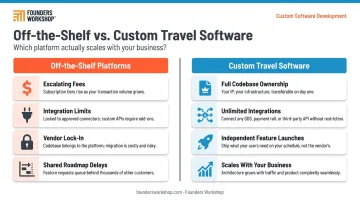
Off-the-shelf travel platforms are engineered for the median use case. If your business is median — generic packages, standard booking flows, common supplier relationships — they'll work fine. The moment you operate outside that center, you start hitting walls.
The Hidden Cost Trap
SaaS travel platforms look affordable at entry. Over time, the math shifts:
- Monthly subscription fees that escalate with usage tiers
- Per-transaction charges that compound at volume
- Developer hours spent building workarounds for missing features
- Vendor lock-in that makes migration increasingly painful and expensive
A custom build has higher upfront investment, but you own it. No per-transaction fees. No surprise price increases. No capabilities gated behind enterprise tiers.
The Integration Problem
This is where generic platforms fail travel businesses. Modern travel commerce requires connecting:
- GDS systems (Amadeus, Sabre, Travelport) — Sabre's agency platform alone unifies content from 420 airlines, 2 million lodging options, and 40,000 car rental locations
- Airline NDC APIs, hotel rate APIs, tour operator feeds
- Payment gateways, fraud detection services
- CRM systems and loyalty platforms
Most off-the-shelf platforms offer shallow API layers — enough for basic connections, but not the normalization, error handling, and real-time synchronization that travel operations actually require. IATA's NDC standard was built to fix exactly the kind of content and differentiation gaps that generic platforms still struggle to address.
The Scalability Gap
Holiday booking windows and flash sales create traffic patterns that are nothing like a typical Tuesday afternoon. Generic platforms scale on their own schedule, not yours. A custom platform can be designed from the start around your specific traffic patterns — whether that means handling 10x normal reservation volume during a 48-hour sale or supporting hundreds of simultaneous agent sessions during a conference.
What Custom Software Actually Gives You
- Full ownership of the codebase, with no third-party restrictions on what you can build
- Independent feature launches without waiting on a vendor's roadmap
- Integration architecture designed for your specific supplier relationships
- A platform that grows with your business rather than one you eventually outgrow
Types of Custom Travel Software Solutions
Travel Portals and Booking Platforms
These are the B2B and B2C systems that centralize search, booking, and itinerary management across flights, hotels, tours, and activities. Online travel agencies, tour operators, and large travel agencies with complex inventory needs are the primary buyers.
What makes them difficult to build correctly:
- Multi-supplier inventory sync — pulling live availability from dozens of APIs simultaneously
- Real-time pricing — rates change constantly; stale data creates booking failures
- Consistent UX across devices — the experience must work identically on mobile, tablet, and desktop
Online Booking and Reservation Management Systems
These systems automate the full lifecycle after a booking is initiated: confirmations, modifications, cancellations, vendor notifications, and customer communications. Automation removes the manual touchpoints where errors accumulate, cutting the time between inquiry and confirmed booking.
Property Management Software (PMS)
Hotels and accommodation providers need operational software that goes beyond booking. A custom PMS connects all of these into a single system tuned to how a specific property operates, rather than forcing staff to adapt to a generic workflow:
- Room inventory and availability management
- Front desk workflows and check-in/check-out
- Housekeeping scheduling and status tracking
- Guest profiles, billing, and reporting
Travel CRM and Loyalty Platforms
Travel CRM platforms go well beyond contact management. They track booking history, destination preferences, preferred airlines, loyalty tier, and behavioral signals that indicate when a traveler is ready to book again. Custom-built platforms can trigger personalized outreach at the right moments, manage tiered loyalty rewards, and build retention programs that off-the-shelf SaaS CRM tools can't replicate.
Mobile Travel Applications
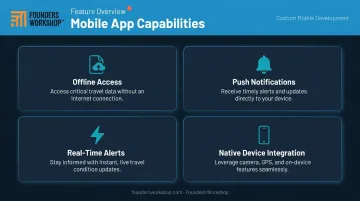
Mobile isn't a nice-to-have in travel. A purpose-built travel app delivers capabilities that a responsive web page cannot:
- Offline access to itineraries and travel documents
- Push notifications for flight changes, gate updates, and check-in reminders
- Real-time alerts for price drops or availability changes
- Native device integration for maps, camera, and biometrics
Essential Features Your Custom Travel Software Needs
Real-Time Inventory and Availability Management
Overbookings damage trust in ways that are hard to recover from. Real-time inventory synchronization across all booking channels — direct, OTA, agent — requires a deliberately designed architecture:
- API connections to each supplier with defined update cadence
- Caching strategies that balance speed with data freshness
- Conflict resolution logic when two bookings arrive simultaneously
Get this wrong at the architecture stage and retrofitting it later costs far more than building it right the first time.
Secure Payment Processing and Compliance
Every travel platform that stores, processes, or transmits payment card data falls within PCI DSS scope. Compliance shapes the entire payment architecture — from tokenization and encryption to data storage access controls. Multi-factor authentication and fraud detection belong in the same conversation.
For platforms serving European travelers, GDPR is equally non-negotiable. The regulation applies to non-EU organizations offering services to EU residents, so a US-based travel company with European customers carries full GDPR obligations.
AI-Powered Personalization and Dynamic Pricing
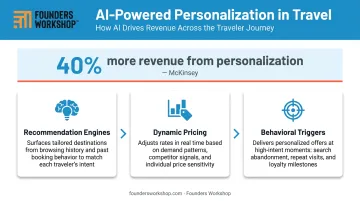
McKinsey research found that faster-growing companies derive 40% more revenue from personalization than slower-growing peers. In travel, that gap is visible in conversion rates, repeat bookings, and average booking value.
Practical AI applications in travel software today:
- Recommendation engines that surface destinations and packages based on browsing and booking history
- Dynamic pricing that adjusts rates based on demand signals, competitor pricing, and booking patterns
- Behavioral triggers that prompt personalized offers at high-intent moments
Amadeus reports that 49% of hoteliers view AI as critical for identifying upsell opportunities, with 46% prioritizing it for personalized guest experiences.
Omnichannel Booking Experience
A traveler starts a booking on their phone during a commute, continues on their laptop at home, and calls an agent to add a tour. Each handoff needs to be seamless. Delivering that across web, app, and agent channels requires a unified data layer — one that preserves session state, enforces consistent pricing, and carries booking context across every touchpoint. A patchwork of generic SaaS tools cannot reliably provide that.
Key omnichannel requirements to build for:
- Persistent session state across devices and channels
- Consistent pricing logic regardless of where a booking originates
- Agent access to full customer context without manual lookup
Business Benefits of Custom Travel Software
Operational Efficiency and Cost Reduction
Manual workflows in travel operations (confirmation emails, vendor notifications, modification processing, refund handling) are slow and error-prone. Sabre's own documentation notes that unified servicing workflows can save agents 5 to 20 minutes per exchange or refund transaction. Multiply that across hundreds of transactions per week.
Custom automation handles:
- Booking confirmations and itinerary delivery
- Modification and cancellation workflows
- Vendor and supplier coordination
- Reporting and reconciliation
Smaller teams can handle higher booking volumes — which means your labor costs stay flat even as transaction volume climbs.
Scalability for Growth and Seasonal Demand
Custom platforms are architected with your traffic patterns in mind. Cloud-native infrastructure scales resources on demand, handling the spike of a holiday booking window without performance degradation. Generic platforms scale on their vendor's infrastructure timeline, which isn't always aligned with your business calendar.
Operational efficiency and scalability lay the groundwork — but the longer-term advantage of custom software is what it does for your brand.
Competitive Differentiation and Brand Loyalty
Two travel agencies running the same SaaS booking platform offer travelers the same experience. Custom software is a brand asset. Competitors using the same generic tool can't replicate what you build specifically for your customers. Over time, that gap widens as you accumulate proprietary data and ship features tied to real traveler behavior. The areas that compound fastest:
- Booking flow design and UX tailored to your audience
- Loyalty program mechanics built around your margins
- Personalization logic trained on your own customer data
Emerging Technologies Reshaping Travel Software
AI and Intelligent Automation
AI adoption in travel is accelerating fast. Deloitte reports that GenAI adoption for travel planning reached 24% for the 2025 holiday season, up from 16% in 2024 and just 8% in 2023 — with usage hitting 31% among millennials. Phocuswright found that 78% of travelers who used GenAI found it helpful for planning and in-destination purposes.
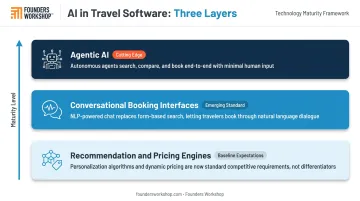
Three practical layers for travel software:
- Recommendation and pricing engines — now baseline expectations, not differentiators
- Conversational booking interfaces — NLP-powered chat replacing form-based search flows
- Agentic AI — early-stage systems that can autonomously search, compare, and book travel on a traveler's behalf
Travel platforms designed without AI architecture baked in from day one face costly restructuring as these capabilities become standard.
IoT Integration and Connected Travel
IATA's 2024 baggage tracking survey of 155 airlines and 94 airports found that 44% had fully implemented Resolution 753 (baggage tracking at acceptance, loading, transfer, and arrival) with another 41% in progress. Baggage tracking is the current adoption leader, but IoT is expanding quickly across the traveler experience:
- Smart room controls tied to guest profiles
- Automated check-in triggers at airport and hotel entry points
- Wearable travel reminders synced to itinerary changes
Building IoT-ready API hooks into travel software now prevents expensive architectural rework as these integrations become expected features.
Blockchain for Security and Automation
Blockchain's most immediate travel applications are practical rather than speculative. PhocusWire profiled blockchain-based automated refund engines that trigger payouts on verified flight delays — removing the manual claims process entirely. Active use cases include smart contracts, immutable booking records, digital identity verification at check-in, and fraud-resistant loyalty point systems. IATA's One ID program is moving toward a document-free passenger journey built on identity management and biometric recognition.
Teams building travel platforms now should map where blockchain touchpoints intersect their booking and identity workflows — the integration points are already defined, even if full adoption is a few years out.
How to Choose the Right Custom Travel Software Development Partner
Evaluate Domain Expertise, Not Just General Capability
Not every software agency that lists "travel" on their website has actual travel domain experience. The distinction matters because travel platforms carry specific technical complexity that general application development work doesn't prepare a team for:
- GDS integration and NDC workflow differences (Travelport's own documentation notes distinct handling requirements between NDC and standard GDS content)
- PCI DSS-compliant payment architecture
- Multi-supplier API normalization
- Real-time inventory management at scale
Ask for proof: live booking platforms they built, specific GDS system experience, demonstrable PCI DSS compliance work. Teams with real travel domain depth compress timelines and avoid the expensive rework that comes from learning the industry on your project.
Assess Process Maturity and Communication Fit
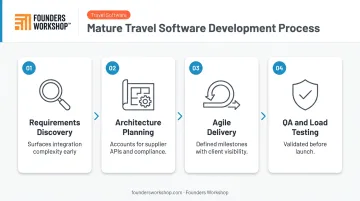
A mature development process for travel projects includes:
- Requirements discovery that surfaces integration complexity before architecture is decided
- Architecture planning that accounts for supplier API variability and compliance requirements
- Agile delivery with defined milestones and regular client visibility
- QA and load testing before launch, not after
Run a paid discovery sprint — typically 2 to 4 weeks — before committing to a full build. This reveals the real working relationship, not just the sales pitch. At Founders Workshop, the Discovery phase (D1) is a 2 to 4 week engagement with a dedicated Project Champion that produces goal definition, feature prioritization, integration scoping, and technology recommendations — before a dollar is committed to development.
Look for AI-First Development and Flexible Team Models
A development partner without demonstrable AI capabilities is building yesterday's platform. Travel software launched today needs recommendation logic, dynamic pricing architecture, and conversational interfaces as foundational layers, not features tacked on in version 3.
Team model also matters for budget. Founders Workshop's nearshore Latin American development team delivers senior-level talent at roughly one-third the cost of comparable US-based teams, without sacrificing timezone alignment, communication quality, or technical depth. For travel founders evaluating a $150,000 to $350,000 platform build, that cost difference is significant.
Together, a structured delivery process (Founders Workshop's 5D Process covers Discovery through Dedicated Support), AI-first development, and a nearshore team model give travel businesses a realistic path to a purpose-built platform. That's a meaningful alternative to the cost of a domestic agency or the oversight gaps that come with unmanaged offshore teams.
Frequently Asked Questions
Frequently Asked Questions
Which software is best for a travel agency?
It depends on your niche, booking volumes, and supplier relationships. Off-the-shelf tools work for small agencies with generic needs. Custom software makes more sense when your workflows are specific, your supplier mix is complex, or you're building toward scale. A discovery conversation with a development partner can clarify the right path in a few hours.
How much does it cost to build a travel agency booking platform?
A basic travel website starts low, but a full custom booking platform with GDS or supplier API integrations, PCI DSS-compliant payment processing, and compliance layers typically ranges from $80,000 to $350,000 for a functional MVP. The biggest cost variables are integration complexity and the partner's domain experience — teams who've built travel software before ship faster and rewrite less.
What is the difference between custom travel software and off-the-shelf platforms?
Custom software is built for your specific workflows, supplier relationships, and customer experience. You own the codebase, can modify it freely, and scale it as your business grows. Off-the-shelf platforms offer faster initial setup but impose customization limits, charge recurring fees, and typically struggle with complex or non-standard integrations.
How long does it take to build custom travel software?
A functional MVP with core booking flows typically takes 3 to 6 months with an experienced team. A full-featured platform with multi-supplier integration, dynamic pricing, and compliance layers takes 9 to 18 months. That timeline compresses significantly when the development team already understands travel domain complexity.
Do small travel agencies need custom software?
Not right away. Off-the-shelf tools are a reasonable starting point for small agencies. Custom software becomes the right move when generic platforms are blocking necessary integrations or creating bottlenecks your business has outgrown.
What are the must-have features in travel agency software?
Core requirements: real-time inventory and availability management, PCI DSS-compliant payment processing, automated booking confirmations and notifications, third-party API integrations (GDS, hotel, airline), and mobile-first UX. AI-powered personalization and dynamic pricing have moved from differentiators to near-baseline expectations for any platform launching today.