Introduction
Most startups don't fail because the idea was bad. They fail because founders build too much, too fast, and run out of runway before learning whether anyone actually wants what they built.
CB Insights' 2024 analysis of VC-backed shutdowns found that 43% of failed startups cited poor product-market fit as the primary cause. That number has barely moved in a decade — which means the lesson still isn't landing.
The answer isn't to build less for the sake of cutting costs. It's to build smarter — validating the right assumptions with real users before committing months and significant budget to features that may not matter.
MVP design is the discipline that keeps founders from building the wrong thing — and this guide breaks down exactly how to get it right. Here's what's covered:
- What an MVP actually is (and what it isn't)
- The principles that separate effective MVP design from wasted effort
- A step-by-step process founders can follow
- The most expensive mistakes to avoid before writing a single line of code
Key Takeaways
- 43% of VC-backed startup failures trace back to poor product-market fit — MVP design exists to prevent that
- An MVP is a learning tool first. Its job is to validate assumptions with real users before you scale — not to ship a polished product on a tight budget.
- Prototype → MVP → MLP → MMP is a proven progression — each stage serves a distinct purpose and builds on the last
- Test with 5 real users before building — catching UX problems early costs a fraction of fixing them post-launch
- Most MVPs can go from discovery to deployment in 3–6 months when scope is tightly controlled
What Is an MVP and Why Does It Matter for Startups?
Eric Ries defined an MVP as "that version of a new product which allows a team to collect the maximum amount of validated learning about customers with the least effort." That definition matters because it reframes what an MVP actually is — not a stripped-down product, but a learning mechanism.
The MVP's primary job is not to impress. It's to answer a specific question: will real users use this, come back to it, and eventually pay for it?
Founders who treat the MVP as "version 1.0 with fewer features" tend to build too much and still miss the mark. Those who treat it as a learning experiment move faster and spend less getting to product-market fit.
Why This Matters More Than Founders Think
The Startup Genome Project tracked 650+ internet startups and found that startups which pivot once or twice raise 2.5x more money, achieve 3.6x better user growth, and are 52% less likely to scale prematurely compared to those that don't pivot. Pivots require data. Data requires a product in the hands of real users.
Getting there means running that cycle deliberately:
- Build the minimum needed to generate a real signal
- Measure what users actually do (not what they say they'll do)
- Decide whether to stay the course or change direction
There's no shortcut for that process. A well-scoped MVP simply compresses how long it takes to run it.
MVP vs. Prototype vs. MLP vs. MMP: Understanding the Spectrum
These terms get used interchangeably, and that confusion leads to scoping mistakes. They are distinct concepts with different purposes.
| Term | Primary Purpose | Functional? | Released to Users? |
|------|----------------|-------------|-------------------|
| Prototype | Test a design hypothesis | Not required | No — internal use |
| MVP | Generate validated learning | Yes | Yes — early adopters |
| MLP | Delight early customers | Yes | Yes — with UX polish |
| MMP | Launch for commercial sale | Yes | Yes — broader market |
Breaking Down Each Stage
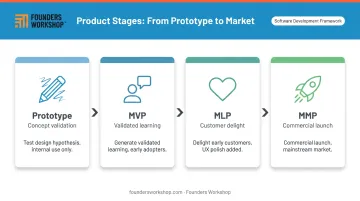
Prototype — A design hypothesis, not a product. It can be a low-fidelity sketch or a high-fidelity interactive mockup, used internally to test design decisions before committing to development.
MVP — A functional product released to real early adopters. The goal is validated learning: do people use it, and does their behavior confirm or challenge your core assumption? Completeness is irrelevant at this stage — learning is the only metric that matters.
MLP (Minimum Lovable Product) — Popularized by Aha! co-founder Brian de Haaff, the MLP reframes the question from "does it work?" to "do users genuinely love using it?" UX depth and delight stop being optional at this stage.
MMP (Minimum Marketable Product) — Roman Pichler's term for the smallest possible feature set that can be marketed and sold to mainstream customers. This is where commercial viability replaces validated learning as the primary benchmark.
Each stage builds on the last: Prototype → MVP → MLP → MMP. Identifying where you sit in that sequence is the first scoping decision you need to make — and it determines everything from feature set to release strategy.
Core Principles of MVP Design for Startups
These principles apply regardless of industry, team size, or budget. Skipping any one of them is expensive.
Solve One Problem Extremely Well
The most common design failure isn't ugly UI — it's diffused focus. Founders try to solve five problems simultaneously and end up solving none of them convincingly. The MVP should anchor to a single, urgent user problem. If you can't state the problem in one sentence, the scope is already too wide.
Usability Is Non-Negotiable, Even at MVP Stage
Users won't give meaningful feedback on a product they can't figure out. There's a minimum UX bar that must be met before launch:
- Clear navigation and logical flow
- Readable typography at all screen sizes
- An obvious path to the product's core value
Nielsen Norman Group's research confirms that testing with just 5 representative users reliably surfaces the most critical usability problems.
Design Around the User Journey, Not a Feature List
Map the 3–5 steps a user must take to experience the product's core value. Build only what enables that path. Features that live outside that critical journey belong in a future iteration — not in the MVP.
Build for Learning First, Scalability Second
MVP design decisions should prioritize testability: tracking where users go, where they drop off, and what they return to. Production-grade architecture can wait. Instrumenting the product to capture behavioral data from day one cannot — that data is what turns early user sessions into actionable decisions.
Clarity Beats Aesthetics
Visual polish is secondary to legibility and hierarchy. A first-time user should immediately understand what the product does and what action to take next. If they have to think about that for more than a few seconds, the design has failed its primary job.
The MVP Design Process: A Step-by-Step Guide for Founders
Step 1 — Define the Core Problem and Primary User
Before any design work begins, validate that the problem is real. Conduct lightweight user research: 5–10 user interviews, a short survey pushed to relevant online communities, or conversations in forums where your target users already spend time.
The question isn't "would you use this?" (the answer is almost always yes). Ask instead: "how do you currently handle this problem, and what does that cost you in time or money?" Their current behavior tells you more than their stated intentions.
At Founders Workshop, this validation work happens during the Discovery phase — a 2–4 week sprint where a dedicated Project Champion aligns product vision with actual market needs before design or development begins.
Step 2 — Map the Critical User Journey
Sketch the 3–5 steps a user must take to get from first contact with the product to experiencing its core value. Be ruthless about which steps are non-negotiable and which can be simplified or deferred.
For example: if you're building a marketplace, the critical path might be "create account → list item → receive offer → complete transaction." Everything outside that path is a future feature.
Step 3 — Wireframe Core Screens and Interaction Flows
Low-fidelity wireframes (even pen-and-paper sketches) let you visualize the product and gather feedback before writing a line of code. The goal at this stage is speed and cheap iteration, not visual polish. Tools like Figma work well, but the medium matters less than making the concept tangible.
A clickable prototype takes this a step further. It gives founders something real to put in front of customers, investors, or stakeholders — and the feedback you gather before development starts is far cheaper to act on than feedback gathered after.
Step 4 — Test with Real Users Before Building
Nielsen Norman Group recommends testing with no more than 5 users per qualitative round and running multiple small tests rather than one large one. After the fifth user, you typically start seeing repeated findings.
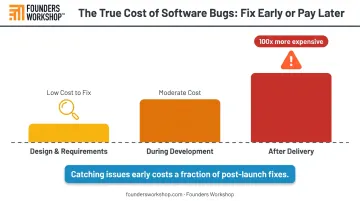
Show your wireframes or clickable prototype to 5+ representative users. Watch where they get confused. Listen to what they ask for. The fixes you make at this stage cost a fraction of what they'd cost after development. Research from Boehm and Basili found that fixing a software problem after delivery can be 100x more expensive than catching it during requirements and design.
Step 5 — Build, Launch to Early Adopters, and Measure
Before launch, pick 2–3 metrics that directly test your core hypothesis: activation rate, Day-7 retention, and qualitative feedback themes are a useful starting set. Tracking everything means learning nothing.
Release to a controlled group of early adopters, then study their behavior. What they do matters more than what they say. That behavioral data drives the next Build-Measure-Learn cycle: either you've confirmed the hypothesis and can build the next feature, or the data tells you something needs to change.
Founders Workshop's 5D Process (Discovery, Definition, Development, Deployment, and Dedicated Developer support) is built around exactly this cycle. Founders move from validated idea through design, development, and launch with a structured team behind them — no wasted resources, no equity given up to bring technical expertise in-house.
How to Scope Features: What Goes In and What Gets Cut
Scope creep is one of the most consistent project killers in software. PMI's 2018 Pulse of the Profession found that 52% of projects experienced scope creep — up from 43% five years earlier — and that poor project performance wasted $99 million for every $1 billion invested.
The Core Scoping Test
For every proposed feature, ask one question: "Would the MVP completely fail to deliver its core value without this?" If the answer is no, the feature doesn't belong in the first release. That's not a permanent rejection — it's a deferral. Put it in a backlog and revisit it after launch data comes in.
The MoSCoW Method
MoSCoW (created by Dai Clegg at Oracle) gives founders a simple categorization framework:
- Must Have — Non-negotiable; the MVP fails without it
- Should Have — Important but not launch-blocking; add in iteration 2
- Could Have — Nice to have if time and budget allow
- Won't Have (this time) — Explicitly out of scope for this release
The "Must Have" list forms your Minimum Usable Subset — the only features that belong in the first release.
The Scoping Mistake That Derails Most MVPs
Founders add features based on what they imagine users want rather than what research has confirmed. Hypothetical "nice-to-haves" are the primary reason MVPs launch late, run over budget, and still miss the mark. Every unvalidated feature you add is a bet made without data.
Competitive analysis helps calibrate scope — identify the minimum feature set your direct competitors offer, then stop there. Matching them feature-for-feature isn't the goal. Your MVP needs to solve one problem better than the alternatives, not win a feature count war.
Types of MVPs: Choosing the Right Format
Not every MVP requires months of custom development. The right format depends on what assumption you're trying to validate.
| MVP Type | Best Used When | Example |
|---|---|---|
| Landing Page MVP | Testing whether demand exists before building anything | Dropbox's explainer video drove its waiting list from 5,000 to 75,000 before the product launched |
| Concierge MVP | Testing whether your process delivers value before automating it | Manually delivering the service to validate the workflow |
| Piecemeal MVP | Simulating the product using existing off-the-shelf tools | Combining Airtable, Zapier, and a simple UI before building custom infrastructure |
Choosing the Right Type
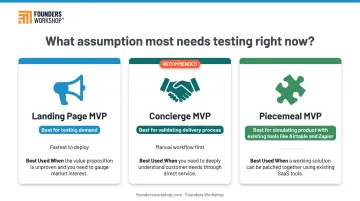
The question driving the choice: what assumption most needs to be tested right now?
- Testing demand? A landing page or explainer video answers that without writing a line of code
- Validating your delivery process? Run it manually first — a concierge approach reveals workflow gaps before you automate anything
- Connecting existing tools? A piecemeal MVP using Airtable, Zapier, or similar off-the-shelf tools gets you to an answer in days, not months
Selecting a lighter-weight format early can save months of development. The format determines the speed of your feedback loop — and in the early stages, faster feedback is worth more than cleaner code.
Common MVP Design Mistakes Founders Make
Mistake 1 — Treating the MVP as a Prototype and Never Launching
An MVP must reach real users to generate learning. Founders who endlessly refine without launching accumulate zero validated data while burning runway. The discomfort of releasing something imperfect is the point — it forces feedback that internal polish never will.
Mistake 2 — Skipping User Research and Designing on Assumptions
Building without validating the problem first is the fastest route to building something nobody uses. A few hours of user interviews before design begins can prevent months of wasted development. The legacy CB Insights benchmark — 42% of failed startups cited no market need — hasn't improved because founders keep skipping this step.
Mistake 3 — Over-Engineering the MVP
Trying to handle every edge case, integration, and polish feature before launch delays releases and inflates costs. The product still often misses the mark — because those extra months of development happened without real user feedback.
Common over-engineering traps include:
- Building integrations users haven't asked for
- Polishing UI before core flows are validated
- Architecting for scale before proving demand
- Adding admin features that manual workarounds can handle early on
Working with an experienced development partner helps here. Founders Workshop has built 200+ software solutions for startups since 2008, and that pattern recognition — knowing what to build now versus what can wait — is one of the clearest advantages of not building alone. Its Discovery and Definition phases are specifically designed to scope the most valuable features before any development budget is committed.

Frequently Asked Questions
What is an MVP for a startup?
An MVP (Minimum Viable Product) is the simplest functional version of a product that lets founders validate a core idea with real users using minimal time and resources. The goal, following the Lean Startup methodology, is to learn what customers actually need before committing to scale.
What is the difference between MVP, MMP, and MLP?
An MVP focuses on validating the core idea with early adopters. An MLP (Minimum Lovable Product) shifts focus to delivering a product users genuinely enjoy using. An MMP (Minimum Marketable Product) is the fully market-ready version prepared for broader commercial release.
What is the difference between an MVP and a prototype?
A prototype is a non-functional or simulated mockup used internally to test design concepts. An MVP is a functional product released to real users to validate market demand and gather behavioral feedback — and only real user behavior generates actionable learning.
What features should be included in an MVP?
Only features essential for delivering the product's core value and enabling feedback collection. If a user can still get value without a given feature, it belongs in a future iteration.
How long does it take to design and build an MVP?
Most software MVPs go from discovery to deployment in 3–6 months with tightly controlled scope. Pre-launch design and research typically takes 6–10 weeks, followed by a 2–3 month development phase — the same structure Founders Workshop follows in its 5D Process.
How much does it cost to build an MVP for a startup?
Costs depend on complexity, platforms, and team model. Founders Workshop typically sees startup MVP budgets between $80,000 and $350,000 for a 3–6 month engagement. Nearshore Latin American teams can cut that figure to roughly one-third of U.S. rates — without the communication friction of offshore development.