Introduction
Fintech compliance teams are drowning in documents. KYC packets, AML investigation files, loan applications, regulatory filings — the volume is staggering, and the stakes are unforgiving. FinCEN received 4.7 million Suspicious Activity Reports in FY2024 alone, averaging nearly 13,000 SARs per day. Getting document review wrong isn't just slow — it's expensive. TD Bank's failure to maintain an effective AML program resulted in a $1.3 billion civil penalty from FinCEN in 2024.
The tools most compliance teams rely on were built for a simpler era of paperwork. AI-powered document analysis is changing that — not by replacing human judgment, but by automating the repetitive, error-prone extraction work that slows teams down.
What follows is a practical look at why compliance documents are so difficult to process at scale, how AI-based systems actually handle them, and what fintech founders need to know before building or buying a solution.
Key Takeaways
- AI document analysis uses machine learning and NLP to extract, classify, and validate financial documents at scale
- It cuts manual review time across KYC, AML, underwriting, and regulatory reporting workflows
- Traditional OCR tools fail on messy, real-world financial documents — AI-based systems understand structure and context, not just characters
- Implementation requires resolving data quality, explainability, governance, and the build-vs-buy decision
Why Financial Compliance Documents Are So Difficult to Process
Financial compliance documents aren't clean, standardized data. They combine dense tables, scanned images, handwritten annotations, legal language, and multi-page layouts that vary by institution, jurisdiction, and time period.
Consider just three common document types:
- Bank statements vary dramatically between institutions — same data, entirely different layouts
- ISDA agreements may bury a critical term in a footnote referencing a definition 40 pages earlier
- KYC utility bills look different in Brazil versus Germany versus the United States, then change again when issuers update their templates
The Format Consistency Problem
Even the same document type changes constantly across countries, systems, and templates. This makes it impossible to rely on static extraction rules. The moment a bank updates its statement format or a government agency revises its tax form layout, template-based systems break — requiring manual re-tuning that compliance teams can't afford.
Research on financial document extraction bears this out: these documents routinely combine narratives, tables, and figures in scanned images with low resolution, skew, rotation, and multilingual content — a combination that defeats any rules-based approach.
Why Volume Makes Accuracy Non-Negotiable
Fintech companies don't process one document at a time. They handle thousands of onboarding flows, loan applications, and transaction investigations simultaneously. Compliance carries a zero-tolerance accuracy bar. A misread beneficial owner name or a dropped table row isn't a minor data entry error — it's a potential regulatory liability.
Where Traditional OCR Falls Short
Legacy OCR tools detect characters on a page but lose structural relationships. They can't tell that two numbers belong to the same table column, that a footnote modifies a clause from three pages earlier, or that indentation carries semantic meaning. Google Cloud's own documentation acknowledges that standard OCR can flatten document structure and lose context such as headings and lists.
The result: extracted text that looks complete but is structurally meaningless — and useless for downstream compliance workflows without expensive cleanup scripting.
How AI-Powered Document Analysis Works in Fintech
AI-powered document analysis applies NLP, computer vision, and machine learning — increasingly anchored by large language models — to extract structured, meaningful information from unstructured financial documents. The key distinction from legacy OCR is that it understands structure and context, not just raw characters.
Layout-Aware Parsing
Modern AI document systems understand that a multi-page table continues across pages, that column proximity carries meaning, and that a footnote modifies a clause from earlier in the document. This structural awareness is what separates them from legacy OCR.
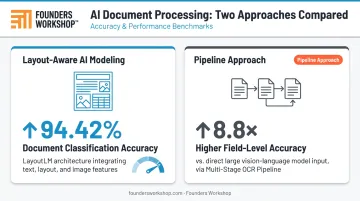
The LayoutLM model — which jointly models text and document layout for scanned document understanding — demonstrated 94.42% document classification accuracy when integrating image embeddings with layout-aware modeling. Separately, research using multi-stage OCR pipelines with compact vision-language models achieved 8.8 times higher field-level accuracy than feeding entire financial documents directly into large vision-language models. That's a meaningful practical finding for any team designing extraction pipelines.
Intelligent Extraction and Classification
Once layout is parsed, AI models identify and classify specific document elements — entity names, dates, financial figures, risk flags, signature fields — and output them in structured formats like JSON or Markdown. These outputs feed directly into compliance systems, audit tools, and connected AI agents without additional cleanup scripting.
Continuous Adaptability
Machine learning models adapt as new document formats appear, regulations change, or new jurisdictions are added — without rebuilding from scratch each time. McKinsey reported that rules-based AML monitoring generates false-positive rates as high as 90%, while machine learning investment can reduce false positives to below 50% and cut false reports by 20–30%. One institution improved suspicious-activity identification by up to 40% and efficiency by up to 30% using ML-based transaction monitoring.
Human-in-the-Loop Design
Effective AI document analysis doesn't remove humans from compliance — it focuses human attention where it matters most. High-confidence extractions move through automatically. Edge cases, anomalies, and high-risk documents go to reviewers alongside structured outputs that make each decision faster and fully traceable. In practice, this means compliance teams spend less time on routine document triage and more time on the judgment calls that actually require human expertise.
Key Use Cases for AI Document Analysis in Fintech Compliance
KYC and Customer Due Diligence
KYC workflows require processing a highly heterogeneous document set: passports, utility bills, corporate registration filings, ownership charts, tax forms. These vary by country, language, scan quality, and institution.
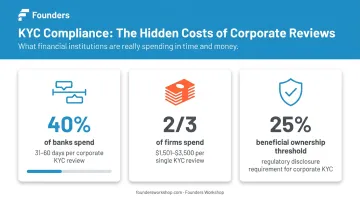
AI document analysis extracts identity fields, validates formatting consistency, cross-references against watchlists, and flags potential forgeries without requiring a custom template per document type. The compliance stakes are clear: FinCEN's CDD rule requires institutions to identify and verify beneficial owners meeting a 25% or more ownership threshold, with ongoing monitoring for suspicious transactions. Getting this wrong triggers enforcement.
The cost of slow KYC is also documented. According to a Fenergo survey of 1,000+ C-suite executives, 40% of banks report that a single corporate-client KYC review takes 31 to 60 days, with two-thirds of firms spending $1,501 to $3,500 per review. AI-assisted document extraction can significantly compress both timelines and costs.
AML Investigation and Suspicious Activity Review
AML compliance requires connecting information across customer records, transaction documents, beneficial ownership structures, and third-party data. Manually correlating these sources across 4.7 million annual SARs — at an estimated 1.98 hours per filing — creates a crushing operational load.
AI converts disparate documents into structured, searchable data that supports faster investigation, case preparation, and SAR filing. The reduction in false-positive burden alone is significant: when 9 out of 10 alerts are false positives, analysts spend most of their time confirming negatives rather than investigating real risk.
Loan Origination and Credit Underwriting
Loan underwriting depends on complex numerical documents — bank statements, tax returns, pay slips, business financials — that are often scanned and inconsistently formatted. AI table extraction and layout-aware parsing convert these documents into structured credit inputs that support faster decisions and reduce manual data entry errors.
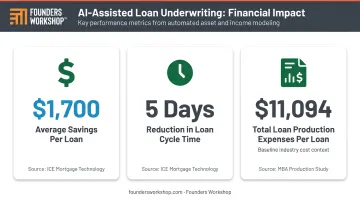
The financial case is concrete. Freddie Mac's automated asset and income modeling capabilities produced average savings of $1,700 per loan and reduced cycle time by 5 days. For independent mortgage banks carrying $11,094 in total loan production expenses per loan, automation at the document level has direct margin impact.
Regulatory Reporting and Contract Analysis
Regulatory reporting — BSA filings, SEC disclosures, EU GDPR documentation — demands accuracy, traceability, and repeatability at scale. The FCA's research on UK firms put the cost of regulatory reporting at £1.5 billion to £4 billion annually, and its Digital Regulatory Reporting TechSprint demonstrated that machine-executable reporting is achievable. US firms face comparable pressure across BSA/AML obligations, SEC filing requirements, and state-level disclosure rules.
The same document-parsing capability applies directly to contract review. JPMorgan Chase's COIN software reviewed commercial loan agreements and reportedly saved 360,000 hours of annual work by lawyers and loan officers. The reason the savings are that large: material terms in ISDA agreements, credit facility agreements, and vendor contracts are buried across definitions, schedules, and annexes. AI-powered clause extraction surfaces those terms automatically — so legal and compliance teams spend time on decisions, not on hunting through 200-page documents.
Key contract review tasks AI handles at scale:
- Identifies non-standard or missing clauses against baseline templates
- Flags deviation from negotiated terms in executed agreements
- Extracts obligation dates, termination triggers, and liability caps
- Cross-references defined terms used across multiple documents
Build vs. Buy: Choosing the Right Path
The intelligent document processing market reached $2.30 billion in 2024 and is projected to grow to $12.35 billion by 2030 at a 33.1% CAGR. Both off-the-shelf platforms and custom builds have legitimate cases.
Off-the-Shelf Platforms
Pre-built compliance document platforms offer faster deployment, lower upfront investment, and ready-made integrations. Gartner's Market Guide for IDP notes the market has no one-size-fits-all solution. Forrester evaluated 14 document mining and analytics platforms across 25 criteria in their Q2 2024 Wave.
When evaluating these platforms, prioritize:
- Accuracy on real, messy production documents (not demo files)
- Output format quality for downstream workflow integration
- Adaptability to your specific document types and jurisdictions
- Data sovereignty and security controls
The limitations are real: customization constraints, data sovereignty concerns, and reduced adaptability for niche document types or complex regulatory requirements.
Custom-Built Solutions
For fintechs with proprietary compliance workflows — or those building compliance as a core product differentiator — custom AI document analysis provides full control over model training, output formats, integration architecture, and data handling. The tradeoff is higher upfront investment and longer build timelines.
Founders Workshop's 5D Process (Discovery, Definition, Development, Deployment, Dedicated Support) gives fintech startups a defined process to scope and build custom AI compliance tools without an in-house AI engineering team. The Discovery phase (2–4 weeks) maps the exact document universe, integration requirements, and regulatory constraints before any build commitment. Projects typically run $80,000–$350,000 over 3–6 months — roughly one-third the cost of a US-only development team.
Post-launch Dedicated Support covers ongoing model maintenance and system updates, which is critical for compliance tools that need retraining as regulations or document formats change.
Decision Framework
Three questions help fintech founders choose:
- Is document compliance a differentiating capability or a commodity function? If it's core to your product, custom builds give you competitive control.
- Do your documents and workflows fit standard templates? High variability across jurisdictions or document types typically exceeds what off-the-shelf tools handle well.
- Do you need full data control for regulatory or security reasons? If yes, custom architecture is often the only viable path.
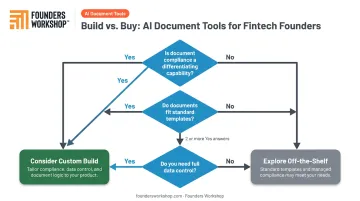
If two or more answers point toward custom, the cost difference between platforms and a custom build narrows quickly when you factor in integration workarounds, per-document pricing at scale, and the compliance risk of a tool that wasn't built for your document types.
Frequently Asked Questions
Frequently Asked Questions
Which AI is best for regulatory compliance?
The right choice depends on document types, jurisdictions, and workflow complexity. LLM-based platforms with layout-aware parsing consistently outperform legacy OCR for fintech use cases. Custom-built solutions deliver the most precision when off-the-shelf tools can't handle complex or proprietary document workflows.
How can AI automate financial document analysis?
AI combines NLP, computer vision, and machine learning to extract structured data from unstructured documents, identifying entities, financial figures, dates, and key clauses. Those outputs route directly into compliance workflows for review, validation, and reporting — no manual data entry required.
What types of financial documents can AI analyze for compliance?
Key document types include KYC identity documents (passports, utility bills), bank statements, tax returns, loan applications, AML investigation files, regulatory filings, ISDA and credit agreements, trade confirmations, and beneficial ownership charts.
What is the difference between traditional OCR and AI-powered document analysis?
Traditional OCR detects characters but loses structural context — table relationships, footnote cross-references, multi-page layouts. AI-powered document analysis understands document structure and meaning, producing outputs far more reliable for downstream compliance workflows.
What are the risks of using AI for financial compliance?
The core risks are inaccurate extractions from poor data quality, explainability gaps (the CFPB has stated algorithm opacity is not a defense for adverse-action failures), and over-reliance on automation without adequate human oversight. Model drift is also a concern when regulations or document formats change without retraining.
How long does it take to build a custom AI document analysis system?
Off-the-shelf tools can be configured in weeks. Custom AI systems take 2–6 months depending on document variety, integration requirements, and model training needs. Founders Workshop's 5D Process delivers an MVP in 3–6 months, from Discovery to Deployment.