The numbers back this up. J.D. Power's 2025 Property Claims Satisfaction Study found that property claims take an average of 32.4 days from filing to finished repairs and more than 44 days from FNOL to final payment. Meanwhile, 53% of first-time insurance buyers now start through digital channels, according to J.D. Power's 2024 Insurance Digital Experience Study. Customers arrive digitally — and too often hit manual, slow processes the moment they need help.
Conversational AI doesn't fix every problem in insurance. But in the right places, it cuts friction where friction hurts most: claims intake, policy questions, renewal outreach, and support at scale. This article covers what it actually does, where it delivers the most measurable impact, and what insurers miss when it's absent.
Key Takeaways
- Conversational AI uses NLP and machine learning to handle insurance interactions in real-time — claims intake, coverage questions, and renewals — across both voice and text channels.
- Key advantages: 24/7 availability, faster claims workflows, structured fraud triage, and measurable cost reduction at scale.
- Highest-ROI use cases: FNOL automation, underwriting data collection, policy self-service, and proactive renewal outreach.
- Without it: per-interaction costs climb, service quality becomes inconsistent, and competitive exposure grows as customer expectations shift digital.
- Real value requires system integration and ongoing optimization — not a one-time chatbot deployment.
What Is Conversational AI in Insurance?
Conversational AI is software that uses natural language processing (NLP) and machine learning to understand what policyholders say or type — and respond in a helpful, contextually aware way across voice and text channels.
Unlike a scripted decision tree that breaks when someone phrases a question unexpectedly, it understands intent, handles follow-up questions, and adapts as the conversation shifts.
Where It Operates in Insurance
Conversational AI shows up across three categories of insurance interaction:
- Customer-facing: Claims intake, policy questions, billing inquiries, renewal conversations
- Internal workflows: Data collection, case routing, adjuster handoffs with full context
- Proactive outreach: Renewal reminders, payment alerts, claims status updates
The insurance chatbot market gives a sense of the trajectory: Allied Market Research values it at $467.4M in 2022 and projects $4.5B by 2032 — a 25.6% CAGR. That growth is being driven by rising claims volumes, policyholder expectations for 24/7 self-service, and pressure on carriers to reduce operational costs without adding headcount.
What separates conversational AI from a basic chatbot comes down to nuanced, multi-turn dialogue. A policyholder describes what happened; the system understands without requiring them to navigate a menu or pick from preset options.
Key Benefits of Conversational AI in Insurance
The advantages below connect to metrics insurers actively track: claims cycle time, cost per interaction, CSAT scores, fraud loss rates, and retention. These are concrete operational improvements tied to specific pain points.
24/7 Availability and Operational Cost Reduction
Conversational AI handles inbound volume around the clock — answering policy questions, processing updates, routing complex cases — without requiring agents on shift. After-hours inquiries get answered. Seasonal volume spikes don't collapse the queue.
The demand for this is clear: 73% of customers prefer digital self-service for low-complexity tasks like payments and coverage lookups, according to J.D. Power's 2025 retention data. That's the majority of inbound contact volume — billing questions, document requests, password resets — that currently routes to agents who could be handling more complex work.
At the same time, 5 out of 6 customers prefer a live person for complex transactions like policy or premium changes. The model, then, is intelligent triage, not full automation. AI handles the volume, humans handle the judgment calls.
KPIs impacted:
- Cost per interaction
- First-contact resolution rate
- Call abandonment rate
- After-hours lead capture
When it matters most: High-volume carriers, regional insurers with small teams, and insurtechs scaling customer bases without proportionally scaling headcount.
Faster Claims Processing and Shorter Cycle Times
Conversational AI accelerates First Notice of Loss (FNOL) by collecting structured claim data in real time — validating policy details, capturing incident information, and routing to the right handler — without manual data entry delays.
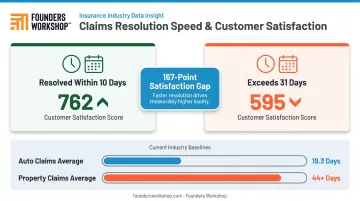
The current baseline shows how much room there is to improve. Auto claims average 19.3 days for repairable vehicles. Property claims stretch past 44 days from FNOL to final payment. And the satisfaction gap is stark: property claims resolved within 10 days average a satisfaction score of 762, while those exceeding 31 days average 595 — a 167-point gap that directly predicts renewal behavior.
80% of auto customers with a poor claims experience had left or planned to leave their carrier, per J.D. Power's 2024 Auto Claims Satisfaction Study. Slow claims aren't just a service problem — they're a retention problem.
AI reduces human touchpoints across the claims workflow by flagging missing data immediately, keeping the process moving, and sending proactive status updates. Insurers currently provide adequate proactive digital updates only 22% of the time, according to J.D. Power's 2025 Claims Digital Experience Study. That gap is a direct automation target.
KPIs impacted:
- Claims cycle time
- Time-to-first-response
- Manual processing cost per claim
- CSAT post-claim
When it matters most: Property and casualty insurers managing high claim volumes, particularly during weather events when manual capacity is exhausted and cycle times spike further.
Fraud Detection and Risk Intelligence
Conversational AI collects and analyzes information simultaneously. During a claims call or intake, AI monitors for behavioral patterns, inconsistencies in stated facts, and signals that match known fraud profiles. It cross-references real-time conversation data against claim history and third-party records to produce a risk score before a human adjuster reviews the case.
The scale of the problem makes this worth the investment. The Coalition Against Insurance Fraud, cited by NAIC, puts U.S. insurance fraud at $308.6 billion annually. NICB estimates 10% or more of property-casualty claims may be fraudulent.
The key operational advantage is timing. Conversational AI flags suspicious patterns at intake, before payouts are made. That's unlike post-claim audits, which recover losses after the fact. Structured intake data also gives Special Investigations Units cleaner, more complete information to work with when cases escalate.
KPIs impacted:
- Fraud detection rate
- Fraudulent claims flagged per quarter
- Loss ratio
- Time-to-flag suspicious claims
When it matters most: Insurers with high claim volumes, complex multi-party claims (auto, liability), or those operating in fraud-prone product lines.
Top Use Cases: Where Conversational AI Delivers the Most Value
These use cases represent the highest-ROI deployment areas — where conversational AI replaces or augments the most time-consuming, error-prone manual workflows.
Claims Intake and FNOL Automation
AI voice agents can manage the full FNOL call: answering, qualifying the policyholder, collecting structured incident data, and routing a complete case summary to an adjuster. No manual transcription, no data-entry lag. The most expensive part of claims (intake) becomes a consistent, auditable workflow rather than a variable one.
Underwriting Support and Speed-to-Quote
Conversational AI collects application data, validates inputs, and accelerates the quoting process. Traditional life insurance underwriting can take months. Data-driven P&C approaches, per McKinsey, can compress quoting to minutes rather than days.
Customer Support and Policy Self-Service
AI handles the majority of inbound policyholder inquiries without agent involvement:
- Billing questions and payment updates
- Coverage explanations and policy lookups
- Renewal processing and document access
- Mid-term policy changes and endorsements
These workflows resolve accurately when the AI connects directly to policy and billing systems — not just a static knowledge base.
Currently, 22% of customers use multiple channels just to find an answer to the same question. That's friction conversational AI eliminates when it's connected to core systems.
Proactive Renewal and Retention Outreach
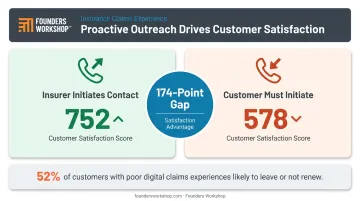
Reactive support handles problems. Proactive outreach prevents them. Conversational AI initiates outbound contact for renewals, payment reminders, and coverage reviews across the policyholder's preferred channel. J.D. Power data shows overall satisfaction scores of 752 when insurers initiate contact, versus 578 when customers must initiate. That 174-point gap has direct retention implications.
52% of customers with poor or just okay digital claims experiences are likely to leave or not renew. Reaching out before a renewal date — or after a claims touchpoint — is one of the most cost-effective ways to hold that relationship.
What Happens When Conversational AI Is Absent
Without conversational AI, insurers operate on manual queues, long hold times, and agents giving answers that vary depending on who picks up. Scaling during a hurricane season or open enrollment period means immediately hiring — or watching service quality degrade.
The downstream effects compound:
- Every delayed claim update increases the odds of churn
- Every unanswered after-hours call is a missed retention opportunity
- Every inconsistent coverage answer creates compliance exposure
More than 30% of insurance customers are already dissatisfied with insurer digital channels, according to McKinsey. And 6 in 10 switch channels before completing a purchase. Insurers that don't address this friction aren't just providing subpar service — they're actively pushing customers to evaluate alternatives.
P&C attrition is a $100B+ problem for the industry, according to J.D. Power's 2025 retention data. That figure makes the cost of inaction hard to ignore.
How to Get the Most Out of Conversational AI in Insurance
Conversational AI delivers compounding value when it's connected — integrated with core policy, claims, CRM, and billing systems so it can act on real data rather than give generic answers. A standalone chatbot that can't pull a policy number or update a claim record has limited practical impact.
Three practices separate high-performing deployments from stalled ones:
- Treat deployment as an ongoing product, not a launch event — update the AI as products, regulations, and customer questions evolve
- Monitor containment rates, drop-off points, and unresolved intents to identify where the system breaks down
- Match build type to complexity — off-the-shelf tools deploy faster, but custom builds give tighter control over logic, data handling, and legacy system integrations
For insurers with non-standard workflows or deep legacy dependencies, a purpose-built solution typically delivers more durable results.
That last point is where the build-vs-buy decision gets practical. Founders Workshop works with insurance startups and SMBs to design and build custom AI-powered software — including conversational AI integrations — tailored to specific workflows and systems. Their 5D Process (Discovery through Dedicated Developer support) is built to handle the integration complexity common in regulated industries, with ongoing optimization support included in the engagement model.
Frequently Asked Questions
What is the difference between a chatbot and conversational AI in insurance?
Chatbots follow scripted, rule-based flows — they work until a question falls outside the script. Conversational AI uses NLP and machine learning to understand intent, handle multi-turn dialogue, and adapt responses dynamically, making it appropriate for nuanced interactions like FNOL intake or coverage questions.
Can conversational AI handle complex insurance claims without human involvement?
For structured intake, data collection, and status updates, yes. Complex claims requiring legal interpretation, coverage disputes, or high-empathy situations route to human adjusters — with the full conversation context already captured, so there's no re-explaining.
How long does it take to implement conversational AI in an insurance company?
Pilot deployments for a single use case typically launch in 4–8 weeks. Full multi-workflow rollouts run 3–6 months, depending on system integrations, compliance requirements, and internal readiness. Legacy platform dependencies are the most common timeline variable.
What are the biggest risks of using conversational AI in insurance?
Poor integration with legacy systems, inaccurate responses on policy specifics, and compliance exposure if the AI provides incorrect coverage information. All three are mitigated through rigorous pre-deployment testing, deep system integration, and ongoing monitoring of containment and escalation rates.
Should insurance companies build or buy their conversational AI solution?
Buying accelerates deployment and reduces maintenance overhead. Building gives tighter control over workflows and data, particularly valuable when core system integrations are complex or proprietary. The right answer depends on how differentiated the insurer's processes are and what the existing tech stack can support.
How does conversational AI improve policyholder retention?
Faster claims resolution, consistent 24/7 support, and proactive renewal outreach all reduce friction at the moments that most influence renewal decisions. Policyholders who experience low-effort service interactions are significantly less likely to switch carriers at renewal.