Introduction
SaaS founders are under constant pressure: build faster, spend less, don't sacrifice quality. U.S. development rates make that math difficult — the Bureau of Labor Statistics reports the median annual wage for U.S. software developers at $133,080, with senior engineers pushing well past $159,000.
Latin American nearshore development has become the practical answer for U.S. SaaS teams. Unlike offshore arrangements in India or Eastern Europe, LatAm partners work in overlapping time zones — typically 0–3 hours from U.S. Eastern — enabling synchronous standups, real-time code reviews, and sprint cycles that stay on schedule.
That said, not every nearshore company is built for SaaS. Many specialize in fixed-scope delivery or staff augmentation without product context. SaaS teams need partners who understand iterative development, recurring feature delivery, and the pressure to ship before runway runs out.
This guide identifies five companies that meet those criteria — and breaks down what to look for before signing with any LatAm partner.
Key Takeaways
- The Latin America IT services outsourcing market reached $70.85B in 2024, growing at 10.1% CAGR — the region's talent infrastructure is well-established
- LatAm nearshoring can deliver over 30% savings vs. U.S. development rates, with timezone overlap that makes agile collaboration practical
- The best SaaS partners combine product development experience with technical delivery — not just staff headcount
- Companies covered: Founders Workshop, BairesDev, Gorilla Logic, Ubiminds, and Bixlabs
Why SaaS Companies Are Turning to Latin America for Nearshoring
The Market Has Matured
According to Grand View Research, the Latin America IT services outsourcing market generated $70.85B in revenue in 2024 and is projected to reach $126.32B by 2030 at a 10.1% CAGR. That trajectory reflects a decade of infrastructure investment, technical education, and startup ecosystem development across the region.
Cities like Buenos Aires, Bogotá, Mexico City, and Medellín now host active tech ecosystems. Startup Genome's 2024 rankings identified São Paulo, Mexico City, and Bogotá among Latin America's leading startup hubs, with StartupBlink tracking hundreds of funded companies in each city.
Why LatAm Specifically for SaaS
SaaS products live and die by iteration speed. That makes timezone alignment non-negotiable.
Key LatAm time zone offsets from U.S. Eastern:
- Mexico City: UTC-6 (1 hour behind EST, aligned during EDT)
- Bogotá: UTC-5 (same as EST)
- Buenos Aires / Montevideo / São Paulo: UTC-3 (2 hours ahead of EST)
This means morning standups, afternoon code reviews, and end-of-day sprint check-ins all happen in real time, with no asynchronous lag to slow iteration momentum.
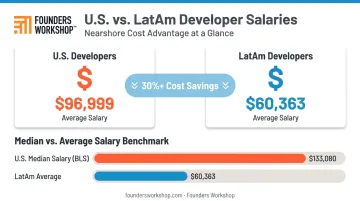
The cost case is equally compelling. Arc's developer salary data shows average remote salaries across Latin America at $60,363, compared to $96,999 for U.S.-based developers in their network. Accelerance reports LatAm outsourcing can deliver over 30% savings versus U.S. rates, with the gap widening at senior levels.
Top Nearshoring Companies in Latin America for SaaS
Each company below was evaluated on criteria relevant to SaaS teams: software product experience (not just staff augmentation), engagement model flexibility, technical depth, client track record, and U.S. collaboration capability.
Founders Workshop
Founded: 2008 | HQ: Arizona, USA | Team: 25+ senior developers, designers, testers, and PMs
Founders Workshop is an Arizona-based software innovation firm that builds custom B2B and B2C SaaS products for startups and SMBs, with a nearshore development team operating across Latin America and the Western Hemisphere. The firm has delivered 200+ software solutions since 2008, with four recognized by the Arizona Innovation Challenge.
What separates Founders Workshop from typical dev shops is the leadership layer. The founding team — CEO Vincent Serpico, CPO Wayne Neale, and COO Michael Vanderslice — collectively brings 30+ years of experience as founders, investors, and business operators.
They've worked with 81 startups and personally owned or operated 31 businesses. That context shapes how they approach SaaS founders — as strategic partners who understand the business stakes, not just the backlog.
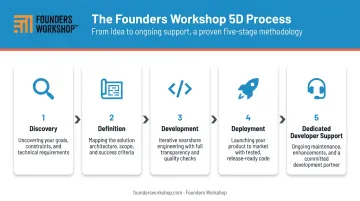
Their 5D Process (Discovery, Definition, Development, Deployment, Dedicated Developer support) guides clients from idea through market-ready MVP with structured phases and defined outputs. U.S.-based business analysts manage client communication and product direction, while nearshore LatAm developers handle execution — eliminating the coordination friction common in purely offshore arrangements.
Staff augmentation is also available at roughly one-third of U.S. team costs, with AI-first development integrated across all engagements.
| Category | Details |
|---|---|
| Engagement Model | Custom software development, staff augmentation, MVP build, AI integration |
| Key Strengths | Entrepreneurial leadership, 5D Process, U.S.-based business analysts + LatAm dev teams, AI-first development |
| Best Suited For | SaaS founders, early-stage startups, and SMBs building or scaling B2B/B2C software products |
BairesDev
Founded: 2009 | HQ: San Francisco, CA (LatAm delivery) | Clutch: 4.9/5 from 62 reviews
BairesDev offers staff augmentation, dedicated teams, and end-to-end software outsourcing, with access to 4,000+ timezone-aligned engineers across Latin America (company-reported). The firm claims to source from the top 1% of LatAm engineers and serves 500+ clients — including enterprise names like Google, Adobe, and Rolls-Royce.
For SaaS teams that need rapid access to vetted senior talent, BairesDev's deployment speed and scale are genuine differentiators. AI/ML specialization has grown alongside enterprise demand, making them a fit for technically complex product roadmaps.
One structural distinction: engineers remain BairesDev employees throughout the engagement. SaaS companies looking to build and eventually internalize an engineering function should factor that into the model.
| Category | Details |
|---|---|
| Engagement Model | Staff augmentation, dedicated teams, end-to-end project outsourcing |
| Key Strengths | Large vetted talent pool, rapid deployment, enterprise-scale capacity, AI/ML focus |
| Best Suited For | Mid-to-large SaaS companies needing fast access to senior LatAm engineers for ongoing development |
Gorilla Logic
Founded: 2002 | HQ: Broomfield, CO | Clutch: 4.9/5 from 23 reviews | Inc. 5000: 8 appearances
Gorilla Logic provides managed Agile delivery teams with engineers across Costa Rica, Colombia, and Mexico. With 250–999 employees (per Clutch) and eight Inc. 5000 appearances, they have a track record with Fortune 500 and high-growth companies that few LatAm firms can match.
Their strength is the managed pod model: Agile teams embedded into client sprint cadences without requiring the client to handle payroll, benefits, or local compliance. Engineers operate on client workflows, attend client ceremonies, and function as de facto internal staff — minus the overhead.
The engagement model is project-oriented rather than capacity-building. SaaS companies planning long-term owned engineering capacity should account for re-engagement dynamics when scoping the relationship.
| Category | Details |
|---|---|
| Engagement Model | Managed Agile teams, dedicated pods, SOW-based delivery |
| Key Strengths | Agile-native delivery, strong Clutch reputation, multi-country coverage, no local entity setup required |
| Best Suited For | SaaS companies scaling sprint-based delivery who want a managed team without internal compliance overhead |
Ubiminds
Founded: 2017 | HQ: Florianópolis, Brazil | Clutch: 4.9/5 from 9 reviews
Ubiminds is explicitly built for SaaS. Their Talent-as-a-Service and employer-of-record (EOR) model connects North American SaaS companies with product-minded engineers, designers, QA, and product managers across Latin America — while handling HR, legal compliance, and equipment logistics in each country.
For U.S. SaaS teams expanding their LatAm headcount, the EOR structure solves a real problem: Latin American labor law is complex, varies by country, and carries meaningful co-employment liability. Ubiminds absorbs that risk. All placed professionals are required to meet C1/C2 English proficiency standards.
The model is best suited for scaling an existing product team rather than building a product from scratch — there's a $100K+ minimum project threshold on Clutch, and the focus is team composition, not end-to-end delivery.
| Category | Details |
|---|---|
| Engagement Model | Staff augmentation, Talent-as-a-Service, fractional roles, development outsourcing |
| Key Strengths | SaaS team-building expertise, EOR compliance, equipment logistics, C1/C2 English requirement |
| Best Suited For | U.S. SaaS companies expanding LatAm teams who want compliance and logistics handled end-to-end |
Bixlabs
Founded: 2014 | HQ: Montevideo, Uruguay | U.S. Office: Houston, TX | Clutch: 4.8/5 from 31 reviews
Bixlabs describes itself as a "Latin American SaaS Development Company" — and the positioning holds up. They specialize in building and scaling applications and SaaS platforms for U.S.-based startups, with public case studies including Theta Lake (AI compliance platform), Trellis, and Muralpay. Client partnerships average over two years.
Their team footprint is smaller than BairesDev or Gorilla Logic, which is actually a fit for early-stage SaaS builds. Engagements include project managers and QA alongside developers — full-service product development rather than headcount-only. Bixlabs has also published client-side IP guidance recommending sole client ownership of application IP, which signals alignment with startup-standard contract practices.
| Category | Details |
|---|---|
| Engagement Model | Dedicated teams, full project outsourcing, staff augmentation |
| Key Strengths | SaaS product specialization, long-term client relationships, startup culture fluency, IP-protective practices |
| Best Suited For | Early-stage SaaS startups needing a full-service product development partner for apps and SaaS platforms |
What to Look For in a Latin American Nearshoring Partner for SaaS
Many nearshore companies are optimized for project delivery — a fixed scope, a defined output, a handoff. SaaS doesn't work like that. Features ship weekly. Priorities shift with user feedback. The roadmap in month three looks nothing like the roadmap at kickoff.
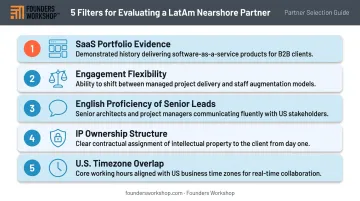
Before signing with any LatAm partner, run them through these five filters:
- SaaS portfolio evidence — Have they shipped iterative software products, or just completed fixed-scope builds? Ask for client references who can speak to long-term delivery.
- Engagement flexibility — Can the team scale up or down monthly based on sprint load? Fixed-headcount contracts are a poor match for early-stage SaaS.
- English proficiency of senior leads — Argentina ranks #26 globally on the EF English Proficiency Index, but other markets vary. Require demonstrated communication skills from technical leads before committing.
- IP ownership structure — Require present-tense assignment language ("hereby assigns") rather than future-promise language ("agrees to assign"). Ensure code repositories sit on your GitHub or GitLab account from the first commit.
- U.S. timezone overlap — Minimum 4–6 hours of shared working hours with your core team. Most LatAm hubs provide this by default, but verify for your specific city pairing.
The Factor Most Founders Overlook
Technical execution is only part of the equation. The real differentiator is whether the partner can help you make product decisions — not just execute tickets.
The best nearshore partners bring business context into the build: they push back on scope creep, flag when a feature doesn't align with the MVP thesis, and have opinions on monetization and UX that come from shipping products themselves.
When evaluating partners, ask: Has anyone on their leadership team ever built and sold a software product? Firms like Founders Workshop are built around this principle — the leadership team includes founders and investors with 30+ years of operating experience, not just developers. That background changes how your roadmap gets challenged. If your shortlisted partner can't answer yes, you're buying execution — valuable, but not a strategic partnership.
Conclusion
Choosing a nearshoring partner in Latin America isn't purely a cost decision. The right partner brings timezone alignment, technical depth, and SaaS-specific delivery experience. The wrong one turns a promising product into a slow, frustrating engagement.
For SaaS founders and SMBs who want a partner that combines nearshore LatAm development with genuine entrepreneurial guidance, Founders Workshop's 5D Process, 200+ delivered solutions, and AI-accelerated build approach make them a strong first call. The leadership team has founded and operated their own businesses, which means they scope projects realistically, protect your equity, and engage with your product like they have skin in the game.
Schedule a Discovery Call with the Founders Workshop team to talk through your product idea and what an engagement could look like.
Frequently Asked Questions
What is nearshoring and how is it different from offshoring for SaaS companies?
Nearshoring means working with development teams in geographically close countries that share or overlap your time zone — Latin America for U.S. companies. Offshoring typically means distant markets like India or Eastern Europe, where 8–12 hour time differences delay sprint reviews and block same-day collaboration — a serious problem for agile SaaS teams.
How much can a SaaS startup save by nearshoring to Latin America?
Accelerance reports LatAm outsourcing can deliver over 30% savings compared to U.S. rates, and BLS/Arc data shows average LatAm remote developer salaries around $60,000 versus $97,000+ in the U.S. Savings vary by country, seniority, and engagement model — Uruguay tends to price higher than Colombia or Mexico, for instance.
Which Latin American countries are best for SaaS nearshoring?
The leading markets are Mexico (strongest U.S. timezone alignment), Argentina (high English proficiency, ranked #26 globally by EF EPI), Colombia and Brazil (large talent pools, active startup ecosystems), Uruguay (senior-level reputation, 300+ software export companies), and Costa Rica (consistent English proficiency and timezone fit).
What engagement model is best for early-stage SaaS companies?
Dedicated product development partnerships beat pure staff augmentation at the early stage. When the product definition is still evolving, you need integrated design, engineering, strategy, and QA — not just developers to assign tickets to. Founders Workshop's 5D Process is an example of this full-service model, versus headcount-only augmentation.
How do I protect my intellectual property with a LatAm nearshore company?
Three steps protect your IP before work begins:
- Use "hereby assigns" (not "agrees to assign") in contracts — the former is an immediate transfer, the latter a future promise
- Require NDA coverage for all personnel and host all code repositories on your own GitHub or GitLab account from day one
- Have your attorney review the IP ownership clause before signing
How long does it take to get a nearshore SaaS development team up and running?
Staff augmentation partners can typically place vetted engineers within 1–3 weeks. Building a dedicated product team with discovery and onboarding usually takes 3–6 weeks — Founders Workshop, for example, can begin work in as little as two weeks. Start with a short paid trial or discovery sprint before committing to a longer engagement.