
Introduction
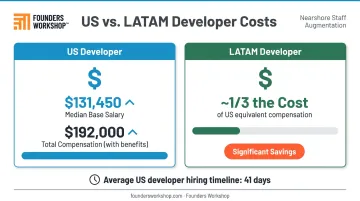
US founders and SMBs are facing a tough reality: the median US software developer earns $131,450 per year, and total compensation at larger companies averages $192,000. Add benefits, recruiting costs, and the time it takes to fill roles — currently 41 days on average even in a favorable market — and building a domestic engineering team adds up fast.
Nearshore Latin America has become the go-to answer — and for reasons offshore alternatives in Eastern Europe or Southeast Asia can't replicate:
- Time zone overlap with US business hours, so standups and code reviews happen in real time
- Cultural alignment with North American work norms and communication styles
- Developer rates that run a fraction of what US-based talent commands
But not every LATAM country delivers equally. Mexico, Colombia, Argentina, Brazil, and Chile each bring different strengths — whether that's English proficiency, talent depth, cost structure, or technical focus. This guide breaks down each country so you can match the right market to your team's actual needs.
Key Takeaways
- LATAM offers US companies time zone overlap, cultural alignment, and developer costs roughly one-third of US rates
- Mexico leads in proximity; Colombia in cost-to-quality; Argentina in English fluency and engineering depth; Brazil in raw talent volume; Chile in stability and senior talent
- Your budget, English requirements, tech stack, and team size needs determine which country fits best
- No single country dominates every use case — the right fit depends on your specific hiring profile
- Country selection matters, but partnering with an experienced nearshore provider matters more
Why Latin America Is the Right Nearshore Region for US Companies
IT staff augmentation in LATAM means adding skilled developers from countries like Mexico, Colombia, Argentina, or Brazil directly to your in-house team — with you maintaining full control over the roadmap and day-to-day management. It's not outsourcing a project; it's extending your team with vetted talent.
Three factors set LATAM apart from other nearshore regions:
- Time zones that actually overlap — Most LATAM countries share 4–8 hours of daily business hours with US teams, enabling real-time standups, code reviews, and product discussions without awkward scheduling
- Cultural alignment — LATAM developers operate within business norms that closely match North American practices: direct communication, agile familiarity, and Western project management conventions
- Cost efficiency without quality trade-offs — Salary benchmarks across LATAM are well below US rates, but the technical depth in leading markets is genuinely competitive
For context, the average US software engineer total compensation is $192,000. LATAM salary benchmarks — even for senior developers — fall well below that figure. Founders Workshop, an Arizona-based nearshore partner operating since 2008, consistently places LATAM developers with US clients at roughly one-third of US team costs.
Those cost advantages hold across the region — but they don't tell you where to hire. LATAM isn't monolithic. Each country has its own talent concentrations, English proficiency levels, and technical specializations. Picking based on name recognition rather than fit is where most companies go wrong.
Best Countries for Staff Augmentation in Latin America
The five countries below were selected based on talent depth, cost-effectiveness, time zone alignment, English proficiency, and cultural fit with US teams. Each profile follows a consistent structure to make direct comparison straightforward.
Mexico
Mexico is the most geographically proximate LATAM market for US companies — and the numbers back it up. DataMexico reports 371,000 analysts, software developers, and multimedia workers as of Q1 2025, making it one of the largest developer concentrations in the region. Mexico's public institutions produced 169,000 STEM graduates in 2021–2022, with 17.6% specializing in ICT fields.
Key differentiators:
- Near-zero time zone difference from most US cities (CST/PST alignment)
- USMCA Article 19.16 provides direct IP protections — no party can require access to source code or algorithms as a condition of doing business
- Strong front-end, full-stack, and mobile development clusters in Mexico City, Guadalajara, and Monterrey
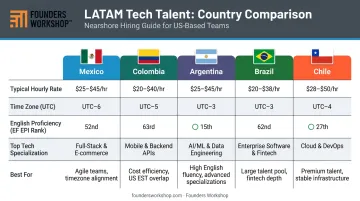
English proficiency is moderate nationally (EF EPI 2025: #103, score 440), but urban tech hubs score significantly higher — Monterrey at 532, Guadalajara at 511.
| Factor | Detail |
|---|---|
| Typical Hourly Rate | ~$25–$45/hr (mid-to-senior, salary equivalent basis) |
| Time Zone | UTC-6 to UTC-8; 0–2 hour difference from most US time zones |
| Best For | Near-real-time collaboration, front-end/full-stack teams, IP-sensitive projects |
Colombia
Colombia's tech sector has grown fast. Fedesoft reports the country's information and telecommunications sector employed 406,000 workers in 2024, with software and IT industry sales reaching $44.25 trillion COP — up 50% since 2020. Government-backed programs like Misión TIC have actively built the talent pipeline, targeting a digital talent gap estimated at 160,000–265,000 professionals.
Key differentiators:
- UTC-5 time zone mirrors US Eastern Standard Time, providing full business-hour overlap for East Coast teams
- One of the most competitive hourly rates among the five featured countries
- Growing specialization clusters in Bogotá and Medellín, particularly in cloud and DevOps
English proficiency sits at EF EPI #76, score 480 — functional but variable. For teams where a technical lead handles architecture discussions and developers execute within defined sprint structures, Colombia is a strong fit.
| Factor | Detail |
|---|---|
| Typical Hourly Rate | ~$20–$38/hr (mid-to-senior, salary equivalent basis) |
| Time Zone | UTC-5; mirrors US Eastern Standard Time |
| Best For | Budget-conscious startups and SMBs needing cloud, DevOps, or full-stack talent |
Argentina
Argentina's export numbers tell the story. CESSI reports the software sector added 6,131 jobs in 2024 and exported USD $2.674 billion in software services, with 46.9% of those exports going to the US — a clear signal that Argentine developers work fluently within US product and engineering cultures.
Key differentiators:
- Highest English proficiency in the region: EF EPI #26, score 575 — well ahead of any other LATAM country in this comparison
- Six-year engineering programs produce graduates with strong theoretical foundations, particularly in backend architecture
- Buenos Aires startup ecosystem closely mirrors North American tech culture
Argentina's currency instability creates some contracting complexity, but it also means senior talent is highly cost-competitive relative to skill level. That combination — strong English, deep engineering training, and US-aligned work culture — makes Argentina the strongest LATAM option for teams where complex architectural discussions, product strategy input, or direct client-facing developer communication matters.
| Factor | Detail |
|---|---|
| Typical Hourly Rate | ~$25–$45/hr (mid-to-senior, salary equivalent basis) |
| Time Zone | UTC-3; 2–3 hours ahead of US East Coast |
| Best For | Senior engineers, AI/ML specialists, complex architecture work, communication-heavy roles |
Brazil
Brazil is LATAM's largest tech market by a wide margin. BRASSCOM reports 2.05 million ICT sector workers as of 2023, with higher education producing approximately 53,000 tech-profile graduates annually — though demand for ICT professionals runs at roughly 159,000 per year through 2025, creating a competitive but deep talent pool.
Key differentiators:
- Largest raw talent pool in the region, suited for rapid team scaling
- Strong technical depth in data science, fintech systems, and cloud infrastructure
- UTC-3 time zone aligns closely with US Eastern time
- Established enterprise-grade development culture across São Paulo, Curitiba, and Florianópolis
Two factors require planning before hiring in Brazil. English proficiency ranks #75 on EF EPI 2025 (score 482), making individual screening important for communication-heavy roles.
Brazil's CLT labor law framework also adds compliance complexity — partnering with a provider who understands local employment classification rules is worth the added structure.
| Factor | Detail |
|---|---|
| Typical Hourly Rate | ~$22–$40/hr (mid-to-senior, salary equivalent basis) |
| Time Zone | UTC-3; 6–8 hours of daily overlap with East Coast teams |
| Best For | Large-scale team builds, enterprise-grade projects, data science and fintech specialization |

Chile
Chile consistently ranks at the top of LATAM for political stability, internet infrastructure, and ease of doing business — factors that matter when you're building a long-term development relationship, not just filling a seat. Its fintech ecosystem is mature — FinteChile/Finnovista reported 348 active fintech startups in 2024, a 16% increase year over year — and the country's legal frameworks align closely with international IP standards.
Key differentiators:
- EF EPI #54, score 517 — second only to Argentina in this group
- Strongest alignment with US corporate compliance expectations, particularly for regulated industries
- WIPO Global Innovation Index 2024 places Chile in the top tier for FDI inflows and tertiary enrollment in the region
Hourly rates are higher than Colombia or Brazil, which reflects the quality premium. Chile is best suited for companies where compliance consistency and senior talent depth outweigh cost as the primary decision factor.
| Factor | Detail |
|---|---|
| Typical Hourly Rate | ~$30–$50/hr (mid-to-senior, salary equivalent basis) |
| Time Zone | UTC-3 to UTC-4; 4–6 hours of overlap with East Coast teams |
| Best For | Regulated industries (fintech, healthcare), senior talent, infrastructure-critical projects |
How to Choose the Right LATAM Country for Your Team
No single country is universally best. The right choice comes from matching your specific priorities to country strengths across four decision factors.
Budget vs. Quality Trade-Off
- Lowest rates: Colombia and Mexico — strong entry points for early-stage startups
- Mid-range with scale: Brazil — solid price-to-quality ratio for teams that need to grow quickly
- Premium tier: Argentina and Chile — higher rates that reflect stronger English proficiency and deeper senior talent
English Proficiency and Communication Needs
For roles requiring architectural discussions, product strategy input, or client-facing developer communication, the ranking is clear: Argentina > Chile > Brazil ≈ Colombia > Mexico.
For roles where developers work within well-defined sprint structures and a technical lead handles external communication, Brazil and Colombia are fully viable.
Tech Stack and Specialization
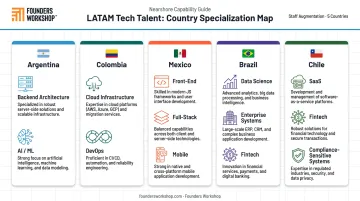
Map your stack to country strengths:
- Argentina — backend architecture, AI/ML development
- Colombia — cloud infrastructure, DevOps
- Mexico — front-end, full-stack, mobile
- Brazil — data science, enterprise systems, fintech platforms
- Chile — SaaS products, fintech, compliance-sensitive systems
Team Size and Time-to-Hire Speed
Brazil and Mexico have the largest raw talent pools for companies needing to hire 5–20 engineers on an accelerated timeline. Smaller markets like Chile are better for niche specialist roles where quality matters more than volume.
Founders Workshop, for example, can place vetted LATAM developers within two weeks — compared to the 3–6 months it takes to recruit and onboard an equivalent US-based hire. For teams racing toward a launch date, that gap is hard to ignore.
How We Chose the Best LATAM Countries for Staff Augmentation
Each country was evaluated across five factors:
- Talent pool size and technical depth
- Cost-effectiveness relative to US rates
- Time zone alignment with US business hours
- English proficiency
- Cultural alignment with North American work practices
Common mistakes companies make when choosing a LATAM country:
- Selecting solely on lowest hourly rate without accounting for English proficiency gaps that slow sprint delivery
- Ignoring labor law complexity in markets like Brazil, where CLT employment classification rules require experienced local partners to navigate correctly
- Choosing based on name recognition rather than fit with their specific tech stack — a React-heavy team needs a country with strong frontend talent, not just the most-recognized outsourcing hub
Country selection is only half the equation. The right partner handles local compliance, runs rigorous technical screening, and integrates remote talent into your existing team — so the engagement runs smoothly from day one.
Conclusion
Mexico, Colombia, Argentina, Brazil, and Chile each offer compelling but distinct advantages. There's no universal answer. The best country depends entirely on whether your team prioritizes cost, English fluency, talent volume, or compliance stability.
For startups and SMBs, the right partner matters as much as the right country. Vetting, compliance, onboarding, and cultural integration determine whether an engagement works — and those are handled by your partner, not the geography itself.
Founders Workshop is an Arizona-based nearshore development and staff augmentation firm that has been building software teams across Latin America since 2008, with 200+ completed software solutions and senior LATAM developers placed at roughly one-third of US team costs. Talk to the Founders Workshop team about your specific hiring needs.
Frequently Asked Questions
Which Latin American country is best for staff augmentation?
There's no single answer. Mexico leads in time zone proximity and front-end talent, Colombia in cost-efficiency, Argentina in English fluency and senior engineering depth, and Brazil in raw talent volume. The right choice depends on your team size, budget, tech stack, and communication requirements.
What jobs are most in demand in Latin America's tech sector?
The highest-demand roles include full-stack developers, DevOps and cloud engineers, data scientists, AI/ML engineers, QA automation specialists, and mobile developers. Colombia and Mexico see the strongest cloud demand; Argentina leads in AI/ML specialization.
What Latin American country has the highest developer wages?
Chile and Argentina typically command the highest developer rates in LATAM, reflecting stronger English proficiency, more mature IT ecosystems, and higher living costs — while still remaining significantly more affordable than equivalent US or Western European rates.
How much can I save by using LATAM staff augmentation instead of hiring in the US?
US developers earn a median of $131,450 per year according to BLS data, with total compensation averaging $192,000 at major companies. LATAM senior developers typically cost about one-third of that. Nearshore partners like Founders Workshop handle sourcing and vetting, so you capture those savings without the hiring overhead.
What is the best LATAM country for early-stage startups and SMBs?
Colombia and Mexico are typically the top choices due to affordable rates, strong technical proficiency, and favorable time zone overlap. Argentina is a strong alternative when English fluency and senior-level engineering judgment are critical requirements.
How do I get started with staff augmentation in Latin America?
Start by defining role requirements, tech stack needs, and budget. Then partner with an experienced nearshore provider who handles local compliance, candidate vetting, and team integration. A good partner can place developers in as little as two weeks, compared to the months a typical US hire takes.