Introduction
Every founder faces the same tension: move fast enough to stay relevant, but avoid building something nobody wants. That second risk is more common than most realize. According to CB Insights' analysis of 400+ startup post-mortems, 35% of startups fail specifically because they built products with no genuine market demand — not because of poor execution, funding problems, or bad timing.
The pattern is predictable: a founder has a strong conviction, builds a full product based on that conviction, then discovers too late that real users see the problem differently. By that point, months of runway are gone.
MVP development services exist to break this pattern. Rather than treating validation as something that happens after launch, a structured MVP process embeds it from day one, closing the gap between assumption and real user evidence before the budget runs out.
What follows breaks down what MVP development services actually include, how product-market fit is measured in practice, and the specific mechanisms that connect the two — so you can evaluate whether this approach fits your current stage.
Key Takeaways
- 35% of startups fail because they never confirmed real market demand before building
- MVP development services build the smallest product needed to test your riskiest assumption, not a finished product
- Product-market fit is measurable: 40%+ of users saying they'd be "very disappointed" without your product is a proven benchmark
- A structured MVP process compresses the build-measure-learn cycle from months to weeks
- Nearshore MVP teams cost roughly one-third of U.S. in-house development — without equity dilution
What Are MVP Development Services?
MVP development services cover the full arc from idea to testable product: strategy, product design, core feature development, testing, and launch — with speed to market and early validation as the primary goals, not feature completeness.
What They Are (and Aren't)
The distinction matters. MVP services are not:
- Freelance coding for hire
- A "cheaper version" of a full product build
- A technical handoff disconnected from your business goals
They are a purposefully minimal product engineered to test the riskiest assumption in a business model with the least possible effort and cost. As Eric Ries defines it, an MVP is the version that lets a team collect maximum validated learning with minimum effort — the keyword being learning, not shipping.
Why These Services Exist
Most founders lack three things needed to build and validate software efficiently:
- An in-house technical team with product development experience
- UX/product design expertise
- A structured validation process
Hiring to fill those gaps is expensive and slow. Building an internal product development team can take three to six months to recruit and cost up to $1 million per year plus equity. MVP services fill that gap by providing a complete, experienced team — developers, designers, QA testers, product managers, and a dedicated project lead — without permanent headcount or equity dilution.
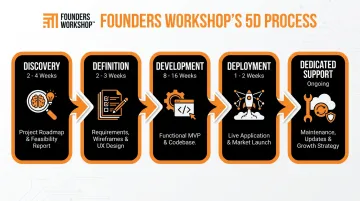
Founders Workshop, for example, operates through a field-tested 5D Process (Discovery, Definition, Development, Deployment, Dedicated Support) built specifically to translate business ideas into market-ready MVPs. Their team has worked across 81 startups collectively, and the leadership team has owned or co-founded 31 businesses — so when a founder hits a pivot decision or a budget constraint, the team has been in that position before.
What Is Product-Market Fit, and Why Is It So Hard to Reach?
Marc Andreessen's original definition remains the clearest: product-market fit means "being in a good market with a product that can satisfy that market." Users aren't just trying it — they're returning to it, recommending it, and willing to pay for it. PMF isn't a single event; it's a signal that strengthens through repeated, validated behavior.
The Assumption Gap
The reason PMF is hard to reach without a structured process comes down to how founders think. Cognitive biases — particularly the false consensus effect — cause founders to overestimate how much others share their beliefs, leading them to build from personal assumptions rather than real user needs.
Steve Blank's research frames this directly: lean startup methodology replaces elaborate planning with experimentation and intuition with customer feedback, precisely because intuition alone consistently misfires.
Why Early Enthusiasm Misleads
The assumption gap compounds a second problem: PMF is easy to fake, at least temporarily. Early sign-ups from friends, enthusiastic beta users, and initial app downloads can all look like traction. They rarely represent sustainable demand.
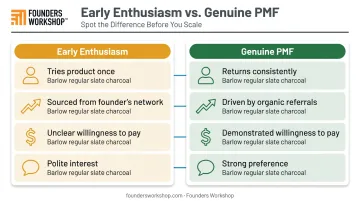
The difference between early enthusiasm and genuine PMF:
| Signal | Early Enthusiasm | Genuine PMF |
|---|---|---|
| User behavior | Tries product once | Returns consistently |
| Growth source | Founder's network | Organic referrals |
| Willingness to pay | Unclear | Demonstrated |
| Feedback tone | Polite interest | Strong preference |
Distinguishing one from the other requires a disciplined validation process — which is exactly where MVP development methodology earns its place.
How MVP Development Services Fast-Track Product-Market Fit
Mechanism 1: Validation Before a Line of Code Is Written
Professional MVP services begin with customer discovery and market sizing, not development — the goal is confirming the problem is real, frequent, and painful enough before any engineering resources are committed.
In Founders Workshop's 5D Process, the Discovery phase (2–4 weeks) covers:
- Goal definition and user feature prioritization
- Business model validation
- Competitive analysis and market sizing
This eliminates the single most common reason products fail: building something the market doesn't need.
Mechanism 2: Compressing the Feedback Loop
Getting a working product in front of real users in weeks in weeks, rather than months, produces far more reliable signal. User behavior data is more honest than survey responses, focus groups, or founder conviction.
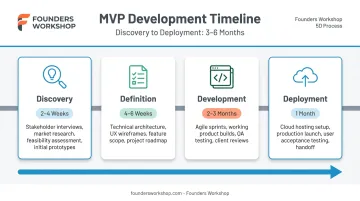
Y Combinator advises most founders to build a lean MVP fast, in weeks rather than months. Founders Workshop's typical timeline runs 3–6 months from Discovery to Deployment, with the development phase alone spanning 2–3 months. That's significantly faster than the 3–6 months typically needed just to recruit an internal team.
Mechanism 3: Agile Development That Responds to Real Signals
Short sprints, continuous iteration, and rapid feature rollouts mean that when user behavior signals a pivot is needed, the team can respond without dismantling months of work. That responsiveness is what keeps early-stage products from becoming expensive bets on the wrong direction.
Mechanism 4: Cost Efficiency Without Equity Sacrifice
Founders Workshop's nearshore Latin American model delivers projects for $80,000–$350,000 over a 3–6 month period at roughly one-third the cost of U.S.-based teams. Compare that to the Bureau of Labor Statistics' 2024 median annual wage for U.S. software developers of $133,080, before factoring in benefits, recruiting time, or equity.
Founders can preserve runway and avoid giving up equity to a technical co-founder just to get a product built.
Mechanism 5: Investor Readiness
A functional MVP with real user engagement data is a fundamentally different fundraising tool than a pitch deck. Y Combinator's guidance on Series A fundraising is explicit: founders must show evidence the business can become large. At seed, most founders need product, users, or growth, not just an idea.
Founders Workshop's Definition phase produces clickable prototypes specifically designed to secure letters of intent from customers and external funding before development begins. Four solutions built by the team have been recognized by the Arizona Innovation Challenge — a track record that matters when investors are evaluating execution capability.
The Stages of a Structured MVP Process
What separates professional MVP services from freelance coding is a repeatable process that embeds market validation at every stage — not just after launch.
Problem and Market Validation
The foundation: who are the early adopters, are they already trying to solve this problem, and what does success look like in their language? This happens through customer interviews, competitor analysis, and market segmentation — before development begins.
In Founders Workshop's Discovery phase, a dedicated Project Champion (a seasoned entrepreneur, not a project manager) leads this work. The output is a scoped feature set aligned with real market needs, not the founder's wishlist.
Core Feature Scoping
Once the problem is validated, the process prioritizes with discipline. Only the feature set that directly addresses the validated need gets built. Everything else goes into a product backlog.
The Definition phase (4–6 weeks) produces detailed wireframes, interface designs, and a clickable prototype, a tangible artifact that can be tested with real users or shown to investors before a single line of production code is written.
Build and Launch
Development is timeboxed and agile. Founders Workshop's Development phase runs 2–3 months, followed by a Deployment phase (~1 month) that includes cloud hosting, 24/7 server monitoring, and the analytics infrastructure needed to measure user behavior from day one.
User analytics are included as a standard component across all post-launch support tiers — meaning engagement data is available from launch, not retrofitted later.
Measure and Learn
Most PMF acceleration happens after launch. User behavior data, retention metrics, and qualitative feedback from early adopters reveal which assumptions held and which need rethinking.
The Dedicated Developer Support phase (D5) turns those signals into action through:
- Usability audits identifying friction points in the live product
- Feature updates driven by actual user behavior, not speculation
- Performance optimization as usage scales
- Product strategy consulting to guide the next development cycle
How to Know When You've Reached Product-Market Fit
The 40% Benchmark
Sean Ellis's must-have survey remains one of the most practical PMF signals available. Users are asked: "How would you feel if you could no longer use this product?" If 40% or more answer "very disappointed," that's a strong indicator of genuine PMF. First Round Capital and Reforge both teach this benchmark as a leading indicator, supplemented by behavioral data.
Below 40%, the signal is weak regardless of other metrics.
Behavioral Indicators to Watch
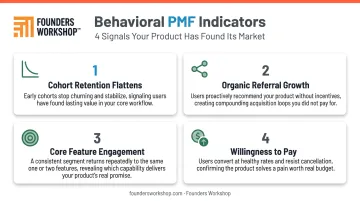
Alongside the Ellis survey, look for:
- Cohort retention flattens over time — users return week after week rather than dropping off after the first session
- Organic referral growth — unprompted recommendations signal the product solves a real, felt problem
- Users engage with the core feature, not just log in — sessions center on the primary value driver, not peripheral functions
- Willingness to pay — conversions to paid tiers or unprompted requests for pricing are strong confirmation signals
PMF Is Not Permanent
Markets shift. Competitors improve. User expectations rise. The build-measure-learn discipline established during MVP development is the same discipline that protects PMF after launch. Teams that treat PMF as a destination rather than an ongoing process are the ones most likely to lose it — usually to a faster-moving competitor who kept iterating.
Conclusion
MVP development services accelerate product-market fit not simply because they build software faster. They do it by making every build decision evidence-based rather than assumption-based — embedding validation, user feedback, and iterative learning into the process from the first week.
Finding a market that needs your product matters more than shipping one that doesn't. Working with partners who have been operators and entrepreneurs themselves — not just developers — means getting strategic insight into what the market actually rewards, alongside technical execution.
For founders who want a structured path from idea to market-ready MVP without sacrificing equity or burning runway on the wrong features, Founders Workshop has delivered 200+ custom software solutions since 2008, working with founders across industries using a field-tested 5D Process built specifically for this kind of high-stakes, early-stage work. If you're ready to move from idea to validated MVP, it's worth a conversation.
Frequently Asked Questions
How do you validate product-market fit?
Validation combines quantitative signals — retention rates, engagement with core features, organic referral growth — with qualitative tools like Sean Ellis's must-have survey. If 40%+ of users say they'd be "very disappointed" without your product, that's a strong PMF indicator. Neither alone is as reliable as both combined.
What does MVP validation mean?
MVP validation tests whether the core assumption behind a product is true: that a specific group of users has a problem your product solves. It uses a minimal working product to gather real user behavior data before investing in full development — replacing founder assumptions with actual evidence.
What is the difference between product-market fit and MVP?
An MVP is a tool — the simplest version of a product used to test assumptions. Product-market fit is an outcome: the confirmed state where a product satisfies a strong, repeatable market demand. In short, the MVP is how you get there.
What is the 40% rule for product-market fit?
Developed by Sean Ellis, the 40% rule states that if at least 40% of surveyed users say they'd be "very disappointed" if they could no longer use the product, that's a strong PMF signal. That level of disappointment signals the product has crossed from useful to genuinely necessary.
How long does it take to build an MVP?
A focused MVP typically takes 3–6 months from Discovery to Deployment. Founders Workshop's ALBedFill MVP, for example, delivered in three months. Timeline depends on feature complexity, problem clarity, and how much discovery work precedes development.
Can an MVP help attract investors?
Yes. A functional MVP with real user engagement data is significantly more compelling than a pitch deck alone. It demonstrates technical execution, market demand signals, and founder discipline — all of which reduce perceived investment risk. Beyond the seed stage, most investors expect traction — and an MVP with real users delivers exactly that.