Introduction
U.S. startups and SMBs face a compounding problem: domestic software developers command a median annual wage of $133,080 according to the BLS, the engineering talent market is projected to need 138,100 new hires per year through 2034, and the pressure to ship product faster has never been higher.
Nearshore software development in Latin America comes up constantly as a cost solution. That framing captures one part of the picture, but misses the bigger story. The real case for LATAM nearshore goes beyond hourly rates — it touches how your team communicates daily, how fast blockers get resolved, and whether your development partner understands the market context of what you're building.
This article breaks down the specific, measurable benefits of nearshore LATAM development — cost, collaboration, talent access — and explains when each one matters most in practice.
Key Takeaways
- Nearshore LATAM development gives U.S. companies access to senior engineering talent at roughly one-third the cost of comparable domestic teams
- LATAM time zones overlap 4–8 hours daily with U.S. business hours, enabling real-time collaboration that offshore models structurally can't match
- Brazil, Mexico, Colombia, and Argentina rank among the fastest-growing developer communities on GitHub, posting 21–27% year-over-year growth
- Cultural alignment and shared work norms reduce friction that routinely derails offshore engagements
- Sustained value requires clear processes and structured engagement, not just a cost-reduction play
What Is Nearshore Software Development?
Nearshore software development means partnering with engineering teams in nearby countries — for U.S. companies, that's Latin America — that share the same or similar time zones and work at meaningfully lower cost than domestic hires.
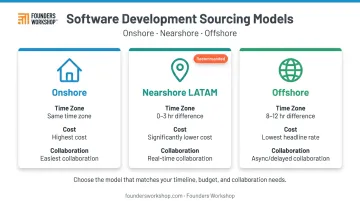
It sits between two other sourcing models, each with real tradeoffs:
| Model | Time Zone | Cost | Collaboration |
|---|---|---|---|
| Onshore | Same | Highest | Easiest |
| Nearshore (LATAM) | 0–3 hrs difference | Significantly lower | Real-time |
| Offshore (India, Eastern Europe) | 8–12 hrs difference | Lowest headline rate | Async/delayed |
Offshore development looks attractive on a rate sheet. The problem shows up operationally: a blocker raised at 4 PM ET doesn't get resolved until the next morning. A design question asked on Monday gets answered Tuesday. Over a 12-week sprint cycle, that lag accumulates into real delivery risk.
Nearshore development is a structural choice. The real question is whether your team can unblock a developer the same afternoon, participate in daily standups without scheduling gymnastics, and build software with someone who understands the U.S. market context. Cheaper hours are a benefit — not the point.
Key Benefits of Nearshore Software Development in Latin America
The benefits below are grounded in how nearshore LATAM partnerships affect actual business outcomes — development cost, time to market, team velocity, and risk. Cost is usually what brings companies to the model. Timezone overlap and talent depth are what keep them there.
Significant Cost Savings Without Sacrificing Quality
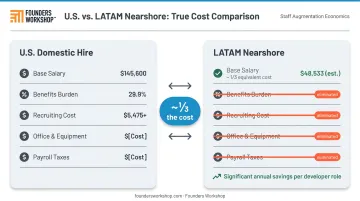
The BLS reports U.S. software developers earn a mean hourly rate of $70.00 and mean annual salary of $145,600 — and that's before accounting for loaded employment costs. BLS December 2025 data shows private-industry employers average $46.15 per hour in total compensation, with benefits adding 29.9% on top of wages. Recruiting overhead adds another $5,475 per hire on average, per SHRM's 2025 benchmarking data.
LATAM compensation sits at a fraction of those figures. While direct percentage comparisons require care — local currencies and cost-of-living contexts differ substantially — the gap is significant across every major market:
- Mexico: Median software engineer total compensation of MX$801,541
- Colombia: Median of COP 121,952,267
- Argentina: Median of ARS 47,354,580
- Brazil: Median of R$176,648
Founders Workshop clients access senior LATAM development talent at roughly one-third the cost of comparable U.S. teams — a figure the company has applied consistently across engagements, including an 8-year staff augmentation relationship with Wellpsyche and multiple MVP builds.
What the savings eliminate:
- Salary and benefits overhead (the 29.9% burden disappears)
- Per-hire recruiting cost ($5,475+ per role, per year)
- Office space, equipment, and infrastructure
- Employer payroll taxes and HR administration
For a pre-revenue startup, this difference determines runway length. For an SMB, it determines whether a software project is fundable at all without giving up equity to a technical co-founder. The cost advantage is most impactful for:
- Pre-revenue companies extending capital before the next raise
- SMBs modernizing software without a dedicated internal engineering budget
- Any team scaling headcount quickly without triggering proportional fixed cost increases
KPIs this affects: development budget utilization, burn rate, cost-per-feature, time to first release.
Real-Time Collaboration Through Time Zone Alignment
Latin America's time zones range from UTC-6 to UTC-3 — meaning a developer in Mexico City, Bogotá, or Buenos Aires is working at the same time as their U.S. counterparts, not receiving a message they'll answer tomorrow.
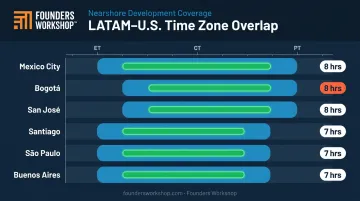
Measured overlap between LATAM hubs and U.S. business hours (9 AM–5 PM local, standard workday):
| LATAM Hub | Time Zone | ET Overlap | CT Overlap | PT Overlap |
|---|---|---|---|---|
| Mexico City | UTC-6 | 6 hrs | 7 hrs | 7 hrs |
| Bogotá | UTC-5 | 7 hrs | 8 hrs | 6 hrs |
| Buenos Aires | UTC-3 | 7 hrs | 6 hrs | 4 hrs |
| São Paulo | UTC-3 | 7 hrs | 6 hrs | 4 hrs |
| San José, CR | UTC-6 | 6 hrs | 7 hrs | 7 hrs |
| Santiago | UTC-4 | 8 hrs | 7 hrs | 5 hrs |
That overlap is what Agile development actually requires. A 2016 academic study of distributed software teams found that time zone differences affect short-term communication delays of 24 hours or less — meaning a single time zone gap doesn't just slow one message, it disrupts the entire feedback loop for that day.
Scrum depends on real-time communication to function. When team members aren't available at the same time, the methodology degrades in predictable ways:
- Standups become asynchronous status reports
- Blockers sit unresolved for a full business day
- Sprint cadence loses its rhythm as handoffs pile up
With nearshore LATAM teams, these sessions happen live. A product manager in Phoenix and a developer in Bogotá are both at their desks at 10 AM.
Flights from Miami to Mexico City run about 3 hours and to Bogotá around 3.5 hours — comparable to a domestic flight. In-person visits, quarterly planning sessions, and team kickoffs are logistically practical in a way they aren't with teams in Asia or Eastern Europe.
Business impact: sprint velocity, issue resolution time, daily active collaboration hours, time-to-decision on blockers, overall time to market.
When this matters most: Agile projects with frequent iteration, early-stage builds where requirements shift weekly, and any setup where U.S. product managers need to stay tightly integrated with their development team.
Access to a Deep and Growing LATAM Engineering Talent Pool
The U.S. domestic engineering market is supply-constrained by design. BLS projects software developer employment to grow 15% from 2024 to 2034, generating approximately 138,100 job openings per year — far outpacing the domestic pipeline.
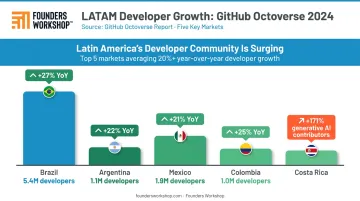
Latin America is closing that gap quickly. GitHub's 2024 Octoverse report shows dramatic year-over-year growth in developer activity across the region:
- Brazil: 5.4M+ developers on GitHub, up 27% YoY
- Argentina: 1.1M+ developers, up 22% YoY
- Colombia: 1M+ developers, up 25% YoY
- Mexico: 1.9M+ developers, up 21% YoY
- Costa Rica: 171% increase in contributors to public generative AI projects
That growth reflects active, current-technology development across the stacks U.S. companies actually use — not just raw numbers. OECD data shows 26% of Mexico's bachelor's degree graduates come from STEM fields, with government-backed initiatives like the 2024 Ministry of Economy and Kyndryl digital skills program further expanding the pipeline.
What this means in practice for U.S. companies:
- Specialized roles — backend, mobile, QA, DevOps, AI, UI/UX — that are difficult to fill domestically can be staffed from a broader, actively growing LATAM pool
- Teams can scale up around a launch or scale down post-launch without the 3–6 month recruiting cycle required for domestic hires
- Senior engineers with experience on modern stacks are accessible without competing against FAANG-level compensation packages
Founders Workshop's team of 25+ senior developers, designers, testers, and project managers covers this full range — front-end (.NET, React, React Native), back-end, iOS/Android, QA, and AI services — built specifically to give U.S. clients access to complete capability without assembling it role by role domestically.
Companies that can't fill engineering roles face delayed launches, technical debt from under-resourced teams, and dangerous dependency on one or two critical employees. LATAM talent access directly reduces each of those risks.
KPIs this affects: time-to-hire for engineering roles, team coverage across required skill sets, developer retention, dependency concentration risk.
What Happens When Nearshore Is Done Wrong
The nearshore model has a failure mode, and it's common enough to address directly.
Choosing offshore to save on rates typically erodes those savings through coordination overhead. A day-long gap between handoffs and miscommunication that compounds over weeks results in slower delivery. The real cost often exceeds what a well-run nearshore engagement would have charged from the start.
Choosing nearshore without structured processes creates a different problem: inconsistent output, reactive problem-solving, unclear ownership, and difficulty scaling. This is especially damaging for early-stage companies where every sprint carries real business consequence.
The risks compound over time:
- Technical debt accumulates when oversight is weak
- Team turnover disrupts continuity mid-product
- Costs that looked like savings at the contract level erode when measured against rework, delayed launches, and re-hiring cycles
Those compounding costs are why structure matters as much as location. A team in Bogotá without clear requirements, defined communication channels, and ownership of outcomes will underperform, regardless of timezone overlap.
How to Get the Most from Your Nearshore LATAM Partnership
Nearshore partnerships deliver sustained value when the structure is right — and that starts with a clear separation of roles from day one:
- U.S.-side stakeholders own product direction, market context, and decision-making
- Nearshore team owns execution with full context on goals — not just task tickets
Founders Workshop has applied this model across 200+ software projects since 2008, pairing U.S.-based business analysts with senior LATAM development teams to keep product intent and delivery tightly aligned.
The company's Product Development Manager role sits at that intersection — functioning as an extension of the client's team to ensure the development side never loses sight of the business outcome it's building toward.
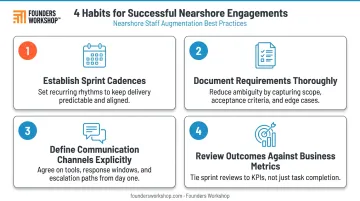
Four process habits prevent the most common engagement failures:
- Establish sprint cadences before work begins — don't assume the team will self-organize
- Document requirements thoroughly — ambiguity at the definition stage becomes rework at the delivery stage
- Define communication channels explicitly — which channel for blockers, which for status, which for decisions
- Review outcomes against business metrics, not just velocity — task completion is not the same as product progress
Founders Workshop's 5D Process — Discovery, Definition, Development, Deployment, Dedicated Support — gives both fully managed projects and staff augmentation engagements a structured foundation. Clients using staff augmentation still start with a Discovery session to align on needs before team members are brought on, which eliminates the ambiguity that sinks underprepared engagements.
Overlapping time zones give you the conditions for real-time collaboration. The processes you build around them determine whether that advantage shows up in your delivery timelines.
Frequently Asked Questions
What are the advantages of nearshore outsourcing?
The core advantages are cost savings relative to domestic hiring, real-time collaboration through timezone alignment, access to a growing LATAM engineering talent pool, and cultural compatibility that reduces coordination friction. Combined, these produce faster delivery and lower cost than either onshore or offshore alternatives on most Agile projects.
How much can companies typically save with nearshore software development in Latin America?
Founders Workshop clients access senior LATAM talent at roughly one-third the cost of equivalent U.S. teams. That gap widens further when you factor in eliminated hiring overhead ($5,475+ per hire per SHRM), benefits burden (29.9% of wages per BLS), office space, and equipment — none of which apply with a structured nearshore partner.
How does nearshore development in Latin America compare to offshore outsourcing in Asia?
Offshore options may offer lower headline rates, but the 9–12 hour timezone gap creates coordination overhead that erodes those savings on projects requiring regular communication. Nearshore LATAM eliminates this problem with 4–8 hours of daily overlap — keeping sprint cycles intact instead of stretching them across gap days.
Which Latin American countries are best for nearshore software development?
Mexico, Colombia, Argentina, Brazil, Costa Rica, and Chile are the most established destinations, all offering timezone overlap with U.S. business hours. Argentina leads on English proficiency (ranked 26th globally per EF EPI 2025); Brazil and Mexico have the largest GitHub developer communities. The right choice depends on your project type, skill sets needed, and which U.S. time zones your team operates in.
What should startups and SMBs look for when choosing a nearshore development partner?
Prioritize: a proven delivery track record with similar-stage companies, a structured process for managing requirements and communication, transparency on team composition and seniority levels, and cultural alignment with U.S. work norms. Hourly rate is a secondary consideration. A poorly managed engagement will cost more than any rate savings it offers.
Is nearshore software development a good option if I don't have a technical co-founder?
Yes — it's particularly well-suited for non-technical founders. A structured nearshore partner provides both development execution and business-aligned technical guidance, allowing founders to retain equity rather than trading it for a technical co-founder. Founders Workshop is built around this use case — a complete senior team with technical leadership included, at a fraction of what a co-founder arrangement costs in equity and salary.