According to the AHA, administrative costs now account for more than 40% of total hospital expenses. Meanwhile, economy-wide inflation grew 12.4% between 2021 and 2023 — more than twice the 5.2% growth in Medicare inpatient reimbursements over the same period. More than half of hospitals closed 2022 operating at a loss. These aren't temporary conditions. They're structural pressures.
Generative AI addresses them directly — through administrative automation, faster clinical documentation, smarter patient communication, and better decision support.
This article covers the current adoption landscape, the use cases with the strongest ROI evidence, what a realistic integration path looks like, and how to manage compliance and governance without stalling progress.
Key Takeaways
- More than 70% of healthcare leaders are already using or actively pursuing generative AI — adoption has crossed into mainstream territory
- The highest ROI comes from administrative automation, clinical documentation, and patient messaging , not advanced diagnostics
- ~60-64% of implementing organizations report positive ROI — contingent on solid data infrastructure and governance
- For startups and SMBs, a phased approach starting with one high-impact workflow outperforms broad deployment every time
- Privacy, hallucination, and bias risks are real — each has well-documented mitigation strategies
The State of Gen AI in Healthcare Right Now
Adoption has moved fast. McKinsey's Q1 2024 survey found that more than 70% of healthcare respondents — including payers, providers, and health services technology groups — were either pursuing or had already implemented generative AI. By Q4 2024, that figure had climbed to 85% of healthcare leaders exploring or deploying gen AI capabilities.
From Pilots to Production
Most organizations are stuck in the middle — past the proof-of-concept stage but nowhere near enterprise-wide deployment. What separates the ones who cross that gap isn't access to better models. It's three things:
- Clean, interoperable data with EHR connectivity
- AI embedded inside existing clinical or administrative processes, not bolted on
- Defined accountability, audit trails, and human review protocols
The Permanente Medical Group offers the clearest production example. According to AMA reporting, their ambient AI scribe deployment logged 2.5 million uses in a single year and saved 15,791 hours of physician documentation time. That's not a pilot result — it's what happens when AI is built into the clinical encounter itself.
The Infrastructure Gap Is the Real Barrier
Accenture found that fewer than 10% of healthcare executives had invested in the infrastructure needed for enterprise-wide gen AI deployment. The barrier isn't awareness — it's the operational capacity to actually deploy.
The organizations winning with gen AI aren't chasing the most advanced models. They're the ones who did the unglamorous work — connecting data systems, defining bounded workflows, and measuring results against clear baselines.
Where Gen AI Delivers the Most Value: Key Use Cases
Not all gen AI use cases are equal in terms of ROI speed or implementation complexity. Here's where the evidence is strongest.
Administrative Automation
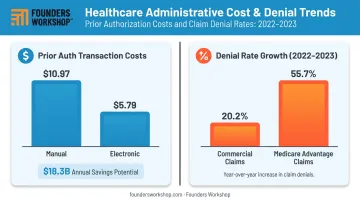
Prior authorization, claims adjudication, and billing are the highest-volume, most measurable targets. CAQH data shows the provider cost of a manual prior authorization transaction is $10.97, versus $5.79 electronically — and fully automating these workflows across the industry could save $18.3 billion annually.
The denial problem is getting worse, not better. Between 2022 and 2023, care denials rose 20.2% for commercial claims and 55.7% for Medicare Advantage claims. Gen AI tools that can draft appeals, flag denial patterns, and auto-populate authorization requests address a growing operational crisis — with unit economics that are easy to measure.
Physicians spent 7.3 hours per week on administrative tasks in 2024, according to AMA. That's not time spent on patient care. It's time that gen AI can partially reclaim.
Clinical Documentation and Scribing
Ambient AI scribing is the most mature gen AI use case in clinical settings. It listens to patient-provider conversations in real time, drafts clinical notes, and populates EHR fields — no keyboard required. The workflow impact is consistent across implementations: less documentation time, fewer after-hours EHR log-ins, lower burnout risk. A JAMA Network Open study links ambient scribing directly to reduced administrative burden and professional fatigue.
For healthcare startups, clinical scribing is an attractive beachhead because:
- The workflow is well-defined and repeatable
- ROI is measurable (time saved, after-hours log-in reduction)
- It doesn't require FDA clearance in most implementations
- Clinician acceptance is growing — 68% of physicians saw definite or some advantage to AI tools in 2024, up from 65% in 2023
Patient Engagement and Experience
Gen AI's role in patient communication goes beyond chatbots. The most defensible near-term application is drafted responses to patient portal messages — where AI generates a reply for a clinician to review and send, rather than operating autonomously.
The evidence here is strong. A JAMA Network Open study on AI-generated draft replies found that AI drafts reduced physician task-load scores from 61.31 to 47.26 — a meaningful reduction in cognitive burden. A separate JAMA Internal Medicine study found chatbot responses were preferred in 78.6% of evaluations and rated higher for empathy than physician responses in the study setting.
UC San Diego Health implemented AI-generated drafts specifically to help providers manage message volume — a practical model worth examining.
For healthcare startups, building AI-powered patient engagement natively is a genuine advantage. Retrofitting these features into legacy systems is far more expensive and time-consuming than architecting them in from the start.
Clinical Decision Support and Drug Discovery
The ROI horizon here is longer and the complexity is higher. Clinical decision support tools that surface evidence-based recommendations can reduce diagnostic errors, but they often require FDA classification review depending on their intended use.
Drug discovery provides the most dramatic frontier examples — Insilico Medicine's generative AI-discovered compound for idiopathic pulmonary fibrosis reached Phase II trials, with results published in Nature Medicine in 2025. AlphaFold 3 has expanded protein interaction modeling to support compound identification. For most healthcare operators, these aren't the starting point — they're proof of how far the technology can eventually reach.
What ROI Actually Looks Like in Healthcare AI
The Baseline
McKinsey's July 2024 healthcare report found that about 60% of healthcare organizations that had implemented gen AI were already seeing or expected positive ROI. By Q4 2024, that figure had edged up to 64% among implementing organizations.
The 40% that haven't seen returns aren't using bad models. Their barriers are:
- 57% of non-adopters cited risk considerations
- 29% cited technology needs and infrastructure gaps
- Lack of proof-of-value frameworks to demonstrate results internally
That's a governance and data-readiness gap — not a reflection of what the technology can do.
Where Financial Returns Come From
| Source | Mechanism |
|---|---|
| Administrative labor reduction | Fewer manual hours on prior auth, billing, claims |
| Denial prevention and reversal | Fewer denials, faster appeals with AI-drafted content |
| Clinician time recaptured | Documentation time converted to patient care capacity |
| Reduced errors and rework | AI-assisted accuracy in coding and documentation |
Build vs. Buy vs. Partner
The right path depends on your situation:
- Buy commercial tools (e.g., existing EHR-integrated scribing products) for standard functions where speed to deployment matters more than customization
- Build custom solutions when your workflow is differentiated and off-the-shelf tools can't match it — better long-term fit, higher upfront cost
- Partner with an AI-first development firm when you need custom capability but don't have the internal engineering team to build it
For healthcare startups and SMBs, the partnering path often makes the most practical sense. Building internally takes time and specialized hiring — a development partner with healthcare software experience can move faster without requiring a full in-house engineering team.
Founders Workshop, for example, has been building EMR integrations, patient portals, and medical workflow tools since 2008. Their 5D Process covers the full arc from discovery to deployment, which helps healthcare clients move from use case to working software without starting from zero.
Time-to-ROI by Use Case
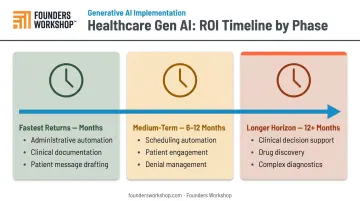
- Fastest returns (months): Administrative automation, clinical documentation, patient message drafting
- Medium-term (6–12 months): Scheduling automation, patient engagement features, denial management
- Longer horizon (12+ months): Clinical decision support, drug discovery, complex diagnostic tools
Integrating Gen AI Into Your Healthcare Product or System
Start Narrow
The organizations that fail at gen AI deployment almost always try to do too much at once. Pick one high-impact, lower-risk workflow. Prove value. Then expand.
Good starting candidates:
- Clinical note generation from ambient listening
- Patient message drafting in the portal
- Prior authorization request automation
- Appointment reminder personalization
Assess Infrastructure and Data Readiness
This is where most projects hit unexpected friction. The AI model is rarely the bottleneck. Data readiness is.
Prerequisites before any gen AI deployment:
- FHIR connectivity — ONC reported ~70% of non-federal acute care hospitals had enabled FHIR-based app access by 2024, but connectivity alone isn't sufficient
- Data quality — structured, complete, and consistently formatted source data
- EHR compatibility — confirmed writeback capability for any generated content
- Identity and access controls — role-based access, PHI segregation, audit logging
- Cloud or hybrid infrastructure — capable of handling model inference at scale
Deloitte's healthcare AI research specifically calls out data availability, quality, compliance, and security as the most common implementation blind spots. Don't skip the data audit.
Choose the Right Build, Buy, or Partner Strategy
Three paths exist, each with different tradeoffs:
- Buy commercial gen AI tools built for healthcare — fastest time-to-value for standard functions, but limited customization
- Build in-house — best long-term fit for differentiated workflows, but requires significant engineering investment and time
- Partner with an AI-first development firm — accelerates time-to-market, manages technical risk, and doesn't require giving up equity
For healthcare startups without large internal teams, the partnering model offers a practical advantage: access to a full product team (designers, developers, QA, project management) without the cost of building one. Founders Workshop, for example, can begin work in as little as two weeks, with MVP development typically running $80,000–$350,000 over 3–6 months — compared to $750,000–$1M annually to staff an equivalent in-house team.
Integration, Testing, and Validation
Once your build path is set, validation determines whether the deployment actually holds up in clinical environments. Cutting corners here is where most healthcare AI projects run into trouble.
Required steps before going live:
- Human-in-the-loop review for any clinical output — generated notes, recommendations, or patient-facing content should have a clinician checkpoint before reaching the patient record
- Bias testing across patient demographics — JAMA Network Open reported an odds ratio of 1.63 for biased LLM assessments involving unhoused Black patients; your deployment needs demographic testing before launch
- Phased rollout — start with a subset of users, measure against defined KPIs, then expand
- Defined KPIs — time saved per clinician, denial overturn rate, task-load score, response time, after-hours log-in reduction
Managing Risk, Compliance, and Governance
The Regulatory Landscape
Healthcare gen AI operates under multiple overlapping frameworks:
- HIPAA — existing privacy and security obligations apply fully to AI systems handling PHI; role-based access, encryption, and audit logging are non-negotiable
- FDA AI/ML SaMD guidance — if your gen AI tool meets the definition of Software as a Medical Device, FDA classification and lifecycle management requirements apply; determine this before building, not after
- California AI Transparency Act (SB 942/AB 853) — effective August 2, 2026, covering providers of publicly accessible gen AI systems above 1 million monthly users
The Top Three Risk Categories
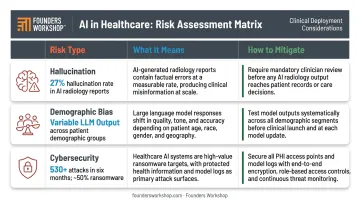
| Risk | Description | Mitigation |
|---|---|---|
| Hallucination | AI generates plausible but incorrect clinical information — radiology research found a 27% hallucination rate in AI-generated reports | Require clinician review for all generated clinical text |
| Demographic bias | LLM outputs vary by patient sociodemographic characteristics | Test outputs across demographic groups before and after deployment |
| Cybersecurity | HHS/AHA reported 530+ attacks against US healthcare in a six-month period, roughly half ransomware | Secure prompts, PHI access, vendor integrations, and model logs |
Governance as a Competitive Advantage
The risks above aren't reasons to avoid gen AI — they're the case for building governance early. McKinsey research on digital trust found that digital trust leaders were 1.6x more likely to see revenue and EBIT growth of at least 10% annually than their peers.
Organizations that invest in AI governance — data privacy controls, model validation, audit trails, change management — protect the ROI they've already built. Clinicians adopt tools they trust. Patients engage with systems that feel safe. Both outcomes compound over time, making governance the foundation for expanding AI use across the organization, not just a compliance checkbox on a single deployment.
Frequently Asked Questions
Is generative AI being used in healthcare?
Yes, actively. More than 70% of healthcare leaders were pursuing or had implemented gen AI as of McKinsey's Q1 2024 survey, rising to 85% by Q4 2024. Current deployments include clinical documentation tools, prior authorization automation, patient portal message drafting, and billing support.
What is the ROI of generative AI in healthcare?
ROI varies by use case and implementation maturity. Roughly 60–64% of implementing organizations expect or have already achieved positive ROI, according to McKinsey. Administrative automation and clinical scribing typically deliver the fastest returns because their unit economics (transaction costs and clinician hours) are straightforward to measure.
What are the biggest risks of using generative AI in healthcare?
The top three are: AI hallucination producing incorrect clinical outputs, patient data privacy and HIPAA compliance exposure, and demographic bias in model outputs. All three are manageable with proper governance, human-in-the-loop review, and systematic testing before deployment.
How long does it take to integrate generative AI into a healthcare product?
Narrow, well-defined use cases can go from concept to deployment in a few months with the right infrastructure in place. Enterprise-wide integrations involving legacy EHRs often take 12–18+ months. The infrastructure and data readiness phase, not the AI model itself, typically takes the longest.
What is the difference between generative AI and traditional AI in healthcare?
Traditional healthcare AI performs narrow, rule-based tasks — flagging abnormal lab values or predicting readmission risk. Generative AI produces new content: drafting clinical notes, writing patient communications, synthesizing research, or generating appeal letters. This content-generation capability opens a much broader range of administrative and clinical applications.
How can smaller healthcare companies or startups afford generative AI?
Domain-specific models and cloud-based tools have reduced the cost of entry significantly. Starting with a single focused use case and partnering with a development firm to build a scoped MVP is typically more cost-effective than enterprise licensing. A well-defined engagement can deliver a functional gen AI feature in 3–6 months.