This post covers 7 real-world FinTech MVP product types—neobanking, P2P payments, personal finance, digital lending, investing, insurtech, and crypto wallets—alongside the best practices that separate validated launches from expensive rebuilds.
Key Takeaways
- A FinTech MVP is a lean, functional financial product built to validate demand and attract early users or investors—without building everything at once.
- Each MVP type covered here has distinct compliance requirements and technical needs — knowing which you're building shapes every decision.
- The most successful FinTech MVPs nailed one use case first, then scaled from there.
- Best practices: define one core use case, tackle compliance early, and build on scalable architecture.
What Is a FinTech MVP?
A FinTech MVP is the minimum version of a financial product that delivers genuine value to real users, generates measurable feedback, and stays lean enough to iterate quickly. What separates it from a standard app MVP isn't just complexity—it's context.
FinTech MVPs operate at the intersection of user trust, regulatory obligation, and financial risk. Some "minimum" requirements are simply non-negotiable from day one:
- Data security and encryption
- Multi-factor authentication
- Compliance-aware architecture
- Audit trails and transaction logging
CB Insights reports that 43% of VC-backed startups fail due to lack of product-market fit and 70% run out of capital. A well-scoped FinTech MVP directly attacks both failure modes: it validates demand before over-building, and it avoids costly regulatory rebuilds that drain budgets fast.
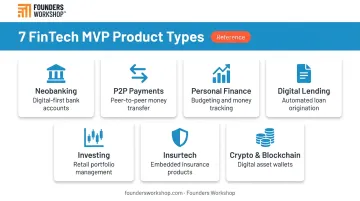
The 7 examples below cover the most common FinTech MVP categories, with a focus on how real products scoped their first version before adding complexity.
7 FinTech MVP Product Examples
Neobanking / Digital Banking MVP
A neobanking MVP is a mobile-first bank account alternative that handles core financial functions without a physical branch. Revolut, founded in 2015 with an early focus on helping users spend and transfer money abroad, is a clear reference point—it expanded to crypto, business accounts, and banking licenses only after proving the core product worked.
Essential MVP features:
- Secure onboarding with identity verification (KYC)
- Account dashboard with balance and transaction history
- Virtual or physical debit card issuance
- Push notifications for transactions
- Basic P2P transfers
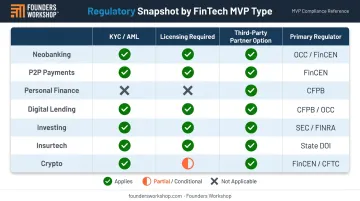
Primary consideration: Even a lean neobanking MVP requires either a Banking-as-a-Service (BaaS) partner (such as Bancorp, Treasury Prime, or Unit) or an e-money institution license to handle funds legally. Partner selection isn't a post-launch decision—it shapes your architecture from day one.
Peer-to-Peer (P2P) Payment App MVP
A P2P payment MVP lets users send and receive money directly. Venmo started as text-message-based payments in 2009. Cash App launched in 2013 as Square's first peer-to-peer system, letting users send money by email directly to and from debit cards—Bitcoin trading didn't arrive until 2018.
Essential MVP features:
- User registration with linked bank account or debit card
- Send/request money flow
- Transaction confirmation and status tracking
- Simple activity feed
Primary consideration: Under FinCEN's definition, money transmission means accepting funds from one person and transmitting them to another—by any means.
Most early-stage P2P MVPs manage this by routing payments through licensed processors like Stripe or Dwolla to reduce the licensing burden during validation. The exact structure and activities you support still determine your regulatory obligations.
Personal Finance & Budgeting App MVP
This MVP type aggregates financial accounts in one place and categorizes spending automatically. Mint launched in September 2007 with exactly this: bank account linking and basic spending categorization. Bill tracking and credit scores came later.
Essential MVP features:
- Secure OAuth-based bank account connection (via Plaid or MX)
- Transaction import and automatic spending categorization
- Spending summary dashboard
- Basic budget-setting functionality
Primary consideration: Personal finance apps typically avoid direct money movement, which reduces licensing complexity. The non-negotiables here are data security, GDPR/CCPA compliance, and user trust around financial credential handling—none of which can be retrofitted after launch.
Digital Lending & Credit Platform MVP
LendingClub launched its marketplace in 2007 connecting borrowers and investors with personal loans ranging from $1,000 to $35,000—and didn't become a bank holding company until acquiring Radius Bancorp in 2021. That gap illustrates the model: a lending MVP automates application, credit assessment, and disbursement without requiring a bank charter from day one.
Essential MVP features:
- Loan application flow with identity verification
- Basic credit eligibility check via credit bureau API (Equifax, Experian, or TransUnion)
- Loan offer display
- Digital agreement and e-signature
- Repayment tracking dashboard
Primary consideration: Lending is one of the most regulated FinTech categories. Most early-stage platforms avoid acting as the lender directly by partnering with licensed lending institutions and operating as a loan marketplace or origination layer instead. States like California require specific licensing under the California Financing Law for anyone making or brokering loans.
Investment & Wealth Management App MVP
An investment MVP gives users access to markets with a low barrier to entry. Robinhood began operations in 2013 and publicly launched in 2015 with a single core feature: commission-free U.S. stock and ETF trading with no account minimums. Options trading and crypto arrived in 2018.
Essential MVP features:
- Brokerage account creation with identity verification
- Basic portfolio view
- Single asset class to trade (stocks or ETFs)
- Order placement and confirmation
- Performance tracking
Primary consideration: Investment platforms require securities licensing—FINRA broker-dealer registration in the U.S. For MVP stage, most founders partner with an existing licensed broker-dealer rather than pursuing independent registration, which can take months and significant capital.
Insurtech Platform MVP
An insurtech MVP applies technology to streamline policy purchase, management, or claims. Lemonade launched in New York in 2016 offering homeowners and renters insurance with AI-powered claims processing—roughly 40% of claims are instantly approved and paid in seconds. Additional product lines followed only after the core model proved out.
Essential MVP features:
- User onboarding and risk intake questionnaire
- Instant quote generation
- Digital policy purchase flow
- Policy management dashboard
- Basic claims submission form
Key regulatory consideration: Insurance is state-regulated in the U.S. and jurisdiction-regulated elsewhere. Most insurtech MVPs partner with an existing underwriter or MGA (managing general agent) to carry the regulatory risk while the startup owns the customer experience layer. The NAIC's Managing General Agents Act framework formalizes exactly this structure.
Crypto Wallet & Blockchain App MVP
A crypto MVP lets users buy, store, send, or receive digital assets. Coinbase launched in 2012 to make it easy to send and receive Bitcoin securely—by October 2012, users could connect a U.S. bank account to buy or sell it. Ethereum support and multi-asset exchange capabilities came years later.
Essential MVP features:
- Account creation with KYC/AML-compliant identity verification
- Wallet creation and key management
- Buy/sell for a single asset
- Transaction history
- Basic security (2FA, biometrics)
Primary consideration: Crypto faces some of the most complex and rapidly evolving regulatory environments globally. FinCEN's 2019 guidance confirms that accepting and transmitting value that substitutes for currency can trigger money transmitter rules under MSB regulations. AML/KYC must be built into the architecture from day one—not added after your first compliance review.
Best Practices for Building a FinTech MVP
Start With One Core Use Case
Every FinTech product example above launched by doing exactly one thing exceptionally well. Venmo sent money. Coinbase bought Bitcoin. Mint linked bank accounts.
The most common FinTech MVP failure is scoping for multiple user segments or product categories simultaneously. Before writing a line of code, identify your "killer feature"—the single workflow that validates your core hypothesis. Everything else is a version two problem.
Address Compliance Early, Not Late
Compliance isn't a launch checklist item. It's an architectural constraint.
Map out which regulatory requirements apply to your specific product type during the discovery phase:
- KYC/AML — Required for most products that move money or involve identity-sensitive data
- PCI DSS — Applies whenever you store, process, or transmit cardholder data
- GDPR/CCPA — Mandatory for any product collecting personal financial data from EU or California users
- Lending/securities licensing — Product-specific and often state-by-state
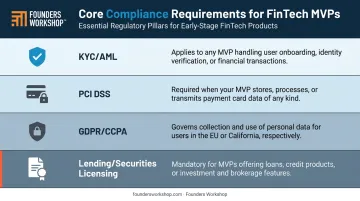
Building on a non-compliant foundation creates the most expensive problem in FinTech: a rewrite after you've already acquired users.
Use Third-Party Providers to Sidestep Licensing Delays
You don't need a bank charter to launch a neobanking MVP. You don't need a broker-dealer license to launch an investment app.
Licensed BaaS providers, payment processors, and broker-dealer partners can supply the regulated infrastructure while you focus on product and user experience. This strategy lets you:
- Launch faster without multi-month licensing processes
- Validate product-market fit before committing to licensing costs
- Pursue independent licenses once you've proven the business model works
The key caveat: partnering with a licensed third party reduces your regulatory burden. It doesn't eliminate it. Your specific activities still determine your obligations.
Don't Cut Corners on Architecture
FinTech MVPs are lean in features, not in foundations. The underlying architecture needs to be built to grow: encrypted data storage, role-based access controls, audit trails, and secure API integrations.
Cutting corners here creates technical debt with specific consequences: failed compliance audits, blocked investor due diligence, and platform scaling issues that require full rebuilds. This is the sharpest distinction between a FinTech MVP and a typical consumer app MVP.
Work With a Development Partner That Understands FinTech
FinTech MVPs require more than general development experience. The work involves financial API integrations, compliance-aware architecture patterns, and security standards specific to regulated environments — areas where gaps surface late and cost the most.
Founders Workshop structures FinTech engagements around its 5D Process (Discovery, Definition, Development, Deployment, and Dedicated Developer support). The Discovery phase — 2–4 weeks — scopes the most valuable features and maps technical integrations before a line of code is written. That upfront discipline is where FinTech projects succeed or fail.
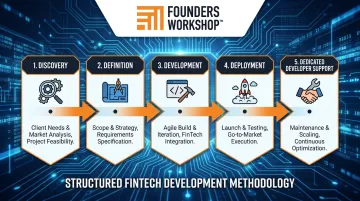
The firm has delivered for FinTech clients, including Bigg Whale, where they built a predictive analytics engine that gave the investment firm's team a measurable competitive edge.
For founders who want to avoid giving up equity to a technical co-founder, Founders Workshop's nearshore Latin American team delivers the same output at roughly one-third the cost of a U.S.-based team, with no equity dilution required.
Conclusion
The 7 FinTech MVP examples covered here—neobanking, P2P payments, personal finance, digital lending, investing, insurtech, and crypto wallets—share a common pattern: none of them launched with everything. They launched with the right thing, built correctly.
What separates products that scale from ones that stall comes down to early decisions: scope, compliance posture, architecture, and who builds it with you. Nail those in the first 90 days and you're no longer guessing—you're iterating on something real.
Founders Workshop has been helping FinTech founders and startups turn financial product ideas into market-ready MVPs since 2008. If you're ready to scope your FinTech MVP without giving up equity or starting over, reach out to schedule a discovery call.
Frequently Asked Questions
What is an MVP in FinTech?
A FinTech MVP is the smallest functional version of a financial product that delivers real value to early users and validates a core hypothesis. Unlike a standard app MVP, it must include security and compliance foundations appropriate for a regulated environment—even at minimum scope.
How much does it cost to develop a FinTech MVP app?
General app development averages around $90,000 per project according to Clutch's 2026 pricing data, but FinTech MVPs vary significantly based on compliance requirements, licensing structure, and third-party integrations. Founders Workshop's typical engagement runs $80,000–$350,000 over 3–6 months—with no equity required—and AI-accelerated or nearshore development can bring costs down further.
How long does it take to build a FinTech MVP?
Most FinTech MVPs take 3–6 months from scoping through deployment, depending on product type. The primary timeline drivers are compliance planning, third-party API integrations (payment processors, credit bureaus, identity verification), and the complexity of the core transaction workflow.
What are the must-have features for a FinTech MVP?
Every FinTech MVP needs four non-negotiables:
- Secure authentication
- A core transaction or financial workflow
- A basic user dashboard
- Compliance-ready architecture (KYC hooks, audit logs, encrypted data storage)
Skipping any of these creates rebuilds, not shortcuts.
Do I need full regulatory compliance before launching a FinTech MVP?
Not necessarily. Many startups reduce regulatory burden by partnering with licensed third parties—BaaS providers, payment processors, or broker-dealers—during the MVP phase. However, compliance-aware architecture must be in place from day one to avoid costly rebuilds when you do pursue licensing or face investor due diligence.
Should I build my FinTech MVP with no-code tools or custom development?
No-code tools can work for very early validation of non-regulated features or concept testing. For any MVP involving money movement, identity verification, or sensitive financial data, custom development with proper security and compliance controls is the only viable path.