
Introduction
Picture a collections team of 12 agents working through a static call list of 800 accounts — calling everyone at 30 days past due with the same script and the same timing. The habitual late payer, the borrower who just lost a job, the small business owner who missed a payment by accident. All treated identically.
The outcome is predictable: delinquency keeps climbing despite added headcount. That's not a staffing problem — it's a structural one baked into how traditional servicing was designed.
Traditional loan servicing was built for a world where data moved slowly and decisions happened manually. Most servicing workflows still haven't adapted. Accounts that could have been rescued slip into default, and collections teams spend their time on low-probability outreach instead of the borrowers most likely to respond.
The cost is measurable. According to MBA's 2024 Servicing Operations Study, fully loaded servicing costs run $176 per performing loan versus $1,573 per non-performing loan — nearly a 9x difference.
This article covers what's actually shifting: the technologies behind collections automation, how default risk gets detected earlier, the real implementation challenges, and what lenders need to consider before building or buying.
Key Takeaways
- AI flags at-risk borrowers before they miss a payment — triggering automated, personalized outreach rather than waiting for delinquency
- ML models replace static origination-time credit scores with continuous risk monitoring across the full loan lifecycle
- ML, NLP, RPA, and Document AI each handle a distinct part of the servicing workflow — from risk scoring to document processing
- Bias, compliance, and legacy integration challenges are real — but solvable with deliberate system design
- Custom-built AI tools give lenders more control over compliance logic, workflow rules, and borrower experience than off-the-shelf platforms allow
Why Traditional Loan Servicing Falls Short
Most collections workflows share the same design flaw: they're reactive. Accounts enter a queue at 30 days past due, agents work down the list, and the outreach is largely uniform — same call cadence, same script, regardless of why a borrower missed a payment or how likely they are to respond.
The problem isn't effort. It's that the system treats all delinquent accounts the same, which means teams spend equal time on the borrower who needs a one-time deferral and the one headed toward charge-off regardless of contact.
Legacy Systems Make It Worse
Legacy servicing platforms compound the issue in predictable ways:
- No real-time data sharing: origination, payment processing, and collections modules operate in silos
- No behavioral signal tracking: the system logs a missed payment but ignores the transaction pattern shifts that preceded it by months
- Manual escalation at every step: moving an account from early outreach to a restructuring offer requires human intervention, slowing response precisely when speed matters
McKinsey research on modernized loan operations found that best-in-class institutions achieve 80–90% straight-through processing in reconciliations, while most banks remain below 50%. Most banks have the underlying technology. What holds them back is the cost and complexity of replacing deeply embedded legacy architecture.
When a performing loan costs $176 to service and a non-performing loan costs $1,573, preventing even a fraction of accounts from crossing that threshold has a direct impact on operating margins.
How AI Automates Collections in Loan Servicing
Intelligent Account Prioritization
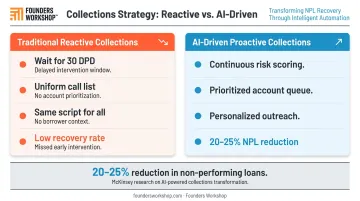
In collections, AI's biggest operational gain is prioritization, not just automation. ML models score every account in a portfolio continuously, ranking by recovery probability, payment history patterns, days past due, and behavioral signals. Collections teams stop working random queues and start working accounts where intervention is most likely to succeed.
This shifts the fundamental workflow from reactive (everyone at 30 DPD gets a call) to proactive (flag the account three weeks before the missed payment). McKinsey's digital-first collections research found that this approach can reduce non-performing loans by 20–25% and cut collections costs by at least 15%.
Personalized Outreach at Scale
AI-driven communications replace the blanket script with something more precise. The system selects:
- The right channel (SMS, email, voice, or app notification) based on how that borrower has responded before
- The right tone — firm reminder or empathetic hardship language, depending on the borrower's profile
- The right offer — standard reminder, partial payment option, or restructuring prompt
- The right time — optimal contact window from individual response history, within CFPB Regulation F's contact-hour restrictions
Natural language processing (NLP) chatbots handle inbound volume at scale — resolving payment questions, presenting hardship options, and escalating only complex cases to human agents. This reduces agent load while keeping response times fast for borrowers who want to resolve their situation quickly.
McKinsey's generative AI analysis for credit customer assistance projects up to 40% operating expense reduction and 10% recovery improvement from end-to-end AI transformation in collections.
Automated Payment Negotiation and Arrangement
For high-volume consumer portfolios, requiring a human agent for every repayment arrangement negotiation creates a serious bottleneck. AI agents can present and lock in flexible arrangements — payment deferrals, restructured plans, settlement offers — within pre-approved policy guardrails, without routing every case to a person.
The AI doesn't improvise. It works from a defined decision tree of approved options, applied based on borrower risk profile and account status. What changes is execution speed and scale: thousands of simultaneous negotiations, no hold queues, no staffing constraints — and a measurable reduction in defaults that would otherwise go unresolved.
How AI Reduces Loan Default Risks
Early Warning Systems and Smarter Credit Scoring
Static credit models make a single risk assessment at origination and rarely update it. A borrower's FICO score at loan closing says nothing about what's happening in their financial life 14 months later — the side business that's struggling, the second credit card going delinquent, the income drop that shows up in transaction data before it shows up in a payment miss.
ML-based early warning systems monitor behavioral and financial signals continuously:
- Missed payments on other obligations
- Changes in spending patterns or average balance levels
- Income volatility indicators from transaction data
- Shifts in credit utilization across the portfolio
BIS research on fintech ML credit models found that machine learning contributed approximately 5.3 percentage points of AUROC improvement over traditional bank-type information in default prediction — and that was without the continuous in-life monitoring that modern servicing systems add.
On the credit scoring side, AI models incorporating alternative data sources — utility payments, rent history, transaction patterns — give lenders a materially different view of borrower risk. Research from the Kansas City Fed found that adding rent-payment history to credit files can increase scores by up to 40 points over 12 months — meaningful for thin-file borrowers who pose less risk than their limited credit history suggests.
Models also retrain on new repayment outcomes over time, becoming more accurate at identifying which loan structures and borrower profiles carry the most default risk for a specific lender's portfolio — not just the industry average.
Automated Decision-Making with Human Oversight
The human-in-the-loop model is often misunderstood. AI handling routine risk flagging doesn't remove human judgment — it redirects it toward decisions that actually require it.
The division of labor looks like this in practice:
- AI handles: pattern recognition, threshold-based flags, communication routing, standard restructuring offers
- Humans handle: hardship exceptions, legal escalation decisions, borrower situations that don't fit the model
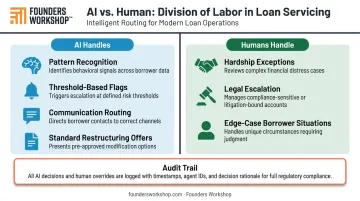
What makes this work in regulated environments is the audit trail. Every AI-generated decision — why an account was flagged, what offer was presented, which rule triggered an escalation — gets logged automatically. Regulators and internal risk teams can review the full decision record without anyone manually reconstructing it.
The CFPB has been explicit on this point: under ECOA and Regulation B, creditors must provide specific reasons for adverse action even when complex algorithms make the decision. A well-architected AI system generates that documentation as a byproduct of normal operation, not as an additional compliance burden.
Core AI Technologies Enabling Smarter Loan Servicing
Each technology in the AI servicing stack handles a distinct function. Understanding the boundaries between them matters when designing a system — or evaluating a vendor's claims.
| Technology | Primary Role in Loan Servicing |
|---|---|
| Machine Learning (ML) | Risk scoring, delinquency prediction, behavioral pattern recognition across portfolios |
| Natural Language Processing (NLP) | Borrower chatbots, written communication processing, document information extraction |
| Robotic Process Automation (RPA) | Payment reconciliation, document verification, compliance reporting — rules-based, high-volume tasks |
| Document AI / Computer Vision | Automated data extraction from loan documents, identity proofs, income statements |
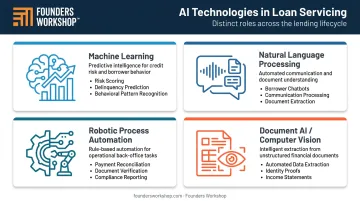
The ML vs. RPA distinction matters more than most implementation teams expect. RPA follows fixed rules and breaks when conditions change — it's suited for consistent, high-volume workflows like payment reconciliation where inputs don't vary.
ML is a different tool entirely. AI agents learn from outcomes, adapt to new patterns, and handle variable scenarios. Dynamic collections prioritization that shifts as borrower behavior changes is an ML job, not an RPA one. Conflating the two leads to misapplied technology and disappointed expectations.
Document processing is where NLP delivers some of its clearest wins. Hardship letters, financial statements, and income verification documents arrive in unstructured formats — NLP-powered Document AI extracts relevant fields, flags inconsistencies, and routes cases based on content. Processing time drops from hours to minutes, a performance gap that compounds quickly across high-volume portfolios.
Key Challenges of AI in Loan Servicing and How to Address Them
Bias and Fairness
AI models trained on historical lending data inherit the patterns in that data — including patterns that reflect past discriminatory practices. A model that learned from a portfolio with historically lower approval rates for certain demographic segments will encode that bias unless deliberately corrected.
Mitigation approaches:
- Regular bias audits across protected class segments
- Diverse training data that represents the full borrower population
- Explainable AI (XAI) techniques that surface which features are driving decisions — making bias detectable rather than hidden
Regulatory Compliance
AI in lending touches FCRA, ECOA, GDPR Article 22, and state-level consumer finance regulations. The key architectural requirement: compliance logic must be built into model guardrails, not bolted on afterward.
This is particularly challenging with third-party AI platforms not designed for regulated lending environments. The platform may be capable, but the compliance layer is the lender's responsibility regardless. Retrievable decision logs are mandatory — regulators use them to verify that adverse action notices are accurate and that protected-class borrowers are being treated equitably.
Legacy System Integration
Most lenders don't have the option to replace core banking infrastructure. The practical approach: API-first integration that layers AI components onto existing systems without requiring a full platform replacement. Modular architecture lets lenders prove value in one area before expanding to others.
Common starting points include:
- Collections prioritization engines that rank delinquent accounts by recovery likelihood
- Early warning scoring modules that flag at-risk borrowers before they miss payments
- NLP chatbots that handle routine borrower inquiries without agent involvement
Building AI Into Your Loan Servicing Platform
The build-versus-buy decision comes down to one question: how much does your specific loan product, borrower profile, and compliance environment differ from what an off-the-shelf platform was designed for?
Off-the-shelf platforms deploy faster and require less upfront investment. They work well when the lender's servicing workflows are relatively standard and compliance requirements don't involve unusual state-level rules or specialized loan structures.
Custom-built AI layers take more time upfront but give lenders direct control over decision logic, compliance guardrails, escalation rules, and borrower experience. For lenders with distinctive products or complex compliance requirements, that control is often worth the investment — particularly when the AI system's decisions are subject to regulatory review.
A Practical Implementation Path
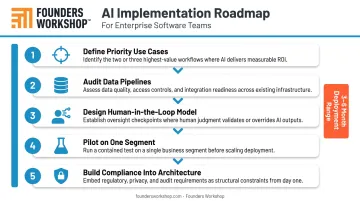
- Define the highest-priority use cases first — collections prioritization and default risk scoring deliver measurable ROI and are good candidates for a first phase
- Audit existing data pipelines — AI systems are only as good as the data feeding them; gaps in payment history, behavioral signals, or borrower data need to be addressed before model training
- Design the human-in-the-loop model explicitly — specify which decisions the AI handles autonomously and which escalate to agents, and document the logic
- Pilot on one loan product or borrower segment — validate performance and refine before expanding to the full portfolio
- Build compliance documentation into the architecture — decision logging, adverse action notice generation, and bias testing should be native features, not afterthoughts
Each of these steps is easier to execute with a development partner who has navigated fintech compliance before. Founders Workshop has built AI-first lending platforms for fintech startups and SMBs — including systems with predictive analytics, RPA automation, and conversational AI — moving from Discovery to Deployment in 3–6 months using a structured 5D process built around compliance and product fit.
Frequently Asked Questions
How does AI automate loan collections without removing the human element?
AI handles routine outreach, account prioritization, and standard payment arrangements within policy limits. These are high-volume tasks that don't require judgment calls. Complex cases, hardship exceptions, and legal escalations route to human agents with full context, shifting the human role from processing to decision-making.
Can AI actually predict loan defaults before they happen?
Yes. ML models monitor behavioral and financial signals continuously throughout the loan lifecycle — including spending pattern shifts, missed payments on other accounts, and income changes — generating dynamic risk scores that can identify at-risk borrowers weeks before a payment is missed.
What AI technologies are most commonly used in loan servicing automation?
ML handles risk scoring and delinquency prediction. NLP powers borrower chatbots and communication processing. RPA manages rules-based tasks like payment reconciliation and compliance reporting. Document AI automates extraction and verification from loan documents and income statements.
How long does it take to implement AI in a loan servicing platform?
Timelines vary from a few weeks to add a single AI-powered feature to 3–6 months for a full servicing automation buildout. The main variables are infrastructure quality, compliance requirements, and how much existing functionality needs to be preserved or replaced.
Is AI in loan servicing compliant with financial regulations?
AI can be designed for compliance, but it requires intentional architecture: explainable decision models, audit trail logging, FCRA- and ECOA-aligned guardrails, and regular bias testing. Compliance logic has to be built in from the start, not added after deployment.
What is the difference between AI agents and RPA in loan collections?
RPA follows fixed rules and fails when conditions change. AI agents learn from outcomes and adapt to new patterns, making them more effective when borrower behavior is unpredictable or varies across account types. RPA is better suited to high-volume, predictable tasks; AI agents handle variable decision scenarios.