Conversational AI is how forward-thinking operators are closing that gap. Not just answering FAQs, but automating check-ins, routing service requests, capturing upsell revenue, and handling inquiry surges during peak periods — without adding front desk headcount. According to PhocusWire's coverage of h2c research, 58% of hospitality IT decision-makers say AI will have its greatest impact on guest communications, and 82% of all hotels plan to increase AI usage within the next 12 months.
This article covers five conversational AI platforms built specifically for hospitality, how to evaluate them against your operation, and when a custom-built approach makes more sense than an off-the-shelf tool.
Key Takeaways
- Conversational AI connects to PMS, CRM, and booking systems to resolve guest requests in real time — not just acknowledge them
- Top 2026 solutions offer omnichannel reach (WhatsApp, SMS, voice, web) with hospitality-native integrations — not generic customer service features
- Key evaluation factors: PMS integration depth, multilingual support, escalation design, and peak-volume handling
- Each of the five tools below targets a distinct use case, from boutique hotels to large chains
- Off-the-shelf tools suit standard workflows — complex integrations or multi-property setups often require a custom-built solution
What Conversational AI Actually Does in Hospitality
A standard chatbot follows a script. It matches keywords to predefined responses and falls over the moment a guest asks something slightly outside the flow.
Conversational AI is different in a way that matters operationally. It uses natural language processing and large language models to understand intent — not just keywords — and maintains context across a multi-step dialogue. When a guest asks to modify a reservation, add a late checkout, and request airport transport in the same conversation, a conversational AI handles all three in sequence. A rule-based bot asks them to call the front desk.
The Structural Problem It Solves
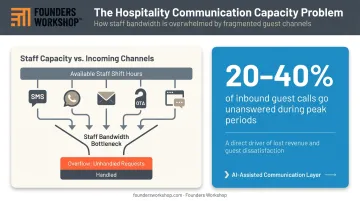
Modern hospitality teams manage guest communication across SMS, WhatsApp, email, OTA inboxes, and the hotel website simultaneously. Meanwhile, staff work finite shifts with no capacity to monitor every channel in real time.
According to Hospitality Upgrade's 2025 industry analysis, hotels historically miss 20–40% of incoming calls — and every unanswered inquiry during peak periods is a potential booking lost or a guest experience degraded. Conversational AI addresses this not by replacing staff judgment, but by handling the volume that would otherwise exceed staff capacity.
The five platforms below were selected based on PMS integration depth, guest journey coverage, channel breadth, and fit relative to property size — criteria that reflect real operational value, not general AI capability.
Best Conversational AI Solutions for Hospitality in 2026
These tools were evaluated specifically for hospitality fit. General AI capability matters less than whether a platform integrates with your PMS, covers the channels your guests use, and handles the nuances of hospitality service requests.
HiJiffy
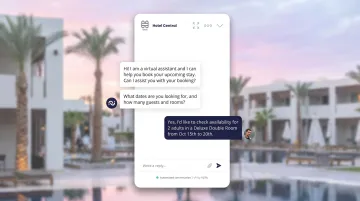
HiJiffy is a hospitality-specialized conversational AI platform focused on converting website visitors into direct bookings. Its behavior-triggered messaging detects what section of your property website a visitor is browsing — rooms, spa, dining — and adjusts the conversation to match, surfacing relevant offers and answering common questions before the visitor clicks away.
The platform has been deployed across 2,100+ hotels in 50+ countries. Leonardo Hotels used HiJiffy to automate 93% of 281,000 queries, saving 14,000 hours of manual work. GHT Hotels resolved 89% of inquiries and attributed €733K in bookings to the platform.
| Attribute | Details |
|---|---|
| Best For | Hotels focused on converting direct bookings and reducing OTA dependency |
| Key Features | Booking page behavior triggers, pre-stay and post-stay messaging, multilingual support, upsell automation during stay |
| Hospitality Fit | Purpose-built for hotels; integrates with 60+ hotel systems including booking engines and PMS platforms; covers the full guest journey from pre-arrival through post-checkout |
Asksuite
Asksuite consolidates guest communications from Instagram, Facebook, WhatsApp, email, and the hotel website into a single inbox. AI agents handle routine inquiries and route complex requests to human agents — with full conversation history attached so no context is lost during handoff.
The unified inbox solves a real operational problem: staff no longer toggle between platforms during shift changes, and no inquiry falls through during peak periods. Asksuite connects with 500+ booking engines for real-time price checks and automated quotes. Royal Resorts generated nearly $3M in B2C quotes with a 13% average conversion rate using the platform.
| Attribute | Details |
|---|---|
| Best For | Hotels managing high inquiry volume across multiple digital channels with fragmented communication |
| Key Features | Omnichannel inbox consolidation, AI-handled FAQs, automated price quotes, human handoff with full context, review management support |
| Hospitality Fit | Built exclusively for hotels; designed around the pre-stay, in-stay, and post-stay guest journey with native hospitality channel integrations |
Canary Technologies
Canary handles 24/7 guest support via voice, text, and web chat while simultaneously building a structured guest data profile during each interaction. Every conversation becomes usable intelligence for loyalty campaigns, repeat booking promotions, and personalized re-engagement — without a separate CRM effort.
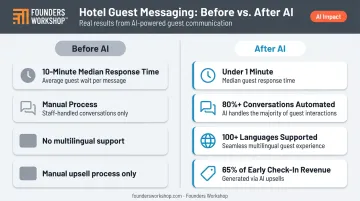
Canary's AI Guest Messaging automates more than 80% of guest conversations and supports automatic translation in 100+ languages. At The LINE SF, the platform reduced median response time from 10 minutes to under 1 minute and drove 65% of early check-in revenue through AI upsells. HotelTechReport named Canary the Best AI Guest Messaging platform in the 2026 HotelTechAwards, drawing on 25,000+ hotelier reviews.
| Attribute | Details |
|---|---|
| Best For | Hotels seeking to combine guest support automation with direct marketing database growth and repeat booking campaigns |
| Key Features | 24/7 voice, text, and web support; real-time translation in 100+ languages; guest data capture during conversations; loyalty and upsell campaign triggers |
| Hospitality Fit | Integrates with all major PMSs; syncs guest profiles and reservation data; spans pre-arrival through post-checkout touchpoints |
Duve
Duve acts as an intelligent triage layer between guests and staff. It analyzes guest tone, journey stage, and inquiry topic to prioritize requests automatically — handling low-stakes approvals like room upgrades, dining reservations, and checkout time extensions autonomously, while surfacing genuinely urgent requests to staff in the right order.
Without that triage, the front desk processes every request at the same urgency level — and the genuinely critical ones get buried. Edgar Suites automated 80% of guest inquiries across 415 properties using DuveAI, with 80% of guests completing online check-in. Sofitel Fiji generated €25K in upsells within two months.
| Attribute | Details |
|---|---|
| Best For | Properties that want to automate upselling and service request prioritization without overburdening front desk staff |
| Key Features | AI-driven request triage, automated upgrade and extras approvals via chat, personalized pre-arrival upsell offers, in-stay service automation across WhatsApp, SMS, Airbnb, and Booking.com |
| Hospitality Fit | Built for hotels and resorts; integrates with PMS for real-time availability checks; personalizes replies using reservation status, loyalty memberships, and booking source |
Runnr.ai
Runnr.ai operates through WhatsApp and SMS — the channels guests already use — handling booking confirmations, amenity overviews, upsell offers, and digital check-in without requiring a downloaded app. It supports digital keys and mobile payments as part of a contactless arrival flow.
Guests don't adopt proprietary hotel apps at high rates, which is why routing through familiar channels makes a measurable difference. Runnr.ai reports 85%+ direct guest reach with a 98% message open rate and 55%+ guest engagement. The Edwin Hotel automated 91% of guest communication within five months of deployment.
| Attribute | Details |
|---|---|
| Best For | Independent hotels and boutique properties seeking fast-deploying front desk communication automation via WhatsApp and SMS |
| Key Features | Automated pre-arrival messaging, digital check-in via WhatsApp/SMS, upsell offer delivery, digital key support, mobile payment processing, post-stay feedback requests |
| Hospitality Fit | Hospitality-native design; integrates with PMS and works within existing guest communication channels with minimal setup or staff retraining |
How We Chose These Solutions
The most common mistake operators make when evaluating conversational AI is selecting a general customer service platform without checking whether it integrates with their PMS, covers their guest channels, or handles hospitality-specific request types. A "support ticket" and a "late checkout request with room upgrade" are different problems, and the platform needs to be built for that distinction.
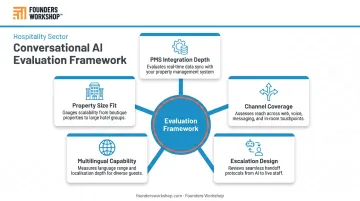
These five tools were evaluated on five criteria:
- PMS and booking engine integration depth: determines whether the AI can act on requests or only acknowledge them. Without PMS access, the tool can't check availability, confirm upgrades, or modify reservations.
- Channel coverage: whether the tool reaches guests on WhatsApp, SMS, OTA inboxes, and voice — not just the hotel's own website.
- Escalation design: how well complex or emotional situations transfer to human staff. Hospitality Technology's 2024 Lodging Technology Study found 69% of hotel operators cite legacy system integration as a major challenge — poor escalation design compounds that problem.
- Multilingual capability: essential for properties serving international travelers, where real-time translation (not just language detection) affects actual service quality.
- Property size fit: whether the tool is realistically deployable by an independent operator or requires enterprise-level implementation resources.
Conclusion
The right conversational AI for a hospitality business isn't the one with the most features. It's the one that integrates cleanly with existing operations, reaches guests on the channels they already use, and hands off to human staff before a situation gets worse — not after it already has.
Before selecting a platform, identify your actual operational gap. Booking abandonment on the property website points toward HiJiffy. Fragmented multi-channel communication points toward Asksuite. Understaffed front desks dealing with high upsell volume point toward Duve. Boutique properties wanting contactless arrival without app friction point toward Runnr.ai.
When the operational environment is more complex — think proprietary PMS systems, multi-property service workflows, or legacy reservation and POS infrastructure that no vendor platform was built for — off-the-shelf tools tend to hit a ceiling fast. Custom development is usually the better fit.
Founders Workshop has built AI-integrated software for SMBs across hospitality and adjacent service industries, including senior care platforms, real estate tools, and customer-facing applications with complex back-end integrations. Our conversational AI services include AI-driven decision assistants, custom GPT implementations, and enterprise API integrations — delivered through a Discovery-to-Deployment process that starts with understanding your existing systems before writing a line of code.
If an off-the-shelf solution doesn't fit your environment, reach out to start a conversation about what a purpose-built approach would look like.
Frequently Asked Questions
What is conversational AI in hospitality, and how is it different from a standard chatbot?
Conversational AI uses NLP and large language models to understand intent and maintain context across a multi-step dialogue. A standard chatbot follows fixed scripts and keyword triggers. In hospitality, that distinction matters because guest requests are often multi-step (modifying a reservation, adding dining, requesting a late checkout) — and scripted responses can't handle that kind of dynamic interaction.
Can small hotels or independent restaurants benefit from conversational AI, or is it mainly for large chains?
Several platforms (Runnr.ai and HiJiffy in particular) are designed for independent and boutique properties with lightweight deployment and no app required for guests. The key is matching the tool to the property's inquiry volume and budget rather than defaulting to enterprise-grade platforms that require extensive configuration.
What systems does a conversational AI solution need to integrate with in a hospitality setting?
Three integration points are critical: the PMS for real-time reservation and room data, the CRM for guest history and preferences, and the communication channels guests already use (WhatsApp, SMS, OTA inboxes). Without PMS integration, the AI can inform guests but can't act on their requests.
How does conversational AI handle situations that require human judgment or emotional sensitivity?
Well-designed systems include escalation logic that recognizes complexity triggers (billing disputes, medical requests, complaints with strong emotional language) and hands off to a human agent with full context attached. That escalation design often determines whether the implementation improves or damages guest experience.
How long does it typically take to implement a conversational AI solution for a hospitality business?
Off-the-shelf hospitality platforms can often be configured and deployed within days to a few weeks, depending on PMS and CRM integration depth. Custom-built solutions follow a longer timeline — typically 3–6 months from Discovery through initial deployment — but offer a closer fit for complex operational environments or multi-property setups.
When should a hospitality operator consider a custom-built conversational AI instead of an off-the-shelf tool?
Off-the-shelf tools work well for standard workflows. Custom development makes sense when you have a proprietary PMS, operate across multiple properties with different service flows, need deep integration with legacy reservation or POS infrastructure, or require a branded guest experience that vendor platforms can't deliver without significant workarounds.